
Hydrogen Fuel Cell Vehicle (HFCV) Market Size, Share, Growth Analysis Report, 2026-2034
REPORT DETAILS
Market Statistics
Hydrogen Fuel Cell Vehicles Market Overview
The hydrogen fuel cell vehicles market size was valued at USD 3.87 billion in 2025 and is projected to grow at a CAGR of 52.4% from 2026 to 2034. The market growth is primarily driven by growing environmental awareness, advancements in fuel cell technology, and the presence of stringent emission regulations.
Key Insights
Source: Polaris Market Research Analysis
The passenger vehicle segment dominated the HFCV market in 2025, accounting for a 50.15% market share. This dominance is because of growing consumer inclination toward greener options, as individuals sought out alternatives to traditional diesel and gasoline-powered cars.- The private end-user segment led the market in 2025 with a 63.22% share. Primarily due to rising individual adoption of clean mobility solutions, supportive government incentives, and people were becoming more aware of sustainable transportation.
- Asia Pacific held the largest share of the HFCV market in 2025, capturing 49.80% of the market, supported by extensive hydrogen infrastructure development and strong government backing.
- Europe is projected to register the highest growth, with a CAGR of 52.9% during the forecast period. Driven by strict rules about zero-emission vehicles and more money being put into hydrogen infrastructure.
Industry Dynamics
- Many countries are making increasing investments in hydrogen as a sustainable alternative to traditional fuels. This rising government support and incentives for clean energy solutions drives market expansion.
- The global shift towards lowering greenhouse gas emissions is another major factor contributing to the increased demand for hydrogen fuel cell vehicles.
- Ambitious plans for hydrogen adoption and infrastructure development in emerging economies are expected to present significant market opportunities.
- The high initial cost associated with hydrogen fuel cell vehicles may present market challenges.
Market Statistics
- 2025 Market Size: USD 3.87 billion
- 2034 Projected Market Size: USD 170.74 billion
- CAGR (2026-2034): 52.4%
- Asia Pacific: Largest Market in 2025
Source: Polaris Market Research Analysis Market.png)
To Understand More About this Research: Download Sample Report
The global hydrogen fuel cell vehicles (HFCV) market represents a transformative shift towards sustainable transportation, leveraging hydrogen as a clean and efficient energy source. Hydrogen fuel cell vehicles utilize hydrogen gas in fuel cells to generate electricity, which powers an electric motor, offering zero tailpipe emissions. These vehicles are considered pivotal in decarbonizing the transportation sector while reducing reliance on fossil fuels. The market encompasses passenger vehicles, commercial vehicles, and heavy-duty trucks, with substantial investments being made to scale production and enhance hydrogen refueling networks.
Increasing environmental awareness, stringent emission regulations, and advancements in fuel cell technology are a few of the key factors driving the hydrogen fuel cell vehicles market growth. Governments worldwide are also actively supporting the transition to hydrogen fuel cell vehicles through subsidies, infrastructure development, and partnerships with private entities to boost hydrogen production and distribution. For instance, according to the National Portal of India, the Indian government invested USD 930 million in 2023 to boost hydrogen production and distribution. Technological innovation, coupled with a collaborative global approach, continues to further shape the adoption and commercialization of hydrogen fuel cell vehicles.
Market Dynamics
Government Support and Incentives for Clean Energy Solutions
Many countries are increasingly investing in hydrogen as a sustainable alternative to traditional fuels. For example, the European Commission has committed to investing over USD 455.80 million in hydrogen projects under the Clean Hydrogen Partnership as part of the Horizon Europe program, aiming to scale up hydrogen infrastructure. Similarly, in the US, the Hydrogen and Fuel Cell Technologies Office (HFTO), a division of the Department of Energy, supports research and development to lower the cost of hydrogen production and fuel cells. These initiatives, combined with tax credits and subsidies for FCVs, are accelerating the adoption of hydrogen-powered vehicles, thereby boosting hydrogen fuel cell vehicles market revenue.
Rising Demand for Low-Emission Vehicles
The global push toward reducing greenhouse gas emissions is another significant driver of the hydrogen fuel cell vehicles market demand. According to the International Energy Agency (IEA), transportation accounts for about 24% of global CO2 emissions, prompting governments worldwide to promote low-emission vehicles. For instance, Japan has implemented policies like the Basic Hydrogen Strategy, aiming for 800,000 fuel cell vehicles on the road by 2030. Similarly, the European Union's Green Deal includes initiatives to promote green hydrogen as a clean fuel for transportation. These efforts, combined with rising consumer awareness of environmental issues, are driving the adoption of hydrogen-powered vehicles as a zero-emission alternative to conventional gasoline or diesel cars.
Source: Polaris Market Research Analysis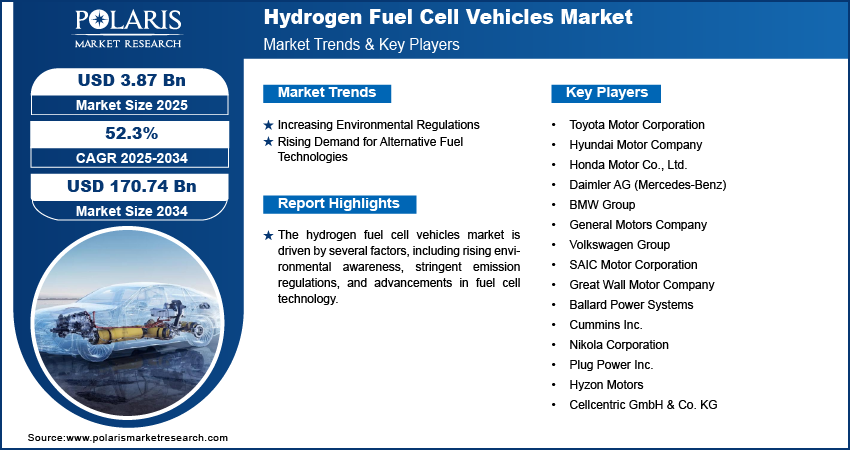
Get Full Segment-Level Forecasts & Insights: Download Sample Report
Segment Analysis
Assessment Based on Vehicle Type
Based on vehicle type, the hydrogen fuel cell vehicles market is segmented into passenger vehicle, commercial vehicle, and heavy-duty trucks. The passenger vehicle segment dominated the hydrogen fuel cell vehicles (FCV) market in 2025, driven by growing consumer demand for low-emission, environmentally friendly alternatives to traditional gasoline and diesel vehicles. Government subsidies, tax incentives, and infrastructure development initiatives further drive the adoption of hydrogen FCVs by making them more affordable and accessible. These incentives, combined with expanding refueling stations, are encouraging consumers to transition to zero-emission hydrogen-powered passenger vehicles, driving segment growth.
Outlook Based on Technology
Based on technology, the hydrogen fuel cell vehicles market is segmented into proton exchange membrane fuel cell, phosphoric acid fuel cell, solid oxide fuel cell, and others. The proton exchange membrane fuel cell segment led the market in 2025 due to their high efficiency and compact design, making them ideal for automotive applications. Proton exchange membrane fuel cells (PEMFCs) provide excellent power density, enabling hydrogen vehicles to operate efficiently with reduced weight and space requirements, which is crucial for passenger vehicles. Their ability to start quickly and operate at lower temperatures also makes them suitable for various environments. Furthermore, advancements in PEMFC technology continue to improve cost-effectiveness, driving their adoption in the automotive fuel cell and contributing to market dominance.
Source: Polaris Market Research Analysis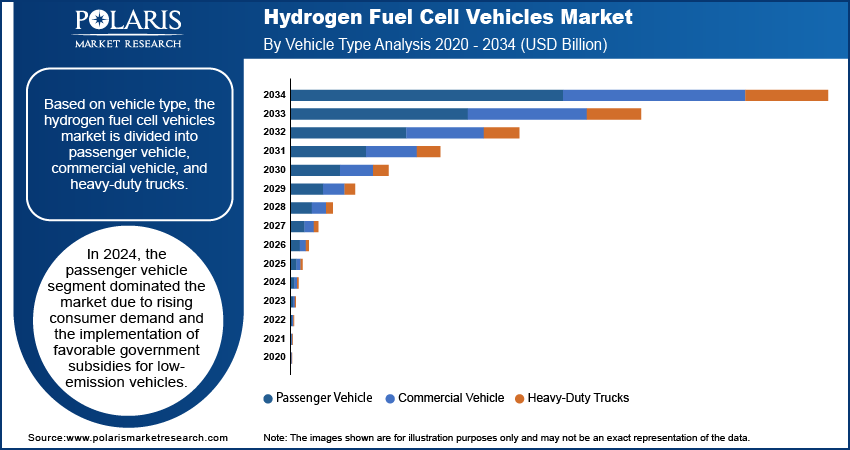
Need Granular Data Across All Market Segments? Request Customization
Market Regional Analysis
By region, the market report offers hydrogen fuel cell vehicles market insights into North America, Europe, Asia Pacific, Latin America, and the Middle East & Africa. Asia Pacific dominated the global market in 2025 due to strong government support, extensive hydrogen infrastructure development, and the presence of major FCV manufacturers. Japan, in particular, leads the regional market due to its comprehensive hydrogen strategy, established refueling infrastructure, government initiatives, and early adoption of FCVs in both passenger and commercial segments. For instance, The Tokyo Metropolitan Government allocated an increased budget for hydrogen-related initiatives, raising the funding to USD 134 million for the fiscal year 2024. This adjustment reflects a strategic commitment to advancing hydrogen technology and infrastructure within the region.
The North America hydrogen fuel cell vehicles market is projected to exhibit the highest CAGR from 2026 to 2034, driven by ambitious zero-emission vehicle mandates, particularly in California and Canada. The growth is further supported by increasing investments in hydrogen infrastructure, government incentives, and rising interest from commercial fleet operators. California stands out as the leading market in North America, benefiting from the California Fuel Cell Partnership initiatives, substantial investments in refueling infrastructure, and progressive environmental policies aimed at accelerating zero-emission vehicle adoption.
Source: Polaris Market Research Analysis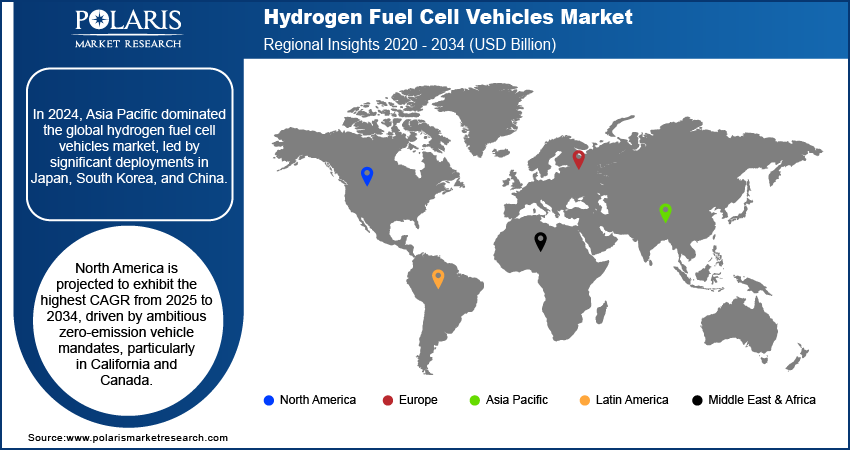
Curious About Regional Market Performance? Request Customization
Key Players and Competitive Insights
The hydrogen fuel cell vehicles market exhibits a highly competitive landscape characterized by intense technological innovation and strategic partnerships. Toyota and Hyundai maintain market leadership through their established FCV models and extensive R&D capabilities. These companies have invested heavily in proprietary fuel cell technology and are actively expanding their product portfolios. Other manufacturers are entering the market through strategic collaborations and joint ventures, particularly in the commercial vehicle segment. Companies like Ballard Power Systems and Plug Power have strengthened their positions by focusing on specific market niches and developing specialized fuel cell solutions. The market is witnessing increased competition, with new entrants like Nikola and Hyzon Motors focusing on heavy-duty applications, while traditional automakers are accelerating their FCV development programs to maintain market relevance.
List of Key Players
- Toyota Motor Corporation
- Hyundai Motor Company
- Honda Motor Co., Ltd.
- Daimler AG (Mercedes-Benz)
- BMW Group
- General Motors Company
- Volkswagen Group
- SAIC Motor Corporation
- Great Wall Motor Company
- Ballard Power Systems
- Cummins Inc.
- Nikola Corporation
- Plug Power Inc.
- Hyzon Motors
- Cellcentric GmbH & Co. KG
Hydrogen Fuel Cell Vehicles Industry Developments
Source: Polaris Market Research Analysis
December 2025: Indian government started a pilot project to test the Toyota Mirai hydrogen fuel cell vehicle. The National Institute of Solar Energy (NISE) received the vehicle for a two-year field trial in a variety of climates and terrains. (Source: ddnews.gov.in)
March 2026: Hyundai Motor Company announced plans to launch the next-generation Hyundai NEXO hydrogen SUV in Japan in 2026. The vehicle with better fuel cell technology and vehicle-to-home (V2H) functionality as part of the company's hydrogen mobility strategy. (Source: fuelcellsworks.com)
March 2025: Toyota Motor Corporation introduced the 2025 Mirai. The vehicle combines hydrogen with oxygen from outside air for generating power. Standard features include digital key capability and panoramic view monitor. (Source: pressroom.toyota.com)
October 2024, Hyundai Motor Company, an automobile manufacturer that designs, develops, manufactures, and distributes vehicles, parts, and powertrains, unveiled its INITIUM hydrogen fuel cell electric vehicle (FCEV) concept at its ‘Clearly Committed’ event held at Hyundai Motorstudio Goyang. (Source: www.hyundai.com)
Hydrogen Fuel Cell Vehicles Market Segmentation
By Vehicle Type Outlook (Revenue – USD Billion, 2021–2034)
- Passenger Vehicle
- Commercial Vehicle
- Heavy-Duty Trucks
By Technology Type Outlook (Revenue – USD Billion, 2021–2034)
- Proton Exchange Membrane Fuel Cell
- Phosphoric Acid Fuel Cell
- Solid Oxide Fuel Cell
- Others
By End Use Outlook (Revenue – USD Billion, 2021–2034)
- Private
- Commercial
- Industrial
- Government/Military
By Regional Outlook (Revenue – USD Billion, 2021–2034)
- North America
- US
- Canada
- Europe
- Germany
- France
- UK
- Italy
- Spain
- Netherlands
- Russia
- Rest of Europe
- Asia Pacific
- China
- Japan
- India
- Malaysia
- South Korea
- Indonesia
- Australia
- Vietnam
- Rest of Asia Pacific
- Middle East & Africa
- Saudi Arabia
- UAE
- Israel
- South Africa
- Rest of Middle East & Africa
- Latin America
- Mexico
- Brazil
- Argentina
- Rest of Latin America
Hydrogen Fuel Cell Vehicles Market Report Scope
| Report Attributes | Details |
| Market Size Value in 2025 | USD 3.87 billion |
| Revenue Forecast in 2026 | USD 5.86 billion |
| Revenue Forecast by 2034 | USD 170.74 billion |
| CAGR | 52.4% from 2026 to 2034 |
| Base Year | 2025 |
| Historical Data | 2021–2024 |
| Forecast Period | 2026–2034 |
| Quantitative Units | Revenue in USD billion and CAGR from 2026 to 2034 |
| Report Coverage | Revenue Forecast, Market Competitive Landscape, Growth Factors, and Trends |
| Segments Covered |
|
| Regional Scope |
|
| Competitive Landscape |
|
| Report Format |
|
| Customization | Report customization as per your requirements with respect to countries, regions, and segmentation. |
Source: Polaris Market Research Analysis
hydrogen fuel cell vehicle market FAQ's
The global hydrogen fuel cell vehicles market size was valued at USD 3.87 billion in 2025 and is projected to grow to USD 170.74 billion by 2034.
The global market is projected to register a CAGR of 52.4% from 2026 to 2034.
Asia Pacific held the largest share of the global market in 2025
Some of the key players in the market are Toyota Motor Corporation, Hyundai Motor Company, Honda Motor Co., Ltd.; Daimler AG (Mercedes-Benz); BMW Group; General Motors Company; Volkswagen Group; SAIC Motor Corporation; Great Wall Motor Company; Ballard Power Systems; Cummins Inc.; Nikola Corporation; Plug Power Inc.; Hyzon Motors; and Cellcentric GmbH & Co. KG.
The passenger vehicle segment dominated the market in 2025.
Download Sample Report of hydrogen fuel cell vehicle market
Please fill out the form to request a customized copy of the research report.


