
Automotive Dashcam Market Growth & Industry Trend 2026-2034
REPORT DETAILS
Automotive Dashcam Market Summary
The global automotive dashcam market is estimated around USD 4.03 Billion in 2025,with consistent growth anticipated during 2026–2034. Growth is supported by rising demand for in-vehicle safety systems, increasing road accident cases, and growing adoption across commercial fleets and private vehicles. The market is projected to grow at a CAGR of 6.6% during the forecast period.
Market Statistics
Key Takeaways
- Basic dashcams segment dominated the segment with 57.5% market share in 2025 due to strong demand for affordable and easy-to-install recording devices.
- Advanced AI dashcams segment is expected to grow rapidly at CAGR of 7.1% due to integration of driver monitoring and real-time alert features.
- Passenger vehicles segment held the largest share of 66.4% due to increasing adoption among private vehicle owners.
- Commercial vehicles segment is projected to grow at a fast pace o 7.0% CAGR due to rising use in fleet monitoring and safety management.
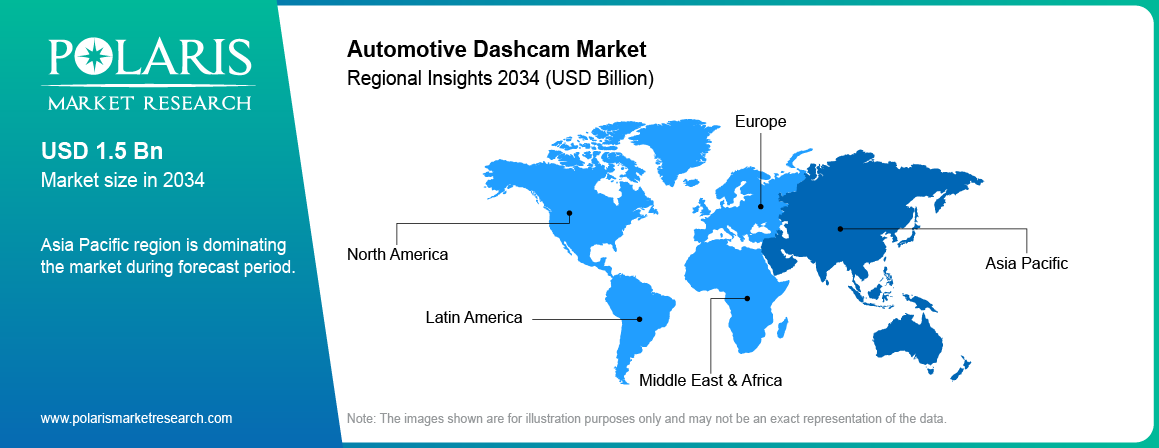
- Asia Pacific dominated the market by holding 39.99% revenue share due to high accident rates and increasing demand for video evidence solutions.
Industry Dynamics
- Rising road accidents are increasing demand for dashcams for safety monitoring and evidence recording.
- Growing cases of insurance fraud are driving adoption of video-based verification systems.
- Data privacy concerns and regulations are limiting adoption in certain regions.
- Integration of AI and telematics is improving dashcam capabilities and expanding use cases.
What is Automotive Dashcam?
Auto dash cam refers to in-car camera system that captures real-time footage of the road environment, driving habits, and events happening around the car. These are placed on the vehicle’s windshield or dashboard for the purpose of surveillance, evidence collection, and observation for motorists.
The growth of the dashcam industry includes its advancement from mere recorders that were used mainly for personal security and collecting evidence in case of an incident. Originally, their application was limited to only specific regions where there were safety concerns. With time, the adoption of dashcams spread to cover private and commercial vehicles as more information came up about their uses.
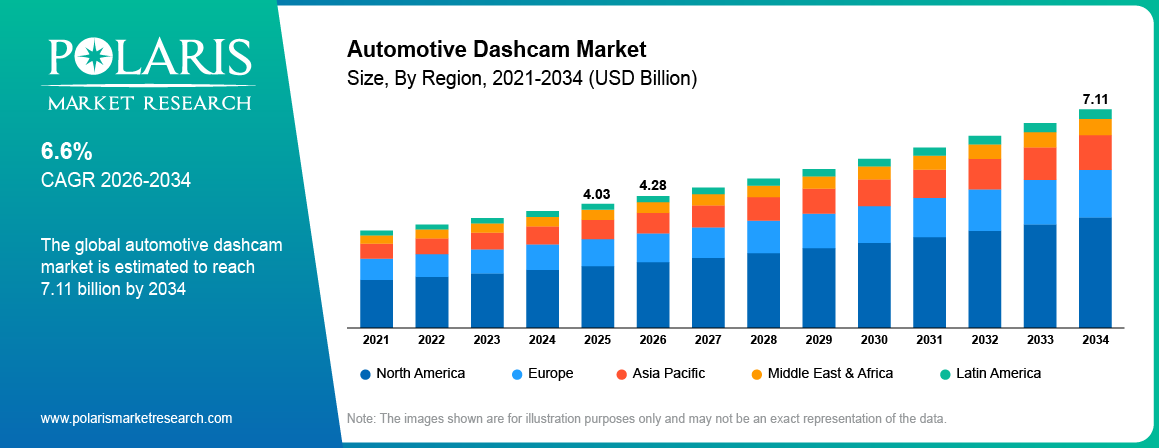
Source: Polaris Market Research Analysis
Want a Deeper Look at Key Market Players? Download Sample Report
In the next phase, integration of connectivity features with GPS tracking and motion detection was witnessed along with cloud storage options, thus making them user-friendly and easier to manage. Moreover, automotive surveillance also became better since businesses began utilizing dashcams for fleet management purposes and driver assessment. The implementation of telematics systems helped the organizations in optimizing their processes and minimizing risks.
Drivers & Opportunities
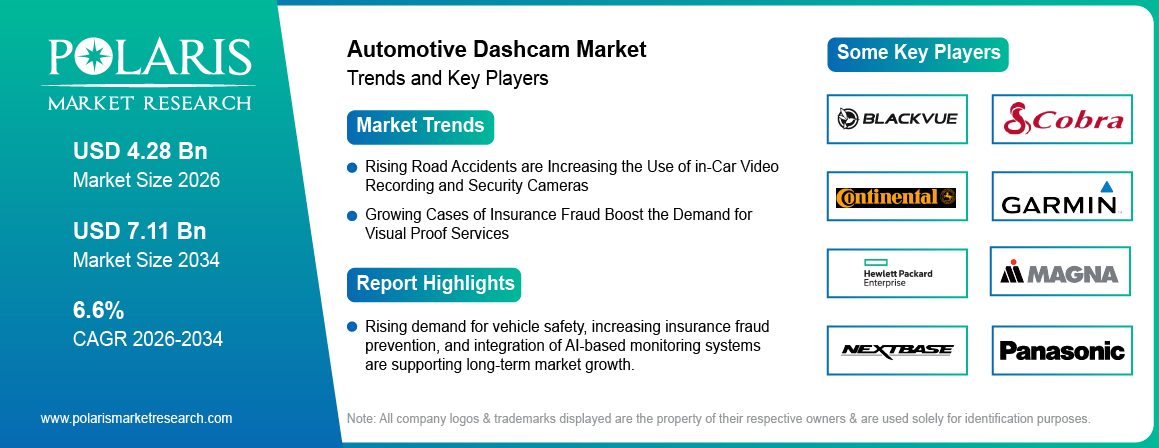
Rising Road Accidents are Increasing the Use of in-Car Video Recording and Security Cameras: Rising number of road traffic accidents are increasing the demand for dashcams in order to collect evidence and monitor drivers. As per the statistics published by World Health Organization, approximately 1.19 million fatalities occur annually owing to road traffic accidents, while at least 20 to 50 million individuals suffer from non-fatal injuries that cause disabilities for life.Rising concerns about road safety are contributing towards more use of automotive dashcams.
Rising Cases of Insurance Fraud Boost the Demand for Visual Proof Services: Insurance companies and car owners are opting to utilize dashcams as a means of supporting their claims while minimizing the number of instances of fraud. Research carried out by the Coalition Against Insurance Fraud in 2022 revealed that fraud cases relating to insurance in the US result in losses amounting to roughly USD 308.6 billion annually due to insurance fraud cases in different kinds of insurance, such as health, property, and automobile.Growing financial losses due to fraudulent claims make dashcams an efficient tool in accident investigation processes due to its ability to provide strong evidence.
Restraints & Challenges
Privacy and Data Protection Law Are Restraining Implementation: Issues with compliance regarding video recording, data retention, and user permission are hindering the implementation process of dashcams. The act of surveillance is restricted by data protection acts such as the GDPR. Surveillance and data mining issues have become a big problem.
Opportunities
AI-Based Analysis is Driving Innovation in Dashcams: The current dash cam technology has progressed from simple video cameras to sophisticated cameras capable of risk detection and driver monitoring using AI-based analysis. Motive released their next generation product called AI Dashcam Plus in January 2026, which is a new-age edge AI technology incorporating stereoscopic vision, sensor fusion, and voiceless communication.The technology is capable of processing more than 30 algorithms simultaneously, with improved processing speed.
Growing Role of Smart City Infrastructure is Enabling Connected Dashcam Ecosystems: The advent of smart city transport systems are increasing the need for vehicle-generated data in for urban surveillance. This helps in traffic management, accident reporting, and also in police actions with the help of live video feeds. The increasing focus on intelligent transport systems opens up new opportunities for dashcam market.
Source: Polaris Market Research Analysis
Get Full Segment-Level Forecasts & Insights: Download Sample Report
Segmental Insights
The report offers comprehensive analysis on the automotive dashcam market segmented by technology and vehicle. The study helps industry participants to understand market segmentation and high growth potential areas of dashcams.
By Technology
-
Basic Dashcams
Basic dashcams segment dominated the market in 2025 owing to high demand for inexpensive and easily installable recording devices. Basic dashcams are extensively adopted by individual vehicle owners for recording accidents and for insurance purposes.
-
Advanced AI Dashcams
Advanced AI dashcams segment is projected to grow at a rapid pace during the forecast period, due to integration of features such as driver monitoring, collision detection, and real-time alerts. These systems are widely adopted in fleet dashcam market where safety, compliance, and operational efficiency are key priorities.
By Vehicle
-
Passenger Vehicles
Passenger vehicles segment led the market in 2025 owing to the growing popularity of dashcam usage amongst car owners. Road accidents, thefts, and fraud cases are increasing the usage of dashcams among consumers. The expansion of the middle class and vehicle ownership in the market are also boosting the demand for this segment.
-
Commercial Vehicles
Commercial vehicles segment is expected to register the fastest growth during the forecast period driven by increasing deployment of dashcams across logistics, transportation, and ride-hailing services. Fleet operators are investing in advanced dashcam systems to improve safety, monitor driver performance, and reduce operational risks.
Source: Polaris Market Research Analysis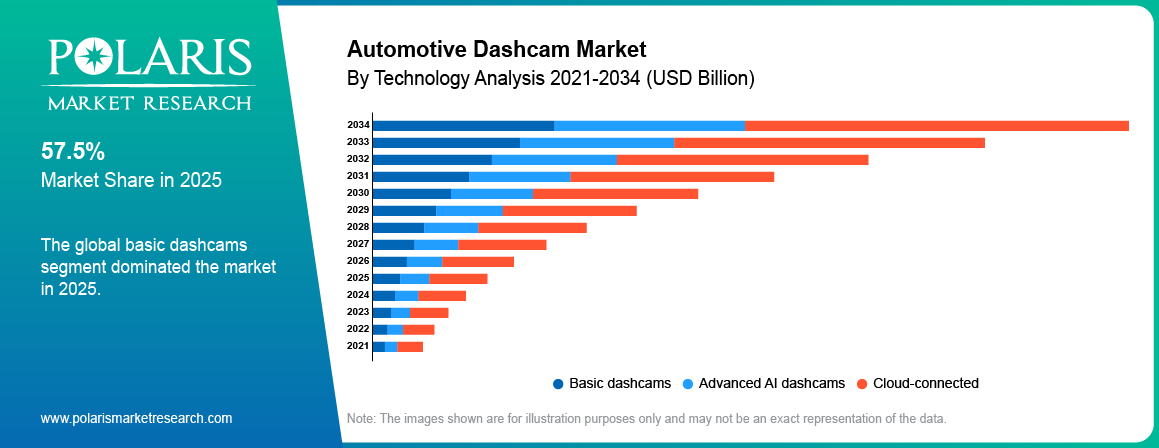
Need Granular Data Across All Market Segments? Request Customization
Regional Analysis
Asia Pacific Automotive Dashcam Market Insights
Asia Pacific led the dashcam market due to high accident rates and rising dispute cases across developing economies. China and India are experiencing high adoption rates in passenger and commercial vehicles. According to World Health Organization data, road crash injuries accounted for about 3.5% of all deaths in Thailand in 2021. Nearly 18 thousand deaths were recorded in the year 2021.Increasing need for video evidence and fleet monitoring is supporting China dashcam adoption and India fleet cameras.
North America Automotive Dashcam Market Overview
North America dashcam market holds a significant share due to strong insurance integration and high usage in logistics fleets. As per Insurance Information Institute, net premium income amounted to USD 1.7 trillion by 2024.The US market shows steady adoption supported by commercial fleet safety requirements. Increasing usage of dashcam video technology for claims processing and risk assessment is fueling the use of US dashcams.
Europe Automotive Dashcam Market Insights
Regulatory framework and data protection policies have an impact on the European automotive dashcam market. Strict norms governing the recording of videos and usage of data prevail in all countries within Europe. Laws like the General Data Protection Regulation guide product development and implementation strategy. Stable demand has been experienced due to awareness about road safety and dashcam legality.
Rest of the World Automotive Dashcam Market Outlook
Latin America and Middle East market is growing due to rising vehicle ownership and emphasis on road safety. Adopted at an early stage, improving awareness and infrastructure developments support the automotive dashcam market trends globally.
Source: Polaris Market Research Analysis
Curious About Regional Market Performance? Request Customization
Competitive Landscape & Key Players
The automotive dashcam industry features average concentration, where competition is based on electronic brands, automobile technology suppliers, and specific dashcam manufacturers. Competition in the market is determined by factors like video resolution, storage capacity, price, and the availability of sophisticated technologies, including artificial intelligence-supported driver assistance and cloud connectivity. Manufacturers are developing strategies to improve reliability, real-time monitoring capabilities, and user-friendly interfaces in their products. The development of intelligent dashcams equipped with collision avoidance, lane departure warnings, and remote connectivity is defining the competitive scenario in consumer and commercial markets.
Leading companies that operate in the automotive dashcam market are Garmin Ltd., Nextbase Ltd., Thinkware Corporation, BlackVue, Cobra Electronics Corporation, Continental AG, Robert Bosch GmbH, Panasonic Corporation, Philips N.V., Magna International Inc., Samsung Electronics Co., Ltd., Hewlett Packard Enterprise Development LP, DOD Tech, ABEO Technology Co., Ltd., and Rexing USA.
Premium Insights
Fleet ROI & Cost Benefits
Fleet operators are reporting 15–25% reduction in accident-related costs after dashcam adoption. Insurance premium rates is projected to fall significantly by around 20%, owing to effective driver monitoring and proof of incidents. Payback time is normally estimated at 6-12 months, ensuring financial feasibility.
Pricing Benchmark Analysis (Ultra-Premium)
Average Selling Price (ASP)
| Segment | Price Range |
| Basic Dashcams | USD 50 – USD 120 |
| Mid-range (GPS, dual cam) | USD 120 – USD 300 |
| AI/Cloud Dashcams | USD 300 – USD 700 |
Source: Polaris Market Research Analysis
Enterprise Fleet Pricing
- Hardware combined with subscription-based model
- Monthly SaaS fees range between $10–$40 per vehicle
Roi & Financial Modeling
Fleet ROI Model
| Metric | Value |
| Accident Reduction | 18–28% |
| Insurance Savings | 12–20% |
| Payback Period | 6–10 months |
| ROI (3-year) | 180–260% |
Source: Polaris Market Research Analysis
Key Players
- ABEO Technology Co., Ltd.
- BlackVue
- Cobra Electronics Corporation
- Continental AG
- DOD Tech
- Garmin Ltd.
- Hewlett Packard Enterprise Development LP
- Magna International Inc.
- Nextbase Ltd.
- Panasonic Corporation
- Philips N.V.
- Rexing USA
- Robert Bosch GmbH
- Samsung Electronics Co., Ltd.
- Thinkware Corporation
Industry Developments
- January 2026: Qubo introduced Connected Dash Cameras with 4G Live and Dashcam Trio offering live stream video, GPS tracking, and three-channel filming for 360° vehicle coverage. [source: autocarpro.in]
- October 2025: Uno Minda launched advanced 2-way and 3-way Dash Cam DVRs offering high definition recordings and multi-channel surveillance of the front, rear, and cabin areas of vehicles. [source: motorindiaonline.in]
Automotive Dashcam Market Segmentation
By Technology Outlook (Revenue, USD Billion, 2021-2034)
- Basic dashcams
- Advanced AI dashcams
- Cloud-connected
By Vehicle Outlook (Revenue, USD Billion, 2021-2034)
- Passenger vehicles
- Commercial vehicles
By Distribution Channel Outlook (Revenue, USD Billion, 2021-2034)
- Online
- In-Store
By Regional Outlook (Revenue, USD Billion, 2021-2034)
- North America
- US
- Canada
- Europe
- Germany
- France
- UK
- Italy
- Spain
- Netherlands
- Russia
- Rest of Europe
- Asia Pacific
- China
- Japan
- India
- Malaysia
- South Korea
- Indonesia
- Australia
- Vietnam
- Rest of Asia Pacific
- Middle East & Africa
- Saudi Arabia
- UAE
- Israel
- South Africa
- Rest of Middle East & Africa
- Latin America
- Mexico
- Brazil
- Argentina
- Rest of Latin America
Automotive Dashcam Market Report Scope
| Report Attributes | Details |
| Market Size in 2025 | USD 4.03 Billion |
| Market Size in 2026 | USD 4.28 Billion |
| Revenue Forecast by 2034 | USD 7.11 Billion |
| CAGR | 6.6% from 2026 to 2034 |
| Base Year | 2025 |
| Historical Data | 2021–2024 |
| Forecast Period | 2026–2034 |
| Quantitative Units | Revenue in USD Billion and CAGR from 2026 to 2034 |
| Report Coverage | Revenue Forecast, Competitive Landscape, Growth Factors, and Industry Trends |
| Segments Covered |
|
| Regional Scope |
|
| Competitive Landscape |
|
| Report Format |
|
| Customization | Report customization as per your requirements with respect to countries, regions, and segmentation. |
Source: Polaris Market Research Analysis
Automotive Dashcam Market FAQ's
The global market size was valued at USD 4.03 Billion in 2025 and is projected to grow to USD 7.11 Billion by 2034.
Asia Pacific dominated the market by holding 39.99% revenue share owing to high accident rates and increasing adoption among passenger and commercial vehicles.
The major uses of automotive dashcams include recording accidents, monitoring drivers, managing fleets, and verifying insurance claims.
Key players include Garmin Ltd., Nextbase Ltd., Thinkware Corporation, BlackVue, Continental AG, and others.
Some of the factors that led to the expansion of the market are high accident rates, rising instances of insurance fraud, and growing demand for fleet safety products.
The highest demand arises in the transportation industry, logistics industry, ride-hailing industry, and personal cars.
Automotive dashcams are advancing towards becoming artificial intelligence-based products.
Yes, commonly adopted for driver behavior tracking, risk management, and business efficiency.
Prices depend on the level of sophistication and degree of technology incorporated, usually ranging from low-budget models to high-end AI-based solutions.
AI integration, smart city integration, connected mobility, and advanced fleet analytics.
Download Sample Report of Automotive Dashcam Market
Please fill out the form to request a customized copy of the research report.


