
Brine Concentration Minerals Market Size, Opportunities 2026-2034
REPORT DETAILS
Market Statistics
What is Brine Concentration Minerals Market Size?
Global brine concentration minerals market size was valued at USD 1.21 billion in 2025 and is anticipated to exhibit the CAGR of 9.9% during the forecast period.
Market Statistics
- 2025 Market Size: USD 1.21 Billion
- 2034 Projected Market Size: USD 2.75 Billion
- CAGR (2026-2034): 9.9%
- Largest Market: Asia Pacific
Market Overview
The growth of brine concentration minerals is driven by several key factors that mirror global trends toward sustainability and rising demand in crucial industries. The increasing use of renewable energy projects and the adoption of electric vehicles are driving the need for minerals such as lithium, potassium, and magnesium, which are essential for batteries and lightweight materials. The shift towards cleaner energy sources is also increasing the demand for energy storage solutions, in which minerals derived from brine are crucial.
For instance, in December 2023, Ganfeng Lithium Group Co., Ltd started production in Argentina, the Cauchari-Olaroz Salt Lake project holds a lithium resource of about 24.58 billion tons of lithium carbonate equivalent (LCE), establishing it as one of the largest Salt Lake lithium extraction projects globally. The initial phase aims to achieve a capacity of 40,000 tons of LCE, while Phase 2 is targeting no less than 20,000 tons of LCE.
Source: Polaris Market Research Analysis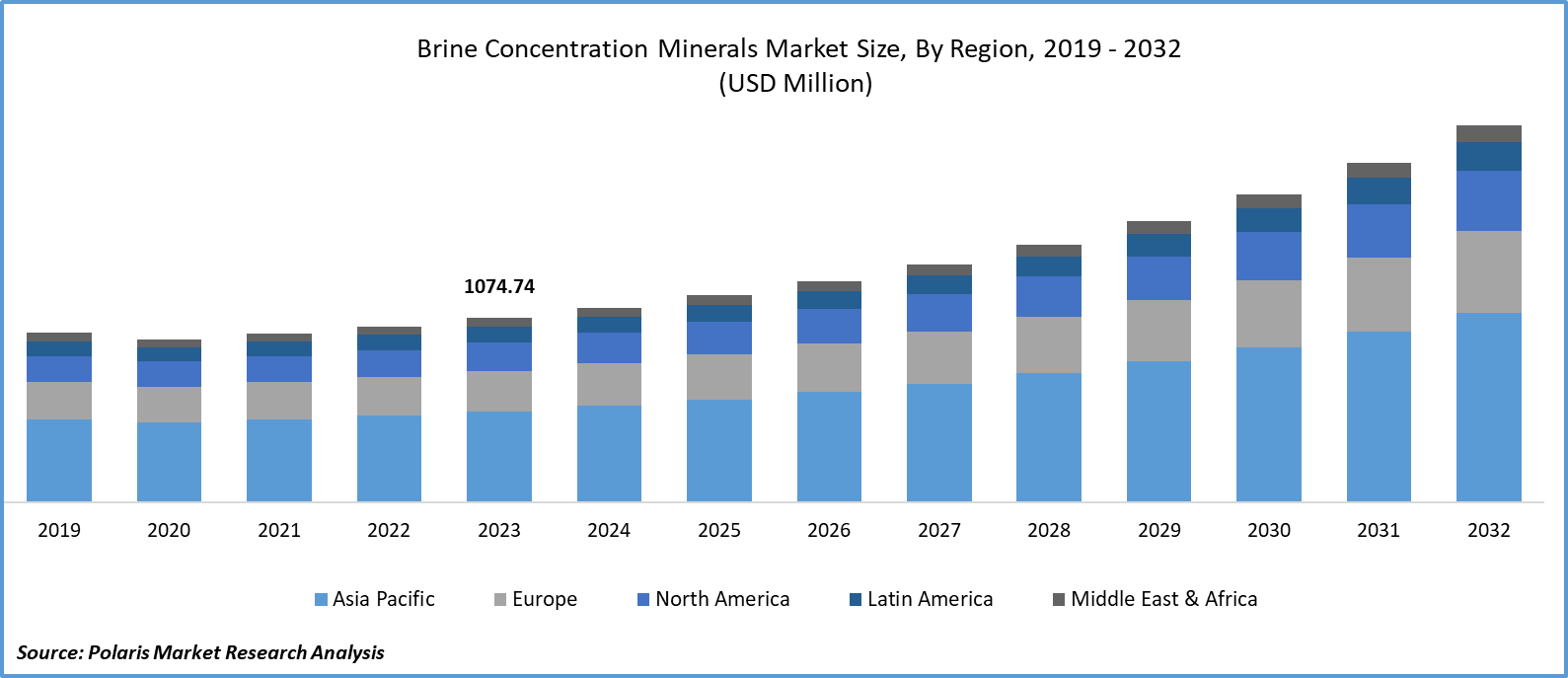
To Understand More About this Research: Download Sample Report
Moreover, the increased use of these minerals in industries beyond energy, such as agriculture, pharmaceuticals, and construction, adds to the growing demand. The importance of sustainable practices in resource extraction makes brine concentration methods more appealing, especially those that reduce environmental impact.
Geopolitically, establishing strategic partnerships and making investments in lithium-rich regions, like the lithium triangle in South America, helps secure a reliable supply chain. Furthermore, advancements in technology, including innovative extraction processes, improve the efficiency and cost-effectiveness of producing brine concentration minerals.
Market Dynamics
Market Drivers
The increasing need for lithium-ion batteries
The increasing demand for lithium-ion batteries is a major factor driving the brine concentration minerals market development, mainly because lithium is a key component in these batteries. Lithium-ion batteries are widely used in electric vehicles, consumer electronics, and renewable energy storage systems. As the world moves towards cleaner and more sustainable energy sources, the demand for lithium-ion batteries is expected to rise sharply. Lithium, crucial for these batteries, is primarily sourced from brine concentration minerals like lithium-rich brine deposits. Extracting lithium from brine is cost-effective and typically involves concentrating the lithium in brine pools through evaporation. This has led the brine concentration minerals market expansion to meet the increasing demand for lithium-ion batteries.
The specific geological conditions needed for lithium-rich brine deposits result in resources being concentrated in certain regions, leading to the emergence of key players in those areas. Countries with abundant lithium resources, such as those in the lithium triangle (Chile, Argentina, and Bolivia), have become focal points for brine concentration mineral extraction. This highlights the crucial role these minerals play in supporting the growing market demand for clean and renewable energy technologies, as well as the global transition towards cleaner energy. The brine concentration minerals market growth is also driven by the growing emphasis on sustainable practices, particularly in terms of environmental friendliness and water resource conservation.
Key Trends in Brine Concentration Minerals
| Trend | Description | Examples/Drivers |
| Direct Lithium Extraction (DLE) | Selective lithium recovery using adsorption, membranes, or solvents from brines. | Faster than evaporation, 90%+ recovery rates, lower water use. |
| Membrane Technologies | Electrodialysis, nanofiltration with modifications for hypersaline brines. | Sustains selectivity in high salinity, reduces fouling. |
| Sustainable Practices | Eco-friendly extraction, brine recycling, reduced environmental impact. | Mitigates water depletion, supports green mining. |
| Green Technologies | Non-toxic, low-energy processes for mineral concentration. | Lowers emissions, complies with regulations. |
| Efficient Extraction Advances | Improved filtration, separation for higher yields from low-grade brines. | Unlocks new resources, cuts costs. |
| Automation & Digitalization | AI, remote sensing for real-time monitoring and optimization. | Enhances safety, efficiency, predictive maintenance |
Source: Polaris Market Research Analysis
Source: Polaris Market Research Analysis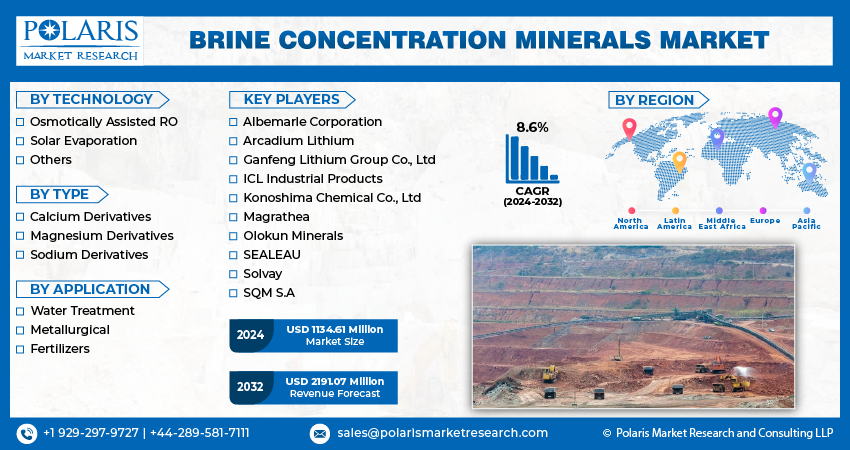
Get Full Segment-Level Forecasts & Insights: Download Sample Report
Market Restraints
Recovering minerals selectively and dealing with low mineral concentrations are likely to impede the market growth.
The brine concentration minerals market development faces significant challenges due to low mineral concentration and the need for selective mineral recovery. Extracting minerals from brine, such as lithium, magnesium, and calcium, involves concentrating and isolating these minerals, which becomes difficult when the initial concentration is low. This complexity and cost of extraction increase as larger volumes of brine must be processed to obtain viable amounts of minerals. Furthermore, selectively recovering specific minerals from brine can be technically challenging. Different brine sources contain a mix of minerals, and achieving high selectivity for desired minerals while avoiding contamination adds complexity and cost. Advanced technologies and additional processing steps are often required for selective recovery, further increasing operational costs. These challenges impact the economic viability and competitiveness of brine concentration minerals in the market.
Report Segmentation
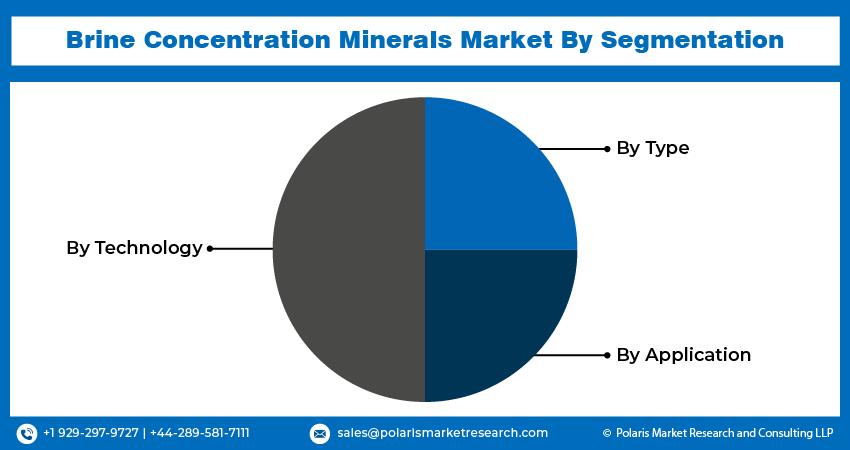
The market is primarily segmented based on technology, type, application and region.
| By Technology | By Type | By Application | By Region |
|
|
|
|
Source: Polaris Market Research Analysis
To Understand the Scope of this Report: Request Customization
Brine Concentration Minerals Market Segmental Analysis
By Technology Analysis
The solar evaporation segment accounted for the largest revenue share in 2025 and is expected to retain its position over brine concentration minerals market forecast period. Because of a number of benefits, the solar evaporation method is unique for extracting minerals from brine. First of all, because it uses natural solar energy and requires little infrastructure, operating expenses are minimized. The process's ease of use makes it possible to execute and run it quickly, which reduces setup delays and initial capital costs. Solar evaporation is thought to be environmentally benign since it uses less energy and doesn't require the use of chemical reagents, which is in line with sustainability objectives. Sun evaporation, depending on the properties of the brine source, is especially beneficial in areas with high sun radiation, such as the lithium triangle (Chile, Argentina, Bolivia). It targets minerals, including calcium, potassium, magnesium, and lithium.
By Type Analysis
The magnesium derivatives segment accounted for the largest market share in 2025 and is likely to retain its market position throughout the forecast period. Magnesium is highly valued in various industries for its diverse applications. In automotive manufacturing, it is preferred for its lightweight properties, which improve fuel efficiency and reduce emissions. This aligns with the industry's push for sustainable transportation solutions, driving up demand for magnesium derivatives. In agriculture, magnesium derivatives are used as fertilizers to address soil deficiencies and promote plant growth. The pharmaceutical sector also relies on magnesium compounds for formulating medications and dietary supplements, highlighting their role in health promotion. Additionally, in construction, magnesium oxide serves as a fire-resistant material, enhancing safety standards. Overall, the broad applications of magnesium derivatives across these industries position them as significant player in the brine concentration minerals market.
By Application Analysis
Based on application analysis, the market has been segmented on the basis of water treatment, metallurgical, and fertilizers. The metallurgical sector is the largest in the brine concentration minerals market, mainly due to the use of these minerals in refractories. Refractories, which are heat-resistant materials used in metal smelting and glass manufacturing, often contain minerals like magnesium oxide, calcium oxide, and alumina from brine. These minerals enhance the refractories' ability to withstand high temperatures and harsh conditions in metallurgical processes.
The demand for refractories in the metallurgical industry, including steel production and non-ferrous metal processing, drives the significance of the metallurgical segment in the market development. With the growth of the global steel industry and metallurgical activities, the demand for brine-derived minerals in refractories is expected to increase, further solidifying the metallurgical segment's importance.
Source: Polaris Market Research Analysis
Need Granular Data Across All Market Segments? Request Customization
Regional Insights
The Asia Pacific region dominated the global market with the largest market share in 2025
The Asia Pacific region dominated the global market with the largest market share in 2025 and is expected to maintain its dominance over the market forecast period. China, a key economic player, drives the demand for brine concentration minerals, using them extensively in electronics, automotive, and construction. The country's strong manufacturing sector, coupled with its position as a top electric vehicle producer, boosts the need for minerals like lithium, potassium, and magnesium in batteries and lightweight materials.
Additionally, in the Asia Pacific region, agriculture relies on these minerals as fertilizers, particularly in countries like India and China, to improve soil fertility and productivity. Asia Pacific also boasts significant lithium resources, crucial for lithium-ion batteries in energy storage and electric vehicles. Despite South America's lithium-rich deposits, Asia Pacific countries invest in the region to secure a steady supply of minerals.
Source: Polaris Market Research Analysis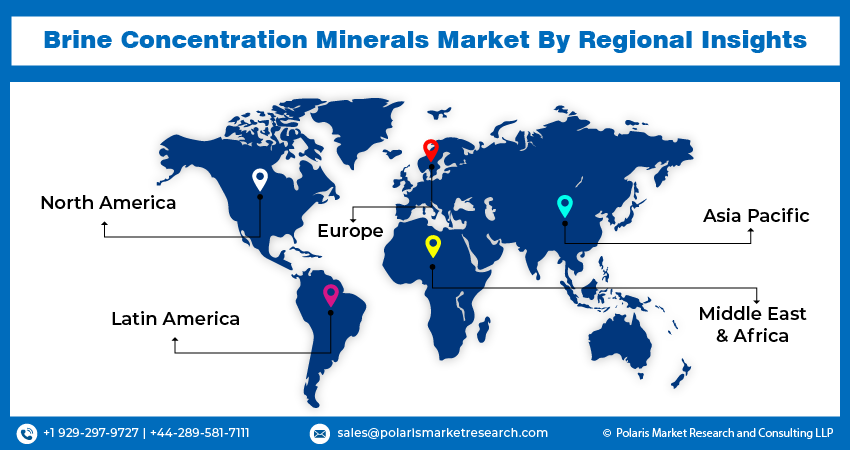
Curious About Regional Market Performance? Request Customization
Competitive Landscape
The Brine Concentration Minerals market development is fragmented and is anticipated to witness competition due to several players' presence. Major service providers in the market are constantly upgrading their technologies to stay ahead of the competition and to ensure efficiency, integrity, and safety. These players focus on partnership, product upgrades, and collaboration to gain a competitive edge over their peers and capture a significant market share.
Some of the major players operating in the global market include:
- Albemarle Corporation
- Arcadium Lithium
- Ganfeng Lithium Group Co., Ltd
- ICL Industrial Products
- Konoshima Chemical Co., Ltd
- Magrathea
- Olokun Minerals
- SEALEAU
- Solvay
- SQM S.A
Recent Developments
- January 2024: Livent increased its lithium production capacity, especially in Argentina, to meet rising demand for lithium-ion batteries. The company is also pursuing strategies to broaden its product portfolio and enter new markets beyond lithium.
- March 2023: Albemarle Corporation announced that the lithium hydroxide Mega-Flex facility, previously planned by the company, will be located in Chester County, South Carolina, US. The facility's plans include an initial investment of at least USD 1.3 billion, aimed at addressing the increasing demand for electric vehicles and lithium-ion batteries both domestically and internationally.
Report Coverage
The Brine Concentration Minerals market report emphasizes on key regions across the globe to provide better understanding of the product to the users. Also, the report provides market insights into recent developments, trends and analyzes the technologies that are gaining traction around the globe. Furthermore, the report covers in-depth qualitative analysis pertaining to various paradigm shifts associated with the transformation of these solutions.
The report provides detailed analysis of the market while focusing on various key aspects such as competitive analysis, technology, type, application and their futuristic growth opportunities.
Report Scope
| Report Attributes | Details |
| Market Size in 2025 | USD 1.21 billion |
| Market Size in 2026 | USD 1.29 billion |
| Revenue Forecast in 2034 | USD 2.75 billion |
| CAGR | 9.9% from 2026 – 2034 |
| Base Year | 2025 |
| Historical Data | 2021 – 2024 |
| Forecast Period | 2026 – 2034 |
| Quantitative Units | Revenue in USD billion and CAGR from 2026 to 2034 |
| Segments Covered | By Technology, By Type, By Application, By Region |
| Regional Scope | North America, Europe, Asia Pacific, Latin America; Middle East & Africa |
| Customization | Report customization as per your requirements with respect to countries, region and segmentation. |
Source: Polaris Market Research Analysis
Brine Concentration Minerals Market FAQ's
The global brine concentration minerals market size is expected to reach USD 2.75 billion by 2034.
Key players in the market are Magrathea, Olokun Minerals, Albemarle Corporation, Ganfeng Lithium Group Co., Ltd
Asia Pacific contribute notably towards the global Brine Concentration Minerals Market
Global brine concentration minerals market exhibiting the CAGR of 9.9% during the forecast period.
The Brine Concentration Minerals Market report covering key segments are technology, type, application and region.
Download Sample Report of Brine Concentration Minerals Market
Please fill out the form to request a customized copy of the research report.


