
Head Up Display Market Revenue Trends & Growth Drivers, 2024-2032
REPORT DETAILS
Market Statistics
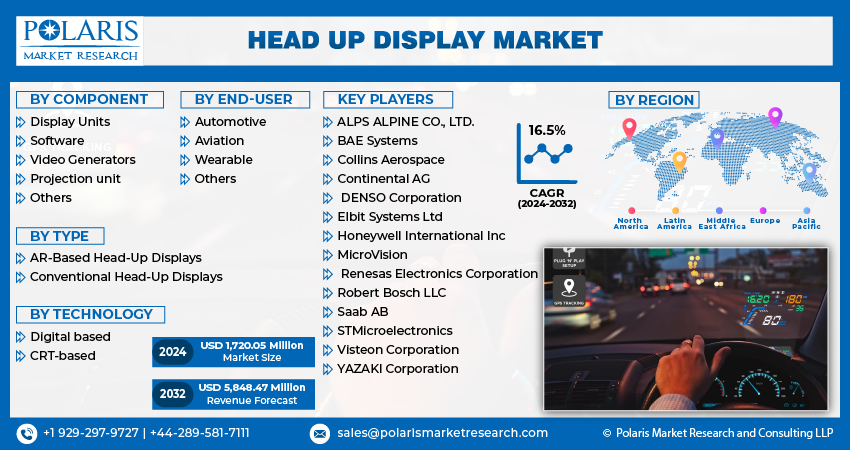
Global Head Up Display Market Size was valued at USD 1,478.34 Million in 2023. The Head Up Display industry is projected to grow from USD 1,720.05 Million in 2024 to USD 5,848.47 Million by 2032, exhibiting a compound annual growth rate (CAGR) of 16.5% during the forecast period (2024 - 2032). The Head Up Display market is expanding significantly, fueled by the growing adoption of augmented reality (AR) technologies. AR enhances the driver's field of vision with critical information, improving safety and user experience. This trend is accelerating as automakers aim to integrate more sophisticated AR features into vehicles, boosting Head Up Display market growth. Additionally, the market is growing as automakers prioritize safety, integrating HUDs to display critical information directly in the driver's line of sight, reducing the need for visual diversion, and enhancing overall driving safety through real-time data presentation.
Source: Polaris Market Research Analysis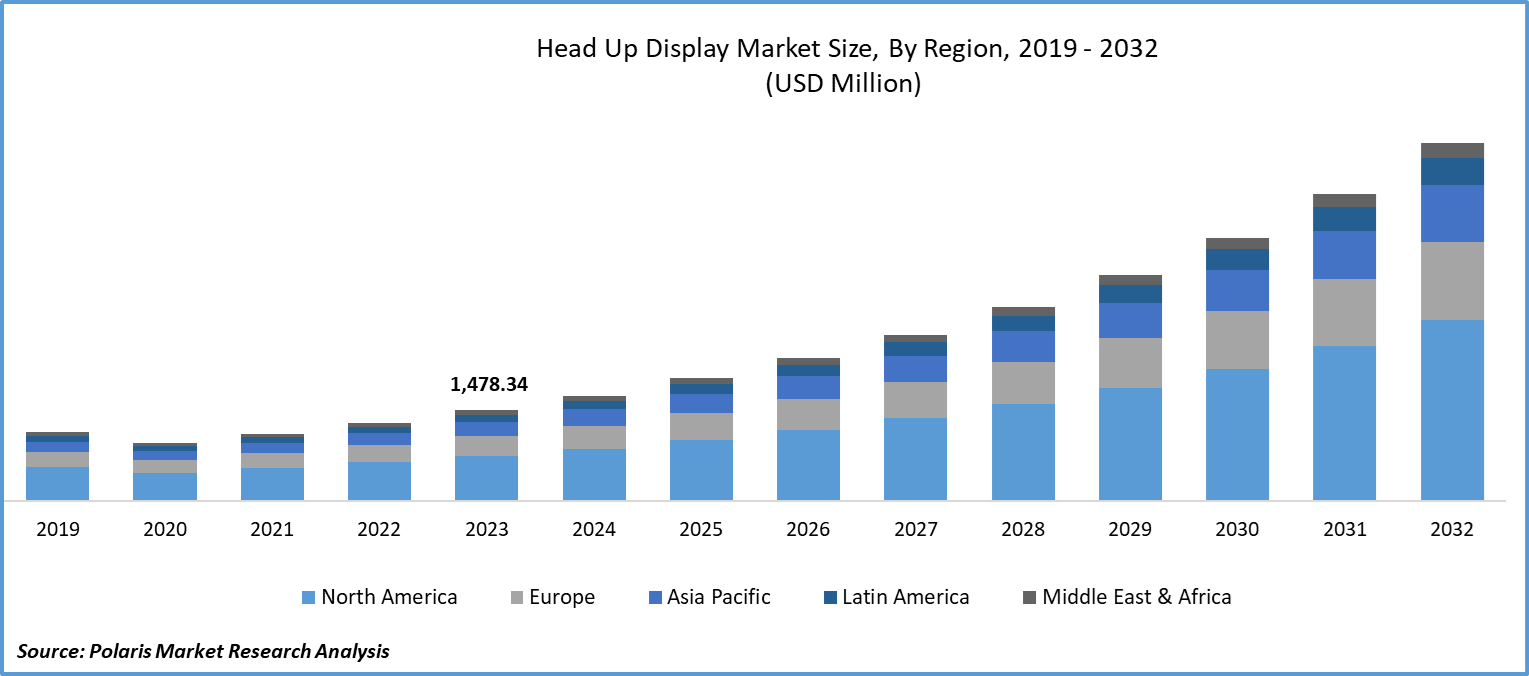
To Understand More About this Research: Download Sample Report
The automobile sector serves as a pivotal force propelling the Head Up Display market primarily through its relentless pursuit of enhancing driver safety, comfort, and overall driving experience. As vehicles become more advanced, HUDs are increasingly integrated to project critical information such as speed, navigation directions, and alerts directly onto the windshield or a dedicated display. This integration minimizes the need for drivers to divert their gaze from the road, thus reducing potential distractions and enhancing overall safety.
Moreover, the HUD technology aligns with the automotive industry's broader trend towards adopting advanced driver assistance systems (ADAS), which include features like lane departure warnings, adaptive cruise control, and collision avoidance systems. These systems rely on real-time data and alerts that HUDs can efficiently display, further reinforcing their importance in modern vehicle designs.
Additionally, as consumer preferences shift towards premium vehicles equipped with cutting-edge technologies, automakers are increasingly incorporating HUDs as standard or optional features, further driving market growth and innovation in HUD technology within the automobile sector.
Market Trends
The rise in Adoption Of Advanced Driver Assistance Systems (ADAS) is Driving the Market Growth
Market CAGR for Head Up Display is being driven by the rising adoption of advanced driver assistance systems (ADAS), enhance vehicle safety and improve the overall driving experience. ADAS technologies, including lane departure warnings, adaptive cruise control, and collision avoidance systems, require real-time data presentation to be most effective. HUDs meet this need by displaying crucial information directly in the driver's line of sight, thereby reducing distractions and enabling quicker reaction times.
Companies are increasingly adopting ADAS to meet consumer demand for safer, more intelligent vehicles. For instance, in December 2023, ECARX, BlackBerry, and Black Sesame Technologies partnered to deploy the Skyland ADAS platform in Lynk & Co's SUV, marking the first large-scale use of the Black Sesame A1000 chip in ADAS solutions. Automakers are integrating these systems across various vehicle segments, not just luxury models, to enhance safety features and comply with stringent regulatory standards. This widespread implementation of ADAS necessitates the use of HUDs to provide seamless, real-time data visualization. Consequently, the growing demand for ADAS-equipped vehicles is propelling the Head Up Display market, as these displays have become essential components in modern automotive design, ensuring both safety and convenience for drivers.
Growing Consumer Preference for Premium and Luxury Vehicles
The Head Up Display market is experiencing significant growth, driven by growing consumer preference for premium and luxury vehicles. As luxury vehicle manufacturers shift towards electric and hybrid models, they emphasize integrating cutting-edge technologies to enhance the driving experience. For instance, In March 2023, Mercedes-Benz tested the launch of the Mercedes-Maybach EQS SUV and announced plans to introduce four electric vehicles within the next eight to twelve months by April 2023. By accelerating its electric mobility drive, aiming for 25% of vehicle sales to be EVs by 2027, Mercedes-Benz demonstrates a commitment to integrating advanced technologies like HUDs in their luxury electric models.
Luxury brands like Mercedes-Benz are actively expanding their electric vehicle portfolios, incorporating HUDs to meet consumer expectations for advanced, high-performance features in environmentally friendly vehicles. This shift not only caters to the demand for eco-friendly transportation but also enhances the appeal of luxury vehicles equipped with sophisticated HUD systems, thereby driving the Head Up Display market revenue.
Growing Consumer Preference For Premium And Luxury Vehicles
The expansion of Head Up Display applications beyond the automotive sector is significantly driving the market growth. Originally designed for vehicles, HUD technology is now being adopted in aviation, where it enhances pilot situational awareness by displaying critical flight information directly on the windshield. Additionally, the technology is making inroads into consumer electronics, such as smart glasses and gaming systems, offering immersive augmented reality (AR) experiences.
The healthcare sector is also exploring HUDs for medical imaging and surgery, allowing surgeons to access real-time data without diverting their gaze from the operative field. This diversification of applications showcases HUDs' versatility, broadening their market appeal and accelerating technological advancements, thereby fueling overall Head Up Display market expansion.
Source: Polaris Market Research Analysis
Get Full Segment-Level Forecasts & Insights: Download Sample Report
Segment Insights
Head Up Display Component Insights
The global Head Up Display market segmentation, based on component includes Display Units, Software, Video Generators, Projection unit, and Others. The projection unit segment holds the highest market share and is expected to lead the Head Up Display market due to its versatile applications across multiple industries. In aviation, projection units enhance pilot situational awareness by displaying critical flight data. In healthcare, they are integrated into operating microscopes, providing real-time data without distracting surgeons. They also offer advanced optical displays in portable systems, aiding in data preservation and wider viewing angles.
Furthermore, projection units are essential in smart healthcare and safety eyewear, incorporating linked features like speakers, microphones, and cameras. These diverse applications highlight the projection unit's adaptability and crucial role in HUD technology, driving its dominant market position and future growth.
Head Up Display Application Insights
The global Head Up Display market segmentation, based on application, includes automotive, aviation, wearable, and others. The automotive segment holds the highest market share and is expected to lead the Head Up Display market due to the growing integration of HUDs with advanced driver assistance systems (ADAS). Automobile manufacturers increasingly adopt these technologies to enhance driver safety and convenience. For instance, in June 2021, Hyundai introduced a groundbreaking "clusterless" HUD for enhanced driver visibility and seamless information display in their vehicles. HUDs display crucial information like speed, navigation, and collision warnings directly in the driver’s line of sight, reducing distractions and improving reaction times. This integration with ADAS ensures a seamless, real-time display of data, making driving safer and more intuitive.
Furthermore, the rapid advancement of technology and the integration of artificial intelligence (AI) in automotive systems significantly drive market growth. AI enhances the functionality of HUDs by enabling features like augmented reality (AR) overlays, predictive maintenance alerts, and adaptive display adjustments based on driving conditions. These innovations cater to the rising consumer demand for high-tech, intelligent vehicles, reinforcing the automotive segment's dominance in the Head Up Display market and propelling future growth.
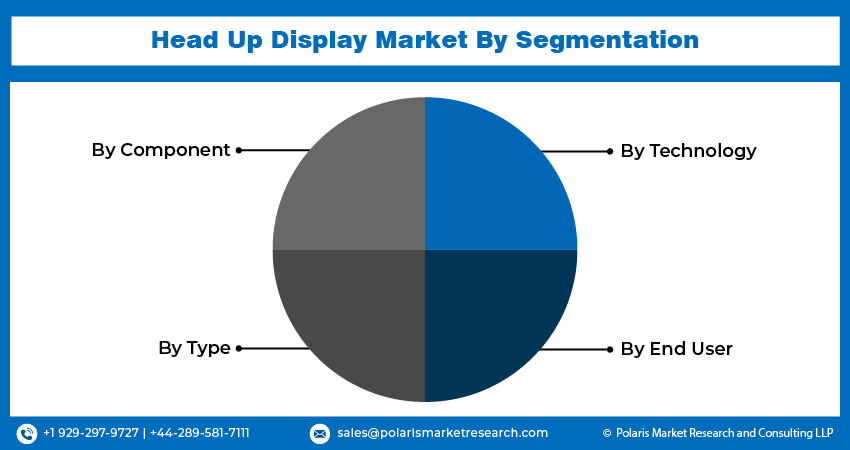
Global HUD Market, Segmental Coverage, 2019 - 2032 (USD Million)
Source: Polaris Market Research Analysis
Need Granular Data Across All Market Segments? Request Customization
Source: Secondary Research, Primary Research, PMR Database and Analyst Review
Regional Insights
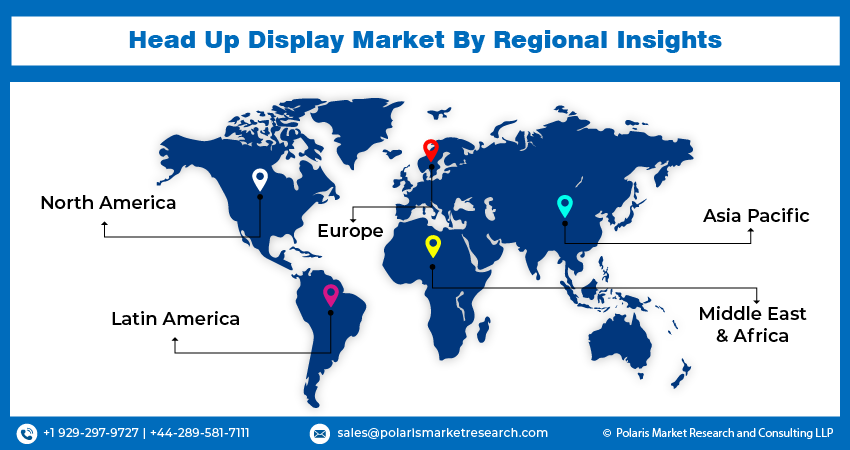
By region, the study provides the market insights into North America, Europe, Asia-Pacific and Rest of the World. North America dominates the Head-Up Display market due to several key factors. The region benefits from the presence of large technology firms and substantial investments in HUD research and development, fostering innovation and market leadership. Recent advancements in automotive technologies like adaptive cruise control and augmented reality are pivotal trends driving increased HUD adoption in the U.S. These technologies enhance vehicle safety and user experience by integrating real-time data display directly into the driver's line of sight, aligning with consumer demands for safer and more sophisticated driving technologies. As these trends continue to evolve, North America is poised to maintain its leading position in driving the growth of the Head Up Display market globally.
Further, the major countries studied in the market report are The US, Canada, German, France, the UK, Italy, Spain, China, Japan, India, Australia, South Korea, and Brazil.
Global HUD Market, Regional Coverage, 2019 - 2032 (USD Million)
Source: Polaris Market Research Analysis
Curious About Regional Market Performance? Request Customization
Source: Secondary Research, Primary Research, PMR Database and Analyst Review
The Asia-Pacific Head Up Display Market is expected to grow at the fastest CAGR from 2024 to 2032. Increasing awareness among users about the safety and convenience benefits of HUD technology is driving adoption across various sectors, including automotive, aviation, and consumer electronics. As consumers become more informed about HUD capabilities in enhancing driving safety and providing real-time information, demand for these systems is escalating.
Moreover, the region's growth is bolstered by rising standards of living and increasing disposable incomes. As personal wealth increases, there is a growing inclination towards luxury vehicles and high-tech gadgets equipped with advanced features like HUDs. This trend is particularly evident in countries like China, Japan, and South Korea, where technological innovation and consumer electronics play a significant role in everyday life. Consequently, Asia Pacific is set to witness substantial market expansion in the forecasted period, driven by both technological awareness and economic factors.
Key Market Players & Competitive Insights
Leading market players are investing heavily in research and development in order to expand their product lines, which will help the Head Up Display market grow even more. Market participants are also undertaking a variety of strategic activities to expand their global footprint, with important market developments including new product launches, contractual agreements, mergers and acquisitions, higher investments, and collaboration with other organizations. To expand and survive in a more competitive and rising market climate, the Head Up Display industry must offer cost-effective items.
Manufacturing locally to minimize operational costs is one of the key business tactics used by manufacturers in the global Head Up Display industry to benefit clients and increase the market sector. In recent years, the Head Up Display industry has offered some technological advancements. Major players in the Head Up Display Market, including ALPS ALPINE CO., LTD., BAE Systems, Collins Aerospace, Continental AG, DENSO Corporation, Elbit Systems Ltd, Honeywell International Inc, MicroVision, Renesas Electronics Corporation, Robert Bosch LLC, Saab AB, STMicroelectronics, Visteon Corporation, YAZAKI Corporation.
BAE Systems PLC, based in London, is Europe's largest defense contractor. It specializes in a wide array of products, including combat systems, aeronautics, land and armaments, avionics, cyber intelligence, and artificial intelligence. The company integrates advanced technologies across the defense, aerospace, and security sectors globally. In May 2022, BAE Systems launched LiteWave, a compact and lightweight Head-Up Display (HUD) using innovative waveguide technology designed for enhanced situational awareness in aircraft cockpits.
Honeywell International Inc., based in Charlotte, NC, operates in aerospace, building technologies, safety solutions, and performance materials, serving diverse industries with innovative products and solutions globally. In June 2023, Honeywell Acquired Saab’s Head-up Display (HUD) Assets to integrate into the avionics system in a three-year agreement to simplify the pilot’s process on the flight deck, enhancing safety and security.
List Of Key Companies
- ALPS ALPINE CO., LTD.
- BAE Systems
- Collins Aerospace
- Continental AG
- DENSO Corporation
- Elbit Systems Ltd
- Honeywell International Inc
- MicroVision
- Renesas Electronics Corporation
- Robert Bosch LLC
- Saab AB
- STMicroelectronics
- Visteon Corporation
- YAZAKI Corporation
Head Up Display Industry Developments
- July 2025: Valeo was selected by a leading Chinese OEM to supply its advanced pillar-to-pillar head-up display for future vehicle models. The system turns the windshield into an interactive interface, projecting key information into the driver’s view. Production is set to begin in 2026, supporting China’s fast-paced automotive innovation cycle.
- June 2025: Xpeng, working jointly with Huawei, created an augmented reality head-up display (AR-HUD) system named “Chasing Light Panorama” for its forthcoming mid-size electric SUV, the G7. The solution merges Huawei’s hardware strengths with Xpeng’s software capabilities to provide advanced navigation and improved driving assistance features.
- April 2025: Nippon Seiki Co., Ltd. formed a joint venture in India with Emerging Display Technologies Corporation (Taiwan), a producer of high-resolution TFT LCD modules. Through this collaboration, the partners will set up a new jointly funded company, EDT-India Private Limited, dedicated to manufacturing TFT LCD modules in India. The proposed facility is planned to support large-scale production of automotive TFT LCD modules by 2027.
- May 2023: Raythink debuted an advanced AR-HUD solution at the Shanghai Auto Show. It features OpticalCore technology for enhanced 3D imaging, a wider field of view, and lower costs. Raythink plans to mass-produce it by mid-2024.
- February 2022: Continental introduced a head-up display for trams to enhance safety by improving driver focus in urban traffic, reducing emergency braking incidents amid increasing challenges and distractions
- January 2023: Panasonic Automotive introduces AR HUD 2.0 at CES 2022. It features a patented Eye-Tracking System (ETS) for enhanced clarity and an intuitive augmented reality experience, powered by SkipGen2 technology
Head Up Display Market Segmentation
Head Up Display Component Outlook
- Display Units
- Software
- Video Generators
- Projection unit
- Others
Head Up Display Type Outlook
- AR-Based Head-Up Displays
- Conventional Head-Up Displays
- Windshield-based HUD
- Combiner-based HUD
Head Up Display Technology Outlook
- Digital based
- CRT-based
Head Up Display Application Outlook
- Automotive
- Premium/Luxury Cars
- Sports Cars
- Basic & Mid-segment Cars
- Aviation
- Wearable
- Others
Head Up Display Regional Outlook
- North America
- US
- Canada
- Europe
- Germany
- France
- UK
- Italy
- Spain
- Netherlands
- Russia
- Rest of Europe
- Asia-Pacific
- China
- Japan
- India
- Malaysia
- South Korea
- Indonesia
- Australia
- Vietnam
- Rest of Asia-Pacific
- Middle East & Africa
- Saudi Arabia
- UAE
- Israel
- South Africa
- Rest of Middle East & Africa
- Latin America
- Mexico
- Brazil
- Argentina
- Rest of Latin America
Head Up Display Report Scope
| Report Attributes | Details |
| Market size value in 2023 | USD 1,478.34 Million |
| Market size value in 2024 | USD 1,720.05 Million |
| Revenue Forecast in 2032 | USD 5,848.47 Million |
| CAGR | 16.5% from 2024 – 2032 |
| Base year | 2023 |
| Historical data | 2019 – 2022 |
| Forecast period | 2024 – 2032 |
| Quantitative units | Revenue in USD Million and CAGR from 2024 to 2032 |
| Report Coverage | Revenue Forecast, Market Competitive Landscape, Growth Factors, and Trends |
| Segments covered |
|
| Regional scope |
|
| Competitive Landscape |
|
| Report Format |
|
| Customization | Report customization as per your requirements with respect to countries, region, and segmentation. |
Source: Polaris Market Research Analysis
Head Up Display Market FAQ's
The global Head Up Display market size was valued at USD 1,478.34 Million in 2023.
The global market is projected to grow at a CAGR of 16.5% during the forecast period, 2023-2032
North America had the largest share in the global market
• The key players in the market are ALPS ALPINE CO., LTD., BAE Systems, Collins Aerospace, Continental AG, DENSO Corporation, Elbit Systems Ltd, Honeywell International Inc, MicroVision, Renesas Electronics Corporation, Robert Bosch LLC, Saab AB, STMicroelectronics, Visteon Corporation, YAZAKI Corporation
The projection unit dominated the market in 2023.
The automotive had the largest share in the global market
Download Sample Report of Head Up Display Market
Please fill out the form to request a customized copy of the research report.


