
M2M Satellite Communication Market Size Forecast Report, 2025-2034
REPORT DETAILS
Market Statistics
The M2M Satellite Communication Market was valued at 3,768.41 million in 2024, growing at a CAGR of 10.32% from 2025 to 2034. The rise of IoT devices in remote areas and demand for uninterrupted data connectivity drive this market.
Market Overview
Machine-to-machine (M2M) satellite communication refers to the automated data exchange between two or more satellite-enabled devices or machines without human intervention. This process utilizes satellite networks to facilitate communication and data transfer between devices situated in remote or inaccessible locations. Machine-to-machine satellite communication becomes especially valuable in situations where conventional terrestrial communication infrastructure is either unavailable or unreliable. Satellites, with their global coverage, can extend communication to remote regions, oceans, deserts, or areas lacking sufficient cellular network coverage.
Source: Polaris Market Research Analysis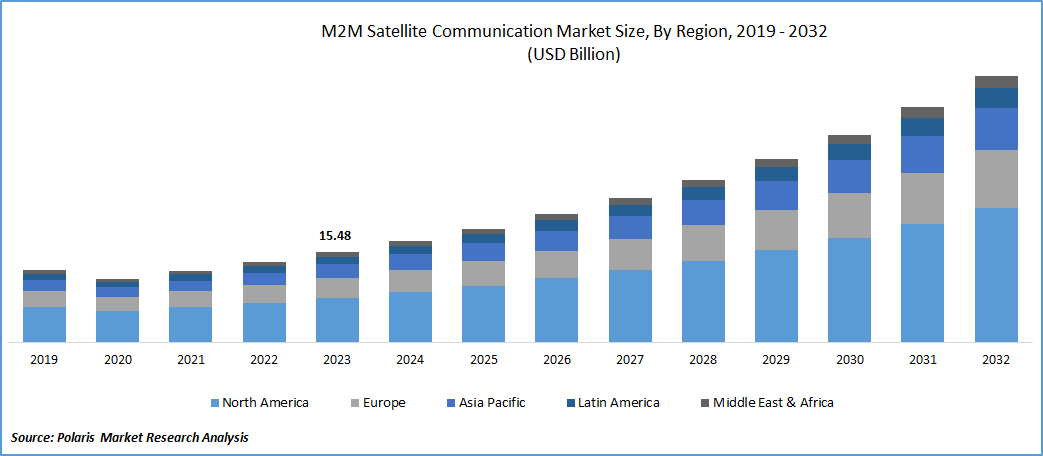
To Understand More About this Research: Download Sample Report
The increasing demand for instantaneous data and information is a key catalyst propelling the growth of the Machine-to-Machine (M2M) satellite communication market size. Governments and corporations are actively seeking ways to oversee and manage their assets in an interconnected world remotely. Satellite-based Machine-to-machine communication emerges as a reliable and efficient solution, especially in areas where terrestrial networks are limited or non-existent. For example, in the agriculture sector, machine-to-machine satellite communication enables remote monitoring of soil moisture, temperature, and crop growth, empowering farmers to make informed decisions and optimize resource utilization.
The demand for Machine-to-Machine (M2M) satellite communication is propelled by the market trend Internet of Things (IoT) and the implementation of smart city initiatives. As the number of connected devices and sensors rises in urban settings, satellite communication becomes crucial for ensuring ubiquitous connectivity. An example of this is evident in machine-to-machine satellite communication, facilitating real-time monitoring of power distribution infrastructure, remote management of grid components, and the optimization of energy consumption within smart grid applications.
The rising demand for enhanced data communication and the widespread applications of global machine-to-machine satellite communication primarily fuel the machine-to-machine satellite communication market growth. Safety concerns pose challenges to this market, while the increasing demand for solutions facilitating asset monitoring and vehicle tracking is expected to generate lucrative opportunities for vendors in the forecast period. Nevertheless, the main obstacles facing the global M2M satellite communication market share include a lack of market knowledge and insufficient infrastructural facilities.
Source: Polaris Market Research Analysis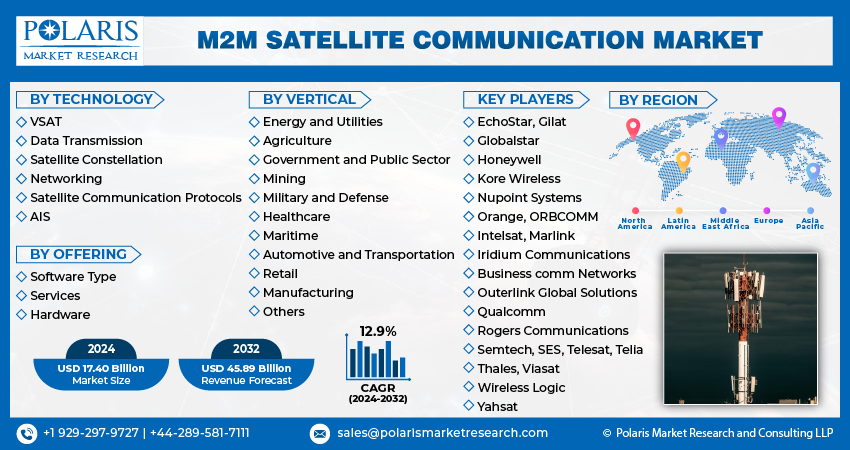
Get Full Segment-Level Forecasts & Insights: Download Sample Report
Market Drivers
Heightened adoption of the Internet of Things (IoT) and communication technologies bolstering the growth of the M2M Satellite Communication market size.
The M2M communication market is set to experience significant growth, primarily driven by the increasing popularity of the Internet of Things (IoT). The proliferation of connected devices is expected to serve as a key catalyst, providing substantial momentum to market expansion during the forecast period. Additionally, advancements in network technology are anticipated to play a positive role in shaping the trajectory of machine-to-machine communication market revenue growth. The ongoing developments in wireless technology further contribute to the positive outlook, projecting an accelerated growth rate for the M2M satellite communication market.
Furthermore, the M2M communication market is poised to witness a substantial impact from the increased penetration of 4G services and the commercialization of 5G services. These advancements in cellular networks are expected to significantly enhance the capabilities and efficiency of machine-to-machine communication, fostering a broader and more seamless connectivity landscape. As a result, the convergence of these technological trends is likely to fuel the expansion of the machine-to-machine communication market, opening up new opportunities and applications across various industries in the years to come.
Market Restraints
Increasing Security Concerns are likely to hamper the growth of the market.
The rapid growth of Machine-to-Machine (M2M) communications is met with a concurrent rise in security issues, which poses a significant challenge to the market's expansion. As M2M communication proliferates across various industries, the vulnerabilities in connected devices become more pronounced, exposing potential threats and risks to the overall system. In the construction of an efficient global digital landscape, the integration of personal and private data becomes inevitable. However, this amalgamation also heightens security and privacy concerns, making it imperative for the industry to address these issues comprehensively. The potential compromises in the security of machine-to-machine communications, especially when dealing with sensitive information, have raised apprehensions among users and organizations, impacting the overall growth trajectory of the M2M Satellite Communication market.
Report Segmentation
The market is primarily segmented based on technology, offering, vertical, and region.
| By Technology | By Offering | By Vertical | By Region |
|
|
|
|
Source: Polaris Market Research Analysis
To Understand the Scope of this Report: Request Customization
Segmental Analysis
By Vertical Analysis
- The Banking, Financial Services, and Insurance (BFSI) segment dominate the market in terms of size in 2024. The vehicles installed technology of communication satellite has witnessed a growing prevalence and offers solutions that amplify efficiency, overall connectivity, and safety.
- Within the automotive sector, Machine-to-machine satellite communication plays a vital role in providing vehicle tracking, telematics services, and real-time navigation. The systems of fleet management make use of precise satellite connectivity monitoring of vehicle health, location tracking, and route optimization. In the transport industry, M2M satellite communication conducts smooth communication between various modes of transportation, thereby improving overall supply chain logistics and management.
By Technology Analysis
- During the forecast period, the VSAT segment is anticipated to exhibit the largest CAGR. VSATs present a dependable and growing solution for establishing connections to remote locations and devices drives the M2M satellite communication market industry analysis. This communication system through satellites uses 0.75 to 2.4 meters antennas for two-way communication via satellites. In the Machine-to-Machine (M2M) communication market growth, VSATs play a crucial role in establishing a link between centralized servers, remote sensors, and devices or machines, ensuring consistent data transfer. The networks of VSAT showcase high adaptability, and their capability to deliver reliable connectivity across extensive geographical regions makes it well-suited for diverse machine-to-machine applications, including control and monitoring systems in transportation, agriculture, and energy. Furthermore, the bidirectional communication support of VSAT systems enables machine-to-machine devices to receive commands or updates.
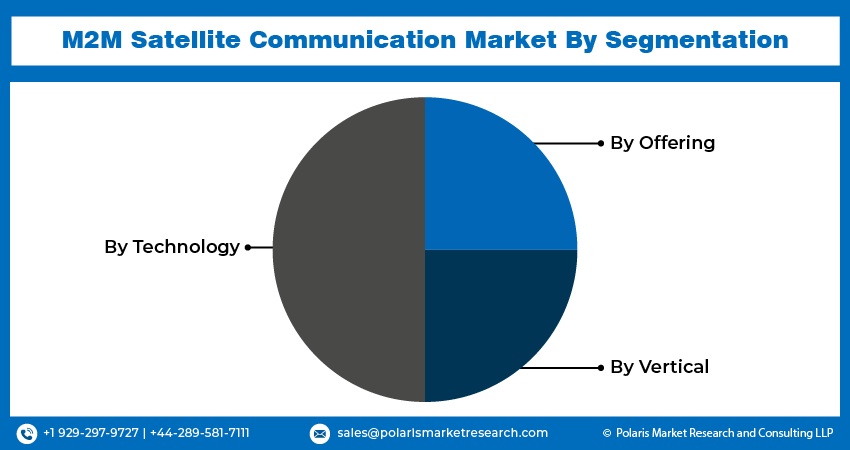
Source: Polaris Market Research Analysis
Need Granular Data Across All Market Segments? Request Customization
Regional Insights
The North American region dominated the global market with the largest market share in 2024
In recent years, North America has experienced notable expansion, propelled by the rising utilization of Internet of Things devices across diverse industries. The escalating need for instantaneous communication and data transfer is particularly evident in environmental monitoring, energy, agriculture, and transportation industries. Numerous North American companies are actively playing a role in advancing solutions for machine-to-machine satellite communication. Key players like Globalstar and Iridium Communications have broadened their networks of satellites, providing improved reliability and coverage for machine to machine applications. Additionally, collaborations between Internet of Things (IoT) developers and providers and satellite networks have streamlined the incorporation of satellite connectivity into Internet of Things (IoT) ecosystems.
Source: Polaris Market Research Analysis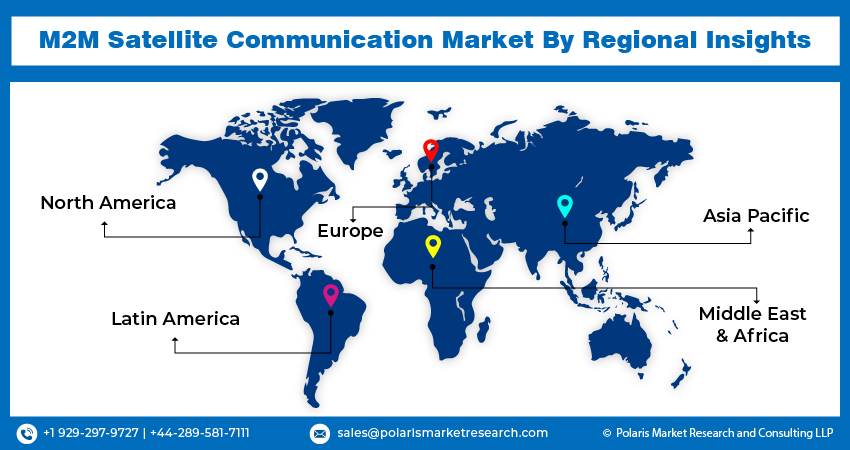
Curious About Regional Market Performance? Request Customization
Competitive Landscape
The M2M Satellite Communication market top companies are fragmented and is anticipated to witness competition due to several players' presence. Major service providers in the market are constantly upgrading their technologies to stay ahead of the competition and to ensure efficiency, integrity, and safety. These players focus on partnership, product upgrades, and collaboration to gain a competitive edge over their peers and capture a significant market share.
Some of the major players operating in the global market include:
- Business comm Networks
- EchoStar
- Gilat
- Globalstar
- Honeywell
- Intelsat
- Iridium Communications
- Kore Wireless
- Marlink
- Nupoint Systems
- Orange
- ORBCOMM
- Outerlink Global Solutions
- Qualcomm
- Rogers Communications
- Semtech
- SES
- Telesat
- Telia
- Thales
- Viasat
- Wireless Logic
- Yahsat
Recent Developments
- In January 2025, Sealsq and Wisesat launched an IoT satellite to enable secure, real-time M2M communications. The SataaS model offers scalable, encrypted satellite-based services for industries like logistics, agriculture, and infrastructure.
- In November 2023, SWISSto12 and Thales joined forces to enhance the progress of Active Electronically Steerable Antennas (AESAs) designed for the Satcom-on-the-move sector, specifically targeting airborne, land, and maritime vehicles. The partnership entails the integration of SWISSto12's pioneering 3D-printed antenna apertures with Thales' state-of-the-art solid-state beamformers.
- In October 2023, Viasat unveiled enhanced in-flight broadband service options for business aviation, aligning its Viasat Ka-band solution with the Jet ConneX solution obtained through the recent acquisition of Inmarsat. This integration is designed to offer upgraded in-flight connectivity services, leveraging the strengths of both Viasat and Inmarsat offerings to deliver a comprehensive and improved in-flight broadband experience for business aviation customers.
- In July 2023, Thales initiated exclusive negotiations for the acquisition of Cobham Aerospace Communications at a value of USD 1.1 billion. This strategic step is in line with Thales' objective to strengthen its Avionics portfolio, aiming to secure a prominent role in safety cockpit communications.
Report Coverage
The M2M Satellite Communication market report emphasizes key regions across the globe to provide a better understanding of the product to the users. Also, the report provides market insights into recent developments and trends and analyzes the technologies that are gaining traction around the globe. Furthermore, the report covers an in-depth qualitative analysis pertaining to various paradigm shifts associated with the transformation of these solutions.
The report provides a detailed analysis of the market while focusing on various key aspects such as competitive analysis, technology, offering, vertical, and futuristic growth opportunities.
Report Scope
| Report Attributes | Details |
| Market size value in 2025 | USD 7,936.00 million |
| Revenue forecast in 2034 | USD 4,242.86 million |
| CAGR | 10.32% from 2025 – 2034 |
| Base year | 2024 |
| Historical data | 2020 – 2023 |
| Forecast period | 2025 – 2034 |
| Quantitative units | Revenue in USD Million and CAGR from 2025 to 2034 |
| Segments covered | By Technology, By Offering, By Vertical, By Region |
| Regional scope | North America, Europe, Asia Pacific, Latin America; Middle East & Africa |
| Customization | Report customization as per your requirements with respect to countries, regions, and segmentation. |
Source: Polaris Market Research Analysis
m2m satellite communication market FAQ's
The global M2M Satellite Communication market size is expected to reach USD 7,936.00 million by 2034.
include Businesscom Networks, EchoStar, Gilat, Globalstar, Honeywell, Intelsat, Iridium Communications, are the top market players in the market.
North American region contribute notably towards the global M2M Satellite Communication Market.
M2M Satellite Communication Market is exhibiting the CAGR of 10.32% during the forecast period.
The M2M Satellite Communication Market report covering key segments are technology, offering, vertical, and region.
Download Sample Report of m2m satellite communication market
Please fill out the form to request a customized copy of the research report.


