
Global Manga Market Size, Share, Growth Analysis Report, 2026-2034
REPORT DETAILS
Market Statistics
Manga Market Overview
The global Manga Market was valued at USD 16.30 billion in 2025 and is projected to grow at a CAGR of 7.50% from 2026 to 2034. Expanding digital platforms and growing global fanbase are key aspects behind market growth.
Key Insights
- North America dominated the global market with more than 38.5% of revenue share in 2025. Wide presence of retail stores and high consumer spending capacity in the U.S. and Canada propels the dominance.
- The Asia Pacific manga market is expected to register the highest CAGR of 8.2 % during the forecast period. Increasing number of manga readers in Japan and China boosts the regional market growth.
- By audience, the adults segment accounted for the largest market share of 43.9% in 2025. Manga includes various genres targeted at adults, including romance, drama, action, horror, and science fiction. Therefore, its popularity is high among adult audience.
- By content type, the digital segment is projected to register the highest CAGR of 9.6% during the projected period. Increasing availability of manga content on manga apps such as Shonen Jump, Crunchyroll Manga, and Manga Rock drives the segment growth.
Note: Figures and projections outlined in this report are the result of Polaris Market Research’s proprietary analytical processes, grounded in the latest available datasets and market observations.
Market Statistics
- 2025 Market Size: USD 16.30 billion
- 2034 Projected Market Size: USD 31.24 billion
- CAGR (2026–2034): 7.50%
- North America: Largest market in 2025
Industry Dynamics
- Rising adoption of digital platforms and online services offering convenient access to manga titles fuels the market growth.
- Increasing production and sales of manga and comics with fascinating stories and attractive graphics influence the manga industry growth.
- Increasing focus on collaborations and partnerships with OTT players is expected to create lucrative market opportunities in the coming years.
- The availability of alternate entertainment sources hinders the growth of the market.
AI Impact on Manga Market
- AI technology facilitates automated translation and localization. Manga companies can simultaneously have multi-language releases. It helps businesses accelerate time-to-market, improving competitiveness and revenue cycles.
- AI-driven tools automate editing, lettering, and formatting tasks. It reduces operational expenses significantly and optimizes production workflows.
- Generative AI supports content creation. The technology helps studios produce manga drafts, backgrounds, and illustrations more efficiently at scale.
- AI analytics provide actionable audience insights. This helps manga players make better content strategy and licensing decisions. They can also easily reach targeted distribution for B2B stakeholders.
- Digital platforms use AI to enhance monetization. Technology use offers personalized recommendations and multilingual content offerings.
Industry Trend
The manga market is a dynamic and rapidly evolving industry that encompasses the creation, publication, and distribution of Japanese comic books or graphic novels. Manga, with its distinctive artistic style and diverse genres ranging from action and romance to fantasy and horror, has gained immense popularity both in Japan and internationally.
Source: Polaris Market Research Analysis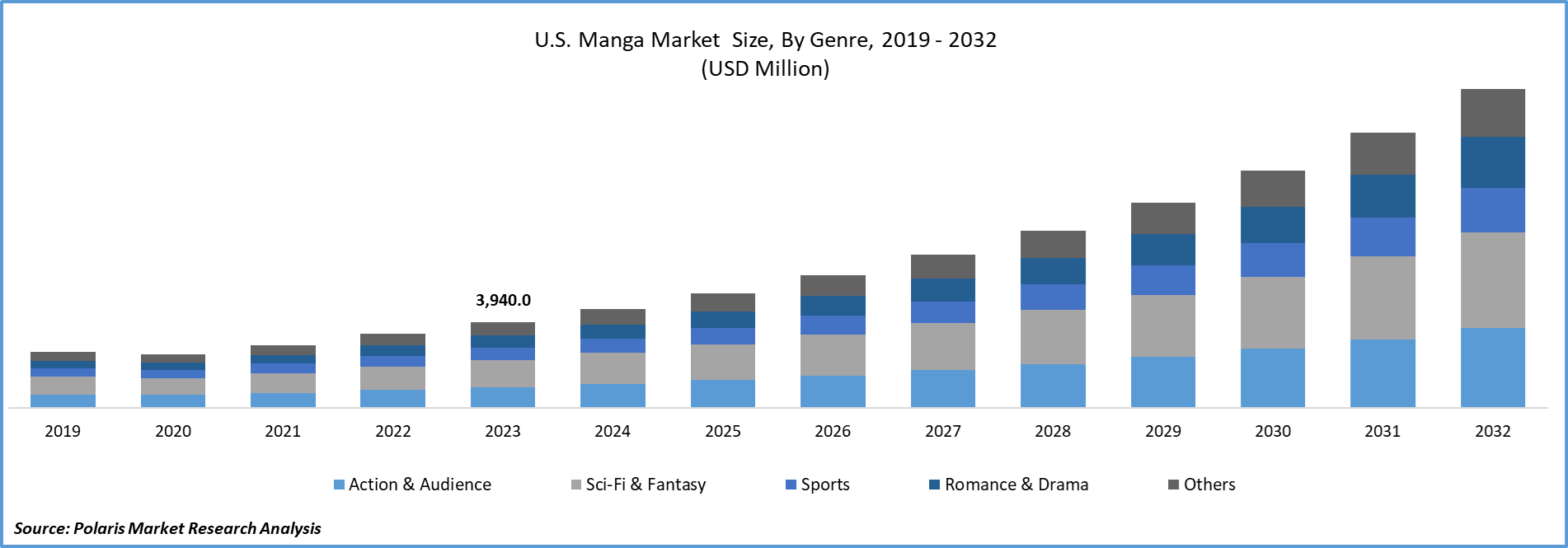
To Understand More About this Research:Download Sample Report
In Japan, manga holds a prominent place in popular culture, with a wide demographic of readers spanning various age groups and interests. Manga series are serialized in weekly or monthly magazines known as "manga anthologies" before being compiled into standalone volumes called "tankobon." The Japanese manga market is multifaceted, with genres catering to diverse tastes, including shonen (targeted towards young boys), shojo (targeted towards young girls), seinen (targeted towards adult men), and josei (targeted towards adult women).
Internationally, manga has experienced significant growth and influence, captivating readers across the globe. The popularity of manga has led to translations into numerous languages and adaptations into various forms of media, including anime, films, and merchandise. Countries such as the U.S., France, South Korea, and China have emerged as major markets for manga outside of Japan.
The digitalization of manga has further transformed the industry, with digital platforms and online services offering convenient access to manga titles on smartphones, tablets, and computers. This shift has expanded the reach of manga to new audiences and facilitated the global dissemination of Japanese pop culture. Rapidly growing production and sales of manga and comics with several fascinating stories and attractive & designer graphics to help illustrate the content quality is a key factor influencing the growth of the global market. These types of books help their readers to enhance mold values, improve vocabulary, and place readers’ minds in an exciting imaginary land. Such type of products is easily available in a variety of genres including noir, romance, sports, science, and fantasy so that they can suite all age categories and hence propel the overall demand and growth of the market.
The aesthetic elements in the printed books attract enthusiasts as they seek to enjoy and collect high-quality and glossy manga books. The digital segment is expected to observe a notable growth rate during the forecast period as consumers are showing an increased interest in e-books as they offer greater convenience, address space constraints, and are relatively cheaper than printed versions. As per the data published by NPD BookScan in 2021, the revenue from e-books in the U.S. increased to around 11.7% in 2020 compared to that in 2022.
The landscape of partnerships and collaborations in the manga market is dynamic and multifaceted, playing a crucial role in the industry's growth and globalization. These partnerships span various sectors, including publishing, digital platforms, animation studios, merchandise producers, and international distributors, each contributing to the widespread appeal and accessibility of manga.
For instance, in December 2022, IDW has partnered with Todd Lieberman's Hidden Pictures to develop its IDW/Top Shelf graphic novel A Radical Shift of Gravity into a feature film.
What are the Market Drivers Driving the Demand for the Manga Market?
Increasing Demand for Graphic Novels Across the Globe
The demand for graphic novels in the manga market has been steadily increasing in recent years. Graphic novels offer a unique storytelling experience that blends text and visual art, allowing for a more immersive and engaging reading experience. This has helped to appeal to a wider range of readers, particularly those who may not be as interested in traditional novels. Manga has become increasingly popular in recent years, with a growing fanbase around the world. This has helped to drive demand for manga graphic novels, as readers look for new and engaging ways to experience their favorite manga titles. Graphic novels offer a greater degree of creative freedom than traditional novels, allowing creators to experiment with different art styles, page layouts, and visual storytelling techniques.
This has helped to create a more diverse range of graphic novels in the manga market, and has helped to expand the appeal of manga to new audiences. Digital distribution has made it easier and more convenient for readers to access manga graphic novels, allowing them to read on their favorite devices and at their own pace. This has helped to increase the availability and accessibility of manga graphic novels, particularly for readers in remote or underserved areas. Overall, the increasing demand for graphic novels in the manga market is driven by a combination of factors, including diverse storytelling, the popularity of manga, creative freedom, and digital distribution. As these trends continue to evolve, it is likely that we will see continued growth and expansion of the manga graphic novel market in the coming years.
Which Factor is Restraining the Demand for Manga?
Availability of Alternative Entertainment Sources
The availability of alternative entertainment sources has indeed restrained the manga market to some extent. With the rise of streaming services like Netflix, Amazon Prime Video, and Hulu, many consumers now have access to a wide range of movies, TV shows, and other forms of entertainment that compete with manga. This has made it harder for manga publishers to attract and retain readers, particularly those who have a limited amount of leisure time. Video games are another popular form of entertainment that compete with manga for consumer attention. Overall, the availability of alternative entertainment sources has created new challenges for the manga market, making it harder for manga publishers to attract and retain readers. However, manga publishers can still compete by offering unique and engaging stories, high-quality artwork, and creative marketing strategies that appeal to manga fans.
Many gamers spend hours playing their favorite games, leaving little time for reading manga. This has made it harder for manga publishers to compete with video game publishers for consumer attention and dollars. While social media has helped to promote manga titles and build fan communities around specific titles or genres, it has also created new forms of entertainment that compete with manga. Social media platforms like TikTok and Instagram offer short-form videos and images that can be consumed quickly and easily, making them more appealing to some consumers than reading longer-form content like manga. Many popular manga titles have been adapted into television shows and movies, which can help to increase the popularity of the manga. However, these adaptations also compete with the manga itself for consumer attention, particularly if the adaptations are well-produced and widely promoted.
Report Segmentation
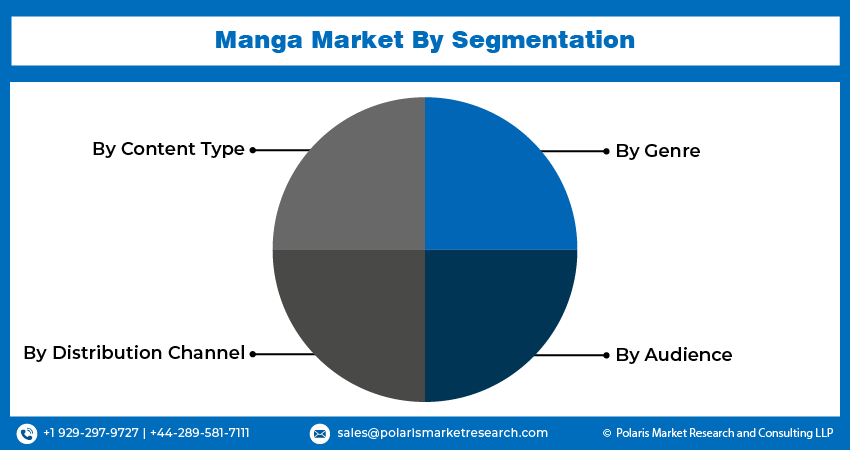
The market is primarily segmented based on content type, distribution channel, genre, audience, and region.
| By Content Type | By Distribution Channel | By Genre | By Audience | By Region |
|
|
|
|
|
Source: Polaris Market Research Analysis
To Understand the Scope of this Report:Request Customization
Category Wise Insights
By Audience Insights
Based on audience analysis, the market is segmented on the children & kids, teenagers, adults. Adults segment held the largest market share of 43.9% in 2025. The manga market has also expanded its audience to include adults, with many manga series targeted specifically at this demographic. Many manga aimed at adults feature mature themes and content, such as violence, sexuality, and complex emotional issues. These manga can be more nuanced and sophisticated than those aimed at younger audiences, and often deal with more serious and challenging topics. The manga market offers a wide range of genres targeted at adults, including romance, drama, action, horror, and science fiction. This allows readers to find stories that cater to their interests and preferences. Many manga aimed at adults are serialized in seinen manga magazines, which are targeted at young adult men. These magazines often offer more mature and complex content, and feature a variety of genres and styles. Many manga aimed at adults feature high-quality artwork, with detailed and intricate illustrations that showcase the artist's skill and talent. This can make the reading experience more enjoyable and immersive, and can appeal to readers who appreciate art and design.
The Japanese manga market is multifaceted, with genres catering to diverse tastes.
Types of Manga (By Target Audience)
| Type | Target Audience | Key Themes & Characteristics |
| Shonen | Teenage boys | Action, adventure, friendship, competition, fast-paced plots, and character growth |
| Shojo | Teenage girls | Romance, relationships, emotions, drama, and expressive storytelling |
| Seinen | Adult men | Mature themes, complex narratives, violence, politics, and psychological depth |
| Josei | Adult women | Realistic romance, career, daily life, and nuanced emotional storytelling |
| Kodomomuke | Children | Simple, educational, moral-based stories with easy-to-understand characters and plots |
Source: Polaris Market Research Analysis
Source: Polaris Market Research Analysis
Need Granular Data Across All Market Segments? Request Customization
By Content Type Insights
Based on content type analysis, the market has been segmented on the basis of printed, digital. The digital segment expected to be the fastest growing CAGR of 9.6% during the forecast period. In addition to printed content, digital content has become increasingly popular in the manga market. Many manga publishers offer digital versions of their books, which can be purchased and read on electronic devices such as tablets and smartphones. There are several apps that allow readers to access and read manga digitally. Some popular manga apps include Shonen Jump, Crunchyroll Manga, and Manga Rock. Many Manga artists publish their work online as webcomics, which are often free to read. Some webcomics gain enough popularity to be published as printed volumes.
By Distribution Channel Insights
The segmentation includes online and offline. The offline segment dominated with 39.0% share in 2025. Manga distribution channels are critical for shaping market reach, revenue generation, and audience engagement across regions. Publishers and distributors adopt a multi-channel strategy. They focus on combining digital and physical platforms. It helps them maximize accessibility and brand visibility. The online segment contains various digital apps. However, the offline segment includes traditional book stores, and conventions and events. Digital apps are driving rapid global expansion through instant access and subscription-based models. Traditional bookstores support print sales and collector demand. Additionally, conventions and events serve as important touchpoints for direct consumer interaction. They are used for promotional activities and market feedback. This enables businesses to strengthen fan communities and test new content effectively.
| Distribution Channel | Description | Key B2B Benefits |
| Digital Apps | Manga distributed via mobile apps and online platforms with instant access | Global reach, recurring revenue (subscriptions), data analytics, lower costs |
| Bookstores | Physical manga sold through retail stores and chains | Strong brand visibility, impulse purchases, established distribution networks |
| Conventions | Sales and promotions at comic/anime conventions and events | Direct fan engagement, merchandising opportunities, brand building, market testing |
Source: Polaris Market Research Analysis
Regional Insights
North America
North America region accounted for the largest market share of 38.5% in 2025. The growth of the regional market can be attributed to the wide presence of retail stores and high consumer spending capacity in countries like the United States and Canada. For instance, according to data published by Publisher Weekly in 2020, there were more than 2,000 independent comic magazines and book shops available in the United States alone. The manga community in North America is strong and active, with many fan events, conventions, and online communities dedicated to manga. This has helped to create a sense of community and support among manga fans, and has helped to promote the growth of the manga market in North America.
Asia Pacific
Asia Pacific market is expected to grow at the fastest CAGR of 8.2% during the forecast period. High prevalence and popularity and rapidly growing number of manga readers in countries like Japan and China and the influencing young generation and imaginative individuals to pursue a career in the manga industry are major factors boosting the growth of the market in the region.
Source: Polaris Market Research Analysis
Curious About Regional Market Performance? Request Customization
Competitive Landscape
The competitive landscape of the manga market is marked by the presence of major Japanese publishers, emerging digital platforms, and a growing number of international players, all vying for market share in a dynamic and globalized industry. Leading Japanese publishers such as Shueisha, Kodansha, and Shogakukan dominate the market with iconic titles like "One Piece," "Attack on Titan," and "Detective Conan," respectively. These publishers set industry standards and drive much of the market's content. On the digital front, platforms like Crunchyroll Manga, ComiXology, and Manga Plus by Shueisha are transforming how readers access and consume manga, offering vast libraries and simultaneous global releases. International publishers, including Viz Media and Panini Comics, play crucial roles in translating and distributing manga to non-Japanese audiences, significantly expanding the market's reach. Additionally, webtoon platforms like Line Webtoon and Tapas Media, along with self-publishing avenues such as Kickstarter and Patreon, are providing independent artists with new opportunities to reach readers directly.
Some of the major players operating in the global market include:
- Shueisha Inc.
- Shogakukan Inc
- Yen Press
- VIZ Inc.
- Houbunsha Co., Ltd.
- Bilibili Comics
- Seven Seas Entertainment, Inc.
- Kadokawa Corporation
- AKITA PUBLISHING CO., LTD. (Akita Shoten Co., Ltd)
- Kodansha Ltd.
- IDW Media Holdings
- DMG Entertainment Inc.
- Futabasha Publishers Ltd.
- Archie Comic Publications, Inc.
- Titan Books (Titan Entertainment Group)
Recent Developments
- In March 2026, Media Do International acquired Seven Seas Entertainment for USD 80 million. Seven Seas Entertainment is an independently owned English-language manga publisher. (Source: sevenseasentertainment.com)
- In July 2025, Kodansha Ltd. unveiled new print manga licenses set for Spring 2026 and shared updates to its Kodansha Print Club program at San Diego Comic-Con. (Source: kodansha.us)
- In October 2025, MAG.NET collaborated with U.S. retailer BoxLunch. From January 2026, a range of official manga goods, such as clothing, accessories and volumes translated into English, will be available at BoxLunch’s 280 stores and its web site. (Source: magnet-global.net)
Report Coverage
The manga market report emphasizes on key regions across the globe to provide better understanding of the product to the users. Also, the report provides market insights into recent developments, trends and analyzes the technologies that are gaining traction around the globe. Furthermore, the report covers in-depth qualitative analysis pertaining to various paradigm shifts associated with the transformation of these solutions.
The report provides detailed analysis of the market while focusing on various key aspects such as competitive analysis, content type, distribution channel, genre, audience, and their futuristic growth opportunities.
MANGA Market Report Scope
| Report Attributes | Details |
| Market size value in 2025 | USD 16.30 Billion |
| Market size value in 2026 | USD 17.51 Billion |
| Revenue forecast in 2034 | USD 31.24 Billion |
| CAGR | 7.50% from 2026 – 2034 |
| Base year | 2025 |
| Historical data | 2021 – 2024 |
| Forecast period | 2026 – 2034 |
| Quantitative units | Revenue in USD Billion and CAGR from 2026 to 2034 |
| Segments covered | By Content Type, By Distribution Channel, By Genre, By Audience, And By Region |
| Regional scope | North America, Europe, Asia Pacific, Latin America, Middle East & Africa |
| Customization | Report customization as per your requirements with respect to countries, region, and segmentation. |
Source: Polaris Market Research Analysis
Manga Market FAQ's
The global manga market was valued at USD 16.30 billion in 2025 and is projected to reach USD 31.24 billion by 2034.
Digital manga is the fastest-growing segment due to greater convenience, affordability, space efficiency, and rising e-book popularity compared to printed versions.
Increasing demand for graphic novels, expanding digital platforms, growing global fanbase, diverse storytelling genres, and enhanced internet penetration drive significant manga market expansion.
Adults segment holds the largest market share due to mature themes, diverse genres, sophisticated content, seinen manga magazines, and high-quality artwork preferences.
North America dominates with over 38.5% market share due to wide retail presence, high consumer spending, strong manga community, and active fan conventions.
Manga are Japanese-style comic books or graphic novels. They cover various genres and are serialized or published in volumes for diverse age groups.
Manga can be read through printed books from bookstores. They are now available on digital apps, online platforms, and official publisher websites offering licensed content.
Action (shonen), romance (shojo/josei), thriller, fantasy, horror, slice of life, and science fiction are a few popular manga genres. They cater to varied audience preferences.
Download Sample Report of Manga Market
Please fill out the form to request a customized copy of the research report.


