
Minibar Refrigerators Market Share, Analysis Report, 2025-2034
REPORT DETAILS
Market Statistics
Market Overview
The global Minibar Refrigerators Market was valued at USD 375.25 Million in 2024 and is expected to grow at a CAGR of 3.65% from 2025 to 2034. Recovery in the hospitality sector, luxury hotel upgrades, and consumer demand for premium room amenities are driving market growth.
Rapid expansion of the hospitality industry stands out as a significant driver for this growth. Particularly in hotels, there is a distinct focus on the unique designs, personalized services, & immersive themes, all of which contribute substantially to market growth. According to Lodging Econometrics (LE)'s, in 2022, the global construction pipeline for hotels reached 14,267, comprising 2,298,846 rooms. This represented a notable year-over-year growth of 4%. In the market context, these properties prioritize the curation of quality mini-bar offerings that align seamlessly with brand identity. This tailored approach caters specifically to guests who value exclusivity and premium amenities. Consequently, the increasing number of hotels and resorts worldwide has significantly bolstered market growth.
Source: Polaris Market Research Analysis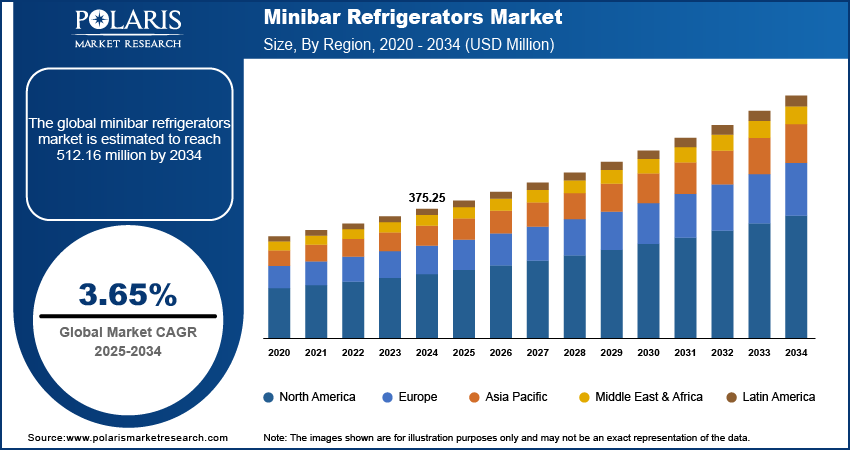
To Understand More About this Research: Download Sample Report
The trend of gatherings & house parties among the U.S. house-holds has resulted in a demand for additional storage space for beverages & frozen snacks during outdoor dining events in places like backyards, terraces, & gardens. Home-owners' growing preference for dedicated cold storages to ensure a continuous supply of drinks & appetizers for special occasions has driven the adoption of minibar fridges in residential settings.
Furthermore, the growing involvement of millennials in the outdoor recreational pursuits and the robust presence of the hospitality industry, particularly hotels, are poised to have a substantial impact on boosting the demand for the mini-fridges in the U.S. Many hotels in the country now offer amenities tailored to meet the preferences for a personalized and comfortable stay. The inclusion of portable mini fridges in hotel rooms caters to guests' needs by providing them with the convenience of the storing snacks, beverages, & medications, thereby enhancing their overall experience.
Traditional cooling systems rely on compressors and working fluids to transfer heat for refrigeration. In this process, thermal fluid is absorbed, and the working fluid, which can pose environmental concerns, is released. However, in this portable mini refrigerator, no such fluids are released into the environment, and it does not produce ozone as a general byproduct. Instead, it utilizes Peltier model coolers, providing several advantages over conventional systems. These coolers are solid-state devices, containing no moving parts, ensuring reliability and quiet operation. Additionally, they can be highly compact, much more so than systems based on compressors.
Source: Polaris Market Research Analysis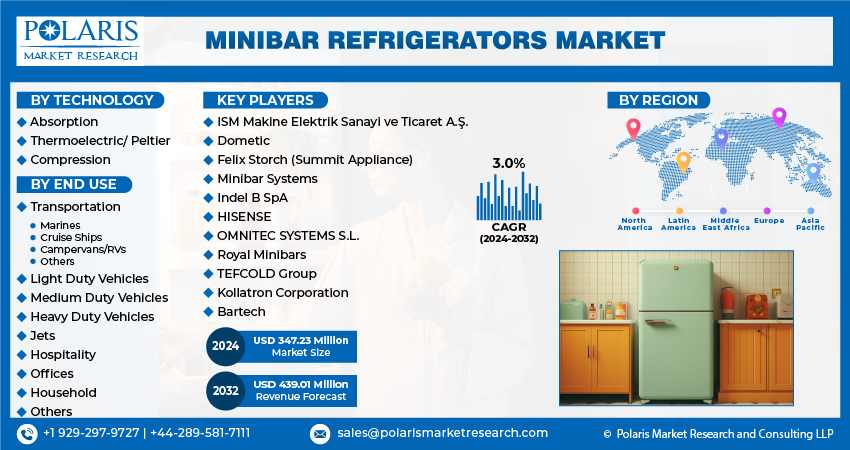
For Specific Research Requirements, Request for a Customized Research Report
Industry Dynamics
Growth Drivers
Technological Advancements
Technological progress has elevated minibar refrigerators from basic cooling units to sophisticated appliances incorporating state-of-the-art features. Modern minibar refrigerators, for example, are equipped with smart capabilities that enable remote control, monitoring, and restocking. This technology empowers hotels to streamline their operations and offer an improved experience to their guests. Additionally, these appliances can generate consumption data, enabling businesses to optimize restocking processes and minimize wastage.
minibar refrigerators market players have introduced energy-efficient minibar refrigerators to cater to evolving consumer needs. For instance, Dometic Group’s HiPro series offers premium minibars that are not only energy-saving but also do not contain chromate, a corrosion inhibitor commonly used in absorption minibars and recently flagged by the EU. Dometic's HiPro minibar refrigerators are designed for rapid cooling without over-chilling. They feature transparent door racks suitable for 1.5 L bottles, along with adjustable and removable shelves to accommodate various products.
Report Segmentation
The market is primarily segmented based on technology, end use, and region.
| By Technology | By End Use | By Region |
|
|
|
Source: Polaris Market Research Analysis
Source: Polaris Market Research Analysis
To Understand the Scope of this Report: Request Customization
By Technology Analysis
Absorption technology segment accounted for the noteworthy market share in 2024
Absorption based segment accounted for largest market. Segment growth is primarily due to importance of energy efficiency, quiet operation, and technological innovation in the market. Absorption technology, which utilizes a heat-driven process for refrigeration instead of the traditional compressor-based system, has gained significant traction due to its unique benefits. A key driving force behind its popularity is the global focus on sustainability and energy conservation. Absorption technology significantly reduces electricity consumption, making it an appealing choice for environmentally conscious consumers and businesses striving to lower their carbon footprint and energy expenses.
Thermo-electric segment will grow rapidly. A key driving force is the growing need for cooling solutions that are both energy-efficient and environmentally friendly. This technology holds a advantage in this context as it operates without refrigerants/compressors, which are linked to increased energy consumption and potential environmental damage.
By End Use Analysis
Hospitality segment held the majority market share in 2024
Hospitality segment held the majority market share. Modern travelers expect more than just accommodation; they seek memorable and distinctive experiences during their journeys. Accommodation providers have recognized this trend and are using minibar refrigerators to elevate guest satisfaction. By offering a thoughtfully curated selection of locally sourced beverages and snacks in minibars, hotels can provide guests with a taste of the destination's culture. This approach enhances authenticity and creates a more memorable and genuine stay for the guests.
As reported by AccomNews, incorporating strategic pairing menus in minibars can boost guest purchases by recommending complementary snacks and beverages. This strategy has been successfully implemented by the Hotel deLuxe in Portland. Additionally, another effective method is to fill minibars with innovative and unique products, differentiating the hotel from competitors and appealing to guests in search of distinctive experiences.
Transportation segment will grow at the rapid pace. The adoption of minibar refrigerators in transportation stems from a combination of factors, aligning with shifting consumer preferences, technological progress, and evolving market trends. This amalgamation has generated distinct opportunities and challenges for manufacturers, suppliers, and stakeholders operating within the transportation and hospitality domains.
The rising desire for convenience and tailored experiences among travelers is driving the demand. With the continuous growth of the global travel and tourism industry, people are expecting smooth and enjoyable journeys. This has elevated the standards for amenities in various modes of transportation like yachts, airplanes, trains, buses, and cruise ships. Integrating minibar refrigerators into these modes enables passengers to enjoy chilled beverages and snacks, significantly improving their travel experience.
Regional Insights
Europe region dominated the global market in 2024
Europe region dominated the global market. European consumers are progressively inclined towards devices that provide convenience, energy efficiency, and connectivity features. This shift in consumer preferences has spurred companies to innovate, leading to the development of new refrigerator models equipped with advanced features. These innovations include touch screens, remote monitoring options, energy-saving capabilities, and seamless integration with other smart home systems.
Asia Pacific will grow at rapid pace. This growth is primarily attributed to the thriving travel and tourism sector and the presence of renowned hotel chains such as Oberoi & Four Seasons. The expansion of the travel and tourism industry often results in a heightened demand for hospitality services, including hotels and accommodations. With more individuals traveling for leisure, business, or other reasons, there is a corresponding increase in the requirement for amenities like minibars in hotel rooms. Minibars offer guests convenient access to a variety of beverages and snacks without the need to leave their rooms.
Source: Polaris Market Research Analysis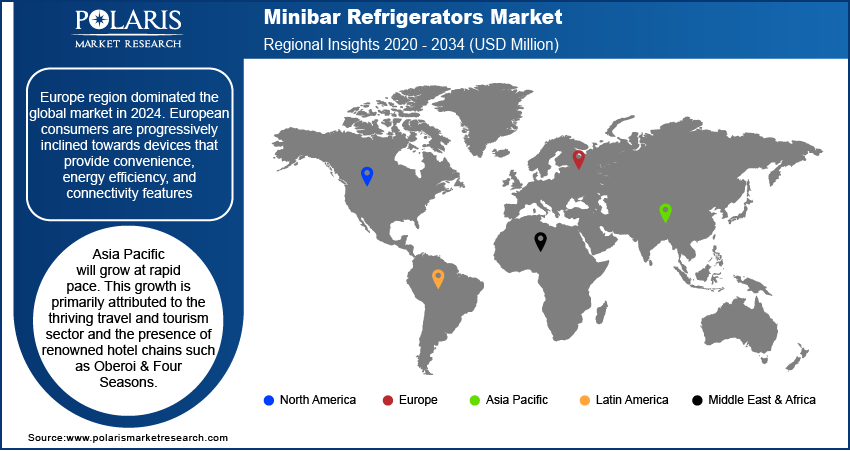
Curious About Regional Market Performance? Request Customization
Key Market Players & Competitive Insights
Major players are concentrating on tactics such as introducing new products, forming partnerships, engaging in mergers & acquisitions, expanding globally, and other strategic initiatives.
Some of the major players operating in the global market include:
- ISM Makine Elektrik Sanayi ve Ticaret A.Ş.
- Dometic
- Felix Storch (Summit Appliance)
- Minibar Systems
- Indel B SpA
- HISENSE
- OMNITEC SYSTEMS S.L.
- Royal Minibars
- TEFCOLD Group
- Kollatron Corporation
- Bartech
Recent Developments
-
In April 2025, Smyths launched the So Chill Mini Fridge Infinity, a compact and stylish fridge ideal for gamers, students, and design-conscious users. It features a mirrored door with 12 LED color options, a 4-litre capacity, and efficient cooling that drops temperatures by 15–20 degrees, blending function with eye-catching style.
-
In October 2024, Bartech unveiled the Flat eFridge, a wall-mounted minibar created to streamline hotel room layouts and improve efficiency. With its clean, modern design, the fridge enhances in-room dining experiences, helping hotels increase guest satisfaction and overall profitability.
-
In May 2023, the five-star Kimpton Blythswood Square hotel in Glasgow launched its "Stay Well" package, swapping out traditional minibars for a Wellness Mini Bar and a unique 'Shroom Service.' Designed for health-focused travelers, the new offering features items like kombucha, CBD drops, and seaweed capsules rich in iodine. This move reflects a broader shift in the hospitality industry toward promoting guest well-being and healthier lifestyle choices during their stay.
Minibar Refrigerators Market Report Scope
| Report Attributes | Details |
| Market size value in 2025 | USD 387.26 Million |
| Revenue forecast in 2034 | USD 512.16 Million |
| CAGR | 3.65% from 2025 – 2034 |
| Base year | 2024 |
| Historical data | 2020 – 2023 |
| Forecast period | 2025 – 2034 |
| Quantitative units | Revenue in USD million and CAGR from 2025 – 2034 |
| Segments covered | By Technology, By End Use, By Region |
| Regional scope | North America, Europe, Asia Pacific, Latin America; Middle East & Africa |
| Customization | Report customization as per your requirements with respect to countries, region and segmentation. |
Source: Polaris Market Research Analysis
Minibar Refrigerators Market FAQ's
The minibar refrigerators market report covering key segments are technology, end use, and region.
Minibar Refrigerators Market Size Worth $439.01 Million By 2032
The global minibar refrigerators market is expected to grow at a CAGR of 3.65% during the forecast period.
Europe is leading the global market
key driving factors in minibar refrigerators market are Technological Advancements
Absorption technology holds the largest market share due to energy efficiency, silent operation, sustainability benefits, and reduced electricity consumption compared to compressor systems.
Thermoelectric minibars offer silent operation, no refrigerants or compressors, lower energy consumption, eco-friendly cooling, and reduced environmental impact compared to traditional models.
Download Sample Report of Minibar Refrigerators Market
Please fill out the form to request a customized copy of the research report.


