Plastic-Free Detergent Market Growth Analysis, 2026-2034
REPORT DETAILS
Market Statistics
Overview
The global plastic-free detergent market is estimated around USD 12.80 Billion in 2025, with consistent growth anticipated during 2026–2034. Expansion is supported by rising consumer awareness of plastic pollution, growing adoption of sustainable household products, and increasing regulatory pressure to reduce plastic packaging waste. The market is projected to grow at a CAGR of 7.9% during the forecast period.
Key Takeaways:
- By Region, Asia Pacific accounted for the largest market share of around 45% in 2025, driven by rapid urbanization and rising middle-class consumption supporting demand for sustainable household cleaning products.
- By Product Form, Detergent Sheets segment accounted for the largest market share of around 48% in 2025, driven by convenience, lightweight properties, and increasing demand for zero-waste cleaning solutions.
- By Ingredient Type, Plant-Based Surfactants segment accounted for the largest market share of around 52% in 2025, driven by rising demand for eco-friendly and biodegradable detergent ingredients.
- By End Use, Residential Consumers segment accounted for the largest market share of around 64% in 2025, driven by increasing awareness of environmental sustainability and household adoption of plastic-free detergents.
- By Distribution Channel, Supermarkets and Retail Chains segment accounted for the largest market share of around 55% in 2025, supported by increased availability of eco-friendly products across retail networks.
Market Statistics
- 2025 Market Size: USD 12.80 Billion
- 2034 Projected Market Size: USD 25.34 Billion
- CAGR (2026-2034): 7.9%
- Asia Pacific: Largest market in 2025
Industry Dynamics
- Increasing environmental awareness regarding plastic usage is driving demand for plastic-free and eco-friendly sustainable detergent packaging solutions.
- Rising adoption of a zero-waste concept with the development of a zero-waste retail infrastructure is supporting the adoption of refill and concentrated detergent products.
- Higher production costs for sustainable packaging materials remain a challenge compared with conventional plastic-packaged detergents.
- Innovation in refillable packaging systems and compostable materials is creating long-term growth opportunities.
What is included in the Plastic-Free Detergent market?
The market comprises cleaning agents contained in packages without plastic containers. These detergents are contained in paper-based packages or other formats to reduce packaging waste. The plastic-free detergent market, especially the plastic-free cleaning products segment, is growing due to the increasing retail space allocated to zero-waste detergent products. Additionally, the plastic-free laundry detergent market is expanding due to the increasing number of detergent packaging innovations. Environmental concerns are driving the plastic-free detergent market, along with the overall eco-friendly detergent market.
Detergent sheets are concentrated cleaning agents that dissolves in water. The plastic-free detergent market therefore focuses primarily on packaging elimination rather than formulation chemistry.
The market includes laundry detergents and household cleaning detergents sold for consumer and small commercial use. Products distributed through refill stations, zero-waste retail stores, and sustainable e-commerce channels are included. Conventional detergents in plastic containers are excluded from the market.
Source: Polaris Market Research Analysis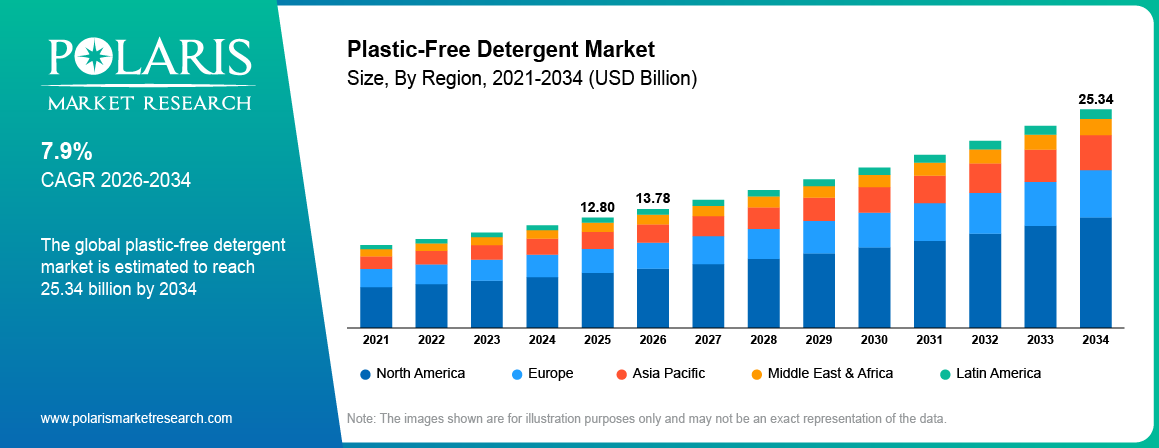
To Understand More About this Research:Download Sample Report
Drivers & Opportunities
Rising consumer awareness of plastic pollution and regulatory pressure: The increasing awareness of plastic pollution among consumers along with rising regulations on plastic pollution, are major factors contributing to the growth of the market. Government driven environmental programs, are encouraging the implementation of plastic packaging reduction policies, which are boosting the adoption of sustainable packaging detergents. In January 2026, the European Commission announced the European Union-funded projects, namely CIRC-PACK and FRESH, which focuses on the promotion of circular packaging solutions and bio-based solutions to minimize plastic waste, thereby increasing the demand for eco-friendly cleaning products.
Expansion of zero-waste product ecosystems: The growing zero-waste lifestyle product market is witnessing a surge in product development, thereby creating a need for adoption of sustainable household products. The eco-friendly consumer movement is compelling brands to go for zero-plastic packaging or offer eco-friendly alternatives. In October 2025, SmartSolve introduced PureNil 0, a 100% bio-based, zero-plastic packaging substrate that is a replacement for traditional flexible plastic films. This helps brands comply with zero-waste retail movement demands while catering to the need for green cleaning products under the sustainable consumer product market.
Restraints & Challenges
Price premium compared with conventional detergents: Plastic-free detergents may face a price premium compared to conventional products due to the relatively high costs of sustainable materials, biodegradable surfactants' market inputs, and the use of special packaging formats. The price premium may be a restraint for the product due to the price sensitivity of the mass market.
Opportunity
Expansion of refillable detergent systems: Growing innovations in refillable packaging system is creating opportunities for the market growth. The refill system helps to reduce packaging waste while minimizing the cost for consumers in the long run. Increasing presence of refill models in supermarkets and zero-waste retail stores strengthens plastic-free detergent demand within the evolving green consumer products market.
Source: Polaris Market Research Analysis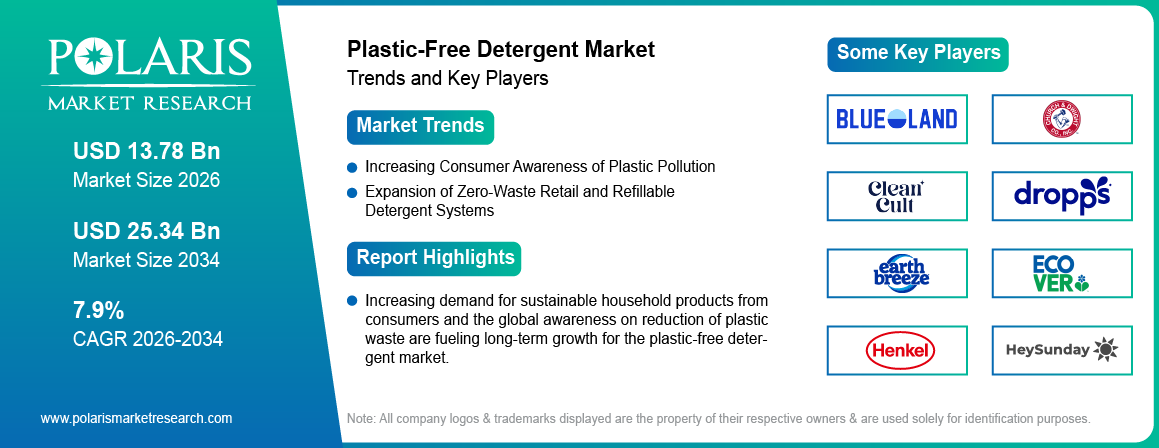
Get Full Segment-Level Forecasts & Insights: Download Sample Report
Segmental Insights
This report offers detailed coverage of the plastic-free detergent market by product form, ingredient type, end use, distribution channel to help readers identify the fastest expanding and most attractive demand segments.
By Product Form
-
Detergent Sheets
Detergent sheets held the highest market share for plastic-free detergent sheets due to their convenience, light weight, and zero waste. Environmentally friendly detergent sheets are highly soluble in water, thereby eliminating the use of plastic bottles. The detergent sheets market is growing at a rapid pace for eco-friendly detergent sheets, which are highly sought after by consumers for convenience.
-
Detergent Tablets and Pods
Detergent tablets are growing at a fast pace among other forms of plastic-free detergents. The eco-friendly detergent pods/sustainable detergent capsules ensure precise dosing and minimal packaging waste. Increasing product availability in subscription-based cleaning products is boosting its demand.
By Ingredient Type
-
Plant-Based Surfactants
Plant-based surfactants market demand holds the highest market share due to the increasing demand for plant-based detergents and eco-friendly detergent ingredients. Plant-based surfactants are in demand for their eco-friendly features, as they are highly soluble in water, thereby reducing waste.
-
Enzyme-Based Detergents
Enzyme-based detergents market is growing rapidly with the advancement of green chemistry-based detergents and enzyme-based detergent formulations. Green cleaning enzymes are efficient for the degradation of protein, fat, and starch-based stains at lower temperatures. The growth of the enzyme-based detergents market is increasing due to the energy-saving washing requirements.
By End Use
-
Residential Consumers
Residential consumers dominated the market share in 2025. Increasing awareness about environmental sustainability is prompting residential consumers to use green cleaning agents for their homes. The market for residential cleaning agents is growing steadily as people increasingly opt for plastic-free cleaning agents for household usage.
-
Commercial and Institutional Users
Commercial cleaning detergent market is witnessing a surge in demand for sustainable cleaning agents. Institutional laundry detergents are increasingly used by hotels and hospitals requiring green cleaning agents.
By Distribution Channel
-
Supermarkets and Retail Chains
Supermarkets and retail chains held largest segment in the distribution channel for sustainable retail chains. Major retail networks increasingly allocate shelf space to eco-friendly cleaning products as demand rises for plastic-free detergent formats.
-
Online Retail
Eco-friendly detergent ecommerce represents the fastest-growing distribution channel. Online detergent sales allow direct-to-consumer detergent brands to reach environmentally conscious buyers. Sustainable cleaning product ecommerce platforms also support subscription models and bulk purchasing.
Source: Polaris Market Research Analysis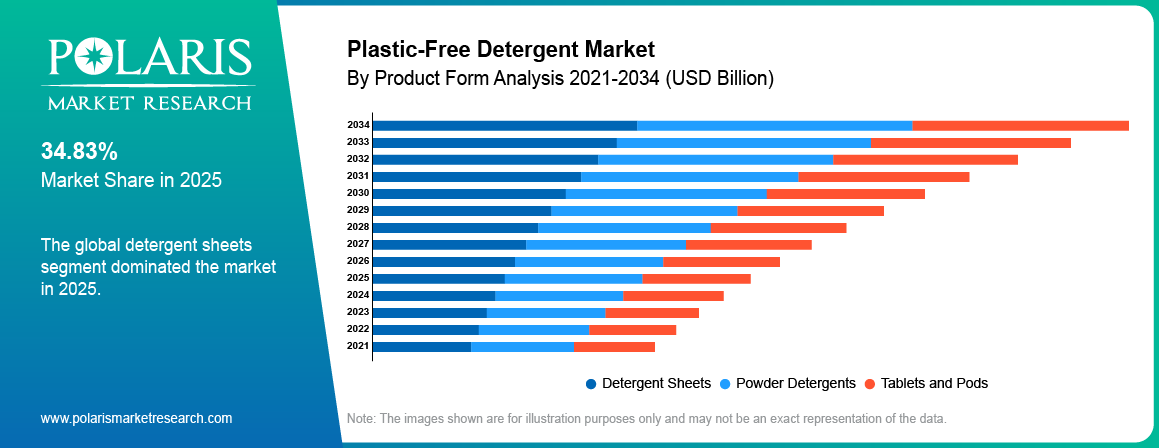
Need Granular Data Across All Market Segments? Request Customization
Regional Analysis
Asia Pacific Plastic-Free Detergent Market Assessment
Asia Pacific dominated the market in 2025 due to rapid urbanization and rising middle-class consumption. According to the United Nations Development Programme, urban populations in Asia-Pacific are projected to grow from 2.48 billion in 2023 to 3.38 billion by 2050. This expansion increased demand for sustainable household cleaning products, strengthening adoption of eco-friendly detergent Asia Pacific and supporting the sustainable cleaning market APAC within the global sustainable cleaning products market.
North America Plastic-Free Detergent Market Insight
North America market is projected to grow at a rapid pace propelled by environmental awareness and concerns over plastic pollution. A 2025 survey by Alaska Research Survey and Alaska Community Action on Toxics showed that 75% of respondents viewed microplastics as a moderate or major threat to drinking water and food systems. This concern supported demand for eco-friendly detergents US and accelerated adoption of sustainable cleaning products North America within the global sustainable cleaning products market.
Europe Plastic-Free Detergent Market Overview
Europe was the second largest market in sustainable detergent driven by strict environmental regulations related to packaging waste and chemical safety. EU policies encouraging reduced plastic use and biodegradable formulations increased adoption of eco cleaning products Europe. Rising consumer preference for environmentally responsible products further supported growth in the green detergents EU market.
Latin America and Middle East & Africa Plastic-Free Detergent Market Assessment
Latin America eco detergent market and Middle East sustainable detergents segment registered gradual growth driven by increasing environmental awareness and development of retail infrastructure. This is boosting the demand for emerging markets plastic-free detergents, thus increasing development in the overall sustainable cleaning products market.
Source: Polaris Market Research Analysis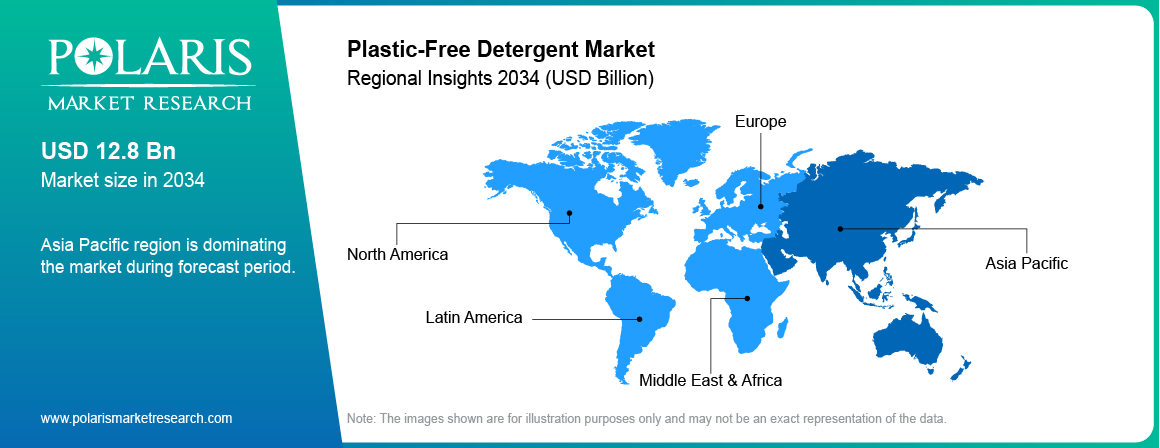
Curious About Regional Market Performance? Request Customization
Key Players & Competitive Analysis Report
The competitive analysis of the market is based on innovations in sustainable products, refillable packaging, and plant-based formulas. Plastic-free detergents are differentiated based on concentrated detergent tablets, sheets, or powder that contain single-use free plastic packaging. Sustainable detergents are differentiated based on plant-based formulas, minimal waste logistics, and direct-to-consumer delivery.
Key companies operating in the market include Blueland Labs, Inc., Church & Dwight Co., Inc., Clean Cult, LLC, Dropps, Inc., Earth Breeze, Inc., Ecover Belgium NV, Good Laundry Company, Henkel AG & Co. KGaA, HeySunday, Kind Laundry, Method Products PBC, Procter & Gamble Company, Seventh Generation, LLC, Tru Earth Inc., and Unilever PLC.
Key Players
- Blueland Labs, Inc.
- Church & Dwight Co., Inc.
- Clean Cult, LLC
- Dropps, Inc.
- Earth Breeze, Inc.
- Ecover Belgium NV
- Good Laundry Company
- Henkel AG & Co. KGaA
- HeySunday
- Kind Laundry
- Method Products PBC
- Procter & Gamble Company
- Seventh Generation, LLC
- Tru Earth Inc.
- Unilever PLC
Premium Insights and Future Outlook
The market is advancing as companies invest in plastic-free cleaning innovation and develop eco packaging detergents using recyclable paper packs, concentrated tablets, and detergent sheets. Growth in future sustainable detergents is supported by rising consumer demand for low-waste household products and environmentally responsible cleaning solutions.
Another emerging trend is the rise of refill economies. Brands are expanding refill detergent systems and subscription-based supply models that reduce single-use packaging. These methods are in favor of circular economy-based detergents, helping companies reduce material wastes while promoting sustainable packaging options for increased customer engagement.
Industry Developments
- February 2026: Procter & Gamble expanded the launch of Tide evo, a waterless detergent formulated as dissolvable fiber tiles and packaged in recyclable cardboard boxes instead of plastic bottles.
- July 2025: TerraSafe introduced plastic-free laundry detergent sheets following its merger with dissolvable film startup DisSolves. The product used water-soluble materials and circular packaging solutions to eliminate plastic containers, strengthening innovation and commercialization of plastic-free detergent solutions in the household cleaning industry.
Market Segmentation
By Product Form Outlook (Revenue, USD Billion, 2021-2034)
- Detergent Sheets
- Powder Detergents
- Tablets and Pods
By Ingredient Type Outlook (Revenue, USD Billion, 2021-2034)
- Plant-Based Surfactants
- Enzyme-Based Detergents
- Natural Cleaning Ingredients
By End Use Outlook (Revenue, USD Billion, 2021-2034)
- Residential Consumers
- Commercial and Institutional Users
By Distribution Channel Outlook (Revenue, USD Billion, 2021-2034)
- Online Retail
- Supermarkets and Retail Chains
- Specialty Eco-Stores
By Regional Outlook (Revenue, USD Billion, 2021-2034)
- North America
- US
- Canada
- Europe
- Germany
- France
- UK
- Italy
- Spain
- Netherlands
- Russia
- Rest of Europe
- Asia Pacific
- China
- Japan
- India
- Malaysia
- South Korea
- Indonesia
- Australia
- Vietnam
- Rest of Asia Pacific
- Middle East & Africa
- Saudi Arabia
- UAE
- Israel
- South Africa
- Rest of Middle East & Africa
- Latin America
- Mexico
- Brazil
- Argentina
- Rest of Latin America
Report Scope
| Report Attributes | Details |
| Market Size in 2025 | USD 12.80 Billion |
| Market Size in 2026 | USD 13.78 Billion |
| Revenue Forecast by 2034 | USD 25.34 Billion |
| CAGR | 7.9% from 2026 to 2034 |
| Base Year | 2025 |
| Historical Data | 2021–2024 |
| Forecast Period | 2026–2034 |
| Quantitative Units | Revenue in USD Billion and CAGR from 2026 to 2034 |
| Report Coverage | Revenue Forecast, Competitive Landscape, Growth Factors, and Industry Trends |
| Segments Covered |
|
| Regional Scope |
|
| Competitive Landscape |
|
| Report Format |
|
| Customization | Report customization as per your requirements with respect to countries, regions, and segmentation. |
Source: Polaris Market Research Analysis
Plastic-Free Detergent Market FAQ's
Common formats include detergent sheets, powder detergents packaged in paper cartons, dissolvable tablets, and refillable detergent concentrates.
Key companies include Blueland Labs, Inc., Church & Dwight Co., Inc., Clean Cult, LLC, Dropps, Inc., Earth Breeze, Inc., Ecover Belgium NV, Good Laundry Company, Henkel AG & Co. KGaA, Kind Laundry, Method Products PBC, Procter & Gamble Company, Seventh Generation, LLC, Tru Earth Inc., and Unilever PLC.
Growth is driven by rising environmental awareness, increasing plastic packaging regulations, expansion of refillable detergent systems, and growing adoption of sustainable cleaning products.
Asia Pacific dominated the market in 2025 due to rapid urbanization, expanding middle-class populations, increasing environmental awareness across China, India, Japan, and Southeast Asia.
Residential household cleaning represents the largest application segment, followed by commercial and institutional cleaning applications.
The global market size was valued at USD 12.80 Billion in 2025 and is projected to grow to USD 25.34 Billion by 2034.
Download Sample Report of Plastic-Free Detergent Market
Please fill out the form to request a customized copy of the research report.


