
Silent Generator Market Demand, Industry Trends, Growth Analysis - 2025-2034
REPORT DETAILS
Market Statistics
Market Overview
The global silent generator market size was valued at USD 3.49 billion in 2024 and is anticipated to register a CAGR of 7.0% from 2025 to 2034. Increasing need for reliable backup power due to frequent outages propels the demand for silent generator. This is especially true in residential, commercial, and industrial areas. Stricter government regulations on noise pollution and emissions are also boosting the demand for quieter and cleaner generators.
Key Insights
- By sound level, the silent segment held the dominant share in 2024 as it offers a great balance between noise reduction and cost.
- Based on phase, the single-phase segment led the revenue share in 2024, due to its common use in residential and small commercial settings.
- In terms of type, the portable segment held the largest share as it has convenience and versatility for a wide range of uses.
- By fuel type, the diesel segment dominated the share as diesel generators are well-known for their reliability and durability.
- In terms of end use, the residential segment is the largest shareholder. Its dominance is driven by the growing need for reliable backup power in homes.
- By region, North America is the leading region and is driven by the frequent power outages caused by severe weather and aging infrastructure.
Industry Dynamics
- The increasing frequency of power outages due to aging infrastructure and natural disasters is a key growth factor. This forces residential, commercial, and industrial sectors to seek reliable, uninterrupted power solutions, boosting the demand for dependable backup systems.
- Strict government regulations on noise pollution in urban areas are also driving growth. These rules impose limits on decibel levels for equipment, especially in hospitals, schools, and residential zones, making quieter generators a necessity to ensure compliance.
- The rising demand for continuous power in industries such as IT and telecommunications is a major driver. Data centers and other critical operations require a stable power supply to prevent data loss and service interruptions, which, in turn, increases the need for backup power.
Market Statistics
- 2024 Market Size: USD 3.49 billion
- 2034 Projected Market Size: USD 6.85 billion
- CAGR (2025–2034): 7.0%
- North America: Largest market in 2024
A silent generator is an electrical device that provides backup power with minimal noise. These generators are designed with advanced soundproofing and mufflers to reduce the engine noise. These benefits make them suitable for residential areas, hospitals, and other noise-sensitive environments where traditional and thermoelectric generators would be too disruptive.
Source: Polaris Market Research Analysis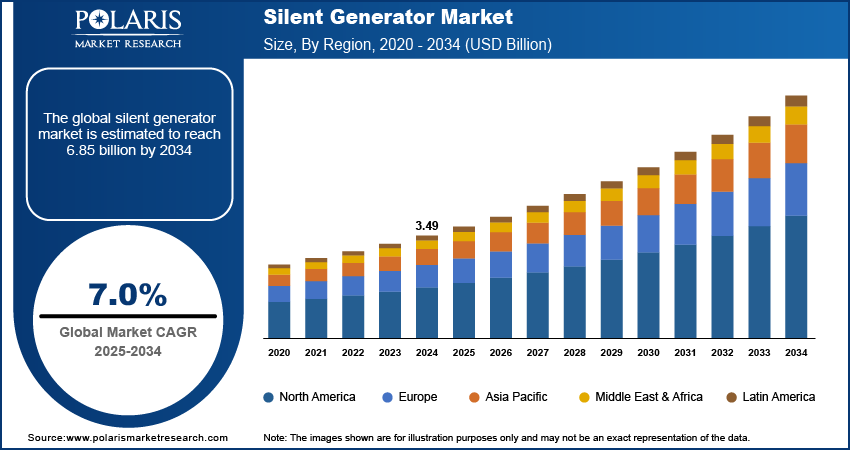
Want a Deeper Look at Key Market Players? Download Sample Report
The increasing use of silent generators in the rental sector and the growing trend of off-grid and remote applications drive industry expansion. Rental companies are adding silent generators to their fleets to meet the demand from event organizers, construction sites, and film crews, who need temporary power without the noise. The versatility and quiet operation of these units make them a preferred choice for temporary needs.
Another important driver is the rising demand for continuous power in off-grid settings and for mobile applications, such as in recreational vehicles and boats. People who live or travel in remote areas need a reliable and quiet power source for their daily electrical needs. For example, in the U.S., the number of people living in recreational vehicles has grown. These people depend on self-sufficient power solutions, and silent generators provide a convenient way to power appliances and electronics without causing noise problems for themselves or others around them.
Drivers and Trends
Growing Frequency of Power Outages: The increasing incidence of power outages across the globe is driving the need for dependable backup power. These outages are common during severe weather, such as during storms and heatwaves, as well as due to an aging electrical infrastructure. Businesses and households seek to minimize the financial and inconvenience impacts of disruptions. This results in an increased adoption of backup power systems, especially those that are ‘silent’ enough to operate in populated zones.
According to a report from the U.S. Census Bureau titled "How Do Power Outages Affect Households?" published in October 2024, approximately 1 in 4 households in the U.S. reported being without power at least once in the 12 months leading up to the survey. About 70% of these households said at least one of their outages lasted six hours or more. The high number of households affected and the length of the outages show the need for dependable power sources. This ongoing problem of unreliable power supply is directly contributing to the increasing demand for silent generators.
Strict Noise Pollution Regulations: Governments are imposing stringent restrictions to combat excessive noise, a major cause of many health issues, especially in metropolitan areas and around sensitive areas such as centers, schools, and residential areas. Resulting policies mandate specific maximum noise emissions and many devices, including generators, are included. Thus, businesses and individuals need to invest in low-cost alternatives to avoid potential fines and stay within the law. This has increased demand for generators that have been engineered with advanced soundproofing to lower noise emissions.
Source: Polaris Market Research Analysis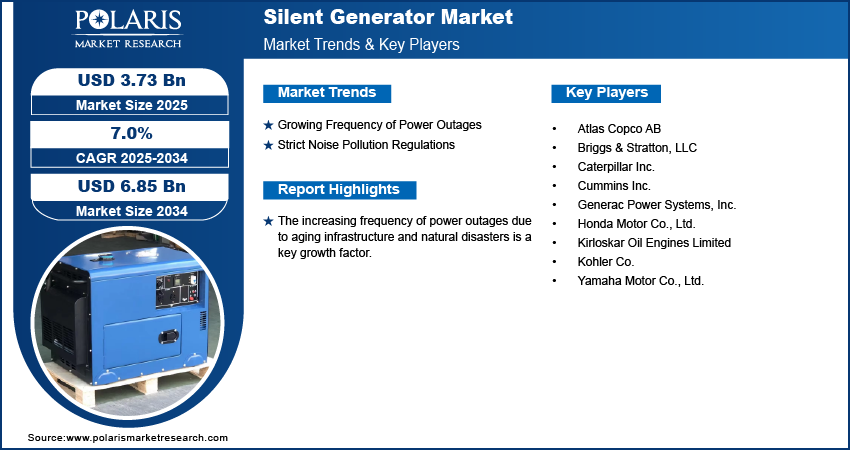
Get Full Segment-Level Forecasts & Insights: Download Sample Report
Segmental Insights
Sound Level Analysis
Based on sound level, the segmentation includes super silent and silent. The silent segment held a larger share in 2024. This is primarily because typical generators, which operate at 60 to 70 decibels, prioritize performance, cost, and noise. They has utility in many areas, including business, construction, and some partially residential zones, such as sensitive areas, where noise is not strictly controlled. The flexibility of these generators to different power requirements and ease of access in many of them are responsible for the dominance.
The super silent range segment is anticipated to register a higher growth during the forecast period. The growth of urban centers and rising population is creating a requirement for many residential and mixed-use buildings. The rise in awareness of health and noise pollution levels is also driving demand for generators, especially silent generators. Super-silent generators that operate at less than 60 decibels are now required in many more places than before. This includes areas such as hospitals, data centers, schools, and similar places where a silent environment is essential.
Phase Analysis
Based on phase, the segmentation includes single-phase and three-phase. The single-phase segment held a larger share in 2024. Single-phase generators are typically used to power homes and small businesses, which is why they are so popular. They are typically used across homes, portable devices, and small businesses, which explains their popularity. They are inexpensive, easy to maintain, and can power lights and small electronics. They are compact, portable, and can power small events, homes, and recreation. This explains their large consumer base and contributes to their dominance.
The single-phase segment is also anticipated to register a higher growth during the forecast period. More smart devices and power outages create a higher demand for backup power at homes. With more people working from home, the high demand for uninterrupted power supplies is driving the need for single-phase units. There are more portable, silent generators available for home use, making them more popular for outdoor use and camping.
Type Analysis
Based on type, the segmentation includes portable and stationary. The portable segment held a larger share in 2024. Portable generators offer a seamless combination of portability and a variety of applications. These small and lightweight generators appeal to many residential consumers and small businesses. They also provide a compact and easily accessible solution during times of blackouts and in remote locations without grid access.
The stationary segment is anticipated to register a higher growth during the forecast period. As the requirement for uninterrupted and large-scale backup power rises, the popularity of this segment will also increase. Stationary generators are often fixed in one position and provide backup power to serve critical infrastructures and large-scale operations. Industries such as data centers, healthcare, and manufacturing are expanding. Thus, the demand for dependable and high-capacity backup power is also rising.
Fuel Type Analysis
Based on fuel type, the segmentation includes diesel, natural gas, and others. The diesel segment held the largest share in 2024. This is a result of the consistent and dependable power provided by diesel engines, which is the most traditionally used type of engine. Diesel generators are also known for their durability and high efficiency. Indefinite power loads can also be sustained at high levels for extended periods. This is no different in highly critical applications. Data centers, hospitals, and manufacturing facilities rely on uninterrupted, highly reliable power.
The natural gas segment is anticipated to register the highest growth during the forecast period. This is due to the global transition to cleaner fuels, tighter emission control regulations, and natural gas generators’ limited emission of nitrogen oxides and particulate matter compared to diesel generators. In addition, natural gas is abundant and more environmentally friendly. Also, its cost is more stable than that of diesel, which is volatile.
Source: Polaris Market Research Analysis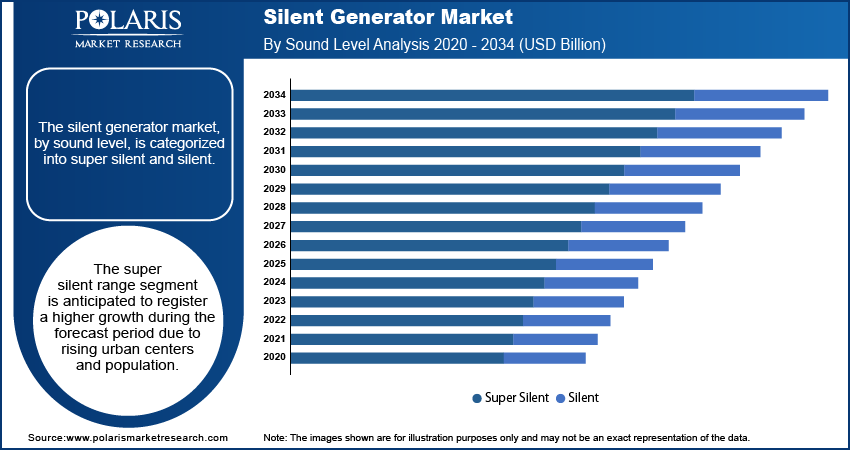
Need Granular Data Across All Market Segments? Request Customization
Regional Analysis
The North America silent generator market accounted for the largest share in 2024. The rising demand for generators with reliable backup power boosts the regional market growth. Residential, along with commercial sectors, experience power outages due to infrastructure aging and policy conflicts with supply. Smart home installations and WFH policies have driven demand for household use. Businesses prioritize avoiding negative profit margins to fulfill operational prerequisites.
U.S. Silent Generator Market Insights
In North America, the U.S. held a prominent share in 2024. This dominance is attributed to the rising natural disasters such as hurricanes, fires, and so on, which lead to long-term cuts in electricity supply. This is coupled with the growing population and urban sprawl, which increases the need for electricity.
Europe Silent Generator Market Insights
Europe is also the main region with growing demand for silent generators among household, commercial, and industrial users. This is attributed to the growing noise health awareness and other socio-legal developments in the control of noise in urban and suburban areas. There is also the emerging global ethos, which seeks cleaner and more sustainable and renewable energy. Therefore, there is an increasing focus on gas and other alternative-fueled generators.
The Germany silent generator market dominated in Europe in 2024. This is because of the industrial base and the increasing need for energy resilience, which makes the county one of the leading users of these generators. The German businesses and the healthcare facilities, for example, need an uninterrupted power supply to keep running. This relates to a point the country is known for: the strong environmental concerns that accompany the use of generators. This explains why quiet, clean models are popular in Germany.
Asia Pacific Silent Generator Market Overview
Asia Pacific is the fastest-growing region for silent generators. Industrialization and urbanization continue to experience a stark increase in the coming years, along with the region’s new infrastructure projects. Many countries within the region face dire needs for reliable backup power for the residential and commercial sectors and deal with unreliable power grids and severe blackouts. In a country such as India, the rise of data centers along with a growing telecommunications industry creates a stable and constant power demand. This, in turn, increases the demand for silent generators.
China Silent Generator Market Overview
In Asia Pacific, China dominated the revenue share in 2024. Demand for portable generators arises due to China’s rapid economic growth and progress with infrastructure projects. More commercial spaces, along with expanded manufacturing facilities in the area, propel the demand for portable generators. Along with this growth comes a desire for the cleaner, quieter generators. New environmental policies within China control the amount of noise and air pollution caused by portable generators.
Source: Polaris Market Research Analysis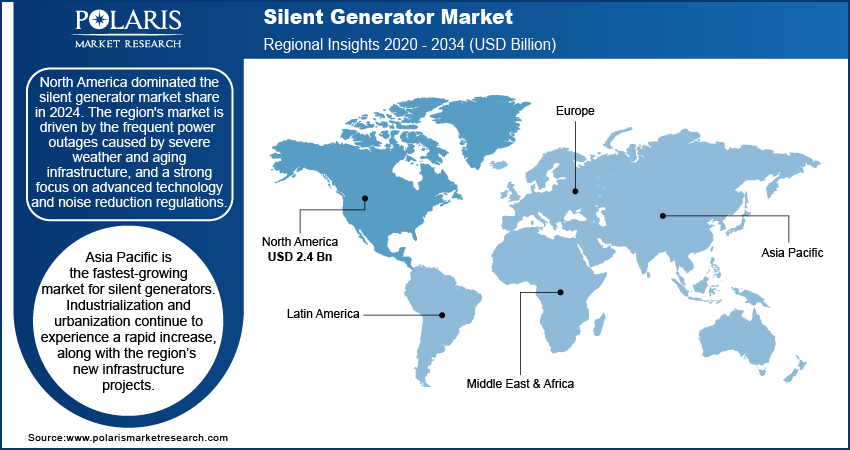
Curious About Regional Market Performance? Request Customization
Key Players and Competitive Insights
In the silent generator market, competition persists among dominant multinational corporations and small local enterprises alike. Businesses are settling for innovation, collaboration, and greater penetration as their means of competition. Major participants are optimizing their products and services in terms of efficiency, sustainability, and the newest technology, such as synthetic natural gas-powered units with remote monitors. The focus of the units should be on developed economies as they improve their after-sales services and customer support, boosting customer retention.
A few prominent companies in the industry include Caterpillar Inc.; Atlas Copco AB; Cummins Inc.; Generac Power Systems, Inc.; Briggs & Stratton, LLC; Honda Motor Co., Ltd.’ Yamaha Motor Co., Ltd.; Kohler Co.; and Kirloskar Oil Engines Limited.
Key Players
- Atlas Copco AB
- Briggs & Stratton, LLC
- Caterpillar Inc.
- Cummins Inc.
- Generac Power Systems, Inc.
- Honda Motor Co., Ltd.
- Kirloskar Oil Engines Limited
- Kohler Co.
- Yamaha Motor Co., Ltd.
Industry Developments
- April 2025: Kirloskar launched Optiprime Dual Core 1000 kVA, the world's smallest generator, targeting industrial and commercial power markets.
- April 2025: Kirloskar introduced Sentinel Series generators for homes and small businesses, focusing on energy efficiency and eco-friendly power solutions.
- August 2024: Rolls-Royce sold lower power range engines, including mtu Classic and series 1000–1500, to Deutz AG for strategic focus shift.
- July 2024: Generac received US DOE funding of $200 million to deploy solar and battery systems for low-income households.
- July 2023: Kirloskar Oil Engines unveiled a Retrofit Emission Control Device (RECD) for its diesel generators from 125 kVA to 1000 kVA. This innovation addresses rising air pollution concerns by lowering harmful emissions and protecting both the environment and public health.
Silent Generator Market Segmentation
By Sound Level Outlook (Revenue – USD Billion, 2020–2034)
- Super Silent
- Silent
By Phase Outlook (Revenue – USD Billion, 2020–2034)
- Single-Phase
- Three-Phase
By Type Outlook (Revenue – USD Billion, 2020–2034)
- Portable
- Stationary
By Fuel Type Outlook (Revenue – USD Billion, 2020–2034)
- Diesel
- Natural Gas
- Others
By End Use Outlook (Revenue – USD Billion, 2020–2034)
- Residential
- Commercial
- Industrial
By Regional Outlook (Revenue – USD Billion, 2020–2034)
- North America
- U.S.
- Canada
- Europe
- Germany
- France
- UK
- Italy
- Spain
- Netherlands
- Russia
- Rest of Europe
- Asia Pacific
- China
- Japan
- India
- Malaysia
- Suth Korea
- Indnesia
- Australia
- Vietnam
- Rest of Asia Pacific
- Middle East & Africa
- Saudi Arabia
- UAE
- Israel
- Suth Africa
- Rest of Middle East & Africa
- Latin America
- Mexico
- Brazil
- Argentina
- Rest of Latin America
Silent Generator Market Report Scope
| Report Attributes | Details |
| Market Size in 2024 | USD 3.49 billion |
| Market Size in 2025 | USD 3.73 billion |
| Revenue Forecast by 2034 | USD 6.85 billion |
| CAGR | 7.0% from 2025 to 2034 |
| Base Year | 2024 |
| Historical Data | 2020–2023 |
| Forecast Period | 2025–2034 |
| Quantitative Units | Revenue in USD billion and CAGR from 2025 to 2034 |
| Report Coverage | Revenue Forecast, Competitive Landscape, Growth Factors, and Industry Insights |
| Segments Covered |
|
| Regional Scope |
|
| Competitive Landscape |
|
| Report Format |
|
| Customization | Report customization as per your requirements with respect to countries, regions, and segmentation. |
Source: Polaris Market Research Analysis
Silent Generator Market FAQ's
The global market size was valued at USD 3.49 billion in 2024 and is projected to grow to USD 6.85 billion by 2034.
The global market is projected to register a CAGR of 7.0% during the forecast period.
North America dominated the market share in 2024.
A few key players in the market include Caterpillar Inc.; Atlas Copco AB; Cummins Inc.; Generac Power Systems, Inc.; Briggs & Stratton, LLC; Honda Motor Co., Ltd.’ Yamaha Motor Co., Ltd.; Kohler Co.; and Kirloskar Oil Engines Limited.
The silent segment accounted for a larger share of the market in 2024.
The single-phase segment is expected to witness a faster growth during the forecast period.
A silent generator is an electrical backup power device engineered with advanced soundproofing and mufflers to minimize engine noise, making it ideal for noise-sensitive environments.
Key trends include rising power outages, strict noise regulations, natural gas generator adoption, data center power demand, and growing residential backup power requirements worldwide.
Download Sample Report of Silent Generator Market
Please fill out the form to request a customized copy of the research report.


