
Third Party Logistics Market Demand, Industry Trends & Forecast, 2026 – 2034
REPORT DETAILS
Market Statistics
Third Party Logistics (3PL) Market Summary
The global third party logistics (3PL) market size was valued at USD 1.27 billion in 2025 and is projected to register a CAGR of 8.1% from 2026 to 2034. The rise in global trading activities as a result of widespread globalization serves as a key factor fueling the industry expansion. Manufacturers and retailers, recognizing the importance of focusing on their core competencies, increasingly rely on external businesses to perform logistics functions. In addition, digitalization and the growing adoption of various disruptive technologies to streamline and automate processes are expected to drive market growth in the coming years.
Key Takeaways
- Asia Pacific held the largest revenue share of 45.12% in 2025. The regional market growth is driven by the rising demand for third party logistics from the manufacturing and retail sectors in emerging nations.
- The industry in North America is being growing at CAGR of 8.8%, propelled by the introduction of new economic policies and rising infrastructure development of rail, road, sea, and air transport.
- The United States held the largest regional share of approximately 81% in 2025, supported by its advanced logistics infrastructure and strong e-commerce growth.
- The domestic transportation segment held substantial market share of around 27% in 2025. The rising carrier rates and growing fuel surcharges are driving the segment growth.
- The manufacturing segment accounted for the largest revenue share of 25.2% in 2025. The manufacturing sector is turning to third party logistics owing to its various benefits in terms of business process development and transport operations
Note: Figures and projections outlined in this report are the result of Polaris Market Research’s proprietary analytical processes, grounded in the latest available datasets and market observations
Market Statistics
- 2025 Market Size: USD 1.27 Billion
- 2034 Projected Market Size: USD 2.56 Billion
- CAGR (2026–2034): 8.1%
- North America: Largest Market Share in 2025
Industry Dynamics
- Rising penetration of e-commerce across the world propels the industry expansion.
- The availability of industry-specific logistics services is contributing to the 3PL market growth.
- Growing adoption of IT solutions is expected to offer lucrative opportunities in the coming years.
- High operational costs restrain the growth of the third party logistics market.
AI Impact on Third Party Logistics Market
- Artificial technology (AI) systems analyze historical data, trends, and weather or economic data to predict demand fluctuations. Using this analysis, 3PL providers maintain sufficient inventory levels and avoid stockouts.
- Autonomous Mobile Robots (AMRs) perform various tasks, including picking, packing, and transporting goods, in warehouses.
- Smart sensors and Internet of Things (IoT) devices are used to monitor inventory and trigger automatic replenishment orders.
- Adoption of automation tools for repetitive tasks, such as sorting, labeling, and packing, reduces reliance on manual labor.
- AI reduces inefficiencies in procurement, delivery scheduling, and inventory management, contributing to significant cost savings
Source: Polaris Market Research Analysis Market.png)
To Understand More About this Research: Download Sample Report
Third party logistics (3PL) is the outsourcing of some or all of the retail and supply chain operations of a retailer from another company. The 3PL practice allows small businesses, which may not have their supply chain infrastructure, to manage large-scale supply chains effectively. 3PL providers independently manage stock control, warehousing, IT infrastructure, and delivery solutions. This model helps reduce significant operational costs and also improves overall efficiency.
Manufacturers and end-use industries in emerging countries face challenges in addressing logistics needs, which drives the need for 3PL services. The adoption of cloud-based customer relationship management (CRM) to improve shipper-merchant conversations and reduce supply chain complexities by offering enhanced visibility throughout the process is expected to provide significant opportunities for small and medium-sized businesses in the third party logistics (3PL) market.
Types of Third Party Logistics
| 3PL Type | Simplified Definition | Main Benefit | Common Applications |
| Asset-Based | Third-party logistics providers that own transportation assets such as trucks and warehouses. | Increased ability to control operations and schedules. | Movement of cargo, warehousing, dedicated transportation. |
| Non-Asset-Based | Third-party logistics providers that manage logistics services without owning assets. | Increased flexibility and broader services. | Brokership of freight, logistics and supply chain management, international transportation. |
Source: Polaris Market Research Analysis
Market Dynamics
Availability of Industry-Specific Logistics Services
The absence of vital internal control has prompted various mid-sized companies to outsource logistic services to overcome challenges. At the same time, the growing variety in transportation capacity and increasing shipping demand enable service providers to improve their supply chain operations. Thus, more service providers shift to offering industry-specific services, the demand for third party logistics is expected to rise. The availability of industry-specific logistics services is one of the key market demand trends anticipated to drive third party logistics market expansion.
Expansion of E-Commerce Worldwide
The rising number of consumers preferring online shopping has compelled businesses to optimize their supply chains to cater to the growing demand for fast and efficient services. As e-commerce demand continues to grow worldwide, businesses face the challenge of delivering orders rapidly and cost-effectively, which often requires the outsourcing of logistics from specialized third-party logistics service providers. 3PL service providers, with their ability to provide scalable solutions tailored to specific industry needs, can streamline business operations, reduce delivery times, and improve customer satisfaction. Thus, the rising penetration of e-commerce propels the third party logistics market demand.
Geopolitical & Regulatory Impact Matrix for 3PLs
| Dimension | Example regulation / geopolitical factor | Reported impact on 3PL operations | Illustrative 3PL responses |
| Customs & trade rules | 2021 EU Brexit implementation, ICS2 security filings, removal of VAT de‑minimis on low‑value imports into EU (DHL Express Europe customs update). | Higher documentation requirements, risk of clearance delays, fines, and increased admin for cross‑border B2C flows. | DHL scaled up customs expertise, digital pre‑clearance tools, and customer guidance to ensure compliant data submission and smoother EU–UK shipping. |
| Tariffs & trade tensions | Rising tariffs and trade policy shifts, including new US and EU tariffs on Chinese goods and EV‑related products (Maersk Annual Report 2024; DHL global connectedness commentary). | Re‑routing flows, higher landed costs, and need for more complex sourcing and routing strategies across competing trade blocs. | Maersk’s trade and tariff advisory services use digital tools to simulate duty exposure, structure tariff‑engineering and FTA usage, and flag sanctions/forced‑labor risks. |
| Sanctions, security & geopolitical conflict | Russia–Europe decoupling, U.S.–China tensions, wars in Ukraine and Gaza, increasing use of sanctions and export controls (DHL Global Connectedness Report summary; Maersk reporting). | Network disruptions, corridor‑specific risk, and need to monitor sanctioned parties, routes, and commodities more closely. | 3PLs like DHL and Maersk emphasize resilience services, alternative routings, and compliance screening embedded in trade‑management platforms. |
| National supply chain & human‑rights laws | German Supply Chain Act and similar due‑diligence rules applying to global subsidiaries and supply chains (DB Schenker sustainability data). | Expanded obligations for human‑rights, environmental, and supplier‑due‑diligence monitoring along logistics chains. | DB Schenker reports aligning subsidiaries worldwide with the German Supply Chain Act and Norwegian Transparency Act, integrating compliance into supplier management. |
| Sustainability & environmental regulation | Growing requirements for emissions disclosure, green‑logistics practices, and sector‑specific biosecurity rules (e.g., New Zealand’s MPI regulations referenced by DHL). | Pressure to reduce carbon footprint, demonstrate sustainable logistics practices, and comply with local environmental/biosecurity regulations. | DHL highlights centralized compliance systems, green logistics offerings, and documentation support to help shippers meet new sustainability and biosecurity requirements. |
| E‑commerce tax & de‑minimis policy shifts | Removal or tightening of de‑minimis import thresholds and related customs changes for low‑value parcels (DHL guidance on EU VAT and later U.S. de‑minimis changes). | Increases customs declarations for small parcels, raising processing complexity and costs in B2C cross‑border logistics. | DHL advises businesses on correct classification and full‑data filings, and promotes solutions like Duty Taxes Paid (DTP) to keep last‑mile experiences predictable despite regulatory changes. |
Source: Polaris Market Research Analysis
Key Operations in Third-Party Logistics Market
3PL Services: Third-party logistics services are responsible for handling transportation and storage for organizations. The services help increase efficiency and minimize costs.
Warehousing Logistics: The warehousing services entail processes such as storing goods, inventory management, product selection, packing, and shipping.
Freight Transport: In freight transport, goods are transported using roads, airplanes, rails, or ships. Other responsibilities of freight logistics include routing and delivering the shipment on time.
Outsourcing Logistics: In outsourcing logistics, one party outsources logistics operations to the other in order to enhance efficiency without having to make large-scale infrastructure investments.
Logistics Automation: Automation technology increases efficiency and reduces costs
Source: Polaris Market Research Analysis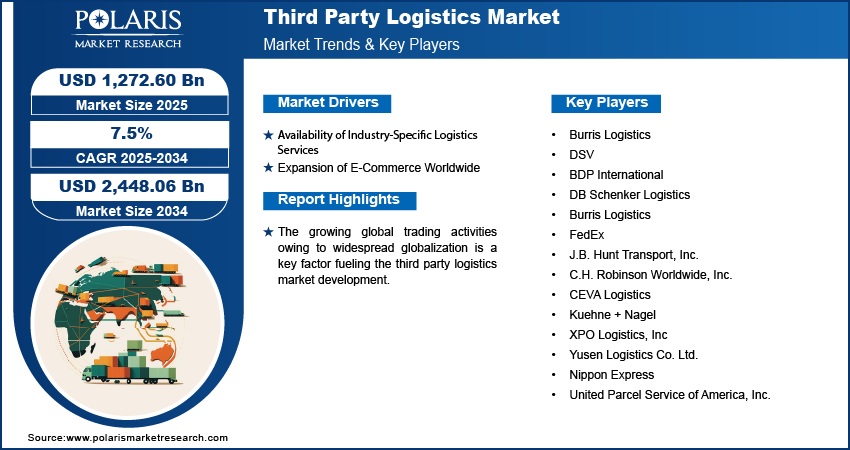
Get Full Segment-Level Forecasts & Insights: Download Sample Report
Segment Insights
Market Outlook by Service Insights
The third party logistics market analysis, based on service, is segmented into dedicated contract carriage, domestic transportation management, international transportation management, distribution and warehousing, and others. The domestic transportation segment held substantial market share of around 27% in 2025. Domestic transportation involves the flow of goods between states of the same country. The rising carrier rates, growing fuel surcharges, and a surge in cross-decking services are a few major factors driving the segment growth. Besides, the rising consumer demand in various sectors, such as healthcare and retail, fuels the need for domestic transportation management services.
Market Outlook by End Use Insights
The 3PL market analysis, based on end use, is segmented into retail, manufacturing, healthcare, and others. TThe manufacturing segment accounted for the largest revenue share of 25.2% in 2025. The manufacturing sector has a complex supply chain process involving the procurement of materials and parts from various regions and resources. The involvement of multiple distributors and suppliers located across different geographies makes managing the logistics operations a complex process. Thereby, the manufacturing sector is turning to third party logistics owing to its various benefits in terms of business process development and transport operations.
Source: Polaris Market Research Analysis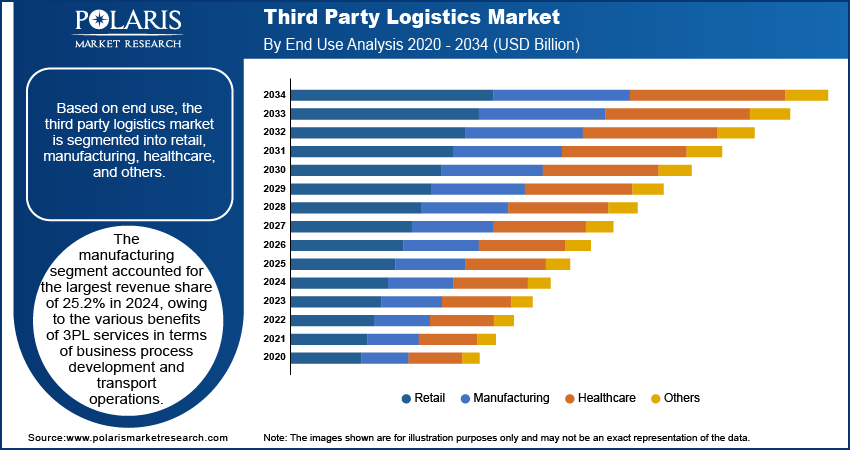
Need Granular Data Across All Market Segments? Request Customization
Regional Analysis
The market report offers third party logistics market insights into North America, Europe, Asia Pacific, Latin America, and the Middle East & Africa. Asia Pacific held the largest revenue share of 45.12% in 2025 and is expected to witness the fastest growth during the forecast period. The regional market growth is primarily fueled by the increased demand for third party logistics from the manufacturing and retail sectors in emerging nations. Besides, the growing trans-regional trade corridors and gateways are anticipated to provide lucrative opportunities for regional 3PL providers and boost the regional market size.
North America is being growing at CAGR of 8.8%, propelled by the introduction of new economic policies; better infrastructure of rail, road, sea, and air transport; and the presence of major logistics companies focused on technological advancements. Further, increased investments from traditional logistics and new e-commerce companies are expected to boost the market in the coming years.
Source: Polaris Market Research Analysis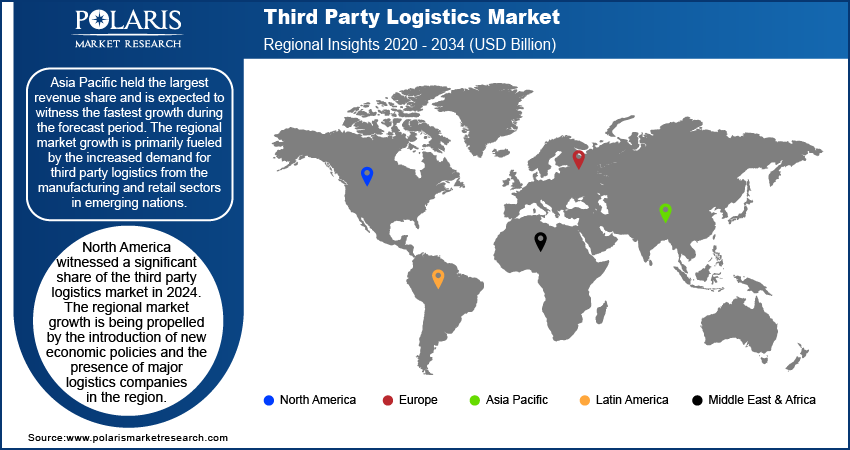
Curious About Regional Market Performance? Request Customization
Key Players and Competitive Insights
The third party logistics market has the presence of established players and new entrants. The leading market participants are making significant investments in R&D initiatives to enhance their product offerings. Also, they are focusing on product innovations, mergers and acquisitions, collaborations, and increased investments to expand their market reach.
One of the major strategies adopted by industry players is offering technologically advanced logistics services such as real-time tracking, fleet management, online documentation, shipment tracking, and real-time status of the fleet and shipment. A few key players in the market are Burris Logistics; DSVl BDP International; DB Schenker Logistics; Burris Logistics; FedEx; J.B. Hunt Transport, Inc.; C.H. Robinson Worldwide, Inc.; CEVA Logistics; Kuehne + Nagel; XPO Logistics, Inc; Yusen Logistics Co. Ltd.; Nippon Express; and United Parcel Service of America, Inc.
List of Key Companies
- Burris Logistics
- DSV
- BDP International
- DB Schenker Logistics
- Burris Logistics
- FedEx
- J.B. Hunt Transport, Inc.
- C.H. Robinson Worldwide, Inc.
- CEVA Logistics
- Kuehne + Nagel
- XPO Logistics, Inc
- Yusen Logistics Co. Ltd.
- Nippon Express
- United Parcel Service of America, Inc.
Third Party Logistics Industry Developments
- March 2026: Thoma Bravo reveal its purchase of WWEX Group, a significant player in the third-party logistics. This acquisition would lead to a merger with Auctane. The final entity aims to combine freight brokerage services with shipping software, creating a comprehensive AI-driven logistics solution. (Source: thomabravo.com)
- January 2026: Gateway Partners-backed by TVS Supply Chain Solutions announced the acquisition of Swamy & Sons 3PL for approximately USD 10.5 million. The deal gives it a stronger support in FMCG logistics, improves its warehousing and distribution potential, and expands its reach in Andhra Pradesh and Telangana in India, supporting growth in high-demand consumption sectors. (Source: vccircle.com)
- April 2025: DSV finalized its EUR 14.3 billion (USD 16.28 billion) acquisition of DB Schenker, creating one of the world’s largest integrated logistics groups with combined revenues of EUR 41.6 billion USD 47.38 billion. (Source: dsv.com)
- January 2025: DHL Supply Chain completed the acquisition of Inmar Supply Chain Solutions, strengthening its U.S. operations by adding 14 reverse-logistics facilities and approximately 800 employees to its network (Source: dhl.com)
- February 2024: Reflaunt, a resale-as-a-service firm, partnered with Germany-based DHL. The company under this partnership aims to offer fulfillment, shipping, and platforming solutions to clients who are looking to enter the branded resale space. (Source: dhl.com)
Third Party Logistics Market Segmentation
By Service Outlook
- Dedicated Contract Carriage
- Domestic Transportation Management
- International Transportation Management
- Distribution and Warehousing
- Others
By Mode of Transport Outlook
- Roadways
- Railways
- Waterways
- Airways
By End Use Outlook
- Retail
- Manufacturing
- Healthcare
- Others
By Region Outlook
- North America
- US
- Canada
- Europe
- Germany
- France
- UK
- Italy
- Spain
- Netherlands
- Russia
- Rest of Europe
- Asia Pacific
- China
- Japan
- India
- Malaysia
- South Korea
- Indonesia
- Australia
- Rest of Asia Pacific
- Middle East & Africa
- Saudi Arabia
- UAE
- Israel
- South Africa
- Rest of the Middle East & Africa
- Latin America
- Mexico
- Brazil
- Argentina
- Rest of Latin America
Future of Third-Party Logistics Market
The 3PL industry is projected to witness robust growth due to the expansion of e-commerce and global business. The use of automation, robotics, and artificial intelligence in logistics processes is expected to enhance efficiency. Growing consumer expectations for shipment tracking and fast delivery services will positively impact the industry’s growth. Initiatives towards sustainability and electric transport fleets are anticipated to drive the future of logistics operations.
Third Party Logistics Market Report Scope
| Report Attributes | Details |
| Market Size Value in 2025 | USD 1.27 billion |
| Market Size Value in 2026 | USD 1.37 billion |
| Revenue Forecast by 2034 | USD 2.56 billion |
| CAGR | 8.1% from 2026 to 2034 |
| Base Year | 2025 |
| Historical Data | 2021–2024 |
| Forecast Period | 2026–2034 |
| Quantitative Units | Revenue in USD billion and CAGR from 2026 to 2034 |
| Report Coverage | Revenue Forecast, Market Competitive Landscape, Growth Factors, and Trends |
| Segments Covered |
|
| Regional Scope |
|
| Competitive Landscape |
|
| Report Format |
|
| Customization | Report customization as per your requirements with respect to countries, regions, and segmentation. |
Source: Polaris Market Research Analysis
third party logistics market FAQ's
The third party logistics market size was valued at USD 1.27 billion in 2025 and is projected to grow to USD 2.58 billion by 2034.
The market is projected to register a CAGR of 8.10% from 2026 to 2034.
Asia Pacific held the largest revenue share of 45.12% in 2025.
Burris Logistics; DSVl BDP International; DB Schenker Logistics; Burris Logistics; FedEx; J.B. Hunt Transport, Inc.; C.H. Robinson Worldwide, Inc.; CEVA Logistics; Kuehne + Nagel; XPO Logistics, Inc; Yusen Logistics Co. Ltd.; Nippon Express; and United Parcel Service of America, Inc. are among the key players in the market.
The domestic transportation segment held substantial market share of around 27% in 2025. The rising carrier rates and growing fuel surcharges are driving the segment growth.
The manufacturing segment accounted for the largest revenue share of 25.2% in 2025.
Download Sample Report of third party logistics market
Please fill out the form to request a customized copy of the research report.


