
Laser-Induced Fluorescence Detection Instruments Market Share, Size, Trends, Industry Analysis Report, 2026 - 2034
REPORT DETAILS
Laser-Induced Fluorescence Detection Instruments Market Summary
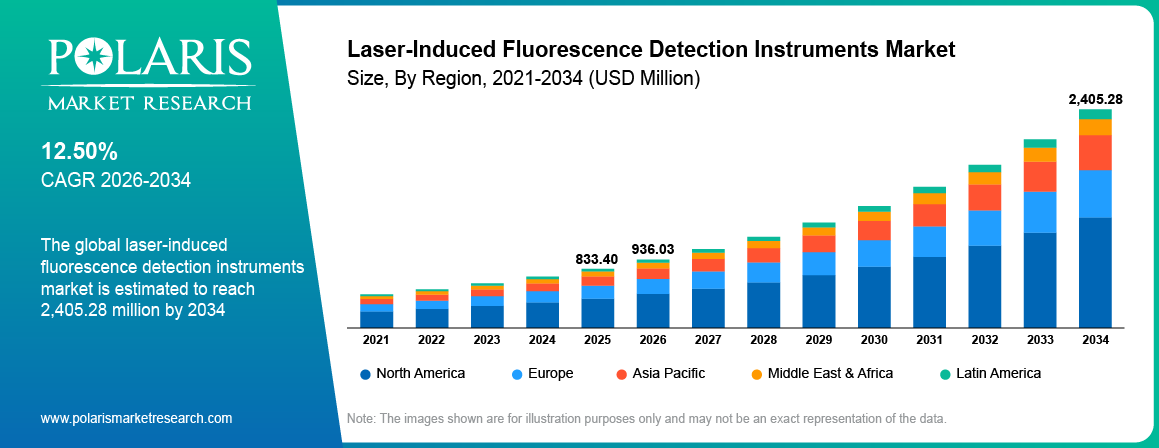
The global laser-induced fluorescence (LIF) detection instruments market is estimated around USD 833.40 Million in 2025,with consistent growth anticipated during 2026–2034. This growth is driven by stricter environmental regulations and rising industrial automation that are increasing demand for LIF instruments globally. The market is projected to grow at a CAGR of 12.50% during the forecast period.
Market Statistics
Key Takeaways
- The benchtop segment dominated in 2025 capturing 66.60% share, due to strong use in laboratories requiring high precision analysis.
- The pharmaceutical & biotech companies segment dominated in 2025 with 48.20% share, due to rising demand for research and quality testing systems.
- Rapid growth is expected in the portable segment at a CAGR of 13.49%, due to increasing need for on-site testing and field analysis.
- Companies are focusing on expanding portfolios across benchtop, portable, and AI-enabled detection solutions.
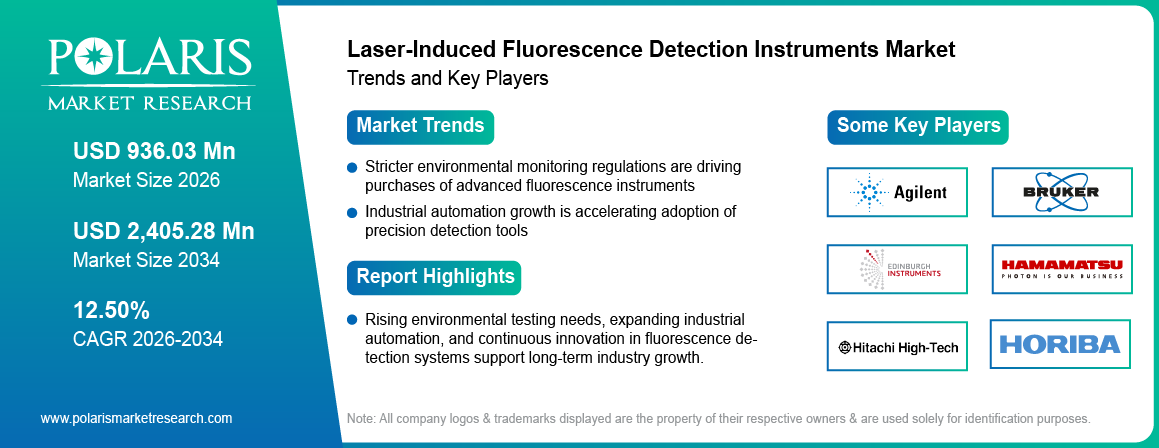
- AI-based data analytics are improving testing accuracy and supporting scalable growth in the laser-induced fluorescence detection instruments market.
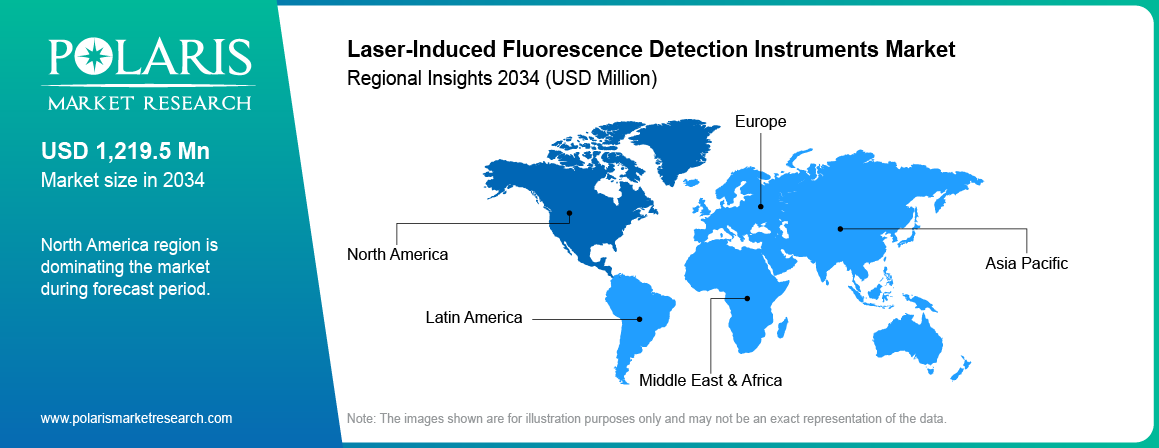
- North America dominated the market accounting for 40.20% share of the global market in 2025, due to advanced research infrastructure and strong technology adoption.
Industry Dynamics
- Stricter environmental monitoring regulations are increasing demand for advanced fluorescence detection systems.
- Industrial automation growth is supporting wider use of precision testing instruments globally.
- High initial equipment cost limits adoption among small laboratories and enterprises.
- AI-based data analysis integration is improving instrument efficiency and customer value.
What is Laser-Induced Fluorescence Detection Instruments?
Laser-induced fluorescence detection instruments are analytical systems used to identify and measure chemical and biological substances through fluorescence signals generated by laser excitation. They are widely applied in environment testing, healthcare diagnosis, pharmaceutical R&D, and quality control in manufacturing companies. The development in the market has been facilitated by increasing need for reliable and speedy analytical devices in many industries.
The supply chain in the industry comprises product design, procurement of components, integration of software, calibration, regulatory approval, distribution, installation, and maintenance. Various regulations set by environmental regulatory organizations like the EPA are pushing industries to use advanced detection methods. Rising attention to pollution and water quality analysis is driving demand for the products.
Source: Polaris Market Research Analysis
Want a Deeper Look at Key Market Players? Download Sample Report
The adoption of fluorescence technology within healthcare applications is rising rapidly in early disease diagnosis and clinical testing. The industrial field also utilizes the systems for optimizing processes, preventing contamination, and quality inspection. Innovations within fluorescence spectroscopy, sensing, and automation have contributed towards improving the efficiency of these systems and driving growth within the industry.
Drivers & Opportunities
Stricter environmental monitoring regulations are driving purchases of advanced fluorescence instruments: There have been stringent regulations imposed by the governments and regulators for the monitoring of water quality, air emissions, and detection of hazardous substances. In December 2025, Lihe Technology announced its plan of investing a sum of USD 3 million towards the localized manufacture of the detection equipment in Kazakhstan, expected to make the manufacture and application of laser induced fluorescent detectors more affordable.
Industrial automation growth is accelerating adoption of precision detection tools: Laser-induced fluorescence systems are becoming common in manufacturing industries for efficient manufacturing operations and reducing defects. In September 2025, Hitachi invested over USD 1 million in expanding its activities in the US, including the establishment of an industrial automation facility that cost USD 72.8 million in Michigan. Therefore, promoting the adoption of laser-induced fluorescence systems aids in performing real-time analysis and contamination detection during manufacturing processes.
Restraints & Challenges
High initial equipment cost is limiting adoption among small laboratories and enterprises: The adoption of advanced lasers, laser optics, and software is one of the key factors responsible for inflating the overall purchase cost of these devices. Many small labs and cost-conscious organizations tend to defer investment due to the limited availability of funds. This acts as a key hindrance to market growth in emerging economies.
Opportunity
Growth in water and air quality testing programs is opening new revenue channels: There is an increasing number of testing programs initiated by public entities and private sectors to monitor the pollution levels and make sure environmental standards are met. According to the report of the European Investment Bank in 2025, there were new loans approved for more than USD 17 million, used for different projects concerning healthcare, renewable energy, transport, and business growth.Laser-induced fluorescence helps detect trace elements within the environment.
AI-based data analysis integration is improving instrument value for customers: AI technology-assisted software helps to assist users in processing the fluorescence data faster with more accuracy. Smart analytics also reduce manual interpretation time and support predictive insights. This advancement is increasing product appeal across laboratories and industrial users.
Source: Polaris Market Research Analysis
Get Full Segment-Level Forecasts & Insights: Download Sample Report
Segmental Insights
This report offers detailed coverage of the laser-induced fluorescence detection instruments market product, application, and end user to help readers identify the fastest expanding and most attractive demand segments.
By Product
-
Benchtop
Based on product, the benchtop segment dominated the market with 66.60% share in 2025, driven by strong use in laboratories requiring high sensitivity and stable analytical performance. This software helps in testing procedures that have been made advanced due to environmental and healthcare facilities. Wider use in regulated laboratories supported segment growth.
-
Portable
Based on product, the portable segment is projected to grow at the fastest CAGR of 13.49% during the forecast period, due to rising demand for field-based testing and on-site analysis. The smaller size and quicker implementation are some factors that make the adoption easier in environmental monitoring projects.
By Application
-
Environmental
Based on application, the environmental segment is expected to grow at a CAGR of 13.20% during the forecast period, driven by growing use in water quality testing, air pollution analysis, and regulatory compliance programs. Rising environmental monitoring activity supported strong segment demand.
-
Healthcare
Based on application, in 2025, the healthcare segment dominated the market share valued at 46.60%, due to increasing use of fluorescence-based diagnostics and early disease detection tools. Rising laboratory modernization is supporting adoption.
By End User
-
Pharmaceutical & biotech companies
Based on end user, the pharmaceutical & biotech companies segment dominated the market with 48.20% revenue share in 2025, driven by rising use in drug research and drug delivery, quality testing, and biological analysis. Higher R&D spending supported segment leadership.
-
Academic & research institutes
Based on end user, the academic & research institutes segment is projected to grow at the fastest CAGR of 13.26%, during the forecast period, due to expanding scientific research programs and growing investment in advanced analytical instruments. Increasing funding activity is aiding segment growth.
Source: Polaris Market Research Analysis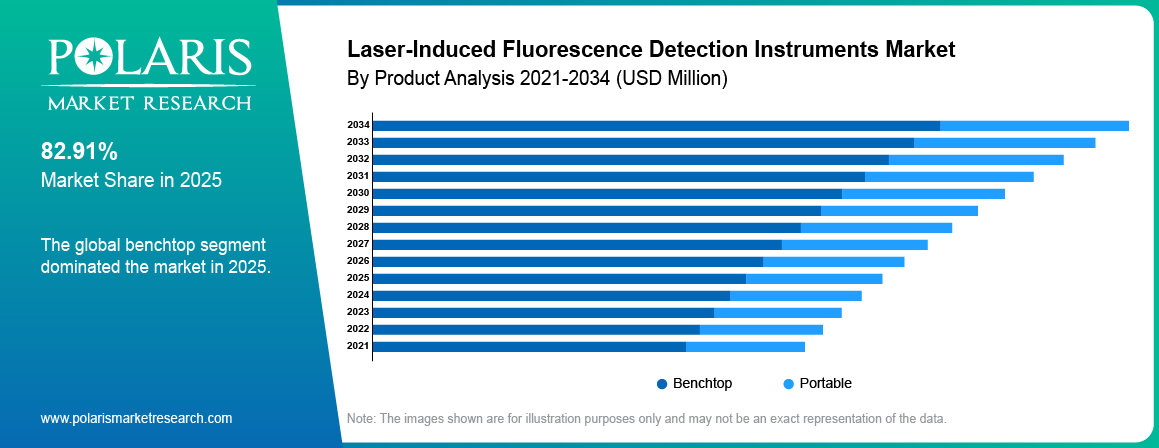
Need Granular Data Across All Market Segments? Request Customization
Regional Analysis
North America Laser-Induced Fluorescence Detection Instruments Market Overview
North America held a large market share accounting for 40.20% in 2025, due to strong research infrastructure, high adoption of advanced analytical instruments, and strict environmental monitoring standards. The US leads the region, supported by large healthcare spending and strong presence of biotechnology and pharmaceutical companies. According to Centers for Medicare & Medicaid Services, US national health spending grew 7.2% to USD 5.3 trillion in 2024, equal to USD 15,474 per person and 18.0% of GDP.
Asia Pacific Laser-Induced Fluorescence Detection Instruments Market Insights
Asia Pacific is expected to witness the fastest growth in terms of CAGR of 14.60%, during the forecast period due to expanding industrial automation, rising pollution monitoring needs, and growing healthcare investments in China, India, Japan, and South Korea. According to United Nations Environment Programme, around 92% of Asia Pacific’s population, nearly 4 million people, faces unhealthy air pollution levels. Without current policies, exposure to harmful particulate matter may rise by over 50% by 2030.In addition, increasing laboratory modernization and wider adoption of portable detection systems are supporting market demand.
Europe Market Insights
Europe has a considerable market share capturing 28.20% share in 2025, owing to robust environmental regulations, strong academic research activity, and growing use of advanced spectroscopy tools. As per Eurostat, the number of full-time researchers in the EU rose 47.3% from 1.50 million in 2014 to 2.21 million in 2024.Countries like Germany, France, and UK are important markets due to the availability of quality standards in industries and innovative healthcare. Increasing emphasis on sustainability and emissions measurement has been instrumental in developing regional markets.
Source: Polaris Market Research Analysis
Curious About Regional Market Performance? Request Customization
Competitive Landscape & Key Players
The market for laser-induced fluorescence detectors is moderately consolidated and competes with other global analytical instrument makers, spectroscopy technology developers, and dedicated sensor equipment makers. Product accuracy, detection speed, software capability, regulatory compliance, and pricing remain key competitive factors in the market. Companies are focusing on portfolio expansion across benchtop and portable systems, integrating AI-based data analytics, forming research collaborations, and expanding into high-growth regional markets.
The following are some of the leading companies in the industry Agilent Technologies, Thermo Fisher Scientific, Shimadzu Corporation, PerkinElmer, HORIBA, Bruker Corporation, Hitachi High-Tech, Teledyne Technologies, Ocean Insight, Hamamatsu Photonics, Edinburgh Instruments, Mettler Toledo, and others.
Premium Insights
- Rising demand for portable systems is increasing adoption of field-based laser-induced fluorescence detection instruments for on-site environmental and industrial testing.
- AI adoption trends are helping enhance data interpretation, work process effectiveness, and timely decision-making within labs and manufacturing plants.
- Emerging markets have been witnessing an increase in growth owing to better research facilities, industry development, and efficient pollution detection systems.
- Advancements in fluorescence methods are contributing to higher instrument efficiency, speed, and accuracy when carrying out complex analysis.
- Advancements in continuous spectrometry technologies have led to their more extensive usage in diagnostics services, pharmaceutical testing, and research activities.
Key Players
- Agilent Technologies
- Bruker Corporation
- Edinburgh Instruments
- Hamamatsu Photonics
- Hitachi High-Tech
- HORIBA
- Mettler Toledo
- Ocean Insight
- PerkinElmer
- Shimadzu Corporation
- Teledyne Technologies
- Thermo Fisher Scientific
Industry Developments
- In November 2025: Scientists at Nankai University have created an innovative radiation detector system using femtosecond laser filaments to detect weak ionizing radiation from far-off distances. [source: nankai.edu]
- In July 2025: Scientists at Oregon State University have improved the laser-based technology for detecting radiation, helping to achieve more sensitive measurements and expanded uses for fluorescence detection devices. [source: oregonstate.edu]
Laser-Induced Fluorescence Detection Instruments Market Segmentation
By Product Outlook (Revenue, USD Million, 2021-2034)
- Benchtop
- Portable
By Application Outlook (Revenue, USD Million, 2021-2034)
- Environmental
- Healthcare
- Industrial
By End User Outlook (Revenue, USD Million, 2021-2034)
- Pharmaceutical & biotech companies
- Academic & research institutes
- Others
By Regional Outlook (Revenue, USD Million, 2021-2034)
- North America
- US
- Canada
- Europe
- Germany
- France
- UK
- Italy
- Spain
- Netherlands
- Russia
- Rest of Europe
- Asia Pacific
- China
- Japan
- India
- Malaysia
- South Korea
- Indonesia
- Australia
- Vietnam
- Rest of Asia Pacific
- Middle East & Africa
- Saudi Arabia
- UAE
- Israel
- South Africa
- Rest of Middle East & Africa
- Latin America
- Mexico
- Brazil
- Argentina
- Rest of Latin America
Laser-Induced Fluorescence Detection Instruments Market Report Scope
| Report Attributes | Details |
| Market Size in 2025 | USD 833.40 Million |
| Market Size in 2026 | USD 936.03 Million |
| Revenue Forecast by 2034 | USD 2,405.28 Million |
| CAGR | 12.50% from 2026 to 2034 |
| Base Year | 2025 |
| Historical Data | 2021–2024 |
| Forecast Period | 2026–2034 |
| Quantitative Units | Revenue in USD Million and CAGR from 2026 to 2034 |
| Report Coverage | Revenue Forecast, Competitive Landscape, Growth Factors, and Industry Trends |
| Segments Covered |
|
| Regional Scope |
|
| Competitive Landscape |
|
| Report Format |
|
| Customization | Report customization as per your requirements with respect to countries, regions, and segmentation. |
Source: Polaris Market Research Analysis
Laser-Induced Fluorescence Detection Instruments Market FAQ's
The global market size was valued at USD 833.40 Million in 2025 and is projected to grow to USD 2,405.28 Million by 2034.
North America leads the market with a share of 40.20% in 2025, due to stringent environmental policies and high penetration of advanced analytical tools.
Major applications include environmental monitoring, healthcare diagnostics, industrial quality control, pharmaceutical testing, and scientific research.
A few of the key players in the market are Agilent Technologies, Thermo Fisher Scientific, Shimadzu Corporation, PerkinElmer, HORIBA, Bruker Corporation, Hitachi High-Tech, Teledyne Technologies, Ocean Insight, Hamamatsu Photonics, Edinburgh Instruments, Mettler Toledo, and others.
Key drivers include stricter pollution monitoring rules, rising industrial automation, and growing demand for rapid detection systems.
The key application areas include pharmaceuticals & biotechnology firms, R&D organizations, healthcare laboratories, and manufacturing industries.
The market outlook remains positive due to AI-based analytics, portable system demand, and expanding environmental testing programs.
Download Sample Report of Laser-Induced Fluorescence Detection Instruments Market
Please fill out the form to request a customized copy of the research report.


