Overview
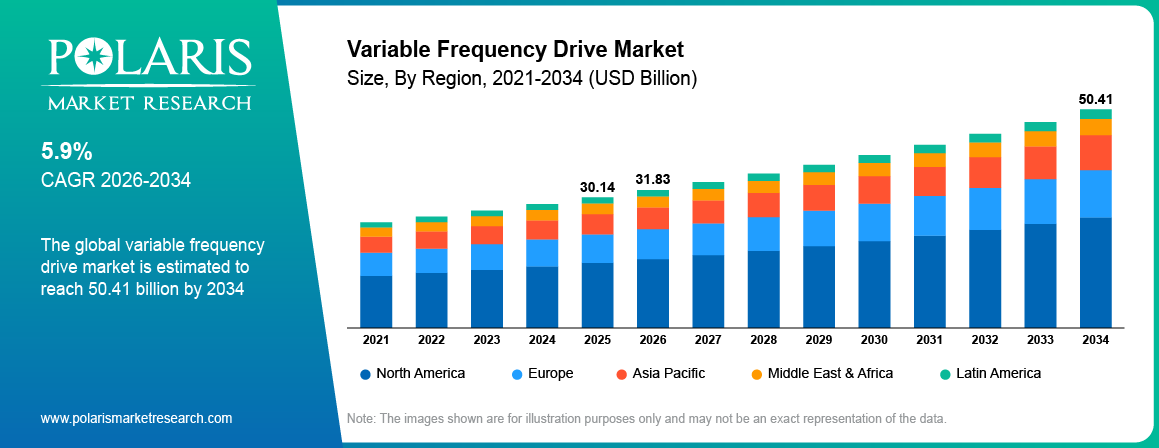
The global variable frequency drive market is estimated around USD 30.14 Billion in 2025, with consistent growth anticipated during 2026–2034. Expansion is supported by increasing industrial automation, rising demand for energy-efficient motor systems, and rapid adoption of smart factory technologies. The market is projected to grow at a CAGR of 5.9% during the forecast period.
Key Takeaways:
- Asia Pacific accounted for the largest market share of around 49% in 2025, driven by strong manufacturing growth and increasing industrial automation across China and India.
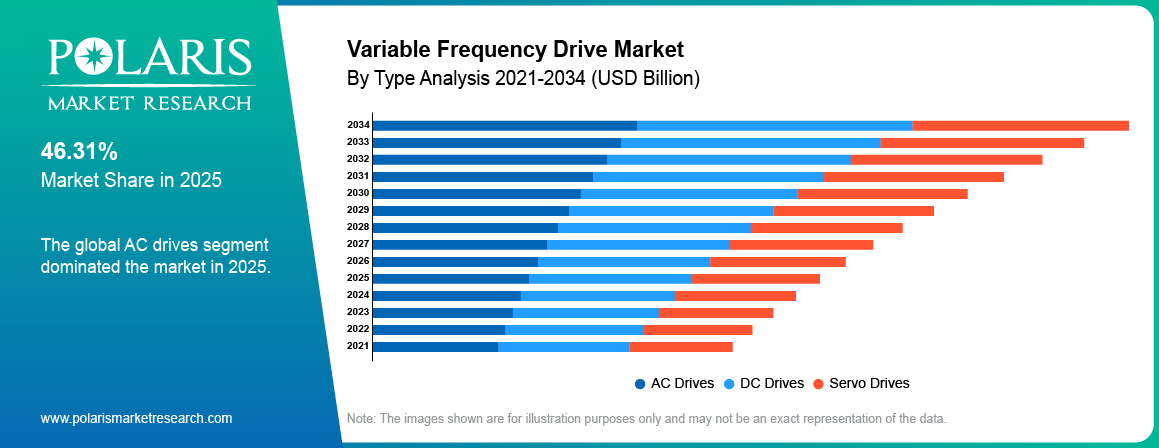
- By Type, AC Drives segment accounted for the largest market share of around 55% in 2025, driven by widespread use in industrial automation applications such as pumps, fans, and compressors.
- By Voltage, Low Voltage Drives segment accounted for the largest market share of around 61% in 2025, driven by extensive usage in HVAC systems, building automation, and light industrial processes.
- By Power Range, Low Power Drives segment accounted for the largest market share of around 53% in 2025, driven by widespread use in commercial HVAC equipment and small industrial machinery.
- By Application, Pumps segment accounted for the largest market share of around 58% in 2025, driven by high adoption in water treatment plants and irrigation systems for energy-efficient operations.
- By End Use Industry, Manufacturing segment accounted for the largest market share of around 57% in 2025, driven by increasing need for automation and motor control systems across industrial production facilities.
Market Statistics
- 2025 Market Size: USD 30.14 Billion
- 2034 Projected Market Size: USD 50.41 Billion
- CAGR (2026-2034): 5.9%
- Asia Pacific: Largest market in 2025
Industry Dynamics
- Increasing industrial automation and smart factory implementations are driving the need for advanced motor control technologies.
- Growing emphasis on energy-efficient motor systems is positively impacting variable speed drive demand.
- The cost of installing or integrating variable speed drive systems remains a hindrance for small and medium-sized industrial enterprises.
- The integration of IoT-enabled smart drives is creating opportunities for predictive maintenance and remote monitoring of industrial motors.
What is included in the Variable Frequency Drive market?
The variable frequency drive market includes electronic devices that control the speed of electrical motors by adjusting the frequency and voltage provided to the motors. The Variable Frequency Drive (VFD) enables electrical motors to perform at variable speeds instead of running at full speed, as in traditional electrical motors. In the AC drive segment and motor control segment, VFDs are commonly employed in controlling electrical motors in pumps, air compressors, conveyors, and HVAC equipment, thereby supporting the automation segment in the industrial automation market.
VFDs are employed in enhancing efficiency in electrical motors as they are able to control the speed of motors in accordance with actual demand instead of running motors continuously at full speed. The increasing adoption toward industrial automation and power efficiency is enhancing the demand for variable speed drive devices.
To Understand More About this Research:Request a Free Sample Report
The market size for the VFD industry is increasing due to the growing adoption of modern motor control technology by industries. The present market analysis for the VFD industry indicates a steady growth rate based on rising demand for industrial motors, HVAC systems, pumps, compressors, etc., thereby boosting the variable frequency drive market.
Drivers & Opportunities
Growing industrial automation and smart factory adoption: increasing trend of industrial automation is contributing to the growth of the VFD market for various industries. Variable frequency drives are used for the precise control of industrial motors used for robots, conveyors, etc., for smart factory applications. The International Federation of Robotics, in its World Robotics 2024 report, stated that industrial robots are installed in 4,281,585 locations globally, increasing by 10%, with more than 500,000 robots installed, marking the third year of this trend. The increased adoption of smart factories is boosting VFD market demand worldwide.
Rising demand for energy-efficient motor systems: Industrial motors consume a large share of global electricity, increasing focus on efficiency improvements. Variable frequency drives regulate motor speed based on load, lowering energy consumption and operating costs. In May 2025, ABB introduced a synchronous motor that reached 99.13% efficiency under its Top Industrial Efficiency program. This demonstrates the importance of VFDs in supporting energy efficiency solutions for HVAC systems, water treatment plants, and other industrial operations.
Restraints & Challenges
High initial installation and integration costs: The process of installing a variable frequency drive demands a high capital cost for infrastructure development in power electronics, control systems, and integration systems. The cost for installing a variable frequency drive is further increased for the retrofitting process, therefore restraining the market growth.
Opportunity
Integration of smart drives with IoT and digital monitoring: Smart motor drives are creating opportunities for the development of connected industrial motor control systems. IoT-enabled VFDs allow real-time monitoring of motor performance, predictive maintenance, and remote diagnostics. Integration with digital factory platforms helps enable the intelligent management of energy and optimization of the process.
Technology Trends Shaping the Variable Frequency Drive Market
The variable frequency drive industry is undergoing a significant impact due to the advancements in the relevant technologies. The recent developments in the drives are helping the industry to transform from the current scenario to an intelligent motor control system that sense the performance of the motors.
-
Transition Toward Smart Drives
The shift towards smart drives includes the integration of sensors and communication modules that offer digital control for motors in an automated system. Such connected drives offer efficient motor management for different industries such as manufacturing, HVAC, and water treatment.
-
Predictive Maintenance and AI Diagnostics
Artificial intelligence-based analytics provides predictive maintenance for a VFD system. The drive use the data collected during the operation to identify faults and minimize unexpected downtime.
-
Wide Bandgap Semiconductor Integration
The use of silicon carbide-based power electronics and GaN semiconductors enhances efficiency for a VFD drive. Such improvements offer a compact and efficient drive.
-
Cybersecurity in Industrial Drives
The importance of cybersecurity for industrial drives has become a necessity in the development and use of industrial IoT drives. The integration of secure communication provides efficient cybersecurity for connected drive networks in a digital manufacturing environment.

Segmental Insights
This report offers detailed coverage of the variable frequency drive market by type, voltage, power range, application, end use industry to help readers identify the fastest expanding and most attractive demand segments.
By Type
The AC drives market held the largest market share due to the widespread use of these drives in various industrial automation applications. AC variable speed motor drives are usually utilized for the control of pumps, fans, and compressors.
The servo drive market is expected to grow at the highest rate due to the growing trend of motion control solutions. The servo drive technology is known for its precision in machine automation solutions like robots, CNC machines, and packaging machines.
By Voltage
Low voltage VFD systems held the largest share due to extensive use in HVAC systems and small industrial motors. These drives are widely applied in building automation, water pumping systems, and light industrial processes.
The medium voltage drive segment is growing rapidly, driven by rising demand for high-capacity industrial motor drives. Large-scale manufacturing plants, mining, and heavy industries require medium voltage systems for controlling high-powered motors.
By Power Range
Low power driver dominated the market in 2025, due to their widespread use in commercial HVAC equipment, light industrial equipment, and small machines. The equipment caters the need for industrial motor power control in processes that require moderate improvements in energy efficiency.
High power motor drives are projected to grow rapidly, due to the increasing adoption of large motor drive systems in mining, oil & gas, and heavy manufacturing industries. The increasing need for energy-efficient high-power motor drive systems is fueling the market growth.
By Application
VFD pumps are the dominant application type of industrial drives due to their extensive usage in water treatment plants and irrigation systems. VFDs are used for precise control of pumps, resulting in energy savings.
Fans and blowers are expected to grow at a rapid pace driven by increasing need for energy-efficient building automation and HVAC systems, boosting the demand for industrial motor control devices.
By End Use Industry
Manufacturing industry dominates the industrial drives market due to its increasing need for automation of manufacturing processes. Motor control devices are used extensively in manufacturing industries for increasing efficiency.
Water treatment motor control systems are the fastest-growing end-use segment. Growing investment in water infrastructure and wastewater treatment plants is fueling the use of VFD pumps and industrial motor drives for efficient fluid management.
Regional Analysis
Asia Pacific Variable Frequency Drive Market Assessment
Asia Pacific VFD market dominated global demand due to strong manufacturing growth across China and India. Expanding industrial production, factory automation, and energy efficiency initiatives increased deployment of motor control systems across manufacturing facilities. According to China’s Ministry of Industry and Information Technology, value-added industrial output of major companies rose by 11.1% year-on-year during the reported period. This industrial expansion also fuels the demand for variable frequency drives in motors used in various manufacturing, processing, and industrial automation applications.
North America Variable Frequency Drive Market Insight
North America motor drives market expanded through increasing adoption of smart manufacturing technologies across the US industrial sector. Improvements in energy efficiency and digital manufacturing systems also increases the demand for advanced motor control systems among manufacturers. In January 2025, the US Department of Energy announced USD 13 million in funding under its State Manufacturing Leadership Program, which would be used for the adoption of smart manufacturing and high-performance computing technologies. This investment boosts the rate of modernization of manufacturing plants in the country, increasing the demand for variable frequency drives.
Europe Variable Frequency Drive Market Overview
Europe was second leading market in variable frequency drivers, due to presence of regulated environment that has enforced energy efficiency measures for industries to reduce their consumption levels. EU regulations on energy efficiency for the 2030 targets have increased the adoption rate for high-efficiency motor control solutions in industries like manufacturing plants, utilities, and energy-intensive industries. These regulations are further increasing the adoption rate for variable frequency drives in industries such as industrial automation.
Latin America Variable Frequency Drive Market Assessment
Latin America showed increasing demand for motor drives due to expansion of mining and metal processing industries in countries such as Chile, Peru, and Brazil. Industrial operations required energy-efficient motor control systems for pumps, conveyors, and processing equipment. According to the International Energy Agency, mining historically accounted for between 13% and 19% of incoming foreign direct investment in the region. This investment activity helped to enhance the industrial adoption of motor control solutions in the emerging markets.
Middle East & Africa Variable Frequency Drive Market Assessment
The Middle East and Africa market is growing at a stable rate, due to the increasing investments in water desalination and wastewater treatment facilities. This region comprises the GCC countries. Large-scale water management schemes are increasingly incorporating variable frequency drives to enhance the efficiency of the energy usage of the pumps. This fueled the market for energy-efficient motor control systems.

Key Players & Competitive Analysis Report
The competitive landscape of the variable frequency drive market is marked by the presence of many global players related to the automation industry. The players operating in the variable frequency drive market are mainly focused on the development of intelligent motor control technologies for improving the efficiency of their products.
Key companies operating in the variable frequency drive market include ABB Ltd., Allen-Bradley (Rockwell Automation, Inc.), Danfoss A/S, Delta Electronics, Inc., Eaton Corporation plc, Emerson Electric Co., Fuji Electric Co., Ltd., Hitachi, Ltd., Honeywell International Inc., INVT Electric Co., Ltd., Johnson Controls International plc, Mitsubishi Electric Corporation, Nidec Corporation, Schneider Electric SE, and Siemens AG.
Key Players
- ABB Ltd.
- Allen-Bradley (Rockwell Automation, Inc.)
- Danfoss A/S
- Delta Electronics, Inc.
- Eaton Corporation plc
- Emerson Electric Co.
- Fuji Electric Co., Ltd.
- Hitachi, Ltd.
- Honeywell International Inc.
- INVT Electric Co., Ltd.
- Johnson Controls International plc
- Mitsubishi Electric Corporation
- Nidec Corporation
- Schneider Electric SE
- Siemens AG
Premium Insights
The outlook for the VFD market is driven by energy efficiency requirements and industrial electrification in manufacturing, utilities, and infrastructure sectors. Variable frequency drives are commonly used for optimizing motor performance and energy efficiency in HVAC, pumps, compressors, and other industrial equipment.
Variable frequency drives are integrated into smart manufacturing environments. Modern VFDs are utilizing various sensors, connectivity, and diagnostics, which are helping industries monitor their systems better. This is a result of ongoing motor drive technology innovations that are helping industries increase operational efficiency.
The consolidation of the VFD market is gradually increasing, driven by automation companies that are expanding their portfolios through acquisitions and OEM relationships. Drive manufacturers are integrating VFDs into industrial equipment, creating closer supply relationships between them. In addition, service revenues are also increasing along with drive installations.
Industry Developments
- November 2025: Invertek Drives announced the Optidrive E4 variable frequency drive at the SPS 2025 show. The Optidrive E4 offers high-end diagnostics, industrial Ethernet connectivity, and induction and hybrid permanent magnet motors.
- September 2025: NOARK Electric announced its Ex9VF7 variable frequency drives at the NECA 2025 show. The Ex9VF7 variable frequency drives offer advanced DSP motor control technology and a wide power range.
Variable Frequency Drive Market Segmentation
By Type Outlook (Revenue, USD Billion, 2021-2034)
- AC Drives
- DC Drives
- Servo Drives
By Voltage Outlook (Revenue, USD Billion, 2021-2034)
- Low Voltage Drives
- Medium Voltage Drives
- High Voltage Drives
By Power Range Outlook (Revenue, USD Billion, 2021-2034)
- Micro drives
- Low power drives
- Medium power drives
- High power drives
By Application Outlook (Revenue, USD Billion, 2021-2034)
- Pumps
- Fans & Blowers
- Compressors
- Conveyors
- Extruders
By End Use Industry Outlook (Revenue, USD Billion, 2021-2034)
- Oil & Gas
- Power Generation
- Food & Beverage
- Mining
- Water & Wastewater
- Manufacturing
By Regional Outlook (Revenue, USD Billion, 2021-2034)
- Germany
- France
- UK
- Italy
- Spain
- Netherlands
- Russia
- Rest of Europe
- China
- Japan
- India
- Malaysia
- South Korea
- Indonesia
- Australia
- Vietnam
- Rest of Asia Pacific
- Saudi Arabia
- UAE
- Israel
- South Africa
- Rest of Middle East & Africa
- Mexico
- Brazil
- Argentina
- Rest of Latin America
Variable Frequency Drive Market Report Scope
|
Report Attributes
|
Details
|
|
Market Size in 2025
|
USD 30.14 Billion
|
|
Market Size in 2026
|
USD 31.83 Billion
|
|
Revenue Forecast by 2034
|
USD 50.41 Billion
|
|
CAGR
|
5.9% from 2026 to 2034
|
|
Base Year
|
2025
|
|
Historical Data
|
2021–2024
|
|
Forecast Period
|
2026–2034
|
|
Quantitative Units
|
Revenue in USD Billion and CAGR from 2026 to 2034
|
|
Report Coverage
|
Revenue Forecast, Competitive Landscape, Growth Factors, and Industry Trends
|
|
Segments Covered
|
- By Type
- By Voltage
- By Power Range
- By Application
- By End Use Industry
|
|
Regional Scope
|
- North America
- Europe
- Asia Pacific
- Latin America
- Middle East & Africa
|
|
Competitive Landscape
|
- Variable Frequency Drive Industry Trend Analysis (2025)
- Company Profiles/Industry participants profiling includes company overview, financial information, product/service benchmarking, and recent developments
|
|
Report Format
|
|
|
Customization
|
Report customization as per your requirements with respect to countries, regions, and segmentation.
|