
Abrasives Market Trends, Forecast, Analysis Report, 2026-2034
REPORT DETAILS
Market Statistics
Overview
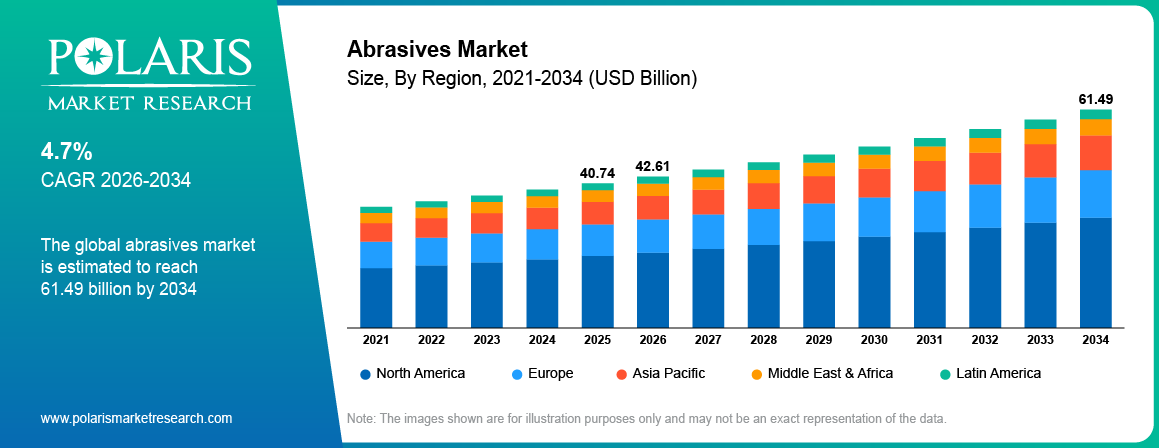
The global abrasives market is estimated around USD 40.74 Billion in 2025, with consistent growth anticipated during 2026–2034. Expansion is supported by rising automotive production, growth in electronics manufacturing, and increasing demand for precision grinding and surface finishing across industrial sectors. The market is projected to grow at a CAGR of 4.7% during the forecast period.
Key Takeaways:
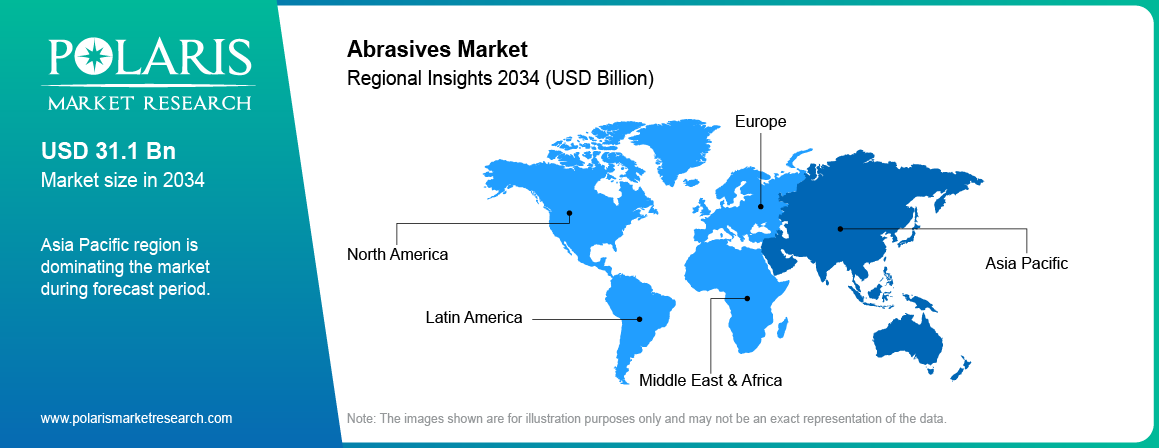
- Asia Pacific accounted for the largest regional share of around 44.7% in 2025, driven by strong electronics manufacturing, semiconductor fabrication, and expanding industrial activities across China, Japan, South Korea, and Taiwan.
- By Product Type, Super Abrasives segment is projected to grow at a CAGR of 6.9%, driven by increasing demand for precision tools such as diamond and CBN abrasives in electronics and hardened steel applications.
- By Material Type, Aluminum Oxide Abrasives segment accounted for the largest share of around 46.3% in 2025, supported by versatility, cost-effectiveness, and widespread use in grinding wheels and finishing tools.
- By Application, Grinding segment accounted for the largest share of nearly 61.5% in 2025, supported by widespread use in metal fabrication, machine tooling, and automotive component manufacturing.
Market Statistics
- 2025 Market Size: USD 40.74 Billion
- 2034 Projected Market Size: USD 61.49 Billion
- CAGR (2026-2034): 4.7%
- Asia Pacific: Largest market in 2025
Industry Dynamics
- Increase in automotive production is boosting the demand for abrasive materials used in grinding and polishing.
- Expansion of semiconductor and electronics manufacturing is fueling the market.
- Raw materials like aluminum oxide, silicon carbide, and diamond face price fluctuations, which in turn restrain the market growth.
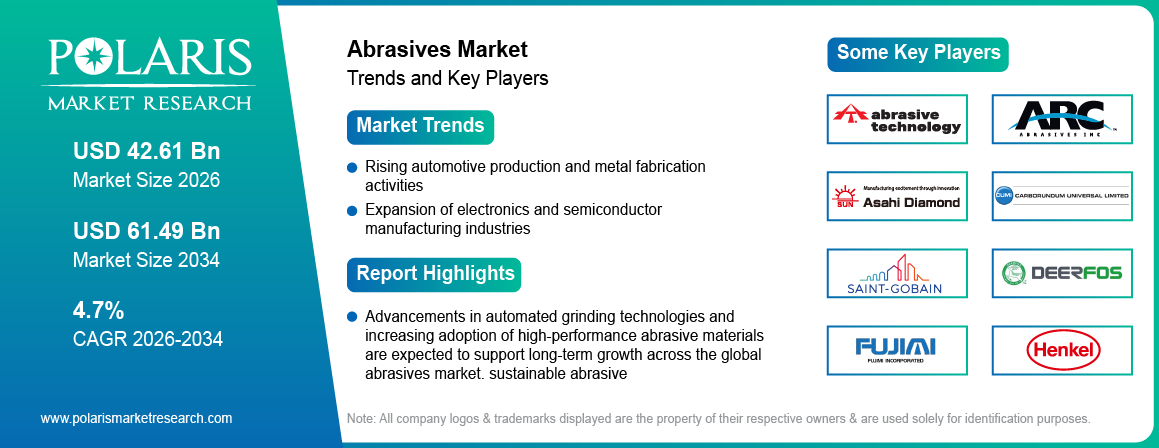
- Advancements in automated grinding technologies and precision machining solutions create long-term growth opportunities across the global market.
What is included in the Abrasives market?
The market includes the production and commercial distribution of materials used for grinding, cutting, polishing, and surface finishing across industrial manufacturing processes. The abrasives industry consists of suppliers of raw abrasive minerals, bonding agents, coated abrasive materials, and finished abrasive tools used in metal fabrication, automotive manufacturing, electronics production, and construction activities.
Products such as bonded abrasives, coated abrasives, and super abrasives enable precise material removal and surface preparation in industrial operations. Assessments by the industry on the global market size portray steady demand for high-volume manufacturing segments where durability and precision are crucial factors for efficiency and performance.
Source: Polaris Market Research Analysis
To Understand More About this Research:Download Sample Report
The market for abrasives comprises products such as grinding wheels, abrasive discs, sandpaper, polishing compounds, and super abrasive products such as aluminum oxide, silicon carbide, cubic boron nitride, and diamond.
Drivers & Opportunities
Rising automotive production: Increasing vehicle manufacturing is strengthening demand across the market for grinding, polishing, and surface finishing applications. Abrasives are widely used in metal shaping, component finishing, and precision machining in automotive manufacturing. According to the European Automobile Manufacturers' Association, in 2024, a total of 74.6 million cars were sold globally, indicating a 2.5 percent increase compared to 2023. This increase in vehicle manufacturing, therefore, translates into an increased demand for abrasives in vehicle engines, bodywork, and transmissions.
Expansion of electronics manufacturing: The production of semiconductors and other components of electronics has been on the rise, thereby creating demand for special abrasives used during wafer polishing operations. According to the Semiconductor Industry Association, in January 2026, a total of 82.5 billion dollars in sales of semiconductors was recorded globally, indicating a 3.7 percent increase compared to December 2025 and a 46.1 percent increase compared to January 2025. This growth is driving the demand for abrasives for high-precision grinding and finishing operations.
Restraints & Challenges
Raw material price volatility: Fluctuating prices of raw materials like aluminum oxide, silicon carbide, and diamond abrasives are a challenge for companies in the abrasive market. Abrasive manufacturing companies require high-quality raw materials like minerals and synthetic abrasives. Fluctuating raw material prices affect production costs, thus hindering growth of the market.
Opportunity
Advancement in grinding and finishing technologies: The increase in grinding automation and simulation technologies, are providing new opportunities for high-precision abrasive technologies. For instance, ANCA introduced software for InsertsPRO in September 2025. InsertsPRO is used for grinding automation of indexable and specialty inserts for precision machining. It includes simulation tools and optimized grinding strategies for precision machining. Such innovations are generating high demand for high-precision abrasives in industries like aerospace, automotive, and precision machining.
Source: Polaris Market Research Analysis
Get Full Segment-Level Forecasts & Insights: Download Sample Report
Segmental Insights
This report offers detailed coverage of the abrasives market by product type, material type, and application to help readers identify the fastest expanding and most attractive demand segments.
By Product Type
-
Bonded Abrasives
The bonded abrasives segment accounts for the largest share of the market size due to extensive use in heavy-duty industrial grinding operations. Grinding wheels market demand is still high in various industries, especially in automotive, metal fabrication, and construction sectors that require precise material removal processes.
-
Super Abrasives
The super abrasives market is growing rapidly due to increasing demand from various industries that require precise and long-lasting tools. The demand for diamond abrasives is growing in the electronics manufacturing sector, and the demand for CBN abrasives is growing in hardened steel grinding applications.
By Material Type
-
Aluminum Oxide Abrasives
Aluminum oxide abrasives is a large segment in the abrasives material type analysis due to its versatility and cost-effectiveness. Aluminum oxide is generally used in grinding wheels, abrasive belts and industrial finishing tools.
-
Ceramic Abrasives
The ceramic abrasives market is the fastest-growing material segment fueled by the higher hardness and longer lifespan. Zirconia alumina abrasives and ceramic abrasives are used for high-performance grinding and finishing.
By Application
-
Grinding
Grinding abrasives market held the largest market share as grinding is the most commonly used process for using abrasives. The grinding process is used for metal fabrication, machine tooling, and automotive parts.
-
Cutting and Deburring
Abrasives for cutting and abrasives for deburring represent the fastest-growing application segment. Increasing automation in manufacturing and the need for clean edge finishing drive growth in this category.
Source: Polaris Market Research Analysis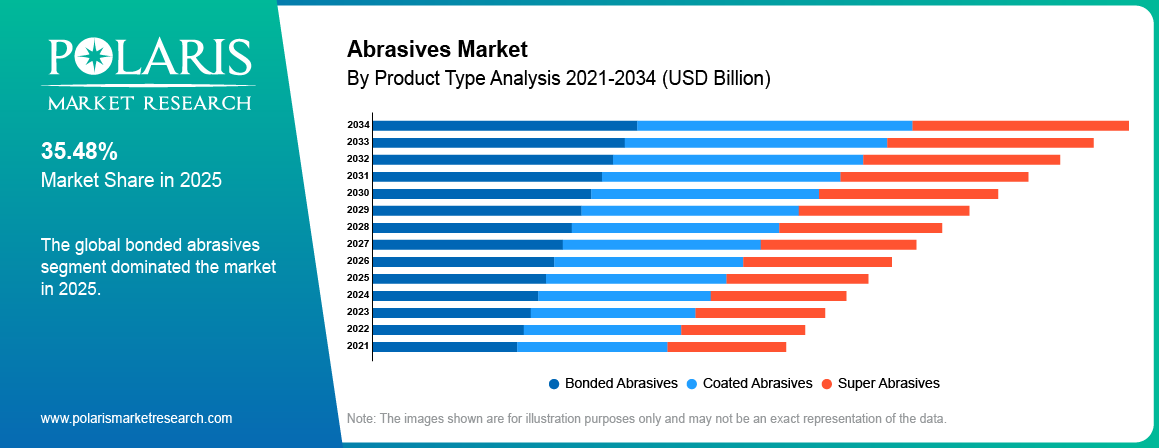
Need Granular Data Across All Market Segments? Request Customization
Regional Analysis
Asia Pacific Abrasives Market Assessment
Asia Pacific abrasives market maintained its dominance in the global demand, driven by the growing electronics manufacturing and semiconductor fabrication industry in China, Japan, Korea, and Taiwan. Abrasive materials play an important role in wafer polishing and micro-electronic components. The Chinese government committed more than USD 150 billion in semiconductor development investments between 2014 and 2030, according to the Semiconductor Industry Association. This large-scale investment accelerated semiconductor fabrication capacity and advanced materials processing, which in turn reinforced China abrasives demand for high-precision grinding and polishing applications used in electronics and semiconductor production.
North America Abrasives Market Insight
North America abrasives market recorded the fastest growth, driven by advanced manufacturing capabilities and strong aerospace and defense production. High-precision abrasive tools play an important role in the machining of turbine parts, aerospace alloys, and engineered materials for next generation aircraft engines. In March 2026, GE Aerospace announced to invest 1 billion dollars in US manufacturing facilities and its engine supply chain. This is expected to increase its manufacturing capacity to meet the growing demand for aviation operations in the US. This investment signifies the rising industrial activity in the US abrasives industry.
Europe Abrasives Market Overview
Europe abrasives market is second largest dominating region as manufacturers increasingly turned to high-precision and environmentally friendly abrasives in industrial processing. Automotive, aerospace, and metal fabrication industries in countries like Germany, France, and Italy are increasingly adopting high-efficiency abrasives in production. The abrasives manufacturing industry in Germany is a key contributor to overall production activity in Europe.
Source: Polaris Market Research Analysis
Curious About Regional Market Performance? Request Customization
Key Players & Competitive Analysis Report
The competitive environment in the market is shaped by factors such as innovation in products, improvement in materials, and increasing demand from automotive, metalworking, electronics, and construction markets. The companies are developing high-performance materials, grinding solutions, and coated and bonded abrasives to enhance their longevity and efficiency in finishing materials. Strategic investments in developing new materials and diversifying business with equipment manufacturers are strengthening their presence in the global abrasives market.
Some of the major players in the market include 3M Company, Abrasive Technology, Inc., ARC Abrasives, Inc., Asahi Diamond Industrial Co., Ltd., Carborundum Universal Limited, Compagnie de Saint-Gobain S.A., Deerfos Co., Ltd., Fujimi Incorporated, Henkel AG & Co. KGaA, and KWH Mirka Ltd.
Key Players
- 3M Company
- Abrasive Technology, Inc.
- ARC Abrasives, Inc.
- Asahi Diamond Industrial Co., Ltd.
- Carborundum Universal Limited
- Compagnie de Saint-Gobain S.A.
- Deerfos Co., Ltd.
- Fujimi Incorporated
- Henkel AG & Co. KGaA
- KWH Mirka Ltd.
Future Outlook of the Market
The market has a favorable outlook for the future, considering the trend of the global manufacturing sector toward electrification, precise machining, and automation of manufacturing systems. Abrasives are critical components for grinding, polishing, and finishing operations in industries such as the automobile, aerospace, electronics, and metal industries. Considering the complexities of these operations and the recent advances in the field of material sciences, it is expected to witness an increased demand for abrasives in the future, particularly for high-performance abrasives.
The electric vehicle industry segment also projected to contribute to the demand for abrasives. Electric vehicle components, such as the battery boxes, motors, and light metals, requires = high-performance grinding operations, thereby creating demand for high-performance abrasives, ceramics, and super abrasives.
Trend in smart manufacturing and Industry 4.0 technologies is also influencing the abrasives industry. Modern manufacturing facilities are increasingly incorporating technologies such as sensorized machining centers, robotic grinding cells, and finishing processes with digital monitoring. These processes demand Industry 4.0 abrasives with consistent cutting and wear properties. As the industry becomes increasingly connected with smart manufacturing platforms, the demand for smart manufacturing abrasives is also likely to increase.
Abrasives materials market is also to get advantage from the revolution in the manufacturing industry. The market is projected to benefit from electrification, precise engineering, and digital manufacturing systems. The market is likely to see long-term demand growth.
Industry Developments
- January 2026: Weiler Abrasives launched Fortis Mill hot and cold roll grinding wheels which are designed using state-of-the-art ceramic grain technology and retention systems to provide improved grinding efficiency.
- December 2024: Saint-Gobain Specialty Grains & Powders launched the Lumeos platform with its first product, AZ25L, an alumina-zirconia abrasive grain engineered to deliver heavy-duty grinding performance while lowering environmental impact.
Market Segmentation
By Product Type Outlook (Revenue, USD Billion, 2021-2034)
- Bonded Abrasives
- Coated Abrasives
- Super Abrasives
By Material Type Outlook (Revenue, USD Billion, 2021-2034)
- Aluminum Oxide Abrasives
- Silicon Carbide Abrasives
- Zirconia Alumina Abrasives
- Ceramic Abrasives
By Application Outlook (Revenue, USD Billion, 2021-2034)
- Grinding
- Polishing and Finishing
- Cutting and Deburring
By Regional Outlook (Revenue, USD Billion, 2021-2034)
- North America
- US
- Canada
- Europe
- Germany
- France
- UK
- Italy
- Spain
- Netherlands
- Russia
- Rest of Europe
- Asia Pacific
- China
- Japan
- India
- Malaysia
- South Korea
- Indonesia
- Australia
- Vietnam
- Rest of Asia Pacific
- Middle East & Africa
- Saudi Arabia
- UAE
- Israel
- South Africa
- Rest of Middle East & Africa
- Latin America
- Mexico
- Brazil
- Argentina
- Rest of Latin America
Report Scope
| Report Attributes | Details |
| Market Size in 2025 | USD 40.74 Billion |
| Market Size in 2026 | USD 42.61 Billion |
| Revenue Forecast by 2034 | USD 61.49 Billion |
| CAGR | 4.7% from 2026 to 2034 |
| Base Year | 2025 |
| Historical Data | 2021–2024 |
| Forecast Period | 2026–2034 |
| Quantitative Units | Revenue in USD Billion and CAGR from 2026 to 2034 |
| Report Coverage | Revenue Forecast, Competitive Landscape, Growth Factors, and Industry Trends |
| Segments Covered |
|
| Regional Scope |
|
| Competitive Landscape |
|
| Report Format |
|
| Customization | Report customization as per your requirements with respect to countries, regions, and segmentation. |
Source: Polaris Market Research Analysis
Abrasives Market FAQ's
The global market size was valued at USD 40.74 Billion in 2025 and is projected to grow to USD 61.49 Billion by 2034.
Asia Pacific dominated the market in 2025, due to strong electronics manufacturing, expanding semiconductor production, and high industrial manufacturing activity.
Major applications include grinding, polishing, cutting, deburring, and surface finishing across automotive, electronics, construction, and metal fabrication industries.
Key companies include 3M Company, Abrasive Technology, Inc., ARC Abrasives, Inc., Asahi Diamond Industrial Co., Ltd., Carborundum Universal Limited, Compagnie de Saint-Gobain S.A., Deerfos Co., Ltd., Fujimi Incorporated, Henkel AG & Co. KGaA, and KWH Mirka Ltd.
Growth is fueled by rising automotive production, expansion of electronics manufacturing, increasing demand for precision machining, and technological advancements in grinding and finishing solutions.
Download Sample Report of Abrasives Market
Please fill out the form to request a customized copy of the research report.


