
Agrochemicals Market Size, Share, Trends, Analysis, 2026-2034
REPORT DETAILS
Market Statistics
Agrochemicals Market Overview
The global agrochemicals market size was valued at USD 307.88 billion in 2025. The market is anticipated to grow from USD 319.40 billion in 2026 to USD 442.01 billion by 2034, exhibiting the CAGR of 4.1% during the forecast period.. The market growth is driven by the increasing demand for food and the need to enhance crop yields. The increasing demand for sustainable products propels the requirement for sustainable agrochemicals, driving industry expansion.
Key Insights
- The fertilizer segment segment accounted the highest revenue share of 75.4% in 2025. It is mainly driven by the rising development of sustainable fertilizers with the potential to promote agricultural productivity.
- The nitrogenous fertilizers segment held a significant share in revenue of 44.3% in 2025. The dominance is highly attributed to the need for nitrogen to develop chlorophyll, which is essential in the plant's photosynthesis process.
- The industry in Asia Pacific is expected to witness the highest CAGR of 4.5% during the forecast period. With a rapidly growing population and increasing urbanization, there is a rising demand for food in the region. Agrichemicals, including fertilizers, pesticides, and plant growth regulators, play a crucial role in enhancing agricultural productivity and ensuring sufficient food production to meet the needs of a growing population.
- China dominated the Asia Pacific agrochemicals market with 33.2% revenue share in 2025. Expansion of large-scale farming propels the demand for agrochemicals in China. Rising government initiatives that promote high-yield agriculture also contributed to the dominance.
- The herbicide segment held the largest market revenue share of 44.7% in 2025. The leading position is driven by the rising development of multiple weeds on agricultural land.
Industry Dynamics
- The rising population across the world propels the demand for food, which drives the demand for agrochemicals to support efficient agricultural production.
- Growing demand for fertilizers to promote plant growth fuels the industry growth.
- Technological advancements in agrochemicals, such as the development of novel active ingredients and formulations, is expected to offer opportunities during the forecast period.
- The rising imposition of stringent government regulations on agrochemicals to promote food safety and soil health restricts the manufacturing of new agrochemicals, which hinders the market expansion.
Market Statistics
2025 Market Size: USD 307.88 billion
Source: Polaris Market Research Analysis
2034 Projected Market Size: USD 442.01 billionSource: Polaris Market Research Analysis
CAGR (2026–2034): 4.1%Source: Polaris Market Research Analysis
Asia Pacific: Largest market in 2025AI Impact on Agrochemicals Market
- Artificial intelligence (AI) revolutionizes the agrochemicals industry. The technology helps enhance precision agriculture, accelerate product discovery, and drive sustainability. This enables safer, smarter, and efficient crop protection solutions.
- AI tools reduce costs and timelines of research and development (R&D). They analyze vast datasets faster than conventional methods to identify promising compounds.
- AI systems predict toxicity and adverse environmental impact early in the design phase, which helps companies avoid costly failures.
- AI companies and agrochemical firms are collaborating to boost innovations in drone delivery, gene editing, and data sharing.
What Are Agrochemicals?
Agrochemicals are chemical products, including fertilizers, pesticides, herbicides, insecticides, fungicides, and plant growth regulators. They are used in agriculture to improve crop productivity and protect plants from pests, weeds, and diseases. They help farmers maintain soil fertility and ensure healthy crop growth. Agrochemicals also reduce losses caused by harmful organisms. In modern farming, they support higher agricultural output and better-quality produce. They are widely used in small-scale and commercial farming systems across the world.
Why Are Agrochemicals Used?
Agrochemicals are used to increase agricultural efficiency and meet the growing global demand for food. Farmers use them to protect crops from insects, fungal infections, weeds, and nutrient deficiencies that can reduce yields. They also help improve crop quality and shelf life. They enable resistance to environmental stress such as drought or poor soil conditions. With limited arable land and rising population levels, agrochemicals support intensive farming practices and sustainable food production. Their use helps ensure stable crop supply and improved farm profitability.
Source: Polaris Market Research Analysis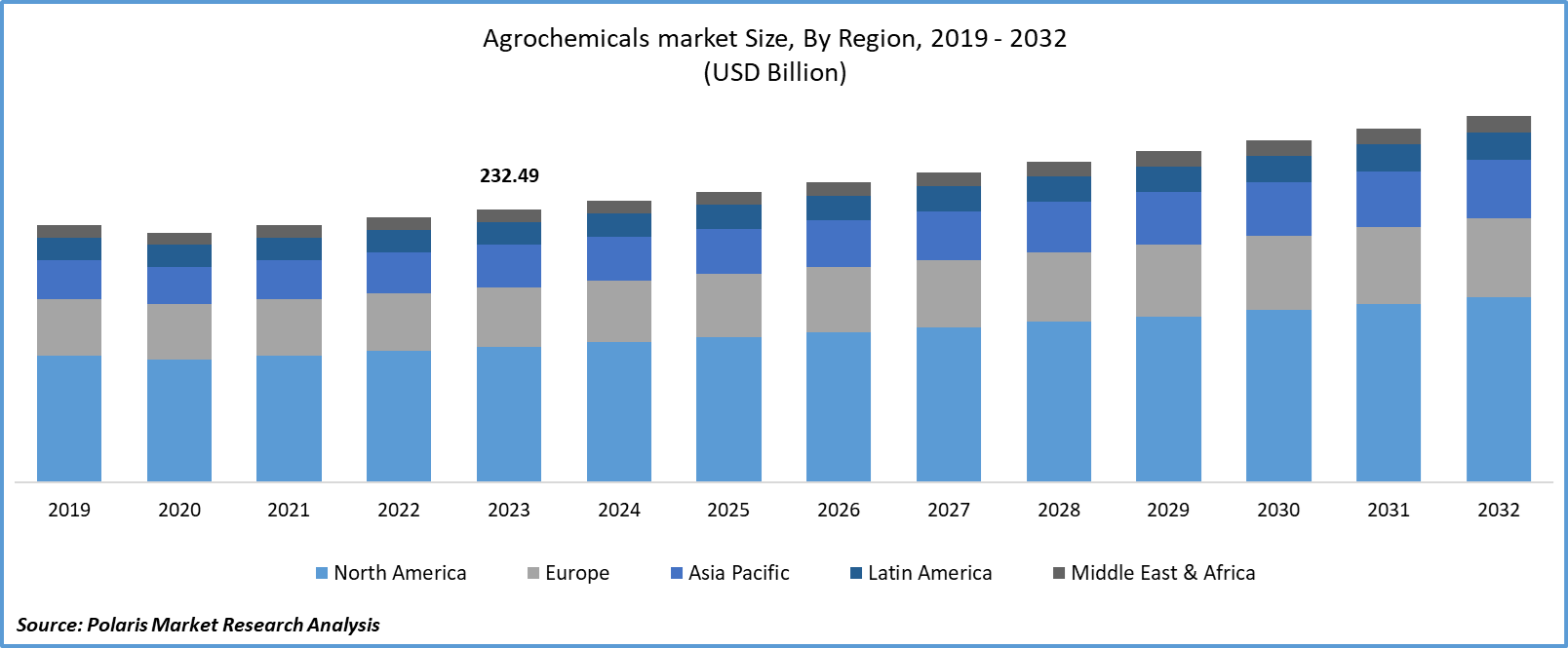
To Understand More About this Research:Download Sample Report
Companies are increasing their efforts to boost agricultural productivity. There will be a huge demand for agrochemicals as the availability of effective fertilizers and pesticides increases around the world. Additionally, rising government regulations to boost food production are optimally stimulating agrochemical availability.
For instance, in September 2023, the Ministry of Agriculture and Rural Affairs in China announced the approval of 12 novel pesticides, including Metarhizium anisopliae PL-GM1, Cyclobutrifluram, and Flusulfinam. In this, chemical pesticides, biopesticides, and microbial pesticides constitute 33%, 17%, and 50%, respectively.
Moreover, the increasing demand for sustainable products is transforming the agrochemicals market, driven by rising environmental-friendly fertilizers development by the major players. For instance, in January 2023, Sumitomo Chemical announced the acquisition of a bio-stimulant firm to expand its capacity to produce sustainable agrochemicals.
Agrochemicals play a crucial role in enhancing agricultural productivity by controlling pests, diseases, and weeds, thus ensuring sufficient food production to meet the needs of a growing population. With the expansion of agriculture into previously uncultivated areas and the intensification of farming practices, there is a growing need for crop protection products to safeguard crops from pests, diseases, and adverse weather conditions. Agrochemicals such as insecticides, fungicides, and herbicides safeners help farmers protect their crops and maximize yields.
The adoption of modern farming practices, including precision farming, integrated pest management (IPM), and genetically modified (GM) crops, drives the demand for agrochemicals. These practices require the use of specialized agrochemicals tailored to specific crops, soil conditions, and insect pest control strategies.
Ongoing technological advancements in agrochemicals, such as the development of novel active ingredients, formulations, delivery systems, and application techniques, contribute to the growth of the market. Innovations in biotechnology, nanotechnology, and digital agriculture offer new opportunities for improving the efficacy, safety, and environmental sustainability of agrochemical products.
However, the higher cost of investment in agrochemical research and development activities is anticipated to hamper the emergence of new companies in the marketplace. The increasing demand for organic products is projected to lower the use of agrochemicals over the forecast period.
Growth Drivers
Increasing Global Population
The rising population growth, mainly among developing nations, is creating huge concerns about increasing agricultural productivity. As per the United Nations Food and Agricultural Organization and the International Food Policy Research Institute Report, by 2050, world food demand is projected to grow by 70% to feed 9.3 billion of the global population, along with the growing consumer income in Asia, Latin America, & Eastern Europe. This is driving the demand for agrochemicals in the world, driven by their potential to protect plants from weeds, pests, and insects.
Growing Demand for Fertilizers
Farmers are increasing the use of fertilizers in their crop cultivation to promote plant growth and supply the required soil nutrients. According to the data published in the Economic Times in 2023, from 54.62 lakh tonnes in 2021-22, the imports of DAP (di-ammonium phosphate) reached 65.83 lakh tonnes in 2022-23, while from 11.7 lakh tonnes, NPK (nitrogen, phosphorus, and potassium) fertilizers imports grew to 27.5 lakh tonnes. This demonstrates the growing fertilizer consumption among farmers. Additionally, rising plant protection agrochemicals are registering significant demand with the growing new product launches.
Source: Polaris Market Research Analysis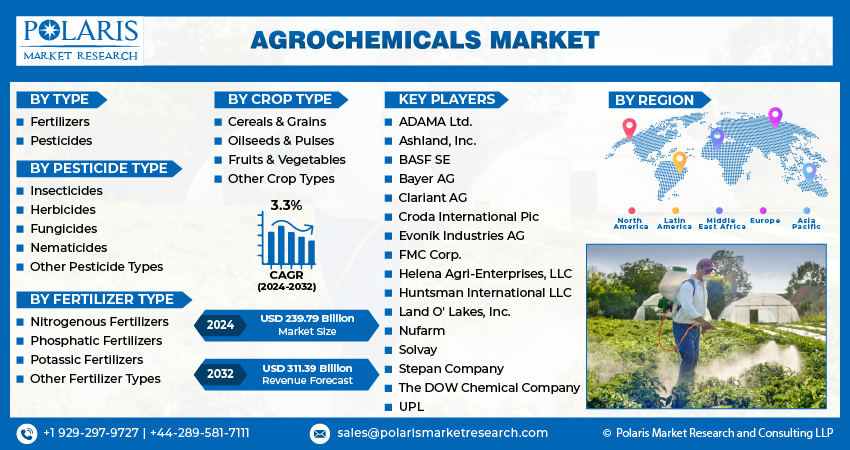
Get Full Segment-Level Forecasts & Insights: Download Sample Report
Restraining Factors
Regulatory Hurdles are Likely to Impede Market Growth
The rising stringent government regulations on agrochemicals to promote food safety and soil health are anticipated to restrict the manufacturing of new agrochemicals in the long run. The prevalence of harmful pesticides and other agrochemicals is likely to experience lower demand with the rising prevalence of human diseases in the world. Additionally, the growing development of electrical tools to remove weeds is potentially hindering market growth.
Report Segmentation
The agrochemicals market is primarily segmented based on type, pesticide type, fertilizer type, crop type, and region.
| By Type | By Pesticide Type | By Fertilizer Type | By Crop Type | By Region |
|
|
|
|
|
Source: Polaris Market Research Analysis
To Understand the Scope of this Report:Request Customization
By Type Analysis
The fertilizer segment is projected to grow at highest CAGR during the projected period, mainly driven by the rising development of sustainable fertilizers with the potential to promote agriculture productivity. Fertilizers play a crucial role in enhancing agricultural productivity by providing essential nutrients to crops, thus increasing yields and ensuring food security for a growing population.
With the expansion of agriculture into previously uncultivated areas and the intensification of farming practices, there is a growing need for fertilizers to replenish soil nutrients and maintain soil fertility. Fertilizers help farmers optimize crop production on both existing and newly cultivated land. he adoption of high-yielding crop varieties, including genetically modified (GM) crops, increases the demand for fertilizers. High-yielding varieties have greater nutrient requirements to support their growth and development, making fertilizers essential for maximizing their potential yields.
The herbicide segment accounted for the largest market share in 2024, attributable to the rising development of multiple weeds on agricultural land, leading to a lack of nutrients for the plants. Additionally, the growing new herbicide development activities by the key companies with technology integration are promoting the availability of effective agrochemicals.
For instance, in May 2023, BASF introduced two new herbicides, Duvelon and Facet, in India to aid tea and rice farmers in protecting their plants from weeds.
By Fertilizer Type Analysis
The nitrogenous fertilizers segment held a significant market share in revenue in 2025, which is highly accelerated due to the need for nitrogen to develop chlorophyll, which is essential in the plant's photosynthesis process. It plays a crucial role in plant growth and the development of quality flowers and fruits. This is encouraging agrochemical companies to expand their production capacity.
For instance, in April 2024, Genesis Fertilizers Limited and Thyssenkrupp Uhde announced their plans to construct a nitrogenous fertilizers complex in Saskatchewan, Canada, with lower emissions.
Source: Polaris Market Research Analysis
Need Granular Data Across All Market Segments? Request Customization
Real-World Examples of Agrochemical Applications in Modern Agriculture
| Application Area | Real-World Example | Purpose |
| Pest Control | In cotton farming, insecticides are used to control bollworms and whiteflies that damage crops | Helps reduce crop losses and improve cotton yield |
| Pest Control | In rice cultivation, pesticides are applied to manage stem borers and leaf folders | Protects rice plants and improves grain production |
| Nutrient Supply | Urea and NPK fertilizers are widely used in wheat and maize farming | Provides essential nitrogen, phosphorus, and potassium for healthy crop growth |
| Nutrient Supply | Micronutrient fertilizers such as zinc sulfate are used in paddy fields | Prevents nutrient deficiency and improves plant development |
| Crop Protection | Fungicides are used in grape farming to prevent powdery mildew and fungal diseases | Maintains fruit quality and reduces disease-related losses |
| Crop Protection | Herbicides are applied in soybean and sugarcane fields to control unwanted weeds | Reduces competition for nutrients, water, and sunlight |
Source: Polaris Market Research Analysis
Regional Insights
Asia Pacific region expected to witness the fastest growing CAGR of the agrochemicals industry during the forecast period. The Asia Pacific region is home to some of the world's largest agricultural economies, including China, India, Indonesia, and Vietnam. Agriculture is a major contributor to the region's economy, employing a significant portion of the population and supporting food security and rural development. With a rapidly growing population and increasing urbanization, there is a rising demand for food in the Asia Pacific region. Agrichemicals, including fertilizers, pesticides, and plant growth regulators, play a crucial role in enhancing agricultural productivity and ensuring sufficient food production to meet the needs of a growing population.
Many countries in the Asia Pacific region are experiencing a shift towards commercial farming and modern agricultural practices. Large-scale commercial farms and agribusinesses require specialized agrichemicals to optimize crop production, manage pests and diseases, and maximize returns on investment. Governments in the Asia Pacific region often provide subsidies, incentives, and support programs to promote agricultural productivity and rural development. This includes subsidies for the purchase of agrichemicals, agricultural machinery, and irrigation systems, stimulating demand for agrichemical products among farmers. Furthermore, the growing launch of new agrochemicals is expected to create significant adoption during the forecast period.
For instance, in June 2023, Crystal Crop Protection Ltd. unveiled Sikosa, an herbicide to safeguard paddy from weeds.
Source: Polaris Market Research Analysis
Curious About Regional Market Performance? Request Customization
Key Players & Competitive Insights
The agrochemicals market is a mix of fragmentation and consolidation. Key players are stepping forward with new strategies to innovate new agrochemical development and brand coverage through expansion activities. Evaluate the product portfolio of key players, including fertilizers, pesticides, herbicides, fungicides, and plant growth regulators. Companies that offer a diverse range of agrichemical products tailored to different crops, pests, and farming practices have a competitive advantage in meeting the varied needs of farmers.
Some of the major players operating in the global market include:
- ADAMA Ltd.
- Ashland, Inc.
- BASF SE
- Bayer AG
- Clariant AG
- Croda International Pic
- Evonik Industries AG
- FMC Corp.
- Helena Agri-Enterprises, LLC
- Huntsman International LLC
- Land O' Lakes, Inc.
- Nufarm
- Solvay
- Stepan Company
- The DOW Chemical Company
- UPL
Recent Developments in the Industry
- March 2026: Aarti Industries Limited (AIL) entered into a multi-year supply agreement with a top global agrochemical innovator for the supply of a critical agrochemical intermediate. The agrochemicals are expected to be used in crop protection formulations. The agreement is projected to generate revenue of approximately USD 150 million over the contract period. (Source: www.aarti-industries.com)
- In June 2025, Micropep Technologies and Corteva announced a multi-year R&D partnership to develop peptide-based biocontrols using Micropep’s Krisalix platform. This collaboration gives Corteva exclusive access to peptides for global biocontrol applications thereby helping in improving sustainable crop protection solutions. (Source: www.businesswire.com)
- In May 2025, ADAMA Ltd., a leading global crop protection company, announced the U.S. registration of its latest herbicide, Temper More. Designed to combat herbicide-resistant weeds in row crops, it provides strong burndown performance and extended residual control. Utilizing ADAMA’s proprietary Sesgama Formulation Technology, the product enhances weed resistance management for farmers. (Source: www.adama.com)
- In March 2025, ADAMA US introduced Maxentis SC, a next-generation fungicide designed to protect corn, soybean, and wheat crops from major diseases like tar spot and frogeye leaf spot. It combines prothioconazole and azoxystrobin in a single, easy-to-use formula for long-lasting disease control and improved plant health. (Source: www.adama.com)
- In August 2024, Syngenta India launched two crop protection products, Miravis Duo and Reflect Top. Miravis Duo targeted diseases in tomato, chili, groundnut, and grape, while Reflect Top offered long-lasting protection against sheath blight in rice, supporting Indian farmers’ productivity. (Source: www.syngenta.co.in)
Report Coverage
The agrochemicals market report emphasizes on key regions across the globe to provide better understanding of the product to the users. Also, the report provides market insights into recent developments, trends and analyzes the technologies that are gaining traction around the globe. Furthermore, the report covers in-depth qualitative analysis pertaining to various paradigm shifts associated with the transformation of these solutions.
The report provides detailed analysis of the market while focusing on various key aspects such as competitive analysis, type, pesticide type, fertilizer type, crop type, and their futuristic growth opportunities.
Agrochemicals Market Report Scope
| Report Attributes | Details |
| Market size value in 2025 | USD 307.88 billion |
| Market size value in 2026 | USD 319.40 billion |
| Revenue forecast in 2034 | USD 442.01 billion |
| CAGR | 4.1% from 2026 – 2034 |
| Base year | 2025 |
| Historical data | 2021 – 2024 |
| Forecast period | 2026 – 2034 |
| Quantitative units | Revenue in USD billion and CAGR from 2026 to 2034 |
| Segments covered |
|
| Regional scope |
|
| Competitive Landscape |
|
| Report Format |
|
| Customization | Report customization as per your requirements with respect to countries, region, and segmentation. |
Source: Polaris Market Research Analysis
agrochemicals market FAQ's
Agrochemicals Market report covering key segments are type, pesticide type, fertilizer type, crop type, and region.
Agrochemicals Market Size Worth USD 442.01 Billion By 2034
Agrochemicals Market exhibiting the CAGR of 4.1% during the forecast period.
Asia Pacific is leading the global market.
The key driving factors in Agrochemicals Market are Increasing global population
Download Sample Report of agrochemicals market
Please fill out the form to request a customized copy of the research report.


