
AI Model Risk Management Market Size, Share, Growth | Report, 2025-2034
REPORT DETAILS
Market Statistics
Market Overview
Global AI model risk management market size was valued at USD 5,703.02 million in 2024. The market is projected to grow from USD 6,428.44 million in 2025 to USD 19,036.19 million by 2034, exhibiting a CAGR of 12.8% during the forecast period.
The AI model risk management market involves the combination of products, services, and best practices for identifying, evaluating, and minimizing the risks associated with artificial intelligence models. The increasing integration of AI in healthcare, finance, retail, and manufacturing sectors has necessitated the development of robust risk management practices. Moreover, the incorporation of AI into pivotal applications such as autonomous vehicles, medical diagnostics, and financial services requires stringent risk management to ensure safety, precision, and dependability. This escalating demand for AI models is driving the need for AI model risk management, thereby contributing to market growth.
Source: Polaris Market Research Analysis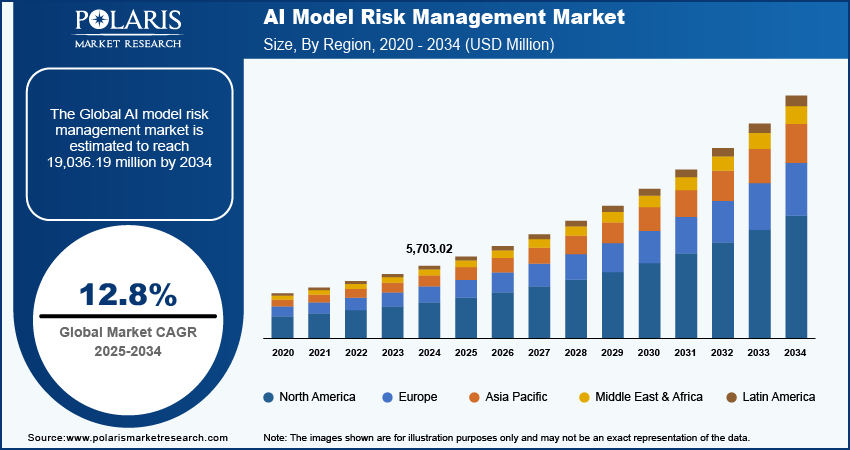
To Understand More About this Research: Download Sample Report
The rising investment in AI technologies and R&D activities is creating a need for robust trust, risk, and security management solutions to protect the investments. Furthermore, the evolution of AI security technologies, including advancements in negative machine learning defenses and secure data handling techniques, is accelerating market growth.
Market Drivers
Increasing Adoption of AI in Manufacturing Sector
The global manufacturing sector is experiencing substantial growth as organizations seek operational scalability and market expansion. For instance, in 2022, the sector contributed USD 2.3 trillion to the U.S. GDP, comprising 11.4% of the total GDP. The increasing importance of the manufacturing sector is accompanied by the widespread adoption of AI model risk management, which is significantly driving market growth. Moreover, the integration of AI in robotics and automation within manufacturing necessitates robust risk management to uphold the safety, effectiveness, and dependability of automated systems, thereby fueling market growth.
Rapid Increase E-Commerce
The rapid expansion of e-commerce, driven by increasing internet penetration and changing consumer behavior, has led to extensive use of AI technologies for enhancing different aspects of online retail. For instance, U.S. retail e-commerce sales surged to USD 289.2 billion in the first quarter of 2024, reflecting a 2.1 percent increase from the fourth quarter of 2023. AI plays a crucial role in customizing shopping experiences, delivering targeted recommendations, and streamlining inventory management. Consequently, with the increasing integration of AI into e-commerce platforms, robust AI model risk management becomes critical, thereby boosting market growth. Moreover, meticulous management of AI models utilized for fraud detection and prevention is essential to mitigate false positives and negatives, ensuring the protection of both customers and the platform.
Source: Polaris Market Research Analysis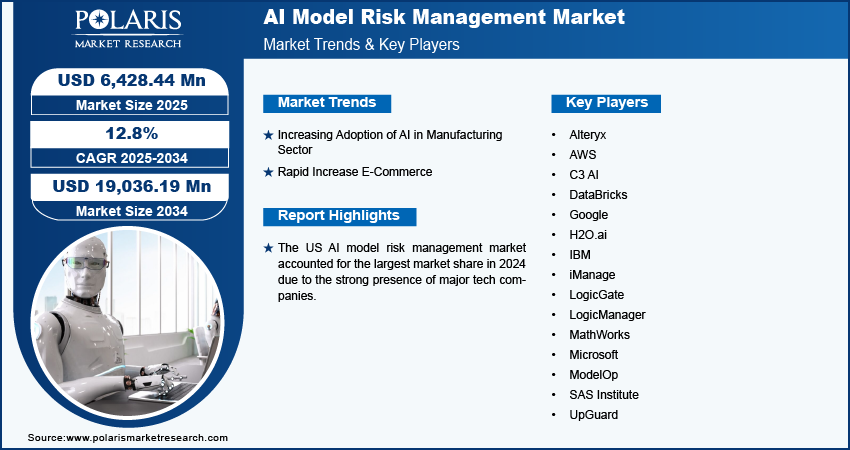
Get Full Segment-Level Forecasts & Insights: Download Sample Report
Market Segment Insights
AI Model Risk Management Market Breakdown by Application Insights
The global AI model risk management market segmentation, based on application, includes fraud detection and risk reduction, data classification and labelling, sentiment analysis, model inventory management, customer segmentation and targeting, regulatory compliance monitoring, and other applications. In 2023, the fraud detection and risk reduction segment accounted for the largest market share. The e-commerce industry, financial services, and other sectors have experienced a significant surge in digital transactions, leading to an increased susceptibility to fraudulent activities.
For instance, in April 2024, the Clearing House RTP network recorded 76 million transactions worth USD 42 billion in the first quarter of 2024 and also recorded over 27 million transactions in March. This surge in digital transactions has highlighted the essential role of AI technologies in the real-time identification and mitigation of associated risks.
Advanced artificial intelligence algorithms are capable of effectively analyzing extensive transaction data to detect both patterns and irregularities indicative of fraudulent behavior. Furthermore, the adoption of AI model risk management frameworks has become critical for organizations as they strive to optimize their fraud detection systems. This, in turn, mitigates the significant financial losses and customer dissatisfaction that arise from fraudulent activities.
AI Model Risk Management Market Breakdown by Vertical Insights
The global AI model risk management market segmentation, based on vertical, includes banking, financial services, and insurance (BFSI); government and public sector; healthcare and life science; IT & telecommunication; manufacturing; media & entertainment; retail & e-commerce; and other verticals. The healthcare and life science category is expected to be the fastest growing market segment. The integration and launching of AI in healthcare and life sciences is revolutionizing diagnostics, treatment planning, drug discovery, and patient care by offering exceptional accuracy and efficiency. For instance, in March 2024, NVIDIA launched around twenty new microservices tailored for healthcare enterprises worldwide, enabling them to leverage the latest advances in generative AI on any cloud platform.
The microservices include NVIDIA NIM AI models and workflows with industry-standard APIs for creating and deploying cloud-native applications. AI model risk management ensures these AI systems operate reliably, are free from biases, and comply with regulatory standards, thereby safeguarding patient privacy and data security. Furthermore, the rapid advancements in AI technologies, along with increasing investments in healthcare innovation, drive the demand for comprehensive risk management solutions to ensure AI models deliver safe, ethical, and effective results.
Source: Polaris Market Research Analysis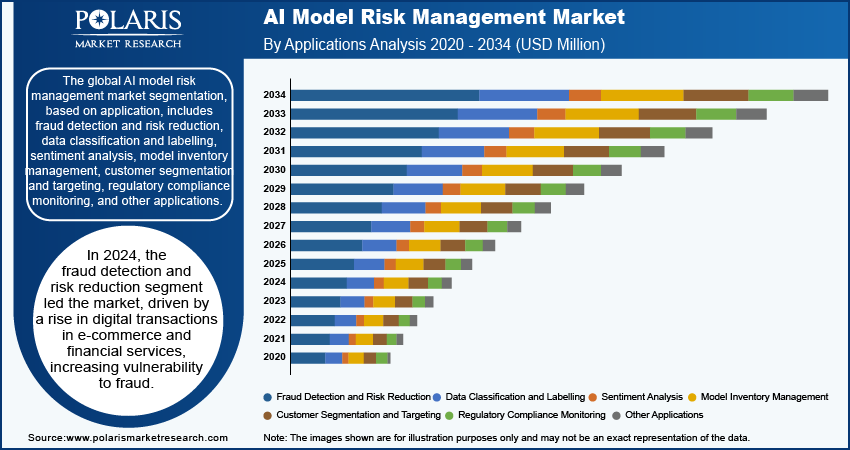
Need Granular Data Across All Market Segments? Request Customization
Market Regional Insights
By region, the study provides market insights into North America, Europe, Asia Pacific, Latin America, and the Middle East & Africa. AI model risk management market in North America accounted for the largest market share in 2024. The region is home to numerous technology giants and innovative startups, which drive significant advancements in AI across various industries. For Instance, in May 2024, Google launched Generative AI, revolutionizing malware analysis for defenders. These advancements have led to increasing demand for AI model risk management solutions in North America. Additionally, the region boasts a well-established infrastructure for AI research and development, fostering continuous innovation in risk management tools. The growing awareness of ethical AI use and the need to address biases further propel the demand for comprehensive risk management solutions.
The US AI model risk management market accounted for the largest market share in 2024 due to the strong presence of major tech companies, increasing AI investments, and the need for robust risk management frameworks have further propelled the market's growth.
Source: Polaris Market Research Analysis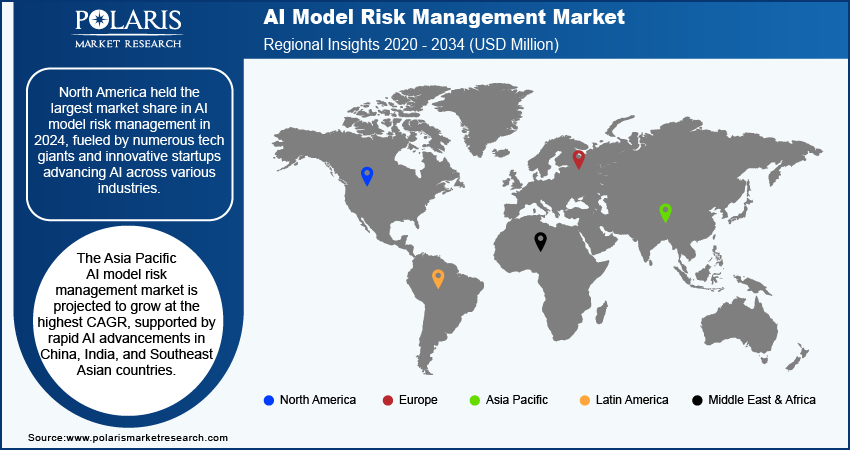
Curious About Regional Market Performance? Request Customization
Asia Pacific AI model risk management market is expected to grow at the highest CAGR during the forecast period. This is due to the presence of countries such as China, India, and Southeast Asian nations that are rapidly advancing their AI capabilities, leading to a heightened demand for robust risk management solutions to ensure compliance and mitigate potential risks. The rapid economic growth in emerging markets throughout the region is driving the widespread adoption of AI technologies across diverse industries. Furthermore, businesses are enhancing their AI capabilities, and there is an increasing necessity for strong risk management strategies to address associated risks. Growing awareness about AI-related risks and the development of local expertise in AI and risk management are further accelerating the market growth.
The market for AI model risk management in China is expected to grow significantly in the coming years. This growth is mainly because of China's strong economy and heavy investments in AI and technology. These factors are making it easier for businesses to focus on advanced risk management solutions to safeguard their AI projects. As a result, more companies will likely seek out AI model risk management services.
Market Key Players & Competitive Insights
Leading market players are investing heavily in research and development in order to expand their product lines, which will help the AI model risk management market grow even more. Market participants are also undertaking a variety of strategic activities to expand their global footprint, with important market developments including new product launches, contractual agreements, mergers and acquisitions, higher investments, and collaboration with other organizations. To expand and survive in a more competitive and rising market climate, the AI model risk management industry must offer cost-effective items.
In recent years, the AI model risk management market has offered some technological advancements. Major players in the AI model risk management market include Alteryx, AWS, C3 AI, DataBricks, Google, H2O.ai, IBM, iManage, LogicGate, LogicManager, MathWorks, Microsoft, ModelOp, SAS Institute, and UpGuard.
Microsoft is a multinational technology company headquartered in Redmond, Washington. The company offers various products and services, including operating systems, productivity software, gaming consoles, and cloud-based solutions. Its flagship product, Microsoft Windows, is the world's most widely used operating system. Other popular products include Microsoft Office, Skype, and the Xbox gaming console. Microsoft has invested heavily in artificial intelligence (AI) and machine learning technologies in recent years. In July 2023, KPMG and Microsoft significantly expanded their global relationship to transform professional services across key business areas such as workforce modernization, secure development, and implementation of AI solutions for clients, industries, and society at large.
International Business Machines Corporation (IBM) is an American multinational technology company operating in over 75 countries. It is the largest technology firm in the world and the second most valuable worldwide brand. The company mainly sells software, which generates 29% of its revenue. For instance, in May 2024, IBM and Palo Alto Networks partnered to provide AI-powered security products for customers. IBM to provide security consulting services across Palo Alto Networks’ platforms to drive business in AI security and cybersecurity.
List of Key Companies
- Alteryx
- AWS
- C3 AI
- DataBricks
- H2O.ai
- IBM
- iManage
- LogicGate
- LogicManager
- MathWorks
- Microsoft
- ModelOp
- SAS Institute
- UpGuard
Industry Developments
May 2024: Union Bank of India partnered with SAS Solutions to enhance its risk management systems. The partnership aims to update and facilitate the bank's risk procedures and reporting using advanced model risk management solutions.
May 2024: Amazon Web Services and CrowdStrike expanded partnerships to enhance cybersecurity consolidation and cloud transformation. Amazon has integrated its cybersecurity defenses using the CrowdStrike Falcon platform, replacing various cloud security products with Falcon Cloud Security and implementing Falcon Next-Gen SIEM and Identity Threat Detection and Response. CrowdStrike is also increasing its use of AWS services to drive innovation in cloud security and cybersecurity AI use cases.
September 2022: C3 AI and Google Cloud extended their partnership for three years to accelerate joint sales and co-development efforts. C3 AI's full suite of enterprise AI applications is now available on Google Cloud. The companies scaled their joint go-to-market strategy and co-developed new AI-driven applications using Google Cloud's Vertex AI and data analytics services.
Market Segmentation
By Offering Outlook
- Software by Type
- Model Management
- Bias Detection
- Explainable AI Tools
- Others
- Software by Deployment Mode
- Cloud
- On-Premises
- Services
- Professional Services
- Consulting and Advisory
- Managed Services
- Others
By Risk Type Outlook
- Security Risk
- Ethical Risk
- Operational Risk
By Application Outlook
- Fraud Detection and Risk Reduction
- Data Classification and Labelling
- Sentiment Analysis
- Model Inventory Management
- Customer Segmentation and Targeting
- Regulatory Compliance Monitoring
- Other Applications
By Vertical Outlook
- Banking, Financial Services, And Insurance (BFSI)
- Government and Public Sector
- Healthcare and Life science
- IT & Telecommunication
- Manufacturing
- Media & Entertainment
- Retail & E-Commerce
- Other Verticals
By Regional Outlook
- North America
- US
- Canada
- Europe
- Germany
- France
- UK
- Italy
- Spain
- Netherlands
- Russia
- Rest of Europe
- Asia Pacific
- China
- Japan
- India
- Malaysia
- South Korea
- Indonesia
- Australia
- Vietnam
- Rest of Asia Pacific
- Middle East & Africa
- Saudi Arabia
- UAE
- Israel
- South Africa
- Rest of Middle East & Africa
- Latin America
- Mexico
- Brazil
- Argentina
- Rest of Latin America
Report Scope:
| Report Attributes | Details |
| Market Size Value in 2024 | USD 5,703.02 Million |
| Market Size Value in 2025 | USD 6,428.44 Million |
| Revenue Forecast in 2034 | USD 19,036.19 Million |
| CAGR | 12.8% from 2025 to 2034 |
| Base Year | 2024 |
| Historical Data | 2020 – 2023 |
| Forecast Period | 2025 – 2034 |
| Quantitative Units | Revenue in USD Million and CAGR from 2025 to 2034 |
| Report Coverage | Revenue Forecast, Market Competitive Landscape, Growth Factors, and Industry Trends |
| Segments Covered |
|
| Regional Scope |
|
| Competitive Landscape |
|
| Report Format |
|
| Customization | Report customization as per your requirements with respect to countries, regions, and segmentation. |
Source: Polaris Market Research Analysis
AI Model Risk Management Market FAQ's
The global AI model risk management market size was valued at USD 5,703.02 million in 2024 and is projected to grow to USD 19,036.19 million by 2034
The global market is projected to exhibit a CAGR of 12.8% during the forecast period, 2025-2034.
North America had the largest share of the global market
The key players in the market are Alteryx, AWS, C3 AI, DataBricks, Google, H2O.ai, IBM, iManage, LogicGate, LogicManager, MathWorks, Microsoft, ModelOp, SAS Institute, and UpGuard.
In 2024, the fraud detection and risk reduction segment accounted for the largest market share. The e-commerce industry, financial services, and other sectors have experienced a significant surge in digital transactions, leading to an increased susceptibility to fraudulent activities.
The healthcare and life science category is expected to be the fastest growing market segment. The integration and launching of AI in healthcare and life sciences is revolutionizing diagnostics, treatment planning, drug discovery, and patient care by offering exceptional accuracy and efficiency.
Download Sample Report of AI Model Risk Management Market
Please fill out the form to request a customized copy of the research report.


