

Market Overview
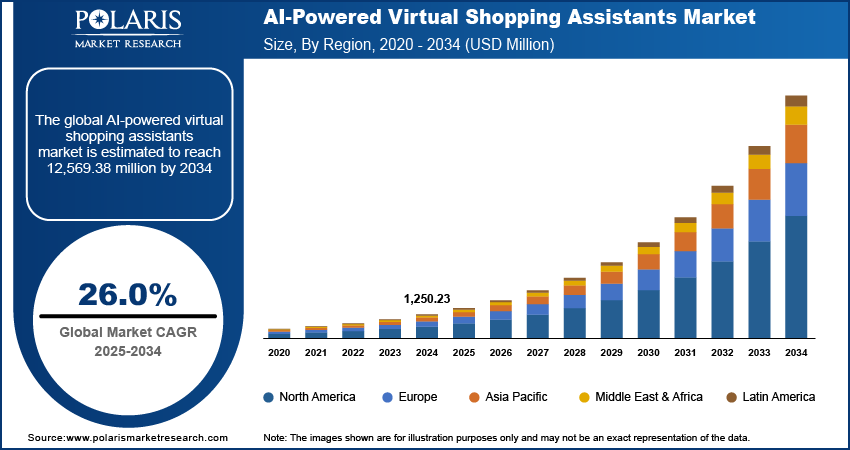
The AI-powered virtual shopping assistants market size was valued at USD 4.18 billion in 2025. It is projected to exhibit a CAGR of 27.2% during 2026–2034. Rising incomes, digitalization, and advanced AI technologies are the main drivers of market growth. Growing urban demand for convenient and personalized shopping fuels market expansion.
Key Insights
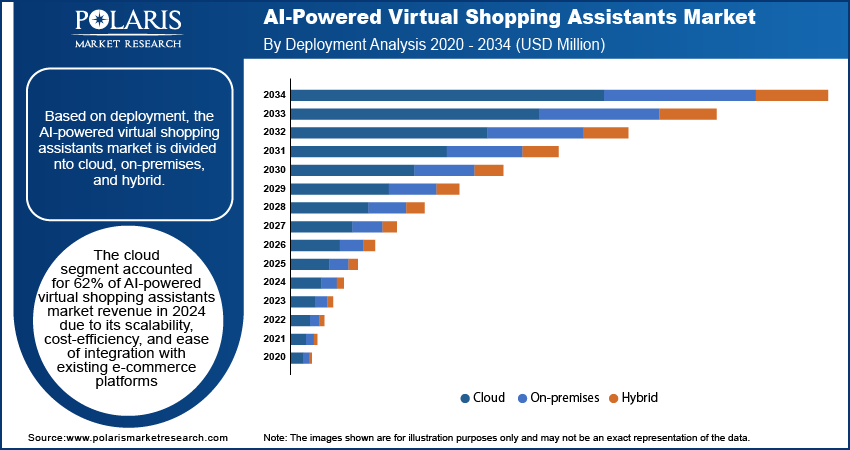
- The cloud segment dominated the AI-powered virtual shopping assistants market. The segment accounted for USD 1.01 billion in revenue in 2025. This is due to its expandability, cost efficiency, and seamless integration across digital channels.
- The e-commerce segment led the AI-powered virtual shopping assistants market in 2025. Virtual shopping assistants are being increasingly used in e-commerce as they improve user experience, reduce cart abandonment, and customizes shopping journeys.
- North America held the largest regional share. Early AI adoption, strong digital literacy, and strong e-commerce ecosystems drive this regional dominance. Major retailers such as Amazon have significant investments in North America.
- The Asia Pacific region is growing fast. The growth in this region is supported by rapidly evolving digitalization and the introduction of 5G smartphones. Adoption of AI assistants is rising in e-commerce, and customer support is increasing in the region.
Industry Dynamics
- Increase in disposable incomes drives more demand for AI-powered virtual shopping experiences that are tailored to individuals.
- Rapid digitalization fuels consumers ' demand for seamless and real-time support. It makes conversation between consumers and digital platforms for customized recommendations.
- Improvements in NLP and machine learning are making AI virtual assistants more accurate for personalization. This can enhance user engagement.
- Increasing urbanization expands the market for on-the-go, efficient AI shopping solutions.
- Privacy concerns and implementation costs are high. They may limit the widespread adoption of AI-powered virtual shopping assistants.
Market Statistics
- 2025 Market Size: USD 4.18 billion
- 2034 Projected Market Size: USD 36.50 billion
- CAGR (2026–2034): 27.2%
- North America: Largest market in 2025
Impact of AI on AI-Powered Virtual Shopping Assistants Market
- Artificial intelligence (AI) is transforming the AI-powered virtual shopping assistants market. It allows retailers to deliver personalized and interactive shopping experiences. AI technologies play an important role in analyzing large volumes of consumer behavior data in real time. The analysis generates accurate product recommendations to improve customer engagement across digital channels.
- The development of generative AI models and large language models (LLMs) is accelerating the innovations in AI-powered virtual shopping assistants. These systems allow assistants to understand complicated customer questions and generate contextual responses. Further, this advancement in technology delivers highly conversational interactions that mimic human sales associates.
- Proper handling of complicated tasks is supported by AI-driven automation. These tasks include order tracking, product discovery, and personalized recommendations.
- Integration of AI in virtual shopping platforms enhances cross-selling and upselling capabilities. It boosts e-commerce sales and customer retention.
- Additionally, multimodal AI assistants are becoming increasingly popular in the retail industry. Multimodal AI assistants, also known as virtual shopping assistants, use AI technology to allow consumers to communicate with virtual assistants using voice, text, and even images. This allows consumers to discover products by simply interacting with these virtual assistants. The aforementioned technologies improve the discovery of products.
- Retailers are adding these AI-powered virtual shopping assistants with AI-Powered Virtual Shopping Assistants Market enable real-time personalization and predictive shopping experiences.
To Understand More About this Research:Request a Free Sample Report
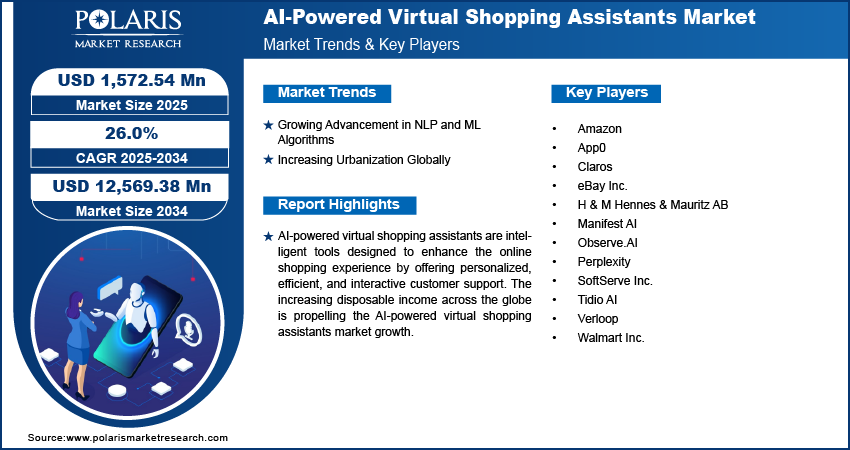
AI-powered virtual shopping assistants are intelligent digital tools. These tools are designed to enhance the digital shopping experience. Personalized, efficient, and interactive customer support are the key offerings of these tools. These solutions power advanced technologies such as natural language processing (NLP), machine learning (ML), and predictive analytics. These tools simulate human-like interactions across digital retail environments. AI-driven virtual shopping assistants provide responses to customer queries in real time and adjust their recommendations according to the customer’s individual preferences. Virtual shopping assistants function like a digital sales assistant that assists customers in the shopping process. Virtual shopping assistants facilitate customers in the shopping process for the website’s various sections. The role of virtual shopping assistants is no longer limited to providing customer support. Virtual shopping assistants provide customers with options to increase the overall sales for the online store through the features of cross-selling and upselling .
These AI-powered virtual shopping assistants play a major role in the AI-Powered Virtual Shopping Assistants Market enables retailers to interact with customers through chat interfaces, voice assistants, and AI-driven product discovery engines. By integrating AI-Powered Virtual Shopping Assistants Market , virtual shopping assistants deliver highly personalized product suggestions. These services also automate customer service operations and guide users throughout the digital purchase journey.
Retailers increasingly deploy AI retail automation platforms. The automation supports omnichannel shopping experiences across mobile apps, websites, and messaging platforms. These assistants function as digital sales associates who analyze real-time customer behavior. Also, these assistants keep purchase history to improve engagement and conversion rates.
The increasing disposable income across the globe is increasing the AI-powered virtual shopping assistants market growth. The Bureau of Economic Analysis (BEA) reported that in January 2025, US disposable personal income increased by USD 194.3 billion, or 0.9%. Higher disposable income encourages consumers to use premium and personalized shopping experiences. This is accelerating the adoption of AI-powered retail technologies. With higher disposable income, users can also try premium services. The services include AI-driven styling advice or virtual try-ons. Retailers are adopting and integrating AI-powered virtual shopping assistants to satisfy users' needs. It enhances consumers' overall shopping experience. This is the reason why the demand for AI-powered virtual shopping assistants is increasing with the rising disposable income across the globe.
As consumer purchasing power grows, shoppers increasingly expect hyper-personalized recommendations. Virtual styling assistance and real-time product discovery tools are helpful while shopping digitally. AI-powered virtual shopping assistants help in fulfilling these users expectations. AI recommendation engines, conversational AI interfaces, and predictive analytics are important tools to provide product suggestions and improve purchase decision-making.
Retailers are therefore investing heavily in AI-Powered Virtual Shopping Assistants Market analyzes customer behavior, anticipates product demand, and optimizes cross-selling opportunities. Such potential of AI-based platforms makes the customers satisfied and increases the rate of conversion in digital commerce spaces.
The market demand for AI-powered virtual shopping assistants is driven by digitalization. The digitalization has created an environment where customers demand seamless and personalized shopping experiences. AI-powered virtual shopping assistants meet these expectations. They provide real-time support, personalized product recommendations, and quick resolutions to queries. Traditional customer service models struggle to deliver expectations regarding personalized choices and recommendations. Additionally, digitalization generates huge amounts of consumer data, allowing AI assistants to learn preferences, improve accuracy, and boost sales over time. This encourages e-commerce platforms to adopt and integrate AI-powered virtual shopping assistants, which contributes to market expansion.
Market Dynamics
Growing Advancements in NLP and ML Algorithms
Improved NLP has activated AI-powered virtual shopping assistants to understand and respond to customer queries more accurately. It provides a seamless and spontaneous shopping experience. On the other hand, machine learning algorithms allow these assistants to learn from user engagement. This offers personalized recommendations that predict consumer needs with high precision. Thus, as these technologies continue to evolve, they allow AI-powered virtual shopping assistants to handle complex tasks. These tasks include processing natural language queries, understanding context, and predicting customer action. This increased practicality and reliability of advanced AI-powered virtual shopping assistants drive their demand. Businesses recognize the potential of these assistants to improve customer satisfaction, increase sales, and secure a competitive edge.
Increasing Urbanization Globally
Urban people often seek faster, more convenient ways to shop without dealing with crowded stores or limited time. AI-powered virtual shopping assistants offer a solution by providing personalized recommendations. Also, they provide instant assistance and convenient access to products from anywhere, which makes them attractive. According to data released by the World Economic Forum, the percentage of the global population living in cities is expected to grow to 80% by 2050 from 55% in 2022. The retailers in these cities have invested a lot in AI technology to lure tech-savvy customers, thus setting them apart in a competitive market. Therefore, with the rise of urbanization, the need for smart shopping on the go increases. This establishes AI-powered virtual assistants as essential tools for modern urban consumers.
Conversational Commerce Ecosystem
Conversational commerce ecosystem refers to a combination of different entities such as chatbots, voice assistants, and messaging platforms. All these enable the user to converse with brands in real time. Virtual assistant platforms, live chat platforms, AI-based customer support systems form a part of the conversational commerce ecosystem. This enables the retailer to provide a seamless shopping experience to the customers. In this ecosystem, users can ask queries, seek advice, and even make purchases through communications. This ever-changing ecosystem is becoming the heart of the modern buyer’s experience for discovering digital products.
AI Retail Technology Stack
The AI retail technology stack includes the essential tools and systems. This stack makes smart retail possible. It covers machine learning platforms, analytics dashboards, natural language processing tools, and automation software. Combinally, these technologies manage product data, forecast demand, improve inventory control, and personalize customer engagement. This stack forms the technical foundation for AI-powered virtual shopping assistants. They support real-time recommendations and interactive and mindful shopping journeys.
AI Product Recommendation Engines
AI recommendation engines are important for analyzing consumer data. The data include browsing behavior, purchase history, and preferences. With this data, engines suggest products that match each user's choices. Retailers can improve sales and build trust. They can alo reduce decision or choice overload on buyers with the help of AI product recommendation engines. When these engines are added to AI-powered virtual shopping assistants, they make online shopping more engaging and customizable. The goal is to offer the right product to the right customer at the right time.
Segment Insights
Market Evaluation by Deployment
Based on deployment, the AI-powered virtual shopping assistants market is divided into cloud, on-premises, and hybrid. The cloud segment accounted for USD 1.01 billion in revenue in 2025. This share is due to its adaptability and cost-efficiency. These assistants are easy to integrate with existing e-commerce platforms. The cloud infrastructure enables retailers to integrate intelligent shopping assistants across multiple digital touchpoints. These points include websites, mobile apps, and messaging platforms without heavy upfront investments in IT infrastructure. Cloud deployment allows real-time data synchronization and updates. It helps enhance personalization and responsiveness in user communications. These capabilities significantly improve the user experience. It leads to higher user satisfaction and increased sales transition, hence driving the dominance of the segment.
Market Assessment by Industry Vertical
The AI-powered virtual shopping assistants market segmentation, based on industry vertical, includes e-commerce, retail, consumer goods, electronics, automotive, healthcare, and others. The e-commerce segment led the AI-powered virtual shopping assistants market in 2025. E-commerce businesses are adopting intelligent shopping technologies to strengthen user experience. These technologies are also important to increase conversion rates and reduce cart abandonment. The nature of digital commerce is highly competitive. This is the reason why companies can personalize customer journeys using advanced AI tools that recommend products, offer real-time assistance, and streamline the decision-making process. The shift in consumers' approach toward mobile and digital shopping created a positive space for AI-powered virtual shopping assistants to engage customers across various platforms.
The retail segment is expected to grow at a high rate in the coming years. The growth of the retail segment is due to the integration of artificial intelligence in physical stores and the concept of unified commerce in retail strategies. Retailers are increasingly using AI technology in their stores for the delivery of in-store digital assistants, personalized promotions, and voice-enabled kiosks, which provide the experience of digital retail. The integration of physical and digital retail provides businesses with better knowledge of the actions of the users and the ability to deliver products in real time. Additionally, the rise in the level of expectation of the customers and the retail industry in the delivery of digital retail is expected to contribute to the growth of the retail segment.
Regional Analysis
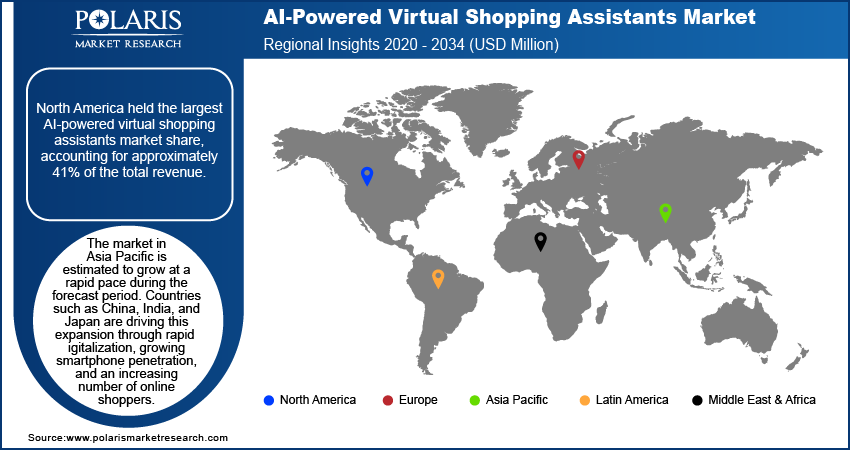
By region, the study provides AI-powered virtual shopping assistants market insights into North America, Europe, Asia Pacific, Latin America, and the Middle East & Africa. North America held the largest AI-powered virtual shopping assistants market share. The region accounted for approximately 50% of the total revenue share in 2025. North America has benefited from the early adoption of advanced AI technologies. Also, the region has high digital literacy and a well-established e-commerce ecosystem. Major retailers and tech companies across the US, such as Amazon, have heavily invested in AI-powered intelligent shopping solutions. The solutions are important to improve customer engagement and drive sales. The high introduction and use of smartphones and growing investment in research and development in information and technology has contributed to the market dominance in the region.
The AI-powered virtual shopping assistants market in the Asia Pacific is estimated to grow at a rapid pace during the forecast period. Countries such as China, India, and Japan are driving this expansion through rapid digitalization, growing 5G smartphone penetration, and an increasing number of online shoppers. Retailers in the region are adopting AI-powered intelligent assistants. These assistants are helping companies meet increasing consumer demands. AI virtual assistants help in terms of convenience, speed, and personalization. The growth is fueled by the increasing IT industry in India and the adoption of AI-powered enterprise automation in customer services. Additionally, financial services are contributing to the growth in terms of increasing market shares. According to the National Association of Software and Service Companies (NASSCOM), the Indian IT industry has achieved revenue of USD 227 billion in FY22, with 15.5% YoY growth. The region’s large population base, coupled with the growing middle class and increased investments in AI infrastructure, are supporting factors for strong growth. Therefore, the Asia Pacific is expected to witness rapid growth in the coming years.
AI-Powered Virtual Shopping Assistants – Key Players and Competitive Analysis
The AI-powered virtual shopping assistants market opportunity is constantly evolving, with numerous companies striving to innovate and distinguish themselves. Major global companies dominate the market by using extensive research and development and advanced techniques. These companies aim for strategic initiatives. They include mergers, acquisitions, partnerships, and collaborations. It enhances their product portfolio offerings and expands into new markets.
The AI-powered virtual shopping assistants market is fragmented, with the presence of numerous global and regional players. Major players in the market are Amazon, App0, Claros, eBay Inc., H&M Hennes & Mauritz AB, Manifest AI, Observe.AI, Perplexity, SoftServe Inc., Tidio AI, Verloop, and Walmart Inc.
Manifest AI is an innovative platform that reshapes e-commerce with its advanced AI-powered virtual shopping assistants. It is designed specifically for eCommerce storefronts, including Shopify stores. Manifest AI aims to enhance users' experiences. They offer personalized and interactive shopping paths. The Manifest AI platform is a virtual sales partner that utilizes NLP and deep learning algorithms to understand the preferences of the users. The platform provides product recommendations and helps the customers throughout the purchase or shopping experience. The company’s platform can be integrated with minimal efforts using tools like ChatGPT. This setup requires minimal effort. Once this tool is added, it systematizes various processes while maintaining versatility for customization.
SoftServe Inc. is a global company in IT consulting and digital services. The company is known for its proficiency in delivering innovative solutions. The company was founded in 1993. The company has established a global presence with offices in several countries. Headquartered in Austin, Texas. SoftServe specializes in empowering enterprises and software companies to achieve digital transformation. It accelerates solution development and optimizes business operations through advanced technologies. The SoftServe Gen AI Retail Shopping Assistant empowers shoppers to make confident purchasing decisions. Features such as interactive virtual try-ons help users. This allows buyers to visualize products in real-time. It ensures consumers can assess the fit and style before committing to a purchase.
List of Key Companies
- Amazon
- App0
- Claros
- eBay Inc.
- H & M Hennes & Mauritz AB
- Manifest AI
- Observe.AI
- Perplexity
- SoftServe Inc.
- Tidio AI
- Verloop
- Walmart Inc.
Startup Ecosystem in AI Retail
New companies develop creative technologies for internet retail. The ecosystem of AI retail start-ups is growing rapidly and smartly. Virtual assistants, personal shopping, AI analytics, and automated and digitalized customer services are the main areas of focus for the start-ups. They work in association with the retailers. The collaboration is important to discover new solutions or improve existing platforms. This fast-moving ecosystem is responsible for innovation and creating job opportunities. It attracts strong investment from both retail giants and venture capital firms.
Future of Generative AI Shopping Assistants
Generative AI will take the AI-powered virtual shopping assistants market to a new level. This integration is essential to creating customer interactions that are more human-like and adaptive. These assistants will generate natural conversations instead of following scripted responses. Generative AI also understands context and creates personalized product stories. It helps strategies go beyond, and users can visualize how products fit their style or needs. As this technology evolves, it will redefine online shopping. The addition of Generative AI turns browsing into an interactive, creative experience. Customers can feel closer to in-store shopping.
AI-Powered Virtual Shopping Assistants Industry Developments
November 2025: Amazon.com, Inc. upgraded its AI shopping assistant Rufus with advanced and context-aware features. Rufus now assists shoppers by understanding events or activities and adding items to carts. It also finds the best deals and remembers user choices through Amazon’s platforms.
October 2025: Alibaba Group Holding Limited introduced the Quark AI Chat Assistant. This is a conversational AI tool. The tool supports text, voice, and images for shoppers. Powered by their Qwen3 large language models. It integrates seamlessly with Alibaba’s e-commerce ecosystem, including Taobao.
January 2025: SoftServe announced the launch of SoftServe Gen AI Retail Shopping Assistant at NRF 2025. The company stated that the new assistant aims to enhance the retail experience.
November 2024: Perplexity, an AI-powered search engine, introduced an AI-powered shopping assistant for Perplexity Pro users in the US.
AI-Powered Virtual Shopping Assistants Market Segmentation
By Deployment Outlook (Revenue, USD Billion, 2021–2034)
- Cloud
- On-Premises
- Hybrid
By Technology Outlook (Revenue, USD Billion, 2021–2034)
- Natural Language Processing (NLP)
- Machine Learning (ML) & Deep Learning
- Voice Recognition
- Others
By Industry Vertical Outlook (Revenue, USD Billion, 2021–2034)
- E-Commerce
- Retail
- Consumer Goods
- Electronics
- Automotive
- Healthcare
- Others
By Regional Outlook (Revenue, USD Billion, 2021–2034)
- North America
- US
- Canada
- Europe
- Germany
- France
- UK
- Italy
- Spain
- Netherlands
- Russia
- Rest of Europe
- Asia Pacific
- China
- Japan
- India
- Malaysia
- South Korea
- Indonesia
- Australia
- Vietnam
- Rest of Asia Pacific
- Middle East & Africa
- Saudi Arabia
- UAE
- Israel
- South Africa
- Rest of Middle East & Africa
- Latin America
- Mexico
- Brazil
- Argentina
- Rest of Latin America
AI-Powered Virtual Shopping Assistants Report Scope
|
Report Attributes |
Details |
|
Market Size in 2025 |
USD 4.18 billion |
|
Market Size in 2026 |
USD 5.30 billion |
|
Revenue Forecast by 2034 |
USD 36.50 billion |
|
CAGR |
27.2% |
|
Base Year |
2025 |
|
Historical Data |
2021–2024 |
|
Forecast Period |
2026–2034 |
|
Quantitative Units |
Revenue in USD billion, and CAGR from 2026 to 2034 |
|
Report Coverage |
Revenue Forecast, Market Competitive Landscape, Growth Factors, and Trends |
|
Segments Covered |
|
|
Regional Scope |
|
|
Competitive Landscape |
AI-Powered Virtual Shopping Assistants Industry Trend Analysis (2025) Company profiles/industry participants profiling include company overview, financial information, product/service benchmarking, and recent developments |
|
Report Format |
PDF + Excel |
|
Customization |
Report customization as per your requirements with respect to countries, regions, and segmentation. |
FAQ's
The AI-powered virtual shopping assistants industry stood at USD 4.18 billion in 2025. The market is projected to reach USD 36.50 billion by 2034.
The market is projected to account for a CAGR of 27.2% during the projection period.
Some of the key players in the market are Amazon, App0, Claros, eBay Inc., H&M Hennes & Mauritz AB, Manifest AI, Observe.AI, Perplexity, SoftServe Inc., Tidio AI, Verloop, and Walmart Inc.
An AI shopping assistant is a virtual helper that supports customers online. These assistants answer product questions, suggest suitable items, and guide buyers. For these suggestions, they use search, comparison, and checkout across digital channels used by consumers.
AI shopping assistants capture customer questions or goals. They also interpret intent and match needs with product and customer data. After this analysis, they deliver suggestions, guidance, and support. These suggestions are improved over time as they learn from past interactions.
AI retail assistants use language understanding, data analysis, and real-time decision tools. These tools connect with product catalogs, pricing, and inventory systems. Assistants deliver accurate answers, customized suggestions, and end-to-end shopping help for consumers.
Page last updated on:
May-2025
Research Methodology
A robust system of research, verification, and forecasting designed to ensure reliable and actionable market insights.
Polaris Market Research uses a clear and structured approach to deliver insights that clients can rely on. The process combines detailed primary and secondary research, including direct communication with industry experts. The detailed information helps build a complete picture of market trends and developments. Secondary data is gathered from credible sources such as industry reports, company filings, government source links, and trusted organization databases. It is then cross-checked through discussions with key stakeholders across the value chain. Market size and forecasts are developed using both bottom-up and top-down methods to ensure accuracy and consistency in the final results.
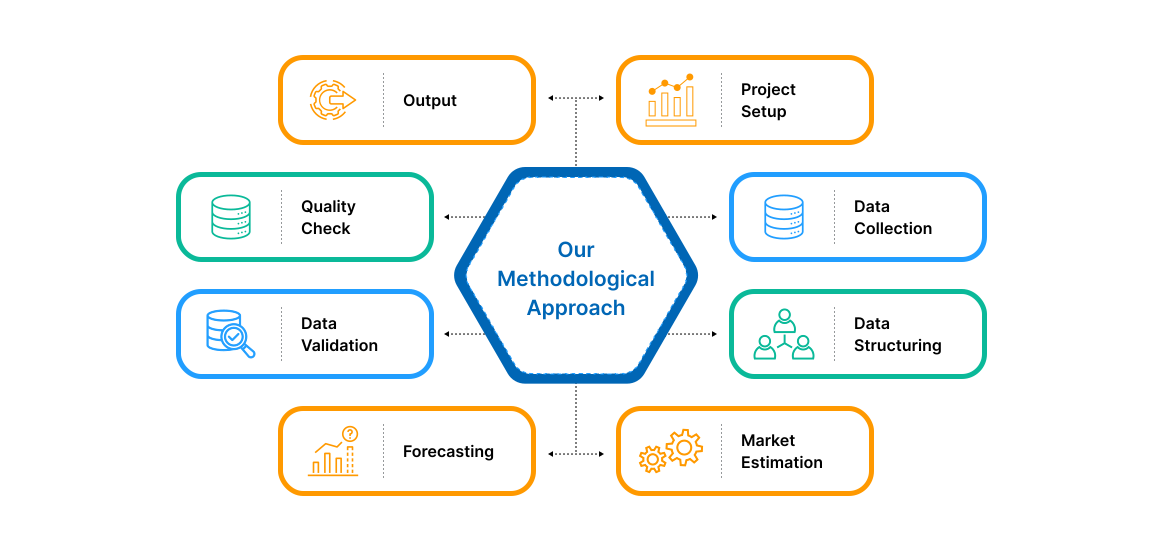
Project Setup
Step 1 & 2:
- We start every project by clearly understanding the client’s objective or goal, then defining the market scope, and aligning regions, segments, and timelines.
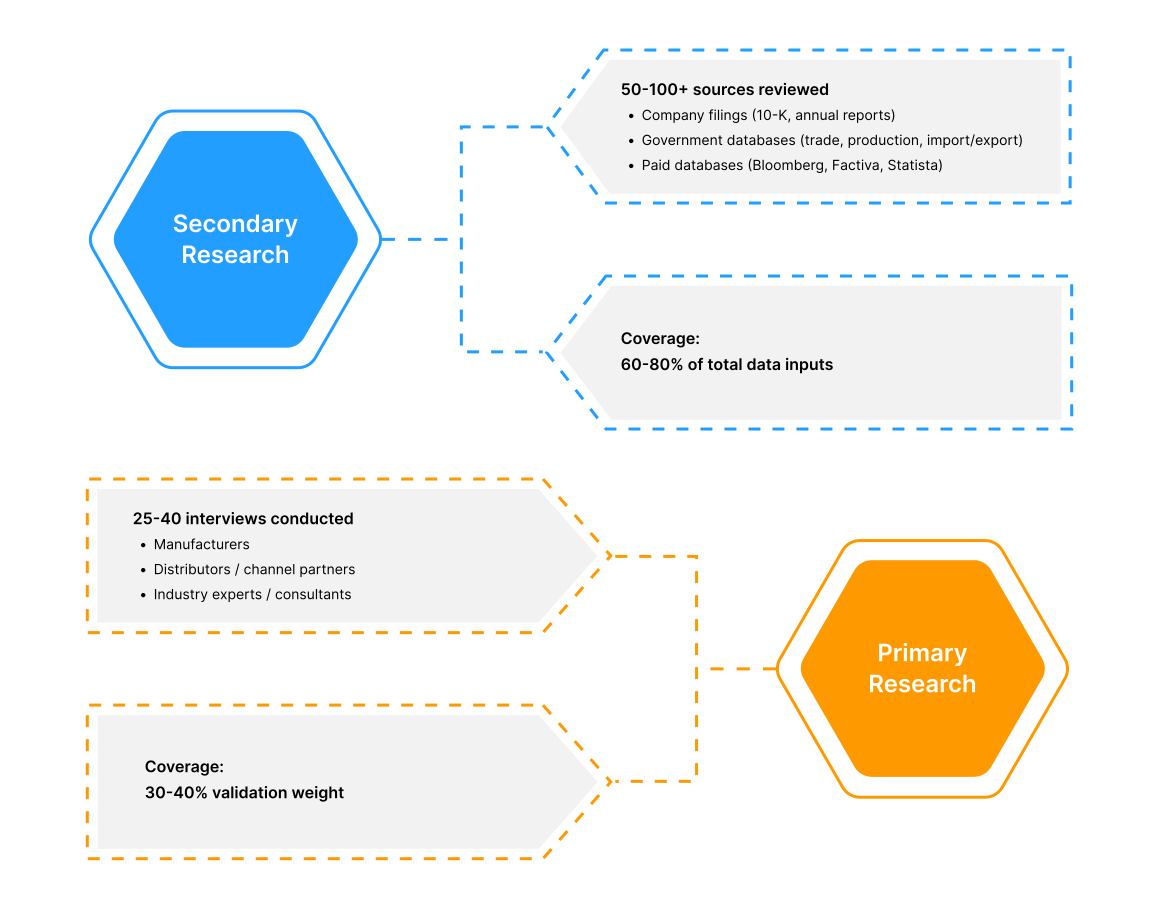
- Once the foundation is set, we collect data from all-around of sources, including company reports, government databases, and paid industry platforms.
- Our research is based on secondary data, which helps us build a strong understanding of the market across regions and industries. Then we validate this information through primary research by speaking directly with industry experts, companies, and stakeholders.
- By combining secondary and primary research, we ensure that our market insights are accurate, practical, and closely aligned with real market conditions.
Data Collection
We gather information from both public and verified sources:
Data Structuring
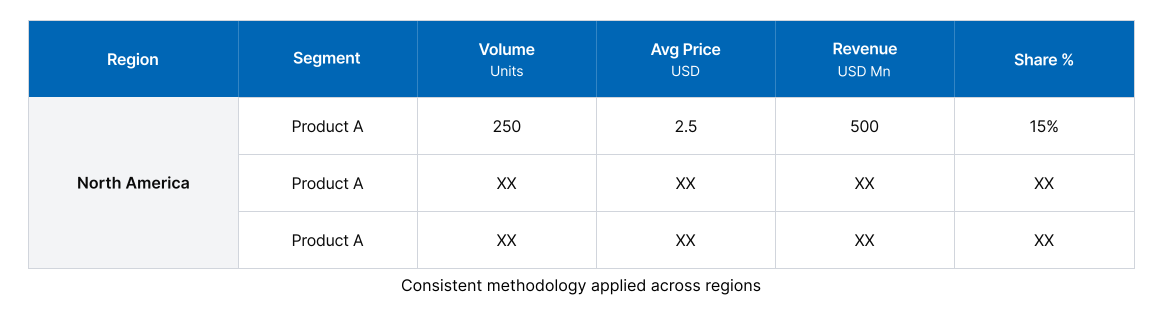
Step 3:
- All collected data is organized into a consistent format to ensure accurate analysis. Since inputs come from multiple sources, they are standardized and aligned before use.
- The data is segmented by product, application, and region, and mapped across a defined historical period (2020–2024). All values are converted into common units (USD Mn/Bn), and volume and pricing are aligned where required to estimate revenue.
- Any overlaps or inconsistencies are reviewed and adjusted to maintain accuracy (<5% variance threshold).
- The result is a structured dataset that allows for clear comparison across regions and supports reliable analysis and forecasting.
Structured Market Dataset, USD Mn/Bn
4. Data Structuring
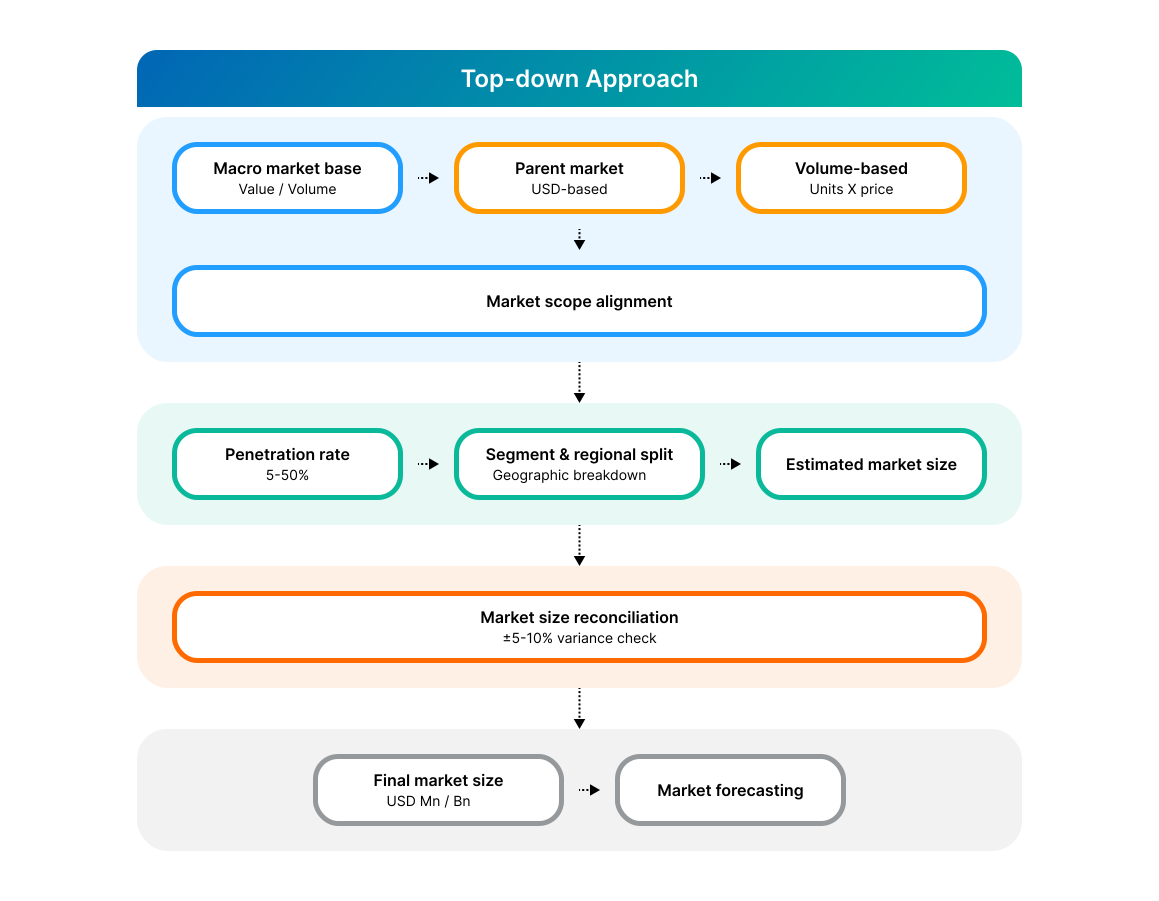
Step 4: TOP-DOWN APPROACH
- We start with the overall market size at a global or macro level.
- The market is then narrowed down based on scope and industry relevance.
- We apply penetration rates and split the data by region and segment.
- This helps us estimate the market size for specific segments.
- The numbers are validated through cross-checks to ensure accuracy.
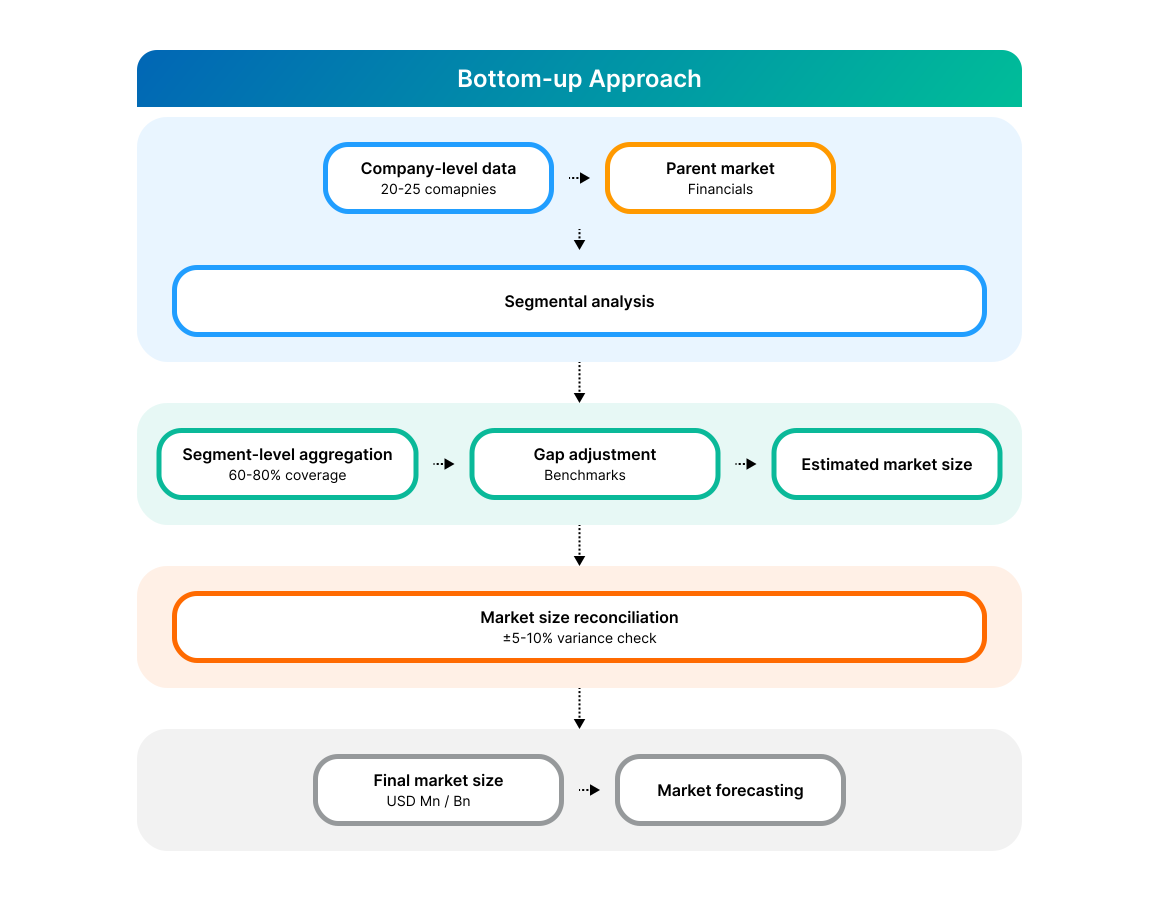
Step 5: BOTTOM-UP APPROACH
- We begin by analyzing data from leading companies in the market.
- Revenue data is collected and mapped across different segments.
- The data is then aggregated to estimate the total market size.
- To fill in any gaps, adjustments are made based on industry standards.
- Validation checks make sure that the results are correct.
5. Data Structuring
Step 6:
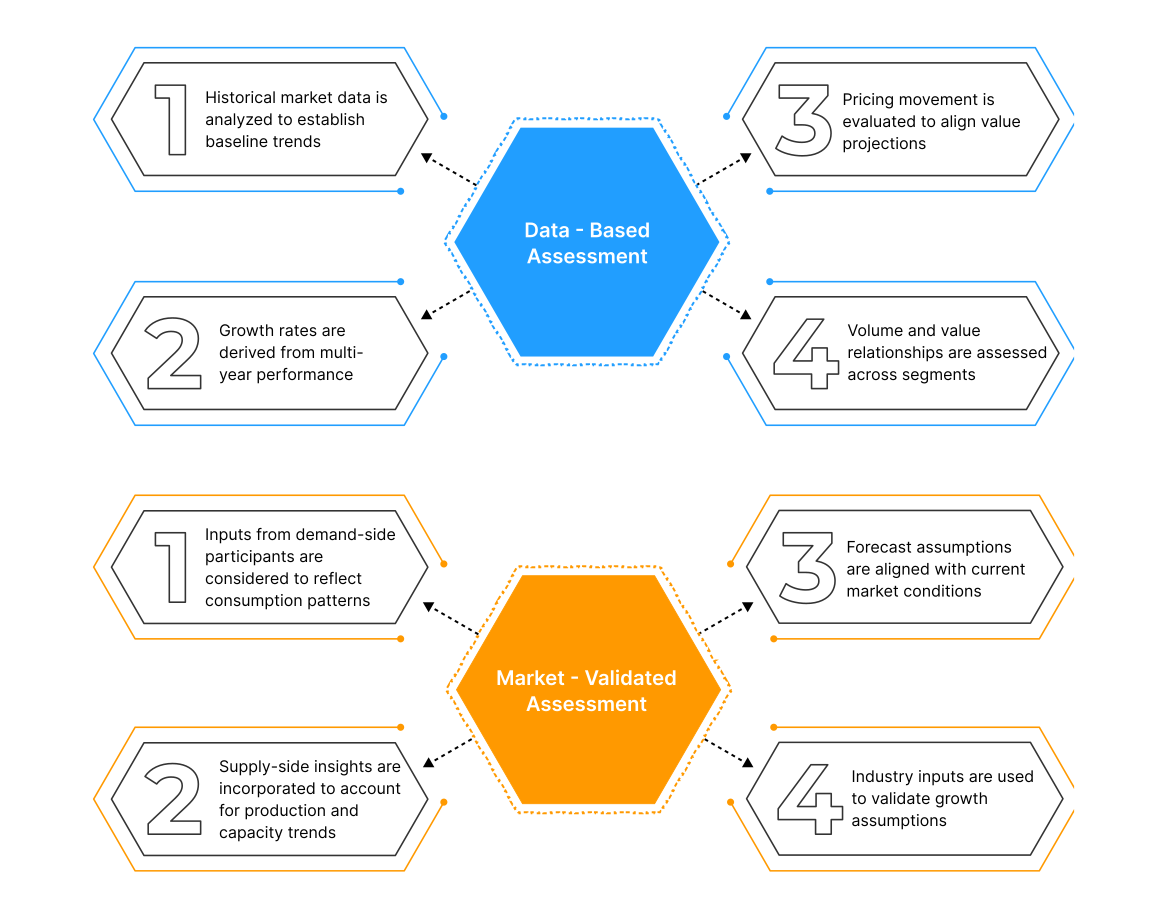
At Polaris Market Research, we employ a methodical forecasting strategy. This approach blends the analysis of historical data with real-time market validation. To forecast future trends with precision, we examine past patterns, pricing fluctuations, and the interplay of supply and demand. To ensure our conclusions reflect the present market landscape, we actively seek input from industry experts and key stakeholders.
To refine our predictions, we carefully consider critical elements such as market drivers and restraints, fluctuations in raw material costs, emerging technologies, and the production capabilities of various regions. Furthermore, we assess regulatory frameworks and potential policy shifts to gauge their potential impact on market expansion.
All this information is synthesized to generate precise forecasts for each segment and region. These forecasts illuminate the current state of the market and highlight forthcoming opportunities.
6. Data Structuring
Step 7:
In the final stage, we validate all our estimates using a triangulation method, where data is cross-checked from multiple reliable sources, like company data, primary interviews, and secondary research. This helps us make sure that our numbers are correct and fit with the rest of the market.
This process involves verifying data consistency across various segments and geographic areas. It also requires comparing historical trends with the assumptions support the forecast. Any discrepancies involve adjustments to ensure everything remains aligned and dependable.
Once the data is finalized, we prepare the final outputs, including market size estimates, segment-wise breakdowns, and growth metrics. These are delivered in structured formats such as tables, charts, and data files for easy analysis and use.
We collaborate closely with clients, ensuring the final products align with their requirements. This includes offering tailored adjustments, supplementary data analyses, and continuous assistance. Furthermore, we monitor market trends post-delivery, providing updates and refinements to maintain the insights' relevance as time passes.
Post-delivery, we continue to monitor market shifts, offering updates and adjustments to ensure the insights remain relevant over time.
Validation
Triangulation Framework
- Company-level data
- Primary inputs from industry participants
- Secondary benchmarks and published data
- Variance maintained within ±5-10%
- Adjustments applied to align estimates
- Segment values validated against overall market structure
Quality Check
Data Consistency & Integrity
- Segment totals validated to 100%
- Regional estimates aligned with global market size
- Historical trends compared against forecast outputs
- Assumptions reviewed for cross-segment and regional alignment
Output & Delivery
Final Outputs
- Market size estimates (USD Mn/Bn)
- Segment-wise distribution (%)
- Growth metrics (CAGR %)
- Structured tables and charts
- Segment-level datasets
- Excel-based data files for further analysis
Client Alignment & Support
- Deliverables are aligned with defined client requirements and scope
- Custom data cuts and segment splits are incorporated as required
- Post-delivery queries are addressed through analyst interactions
- Additional clarifications and data support are provided upon request
Client Continuity & Updates
- Market developments are tracked post-delivery to capture changes in key trends
- Updated data and revisions are provided based on new market inputs
- Additional refinements and data cuts are shared as required
- Continued analyst engagement supports evolving client requirements


