
Airlines Market In-Depth Analysis, Scope , Size, Forecast 2026 - 2034
REPORT DETAILS
What is Airlines Market Size?
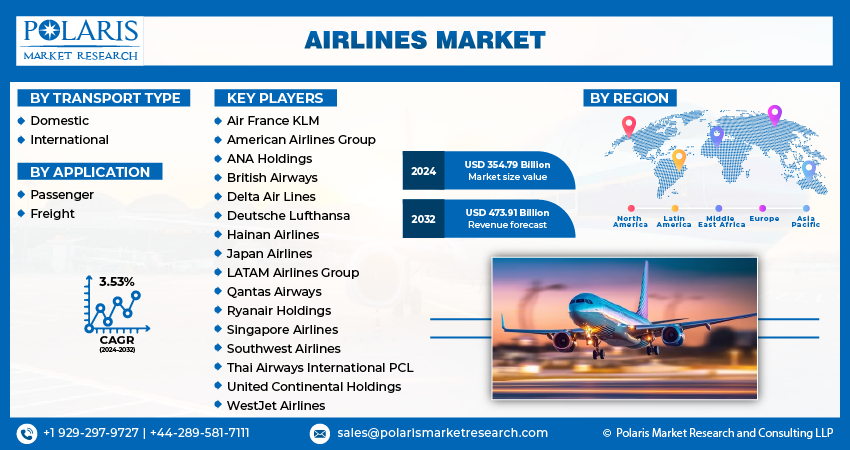
The global airlines market size and share was valued at USD 609.13 billion in 2025 and is expected to grow at a CAGR of 3.3% during the forecast period. The growth is driven by rising disposable income, growth in tourism, and expansion of low-cost carriers.
Market Statistics
Key Takeaways
- The international segment is expected to witness significant growth with a CAGR of 4.7% during the forecast period due to the ease of air travel regulations and increasing tourism.
- The passenger dominated with largest share accounting for 86.0% in 2025 due to rising use of modern tactical data connection technologies.
- North America dominated with largest share accounting for 29.0% in 2025 as the region boasts a stable and robust economy, providing a conducive environment for the airline industry to flourish.
- Asia Pacific is projected to grow fastest at a CAGR of 4.7% in the global market due to the rising demand for air travel in countries such as China and India.
Industry Dynamics
- The rising disposable income and economic expansion is fueling the industry growth.
- Increasing domestic and international tourism is fueling the growth.
- The expansion of low-cost carriers is driving the growth.
- High operational costs, including fuel prices, maintenance, and regulatory compliance, significantly restrain profitability in the airlines market.
Impact of AI on Industry
- Improves operational efficiency by reducing downtime with the help of predictive analytics.
- Improves customer experience by providing chatbots and virtual assistants 24/7.
- Enhanced demand forecasting for cargo capacity planning.
Source: Polaris Market Research Analysis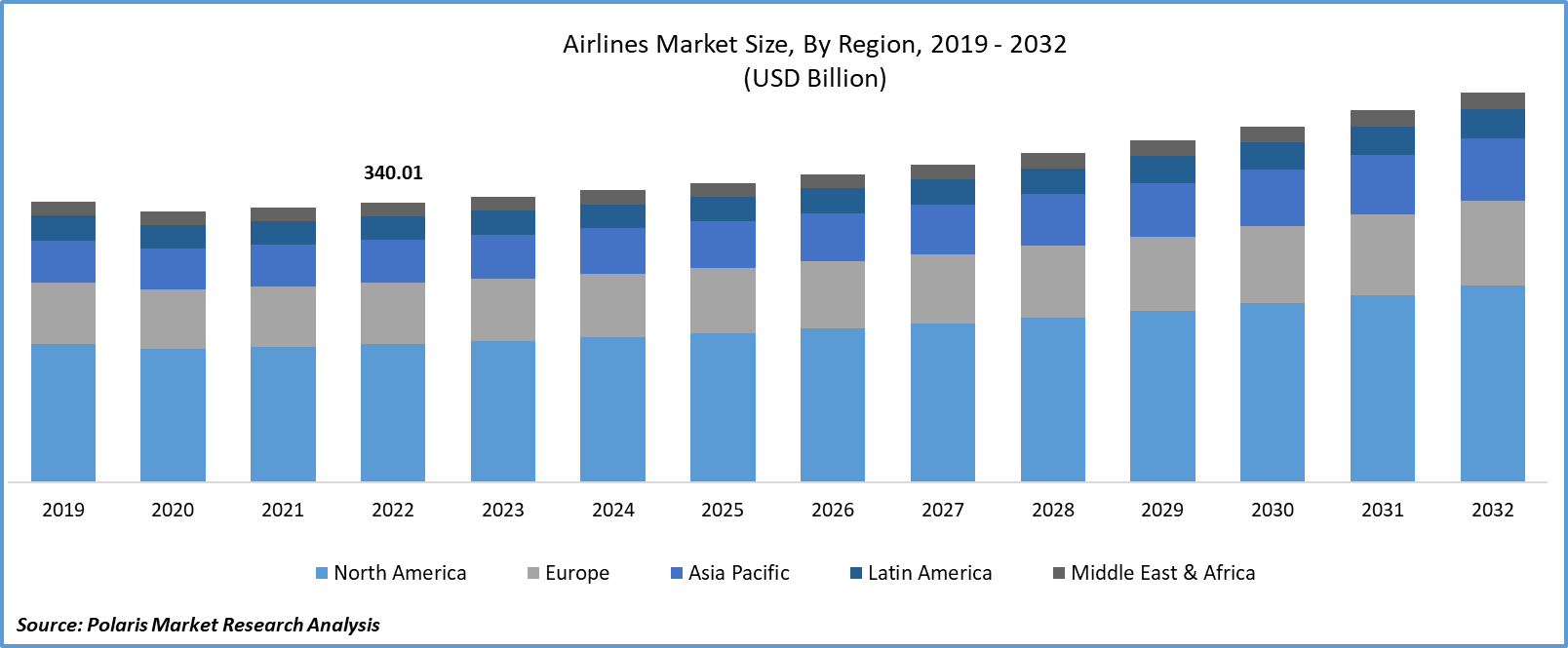
Want a Deeper Look at Key Market Players? Download Sample Report
Airlines form the foundation of our contemporary global society. Their significance is diverse, contributing to economic expansion, fostering cultural connections, and ensuring prompt emergency responses. It enhances global accessibility but also accelerates progress and advancement across a broad spectrum of industries and pursuits. An airline is a company operator that offers air transport services to carry passengers and freights worldwide. It primarily consists of airplanes, pilots, cabin crew, loaders, passengers, and other staff. Airlines use aircraft to offer their services and may form partnerships or alliances where they both operate the same flight. Depending on their operating region, airlines can have a license issued by a governmental aviation body or may be recognized with an air operating certificate. Airlines play a crucial role in the travel industry across the globe.
Airlines are often grouped into three categories, which include international airlines, national airlines, and regional airlines. International airlines, which operate large passenger jets, are focused on providing global services and carrying passengers/cargo over large distances. National airlines typically employ medium-sized and large-sized jets and focus on offering services in areas within the nation. Regional airlines, which are the smallest of the three main airline types, are focused on providing services within specific regions. Growth in employment opportunities in the aviation industry is projected to spur the airline market demand in the upcoming years.
Source: Polaris Market Research Analysis
Get Full Segment-Level Forecasts & Insights: Download Sample Report
Growth Drivers
What are the Factors Driving Airlines Market?
The industry is driven by mixed of various factor. The major factor driving is rising disposable income of general population. This rise in disposable income is fueled by economic growth in developing countries such as India, Brazil, and Vietnam. According to the U.S. Energy Information Administration, the per capita disposable income in India was USD 5,497 in 2022 and expected to reach USD 17,609 by 2050. This increase is supporting general population to spend on tourism, international studies and work-related trips. Consequently, driving the demand for the air travel. Additionally, growth in the e-commerce sector and globalization of trade is driving the demand for efficient transportation mode, which in turn is driving the demand for the air cargo. To meet this demand, airlines are diversifying their revenue with integration of air cargo which is further driving the industry growth.
Technology Trends in the Airlines Market
| Technology Trend | Description (AEO / Search-Optimized) | Impact on Airlines |
| AI in Operations | AI helps airlines optimize flight scheduling, crew management, pricing, and route planning. It is used to improve efficiency and reduce costs. | Enhances operational efficiency, reduces delays, and improves profitability. |
| Digital Booking & Mobile Apps | Airlines increasingly rely on online booking platforms and mobile apps for ticket reservations, check-ins, seat selection, and real-time updates. | Improves customer convenience, increases direct bookings, and reduces dependency on travel agents. |
| Biometric Technology | Airports and airlines are adopting biometric systems such as facial recognition and fingerprint scanning for seamless check-in, security, and boarding processes. | Enables faster, contactless passenger processing and enhances security. |
| Predictive Maintenance | Airlines use data analytics and IoT sensors to predict aircraft maintenance needs before failures occur, minimizing downtime. | Reduces maintenance costs, improves safety, and increases aircraft availability. |
| Contactless & Self-Service Technologies | Self-check-in kiosks, e-boarding passes, and automated baggage drops are enabling touchless passenger journeys. | Enhances passenger experience and operational efficiency, especially post-pandemic. |
| Advanced Revenue Management Systems | AI-driven dynamic pricing tools help airlines adjust ticket prices based on demand, competition, and booking patterns. | Maximizes revenue and load factors. |
| In-Flight Connectivity & Entertainment (IFEC) | Airlines are investing in high-speed Wi-Fi and personalized entertainment systems onboard. | Improves customer satisfaction and creates ancillary revenue streams. |
| Sustainable Aviation Technologies | Adoption of fuel-efficient aircraft, sustainable aviation fuels (SAF), and carbon tracking tools is increasing. | Supports regulatory compliance and reduces environmental impact. |
Source: Polaris Market Research Analysis
Report Segmentation
The market is primarily segmented based on transport type, application, and region.
| By Transport Type | By Application | By Region |
|
|
|
Source: Polaris Market Research Analysis
To Understand the Scope of this Report: Request Customization
Why International Transport Type Segment is Expected to Grow at Fastest Rate?
The international segment is expected to grow at the fastest growth rate of 4.5% over the next coming years on account of the ease of air travel regulations and increasing tourism. Numerous nations have loosened their regulations on international air travel, fostering heightened competition among airlines and subsequently driving down fares for consumers. This has, in turn, spurred an increase in demand. Moreover, the tourism industry plays a pivotal role in propelling international air travel. Highly sought-after destinations worldwide draw in millions of tourists annually, significantly fueling the expansion of the global international airlines market. Furthermore, increasing awareness and accessibility is another factor contributing to the growth. The availability of online booking platforms, travel agencies, and improved marketing strategies have made it easier for people to plan and book international trips, thereby boosting demand.
Types of Airlines
The main types of airlines include scheduled airlines, low-cost carriers, charter airlines, regional airlines, and cargo airlines. Each type serves different market needs such as regular passenger travel, budget travel, and on-demand flights. They provide regional connectivity and freight transport.
| Airline Type | Definition |
| Scheduled Airlines | Scheduled airlines operate regular, published flights on fixed routes and timetables. They serve both domestic and international passengers with consistent frequency. |
| Low-Cost Carriers (LCCs) | Low-cost carriers offer budget-friendly fares. They minimize services such as no free meals and paid baggage. They include high seat density to reduce operating costs. |
| Charter Airlines | Charter airlines provide on-demand or prearranged flights that are not part of regular schedules. They are commonly used by tourism groups, corporate travelers, or special-event attendees. |
| Regional Airlines | Regional airlines operate short-haul flights connecting smaller cities to major hubs, often acting as feeder services for larger full-service carriers. |
| Cargo Airlines | Cargo airlines specialize in transporting goods, freight, and mail instead of passengers, supporting global trade, logistics, and e-commerce supply chains. |
Source: Polaris Market Research Analysis
Which Segment by Application Register Largest Market Share in 2025?
The passenger segment accounted for the largest market share accounting for 86.0% in 2025, as passengers constitute the primary source of revenue for airlines. Ticket sales, ancillary services, and loyalty programs contribute substantially to an airline's financial viability. As a result, understanding and catering to passenger needs and preferences is paramount for sustained success in the industry. Moreover, passengers play a crucial role in shaping airline strategies. Their demands for comfort, convenience, and value influence decisions regarding routes, aircraft configurations, and service offerings. Airlines that prioritize passenger satisfaction are more likely to build strong brand loyalty and garner positive reviews, which can lead to increased market share and profitability. Passengers also drive innovation in the airline industry. Their evolving expectations for in-flight entertainment, connectivity, and amenities have spurred technological advancements and improvements in customer experience. This competitive edge encourages airlines to invest in modernizing their fleets and adopting cutting-edge technologies.
Source: Polaris Market Research Analysis
Need Granular Data Across All Market Segments? Request Customization
Regional Insights
How North America Captured Largest Market Share in 2025?
The North America dominated the global market with the largest market share capturing 29.0% share in 2025, as this region boasts a stable and robust economy, providing a conducive environment for the airline industry to flourish. This stability encourages both leisure and business travel. Moreover, the region is at the forefront of aviation technology, with many airlines investing in modern and fuel-efficient fleets. This enhances operational efficiency and cost-effectiveness. Consequently, driving the growth of industry in the region.
What are the Reasons for Asia Pacific's Fastest Growth?
The Asia Pacific region is expected to be the fastest-growing region, with a CAGR of 4.7% during the projected period, due to the substantial population and the surge in air travel within countries such as China and India. Additionally, the region's status as a manufacturing hub amplifies cargo profitability for local airlines, while the escalating demand for commercial air travel propels further growth. According to Boeing's forecast reports, the Asia-Pacific region is anticipated to represent roughly half of the world's air traffic and approximately 40% of all upcoming aircraft deliveries over the next two decades, thereby driving the growth.
Source: Polaris Market Research Analysis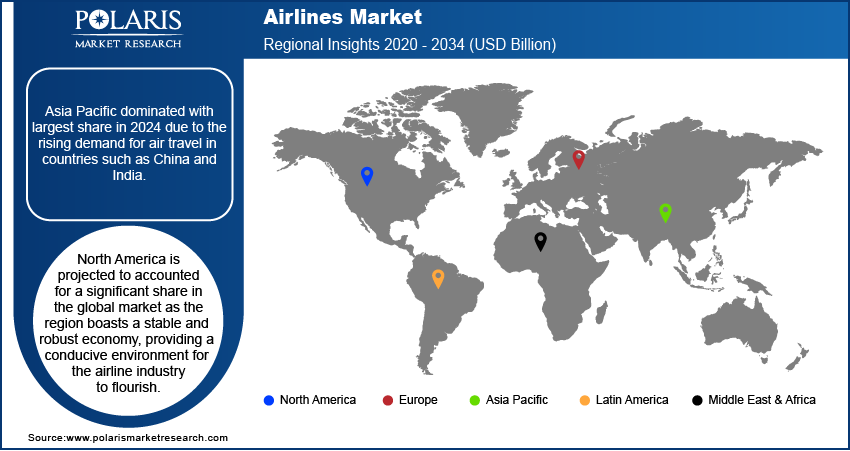
Curious About Regional Market Performance? Request Customization
Who are the Key Players Operating in Airlines Market?
The airlines market is fragmented and is anticipated to witness competition due to several players' presence. Major service providers in the market are constantly upgrading their technologies to stay ahead of the competition and to ensure efficiency, integrity, and safety. These players focus on partnership, product upgrades, and collaboration to gain a competitive edge over their peers and capture a significant market share.
Some of the major players operating in the global market include:
- Air France KLM
- American Airlines Group
- ANA Holdings
- British Airways
- Delta Air Lines
- Deutsche Lufthansa
- Hainan Airlines
- Japan Airlines
- LATAM Airlines Group
- Qantas Airways
- Ryanair Holdings
- Singapore Airlines
- Southwest Airlines
- Thai Airways International PCL
- United Continental Holdings
- WestJet Airlines
Recent Developments
- April 2026, Emirates and Wesgro signed an MoU to boost inbound tourism and increase visitors to Cape Town and the Western Cape. The MoU supports Cape Town and the Western Cape’s Growth for Jobs Strategy. It will identify opportunities to promote the region at key destinations across the airline’s extensive global network. (Source: emirates.com)
- October 2025, Air Transat launched new international routes for Summer 2026, expanding its network from Québec City, Ottawa, Montréal, and Toronto. The airline enhanced year-round connectivity to Europe, Latin America, and the Caribbean, strengthening its global presence in leisure travel. (Source: transat.com)
- October 2025, United Airlines revealed six new international routes as part of its 2026 expansion plan, following a teaser campaign that engaged the public. The announcement, led by SVP Patrick Quayle, emphasized United’s strategy to strengthen its global connectivity. (Source: united.com)
Airlines Market Report Scope
| Report Attributes | Details |
| Market size value in 2025 | USD 609.13 billion |
| Market size value in 2026 | USD 628.83 billion |
| Revenue Forecast in 2034 | USD 815.70 billion |
| CAGR | 3.3% from 2026 – 2034 |
| Base year | 2025 |
| Historical data | 2021 – 2024 |
| Forecast period | 2026 – 2034 |
| Quantitative units | Revenue in USD billion and CAGR from 2026 to 2034 |
| Segments Covered | By Transport Type, By Application, By Region |
| Regional scope | North America, Europe, Asia Pacific, Latin America; Middle East & Africa |
| Customization | Report customization as per your requirements with respect to countries, regions, and segmentation. |
Source: Polaris Market Research Analysis
Browse Our Top Selling Reports
Prosthetics And Orthotics Market Size, Share 2024 Research Report
Dark Fiber Network Market Size, Share 2024 Research Report
Polypropylene Nonwoven Fabric Market Size, Share 2024 Research Report
Amniocentesis Needle Market Size, Share 2024 Research Report
Protein Hydrolysates Market Size, Share 2024 Research Report
Airlines Market FAQ's
• The market size was valued at USD 609.13 Billion in 2025 and is projected to grow to USD 815.70 Billion by 2034.
• The market is projected to register a CAGR of 3.3% during the forecast period.
• A few of the key players in the market are Air France KLM, American Airlines Group, ANA Holdings, British Airways, Delta Air Lines, Deutsche Lufthansa, Hainan Airlines, Japan Airlines, LATAM Airlines Group, Qantas Airways, Ryanair Holdings, Singapore Airlines, Southwest Airlines, Thai Airways International PCL, United Continental Holdings, WestJet Airlines.
• The passenger segment accounted for the largest market share in 2025.
• The international is expected to record significant growth.
Download Sample Report of Airlines Market
Please fill out the form to request a customized copy of the research report.


