
Global Airport Services Market Size, Share Analysis Report, 2026-2034
REPORT DETAILS
Market Statistics
Market Overview
The global airport services market size was valued at USD 167.05 billion in 2025, registering a CAGR of 17.2% from 2026 to 2034. The rapid growth of air traffic services led to the market expansion. In addition, the growing disposable income and rising urban population boost the tourism market growth, which propels the demand for airport services. In addition, high investments in the airport development across the globe are expected to drive lucrative opportunities in the market during the forecast period.
Market Insights
- In 2025, the domestic type segment held the largest revenue share. It is due to the rapid growth of the middle-class population and the rising demand for commercial air travel.
- The greenfield infrastructure segment dominated the airport services market share in 2025. Growing trade and tourism and rising demand for sustainable airport services boost the segment growth.
- The Aeronautical application segment led the market in 2025, due to the rising demand for maintenance services and aircraft ground handling services.
- North America held the largest revenue share of the global market in 2025. The strong presence of top airport service providers contributed to the regional market growth.
- The Asia Pacific airport services industry is expected to witness significant growth during the forecast period. It is attributed to government support in the airport industry and an increase in the import and export trade.
Industry Dynamics
- Rising population and increasing disposable income of middle-class populations drive the growth of the air tourism industry. This factor propels the need for airport services.
- Increasing consumer demand for luxurious, desirable, and comfortable airport services will boost the market expansion during the forecast period.
- Growing investments in airport development in developed and developing countries are expected to offer opportunities for the market during 2026–2034.
- Stringent regulatory compliance requirements restrain the market growth.
Market Statistics
- Market Size in 2025: USD 167.05 billion
- Projected Market Size in 2034: USD 698.02 billion
- CAGR, 2026–2034: 17.2%
- Largest Regional Market, 2025: North America
AI Impact on Airport Services Market
- Automation of passenger services: Various airports are installing AI-powered chatbots, kiosks, and biometric systems. It helps them improve check-in, boarding, and customer support. The integration also reduces wait times and improves passenger experience.
- Smart security screening: AI-based image recognition and analytics enable faster threat detection in baggage and passenger screening. This improves airport security operations.
- Predictive maintenance: Airports use AI to monitor equipment like baggage handling systems, escalators, and runways. This helps predict failures and reduce downtime.
- Optimized airport operations: Airport management uses AI-driven analytics to handle flight scheduling, gate allocation, and ground handling. It helps improve operational efficiency.
- Personalized passenger engagement: AI analyzes traveler data to deliver customized services, retail recommendations, and real-time travel updates within airport terminals.
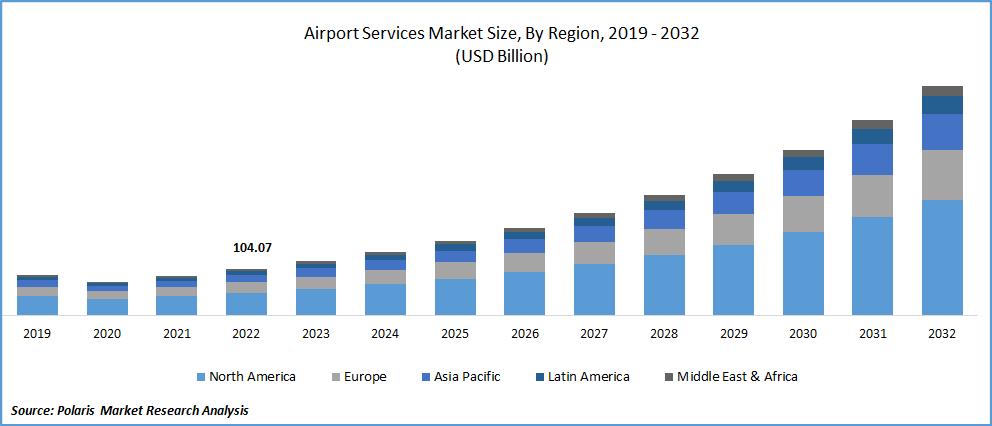
Source: Polaris Market Research Analysis
To Understand More About this Research:Download Sample Report
Airport services represent a critical component of the global aviation ecosystem. It supports both airline operations and airport passenger services. Airport services offer commercial assistance and airport cargo services. It also delivers district airline services, including security, transit facility, landing charges, terminal navigations, parking, housing charges, terminal navigation charges, route navigation, and others.
The airport services industry focuses on passenger handling, ground handling, cargo handling, baggage handling, rental services, Wi-Fi services, and more. Governments are investing in airport digital transformation. Modern airports are using digital services like smart baggage tracking, Wi-Fi, lounge services, and real-time flight information systems. These services are improving operational efficiency and passenger satisfaction.
Market Dynamics
Adoption of AI, Automation, and IoT technologies
Airports across countries are investing in smart airport services and technologies. Airport automation technologies are integrated with artificial intelligence and other systems. Airports are installing AI-based passenger flow management systems and automated baggage handling technologies. They are also emphasizing AI in airport operations and IoT- enabled monitoring platforms. These technologies help airport management boost operational efficiency and improve passenger experience. Thus, rising use of smart technologies across airports will fuel the airport services market growth. In addition, the growing air travel industry and large-scale investments in airport infrastructure development projects propel demand for advanced airport service solutions.
Growing Population Coupled with High Investment in Airport Services
The rising global population and increasing disposable income of the middle-class population propel the tourism industry growth, which drives demand for air travel. The International Air Transport Association (IATA) stated that global airline passenger numbers will reach about 5.2 billion in 2026, an increase of 4.4% from 2025. According to estimates from the Airports Council International (ACI), total passenger traffic at airports worldwide will reach around 10.2 billion in 2026. It is showcasing 3.9% Y-o-Y growth. These numbers highlight rising aviation activity across the world. To accommodate such rising passenger traffic, governments and private stakeholders invest heavily in airport infrastructure expansion. Investments are done in advanced airport security services, ground handling systems, and digital airport technologies. Thus, rising population and growing investments in airport services accelerate the demand for airport services globally.
Airport Services Market Value Chain
The value chain includes multiple interconnected stages and stakeholders. Proper collaboration among them allows airport operations and passenger services to work well.
| Value Chain Stage | Key Activities | Key Stakeholders | Importance |
| Infrastructure Development | Construction and expansion of terminals, runways, hangars, and cargo facilities | Airport authorities, construction firms, and government agencies | Provides the foundational infrastructure required for airport operations and service delivery |
| Technology & Equipment Providers | Supply of ground support equipment, baggage handling systems, security screening systems, and IT solutions | Technology vendors, equipment manufacturers, and system integrators | Enhances operational efficiency, security, and passenger experience |
| Airport Operations & Management | Airside and landside operations, passenger services, aircraft handling, and facility management | Airport operators and airport management companies | Ensures smooth airport functioning and coordination between different service providers |
| Ground Handling & Support Services | Baggage handling, ramp services, aircraft refueling coordination, catering, and airport logistics services | Ground handling service providers and airline partners | Critical for efficient aircraft turnaround and passenger service management |
| Security & Safety Services | Passenger and baggage screening, surveillance, and compliance with aviation regulations | Security service providers and aviation regulators | Maintains passenger safety and ensures compliance with international aviation standards |
| Passenger & Commercial Services | Retail, duty-free, lounge services, passenger assistance, and parking services | Retail operators, hospitality providers, and airport service companies | Enhances passenger experience and generates non-aeronautical revenue |
| Maintenance & Support Services | Maintenance of airport facilities, equipment servicing, and operational support | Maintenance providers and technical service companies | Ensures reliability and long-term operational efficiency of airport systems |
Source: Polaris Market Research Analysis
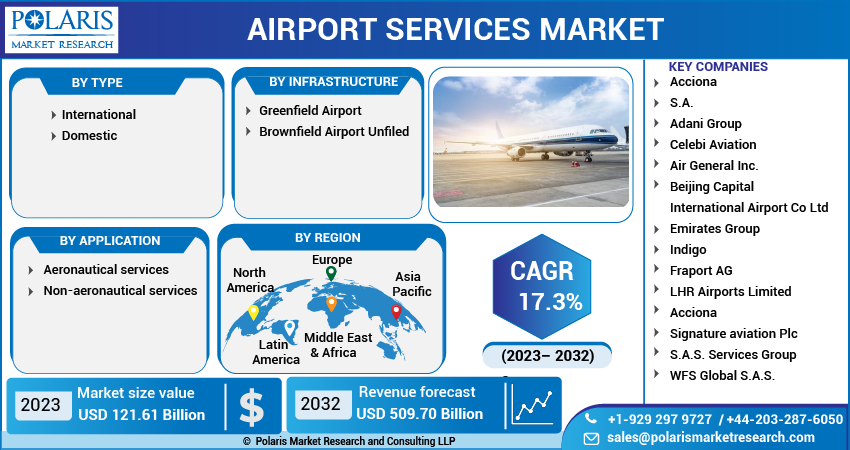
Source: Polaris Market Research Analysis
Get Full Segment-Level Forecasts & Insights: Download Sample Report
Segment Overview
By Type
In 2025, the domestic segment led the market share. The dominance is driven by the expansion of low-cost carriers and increased domestic flight frequency. According to data from B.A.G Convergence, Indian domestic airlines transported 77.07 million passengers from January to August 2022, up 67.38% from the previous year. Additionally, the rise in domestic air passengers is fueled by fast local business growth, increased tourism, and higher disposable income. These factors are increasing the demand for domestic airport services.
The international segment is likely to experience rapid growth during the forecast period. An increase in international tourism and rising economic liberalization drive the segment growth. Further, airports that handle international traffic require efficient border control procedures and advanced security systems. They also need to adhere to global aviation regulations.
By Infrastructure
In 2025, the Greenfield infrastructure segment accounted for the largest market share. Greenfield airport infrastructure refers to the development of new airports on previously undeveloped land. Governments and private entities increasingly invest in Greenfield airport development to enhance connectivity and boost trade and tourism. In addition, developed and developing economies such as the U.S., China, India, and others have opted for Greenfield airport services.
The Brownfield infrastructure type is expected to register the highest CAGR during the forecast period. The segment includes the expansion, redevelopment, and modernization existing airports. It is more cost-effective than Greenfield infrastructure. Thus, several airport operators opt for this type of service. Brownfield airport developments are undertaken to reduce congestion, address rising passenger traffic, and improve passenger experience.
By Application
The aeronautical application segment dominated in 2025. A few aeronautical services are aircraft landing, takeoff, and parking assistance; air traffic management support; ground handling; refueling coordination; baggage handling; and runway and taxiway management. Aircraft maintenance services include inspections, repair replacements, disclosure changes, and compliance with airworthiness directives. These services paly essential role in ensuring safe and timely aircraft movement and flight operations. Passenger services include transit service, baggage carrying, passenger maintenance, and others. This factor will offer new opportunities for airport services. Furthermore, data published by Air Transport Action Group shows that the aeronautical industry is expected to grow significantly in the coming decades. By 2038, the global air transport industry is expected to give 143 million jobs and contribute USD 6.3 trillion to the global economy. This factor is anticipated to create new business growth for airport services.
Technology Trends in Airport Services
Technological advancements transform airport operations and service delivery. Airports are increasingly using AI for predictive analytics, security screening, and operational management. This helps manage passenger flow more efficiently. Automation technologies, like self-service interactive kiosks and automated baggage handling systems, reduce waiting times and improve efficiency. At the same time, smart airport initiatives use the Internet of Things (IoT), cloud platforms, and real-time data analysis to create connected airport environments. These technologies enable operators to optimize resource use, improve safety and security, and provide a smoother, more personalized travel experience for passengers.
| Technology | Key Applications in Airport Services | Benefits |
| Artificial Intelligence (AI) | Passenger flow prediction, facial recognition for identity verification, baggage tracking, and predictive maintenance for airport equipment | Improves operational efficiency and security, reduces delays, and supports enhanced passenger experience |
| Automation | Automated check-in kiosks, self-service baggage drop, robotic cleaning systems, and automated boarding gates | Reduces manual intervention, speeds up passenger processing, lowers operational costs, and improves service efficiency |
| Smart Airports | Integration of IoT devices, real-time data analytics, digital passenger services, smart security and surveillance systems | Enables seamless airport operations, improves decision-making through real-time insights, and enhances overall passenger convenience |
Source: Polaris Market Research Analysis
.webp)
Source: Polaris Market Research Analysis
Need Granular Data Across All Market Segments? Request Customization
Regional Market Analysis
In 2025, North America had the biggest share of the global market. Its well-established aviation infrastructure and high passenger traffic drive this dominance. Also, the high presence of market players and increasing investments in airport modernization boost the North America airport services market growth. The region, particularly the U.S. and Canada, has a large network of domestic and international airports. It supports both passenger and cargo operations. According to the Airports Council International North America, passenger traffic at North American airports increased by 4.5% in 2024 compared with 2023. It reflects a steady recovery and growth in air travel in the region.
Europe held a significant revenue share in 2025. The European market growth is attributed to the strong existence of top airports, such as Munich International Airport, Zurich Kloten International Airport, Switzerland, London Heathrow Airport, Frankfurt Airport, and others. The airports are consistently adding value by offering luxurious and desirable airport services. Furthermore, several key manufacturers such as Frankfurt and LHR are constantly engaged in product launches, partnerships, business expansion, agreements, and other strategies. Such key developments are contributing to the Europe airport services market growth.
The Asia Pacific airport services market has shown significant growth during the forecast period. Government support in the airport industry, high investments in R&D activities, and increasing import and export trade propelled the market growth. A growing population, coupled with a rising disposable income among people, boosts the market expansion. Also, a growing air tourism industry and consumer demand for luxurious, desirable, and comfortable airport services enhanced the performance of domestic, international, and greenfield airport infrastructure services. These factors will positively impact import and export services during the forecast period. In India, airport services are growing at a rapid pace, due to the rapid growth of the middle-class population and the growing demand for commercial air travel, Indian airlines have placed large orders for aircraft.
Source: Polaris Market Research Analysis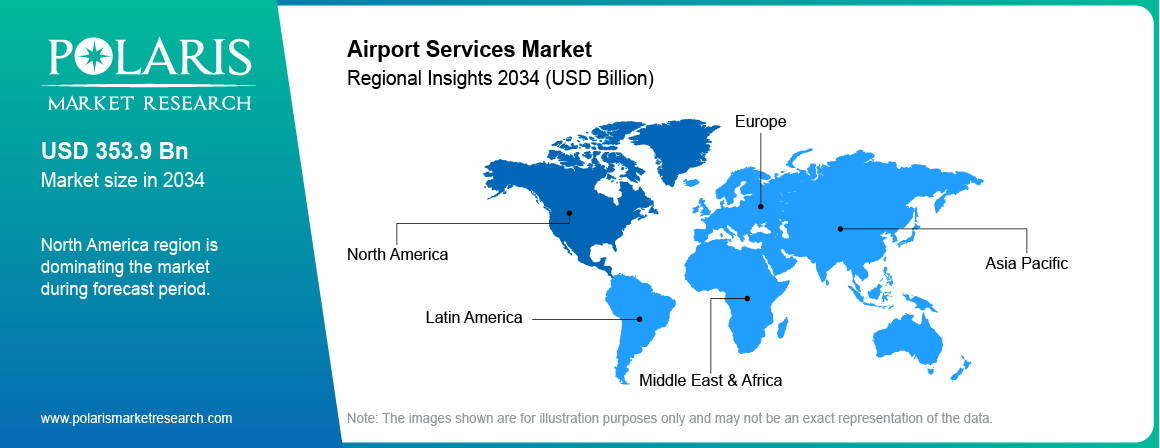
Curious About Regional Market Performance? Request Customization
Key Players and Competitive Landscape
The airport services industry is somewhat fragmented, with many global and regional companies. These companies compete based on service quality, technology, and operational efficiency. Some key players in the market are Acciona, Adani Group, Celebi Aviation, Air General, Beijing Capital International Airport, Emirates Group, Indigo, Fraport, LHR Airports Limited, Signature Aviation, S.A.S. Services, and WFS Global.
Market players are signing long-term partnership contracts with airlines and airport operators. They are also concentrating on strategies like mergers and acquisitions and investing in digital technologies. These efforts help them expand their geographic reach and improve operational efficiency. Additionally, many service providers are using automated passenger counting and information systems. They invest in AI-based passenger management systems and better baggage handling technologies. Technological improvements help reduce aircraft turnaround time and improve the passenger experience.
List of Key Market Players
- Acciona
- S.A.
- Adani Group
- Celebi Aviation
- Air General.
- Beijing Capital International Airport
- Emirates Group
- Indigo
- Fraport
- LHR Airports Limited
- Signature Aviation
- S.A.S. Services
- WFS Global.
Airport Services Industry Developments
In July 2025, Heathrow became part of the pioneering BOOST initiative, joining Amsterdam Airport Schiphol, Avinor, Brussels Airport, and Incheon International Airport. BOOST was launched by Future Travel Experience (FTE) in partnership with innovation consultancy nlmtd (Unlimited) and originated from the FTE Baggage Innovation Working Group.
In December 2022, Adani Group launched a consumer app for airport services. This app will help the consumer to book tickets, flight status, lounge access, duty-free products, & avail parking facilities. This strategic product launch is projected to enhance the market in Europe.
In October 2022, Delta launched electric aircraft services for the home to airport services. This builds electric vertical take-off & landing (eVTOL) aircraft, to offer home-to-airport transportation. This strategic product launch is projected to strengthen the potential sales of the airport services market in the USA.
In November 2022, IndiGo launched commercial flights from the newly constructed Donyi Polo Airport, Arunachal Pradesh's first civil airport. This strategic product launch is anticipated to boost the company’s potential sales of airport services.
Market Segmentation
By Type Outlook (Revenue – USD Billion, 2021–2034)
- Domestic
- International
By Infrastructure Outlook (Revenue – USD Billion, 2021–2034)
- Greenfield Airport
- Brownfield Airport
By Application Outlook (Revenue – USD Billion, 2021–2034)
- Aeronautical Services
- Non-aeronautical Services
By Regional Outlook (Revenue – USD Billion, 2021–2034)
- North America
- U.S.
- Canada
- Europe
- Germany
- UK
- France
- Italy
- Spain
- Russia
- Netherlands
- Rest of Europe
- Asia Pacific
- China
- India
- Japan
- South Korea
- Indonesia
- Malaysia
- Rest of Asia Pacific
- Latin America
- Argentina
- Brazil
- Mexico
- Rest of Latin America
- Middle East & Africa
- UAE
- Saudi Arabia
- Israel
- South Africa
- Rest of Middle East & Africa
Airport Services Market Report Scope
| Report Attributes | Details |
| Market Size in 2025 | USD 167.05 billion |
| Market Size in 2026 | USD 194.94 billion |
| Revenue Forecast in 2034 | USD 698.02 billion |
| CAGR | 17.2% from 2026 to 2034 |
| Base Year | 2025 |
| Historical Data | 2022–2024 |
| Forecast Period | 2026–2034 |
| Quantitative Units | Revenue in USD billion, 2021–2034 and CAGR from 2026 to 2034 |
| Report Coverage | Revenue Forecast, Market Competitive Landscape, Growth Factors, and Trends |
| Segments Covered |
|
| Regional Scope |
|
| Competitive Landscape |
|
| Report Format |
|
| Customization | Report customization as per your requirements with respect to countries, regions, and segmentation. |
Source: Polaris Market Research Analysis
Airport Services Market FAQ's
The global market is valued in the hundreds of billions today. The market is projected to reach USD 698.02 billion by 2034, registering a CAGR of 17.2% driven by surging air traffic.
Rising global air travel demand and increasing adoption of smart airport services drive the market growth. It is also fueled by growing investments in greenfield airport development and integration of technological advancements like AI and biometrics.
North America accounted for the largest market share in 2025. Strong infrastructure and major hubs like Atlanta, LAX, and JFK drive regional market expansion fuel the dominance.
Use of AI, biometric authentication, and IoT-based real-time analytics enhances airport operations. Automated baggage handling and self-service kiosks reduce wait times. Technology integration significantly improves the passenger experience.
By application, the aeronautical services segment dominated the market in 2025. The segment includes ground handling, aircraft maintenance, and passenger services.
Airport ground handling services include ramp operations, towing aircraft, fueling, handling baggage, cleaning lavatories, and supporting passenger boarding. These services make sure that the turnaround between flights goes smoothly.
Acciona, Adani Group, Celebi Aviation, Air General., Beijing Capital International Airport, Emirates Group, Indigo, Fraport, LHR Airports Limited, Signature Aviation, S.A.S. Services, and WFS Global are among the major airport service providers.
Download Sample Report of Airport Services Market
Please fill out the form to request a customized copy of the research report.


