
Asia Pacific Excavator Market Size, Outlook Report, 2026-2034
REPORT DETAILS
Market Statistics
What is the Current Market Size?
The Asia Pacific excavator market was valued at USD 25.39 billion in 2025 and is expected to grow at a CAGR of 4.60% during the forecast period.
Market Statistics
- 2025 Market Size: USD 25.39 billion
- 2034 Projected Market Size: USD 38.03 billion
- CAGR (2026-2034): 4.60%
- Japan: Largest market in 2025
The market is a significant segment of the global construction equipment industry, with a substantial share of the market attributed to countries such as China, Japan, India, and South Korea. The demand for excavators in this region is primarily driven by increasing infrastructure development projects, rapid urbanization, and growing mining activities.
In terms of trends, the market is shifting towards more environment-friendly and technologically advanced machines. Manufacturers are introducing electric and hybrid excavators, which offer improved fuel efficiency and reduced emissions. Also, advancements in automation and robotics are enabling the development of autonomous excavators, which can improve safety and productivity on job sites.
Source: Polaris Market Research Analysis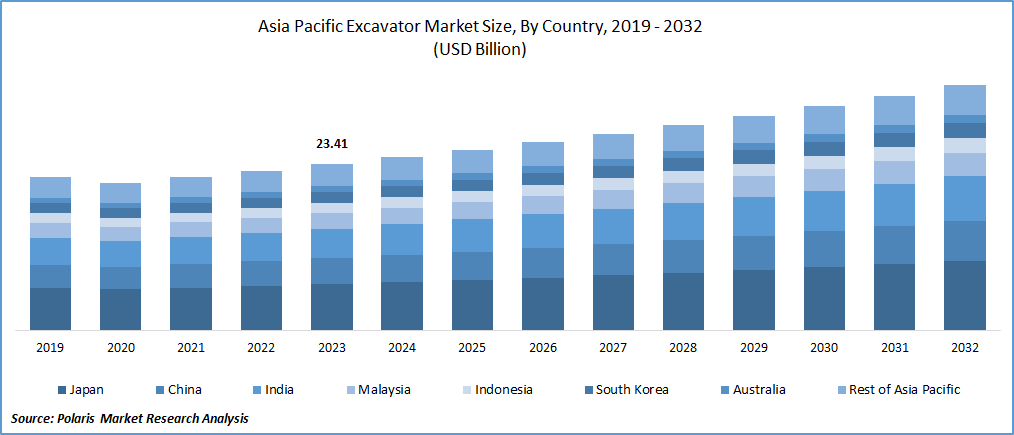
To Understand More About this Research: Download Sample Report
Despite the positive outlook for the market, certain factors hinder the market's growth, such as the pandemic like COVID-19, which has resulted in a decline in construction activity, thereby reducing the demand for excavators. Another factor hampering the market's growth is the high cost of ownership and maintenance of excavators, which acts as a barrier for small and medium-sized construction companies.
Growth Drivers
Growth in the rental market fuels the sales of excavators in the region
The growth in the rental market has had a significant impact on the sales of excavators in the Asia Pacific region. This is because the increasing demand for construction and infrastructure development projects, associated with the rising focus on renting heavy equipment instead of purchasing it outright, has led to an increase in the demand for excavators in the region.
The construction and infrastructure development projects require heavy machinery like excavators, which are often too expensive for small-scale contractors and construction companies to purchase. As a result, many of these companies are turning to rental options to meet their equipment needs.
Advancements in technology have also fueled the growth of the excavator rental market in Asia Pacific. Modern excavators come equipped with advanced features such as GPS tracking, telematics, and remote monitoring systems, which enable rental companies to optimize their management and provide better services to their customers. For example, rental companies are now able to track the location and usage of their excavators in real time, allowing them to allocate equipment more efficiently and reduce downtime. Owing to all these factors, the renting of construction equipment is fueling the sales of the excavator market.
Source: Polaris Market Research Analysis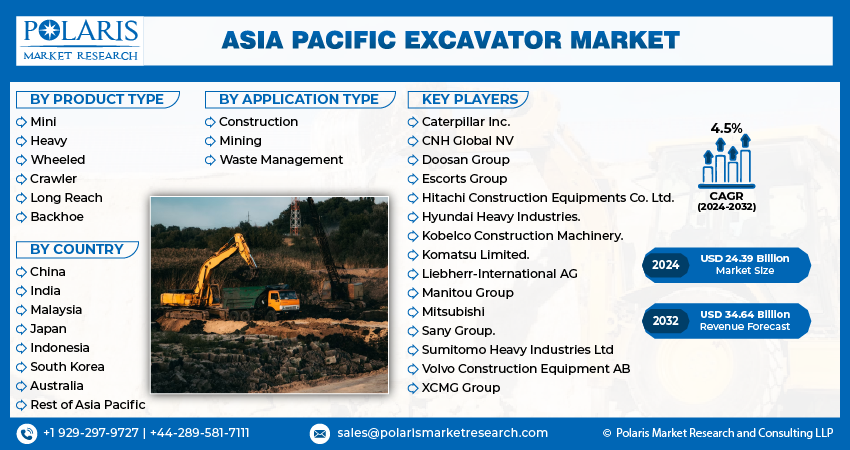
Get Full Segment-Level Forecasts & Insights: Download Sample Report
Product Feature & Localization
| Brand/Model Example | Monitoring/Hydraulics | Design/Weight | Power/Dig Depth | Localization Notes |
| Hitachi ZX (e.g., ZX225USLC-6) | IT monitoring (movement/pressure logs); precision hydraulics | Compact short tail swing; 20-22 tons | 159 HP; 5.94m | APAC urban fleets (Singapore/India sites); PC-based analysis |
| Kobelco SK (e.g., SK230SRLC-5) | iNDr cooling, engine control; superior hydraulics | Tight-space radius; 21-23 tons | 166 HP; 6.21m | SE Asia tropical durability, local service |
| SANY SY (e.g., SY215C) | SmartCare telematics; electronic hydraulics | Reduced tail swing; 21 tons | 170 HP; 6.3m | China/India manufacturing; dust-resistant for APAC mining |
| LiuGong (e.g., 225NLC) | GPS telematics; load-sensing hydraulics | Zero tail swing option; 22 tons | 174 HP; 6.5m | Localized assembly in India/SE Asia; monsoon-adapted seals |
| Zoomlion ZE (e.g., ZE225E) | Remote diagnostics; variable pumps | Compact undercarriage; 22 tons | 172 HP; 6.2m | China-based exports to APAC; high-altitude/heat optimizations |
Source: Polaris Market Research Analysis
Report Segmentation
The market is primarily segmented based on product type, application type, and country.
| By Product Type | By Application Type | By Country |
|
|
|
Source: Polaris Market Research Analysis
To Understand the Scope of this Report: Request Customization
By Product Type Analysis
The crawler excavator held the dominating revenue share in 2025.
The crawler excavator segment accounted for the largest revenue share in the market in 2025, owing to its increasing demand in various applications such as construction, mining, and infrastructure development. Crawler excavators are adaptable machines that can operate efficiently in rough terrain and harsh environments, making them ideal for use in various landscapes across the region. Also, their ability to work effectively in congested spaces and perform heavy-duty tasks has led to their growing popularity among contractors and project developers. Advancements in technology have made crawler excavators more fuel-efficient and environment-friendly, further boosting their adoption in the region.
By Application Type Analysis
The construction segment dominated the market in 2025.
The construction segment dominated the market in 2025, owing to the increased infrastructure development and construction activities in countries such as China, India, and Indonesia. The heightened demand for residential and commercial spaces, as well as government initiatives to develop smart cities, have driven the growth of the construction industry, which in turn boosted the demand for excavators.
Also, the increasing investment in energy projects, such as wind and solar power plants, requires the use of excavators for installation and maintenance purposes. The expansion of transportation networks, including roads, highways, and railways, also created the need for excavators to prepare the land and lay the foundation for these projects. All these factors collectively contributed to the dominant share of the construction segment in the Asia Pacific excavator market.
Source: Polaris Market Research Analysis
Need Granular Data Across All Market Segments? Request Customization
Country Insights
Japan dominated the Asia Pacific market in terms of revenue share in 2025.
Japan is the world's largest construction market, and its demand for excavators is driven by various infrastructure projects such as building highways, railways, airports, and urbanization initiatives. Additionally, the country has a large number of domestic players that manufacture excavators, which helps meet the local demand and also enables them to export to other countries in the region. Japan-based companies have been aggressively investing in research and development, which has enabled them to produce technologically advanced machines that cater to the needs of various industries. All these factors combined have contributed to China's leading position in the market.
Source: Polaris Market Research Analysis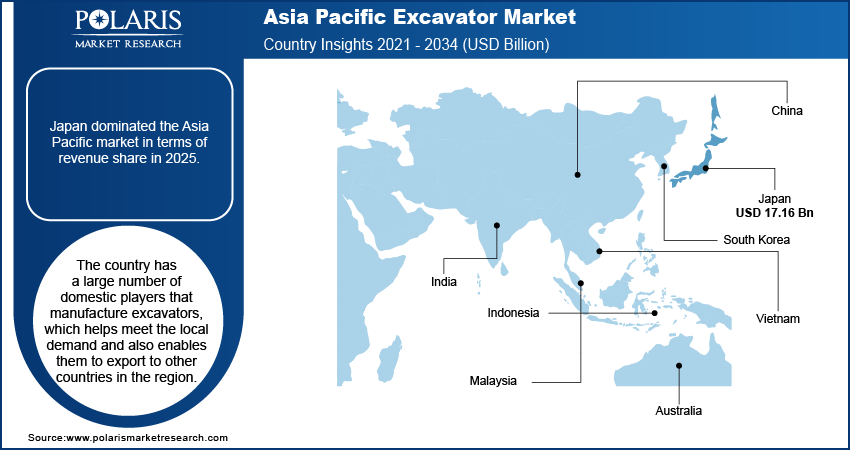
Curious About Regional Market Performance? Request Customization
Key Market Players & Competitive Insights
The Asia Pacific excavator market is highly competitive, with several prominent players vying for market share. Leading manufacturers such as Caterpillar, Komatsu, Hitachi Construction Machinery, and Volvo CE dominate the market. At the same time, other players like Hyundai Heavy Industries, Doosan Infracore, and JCB are also present in the region. These companies are focusing on product innovation, customer service, and expansion into new markets to stay ahead of the competition.
Some of the major players operating in the Asia Pacific market include:
- Caterpillar Inc.
- CNH Global NV
- Doosan Group
- Escorts Group
- Hitachi Construction Equipments Co. Ltd.
- Hyundai Heavy Industries.
- Kobelco Construction Machinery.
- Komatsu Limited.
- Liebherr-International AG
- Manitou Group
- Mitsubishi
- Sany Group.
- Sumitomo Heavy Industries Ltd
- Volvo Construction Equipment AB
- XCMG Group
Recent Developments
- In November 2023, HD HYUNDAI INFRACORE, an affiliate of HD Hyundai, launched Korea’s first 130-tonne demolition excavator, which is a long-reach excavator that can work up to 46 meters or five floors height above the ground level.
- In November 2023, Volvo Construction Equipment launched its ECR25 Electric compact excavator in the Asian market, including countries like China, South Korea, Japan, and Singapore.
Asia Pacific Excavator Market Report Scope
| Report Attributes | Details |
| Market size value in 2025 | USD 25.39 Billion |
| Market size value in 2026 | USD 26.49 Billion |
| Revenue Forecast in 2034 | USD 38.03 Billion |
| CAGR | 4.60% from 2026 – 2034 |
| Base year | 2025 |
| Historical data | 2021 – 2024 |
| Forecast period | 2026 – 2034 |
| Quantitative units | Revenue in USD Billion and CAGR from 2026 to 2034 |
| Segments Covered | By Product Type, By Application Type, By Country |
| Country scope | China, India, Malaysia, Japan, Indonesia, South Korea, Australia, Rest of Asia Pacific |
| Customization | Report customization as per your requirements concerning countries, regions, and segmentation. |
Source: Polaris Market Research Analysis
Asia Pacific Excavator Market FAQ's
The Asia Pacific excavator market size is expected to reach USD 38.03 Billion by 2034.
., CNH Global NV, Doosan Group, Escorts Group, Hitachi Construction Equipments Co. Ltd., Hyundai Heavy Industries., Kobelco Construction Machinery., Komatsu Limited are the top market players in the market.
Japan region contribute notably towards the global Asia Pacific Excavator Market.
The Asia Pacific excavator market is expected to grow at a CAGR of 4.60% during the forecast period.
Product type, application type, and country product type, application type, and country.
Download Sample Report of Asia Pacific Excavator Market
Please fill out the form to request a customized copy of the research report.


