
Blockchain Technology Market Size, Share, Analysis Report, 2026-2034
REPORT DETAILS
Market Statistics
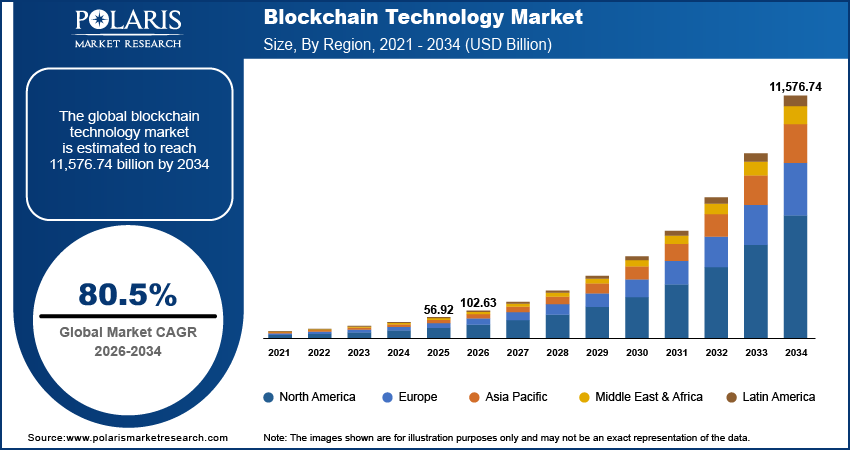
The global blockchain technology market is projected to witness robust growth. It was valued at USD 56.92 billion in 2025, exhibiting a CAGR of 80.5% over the forecast period, 2026 – 2034.
Blockchain technology is a form of distributed ledger technology that enables secure, transparent, and tamper-proof record-keeping on a decentralized network. In the enterprise blockchain market, it is commonly employed to develop digital trust, automate transactions, and minimize the need for intermediaries across both financial and non-financial use cases. This is an indicator of the growth of the distributed ledger technology market.
Based on the blockchain technology market overview, the market comprises public, private, and hybrid blockchain models. The scope also encompasses the core infrastructure, protocols, middleware, and application-layer solutions. These solutions are used by enterprises, governments, and institutions globally, thus determining the overall blockchain market scope.
Key Insights
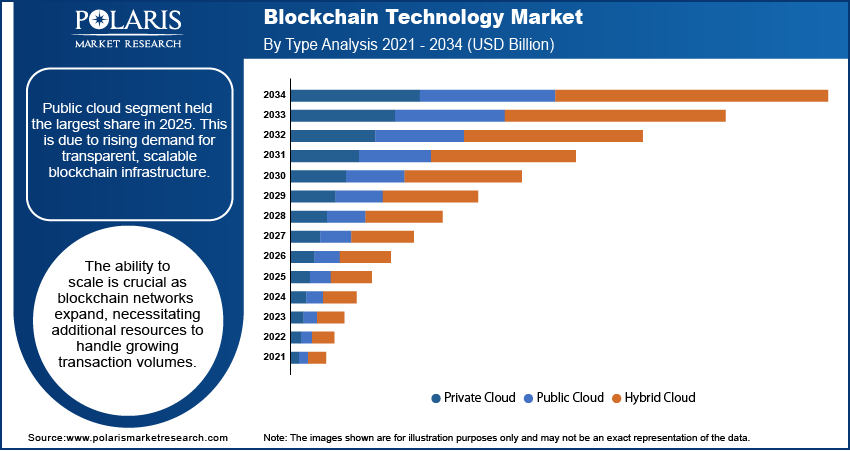
- By type, the public cloud segment held the largest share in 2025. This is due to rising demand for transparent, scalable blockchain infrastructure, supporting blockchain infrastructure adoption.
- Cloud-based models of blockchain deployment have become increasingly preferred by enterprises because they reduce initial infrastructure costs while enabling scalable deployment.
- By component, the infrastructure and protocols segment held the largest share in 2025. Standardized blockchain protocols such as Ethereum and Hyperledger are becoming the preferred building blocks for enterprise blockchain infrastructure.
- By enterprise size, large enterprises accounted for the largest share in 2025. The market is driven by substantial financial capacity and strategic digital transformation initiatives, thereby fueling enterprise blockchain adoption.
- Large companies are leaders in adopting blockchain technology, owing to their capacity to integrate it with their existing IT infrastructure.
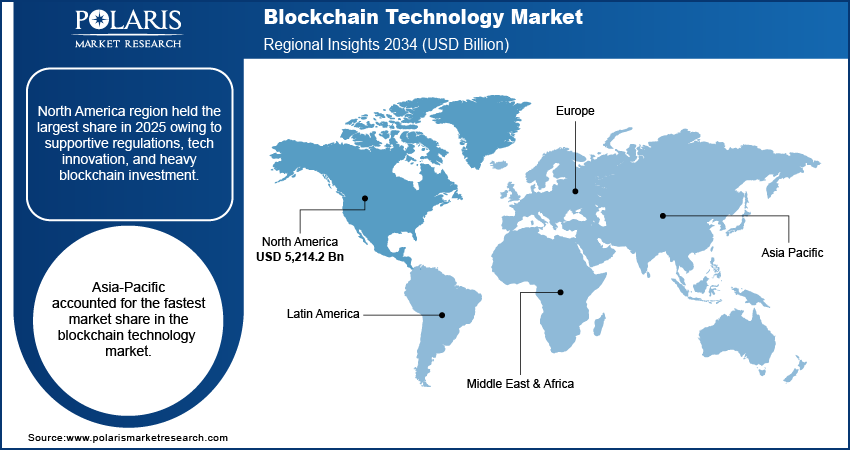
- By region, North America accounted for the largest share in 2025 owing to supportive regulations, technological innovation, and substantial investment in blockchain.
- The blockchain landscape in the region is relatively mature, owing to support from the cloud industry, the financial sector, and the government, reinforcing the North America blockchain ecosystem.
Industry Dynamics
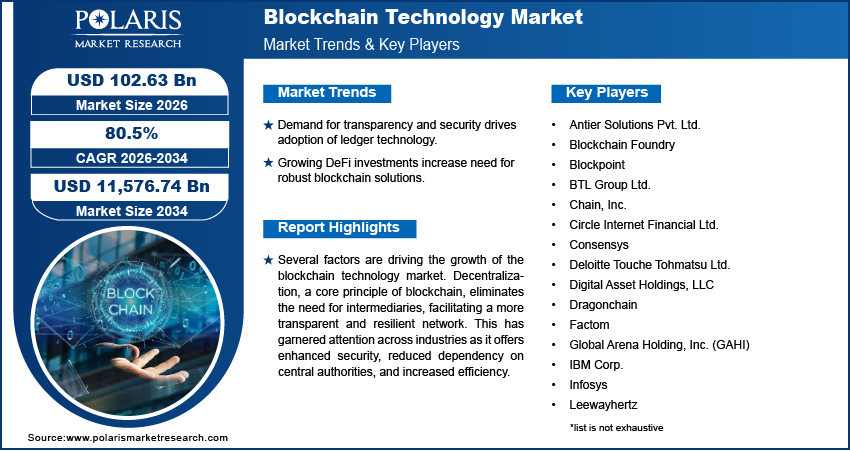
- The growing demand for transparency and security across sectors is driving market growth, as blockchain security solutions facilitate fraud prevention by providing immutable transaction records.
- The growing demand for decentralized finance is driving the DeFi blockchain market, as DeFi applications are built on blockchain technology to enable asset tokenization, automated payments, and the execution of smart contracts.
- The growing demand for traceability in supply chains is driving adoption, as blockchain technology enhances end-to-end tracking and facilitates enterprise data transparency.
Market Statistics
- 2025 Market Size: USD 56.92 billion
- 2034 Projected Market Size: USD 11,576.74 billion
- CAGR (2026-2034): 80.5%
- North America: Largest market in 2025
Source: Polaris Market Research Analysis
Want a Deeper Look at Key Market Players? Download Sample Report
AI Impact on the Market
- Integrating blockchain with artificial intelligence is improving network security and efficiency. It enables real-time transaction monitoring, detects anomalies, and helps prevent fraud, thereby driving the adoption of AI in the blockchain market.
- AI enhances blockchain performance by optimizing network traffic and validating transactions, thereby helping businesses improve scalability, reduce latency, and deploy more efficiently.
- AI-powered smart contracts enhance the functionality of traditional smart contracts by enabling them to respond to dynamic changes, automatically verify compliance, and improve governance in blockchain networks.
The market for blockchain technology is driven by several factors. One of the most important aspects of blockchain technology is decentralization. This aspect reduces the need to involve third parties, thereby enhancing security and robustness. Smart contracts enable trustless transactions. This means that people can conduct transactions without a central authority.
The launch of Bitcoin led to the widespread adoption of blockchain technology, which is currently being used for transactions by many financial institutions. In various sectors, blockchain technology is used for document management, exchanges, payments, smart contracts, and receipts. This has also led to the development of innovative blockchain solutions by many startups.
The spread of the pandemic has increased the adoption of blockchain across the business sector, owing to weaknesses in existing systems that the pandemic has highlighted. While economic uncertainty temporarily slowed investment, industries such as healthcare, finance, and supply chain management continued to adopt blockchain. Following the pandemic, blockchain has been viewed as a strategic layer for digital resilience and secure operations, thereby fueling post-pandemic blockchain adoption.
Several governments and regulatory agencies in various countries have recognized the enormous potential of blockchain and are developing supportive regulations to encourage its growth and adoption. In this way, effective regulations have helped increase investment in and the innovativeness of blockchain technology across industries. Major companies and other technologically advanced nations are also contributing to the development and growth of blockchain technologies.
Industry Dynamics
Growth Drivers
Increasing Demand for E-Identity will Facilitate the Market Growth
The growth of the blockchain technology market is primarily driven by increasing demand for e-identity. Blockchain-powered platforms have diverse applications in areas with inadequate identification systems and in countries that require established regulatory frameworks. At the national level, several governments have adopted blockchain technology to develop identity platforms in response to market demand. This deliberate integration is intended to enhance transaction security across the public and private sectors. In recent years, numerous governments have incorporated blockchain into their e-citizenship initiatives, thereby streamlining identity-related processes and automating bureaucratic procedures. As a result, these nations have effectively digitized a broad spectrum of public transactions by leveraging secure digital identities enabled by blockchain technology.
Fraud and data breaches are among the challenges faced in traditional identity verification; consequently, the adoption of blockchain-based e-identity solutions has increased. E-identity solutions based on blockchain employ cryptography to safeguard user information and facilitate more secure, transparent identity verification. In an era in which online interactions and transactions are ubiquitous, the demand for secure and efficient e-identity solutions within the blockchain ecosystem is driven by the imperative to establish trust, enhance security, and streamline processes across sectors such as finance, healthcare, and supply chain management.
Source: Polaris Market Research Analysis
Get Full Segment-Level Forecasts & Insights: Download Sample Report
Report Segmentation
By Type Analysis
Public Cloud Segment Accounted for Largest Revenue Share in 2025
The public cloud segment accounted for the largest share of revenue in the blockchain technology market. Public cloud providers provide a flexible and economical foundation for implementing blockchain solutions. The ability to scale is crucial as blockchain networks expand, necessitating additional resources to handle growing transaction volumes. Additionally, these providers have made substantial investments in security and compliance measures, which are critical to blockchain applications.
On the other hand, the private cloud segment is expected to witness substantial growth. Private cloud services provide dedicated infrastructure and resources tailored exclusively for corporate utilization. This specialized cloud environment enables businesses to conduct transactions at economically favorable rates, thereby contributing significantly to the sector's expansion. Additionally, the growing acceptance of private cloud solutions among large enterprises and small- to medium-sized businesses is a crucial factor driving market growth.
By Component Analysis
Infrastructure & Protocols Segment Accounted for Highest Market Share
The infrastructure & protocols segment accounted for the highest market share during the forecast period. The increasing demand for standardized blockchain protocols such as Ethereum, OpenChain, and Hyperledger is driving growth in this sector. Users seek these protocols to enable dependable and secure information sharing across cryptocurrency networks. As a result, the benefits of these infrastructures and protocols are driving the segment's expansion.
On the other hand, the middleware segment is expected to grow significantly over the forecast period. Middleware plays a crucial role in enhancing the efficiency of application development for developers. Specifically, in the healthcare sector, middleware tools are instrumental in automating clinical data authentication. Anticipated increases in healthcare investment are expected to drive growth in this segment. Further, middleware tools are adept at monitoring laboratory performance metrics, contributing to the expansion of this segment.
Source: Polaris Market Research Analysis
Need Granular Data Across All Market Segments? Request Customization
Regional Insights
Asia Pacific Blockchain Technology Market Assessment
Asia Pacific is expected to experience the fastest growth during the forecast period. The field of blockchain technology and its growing adoption across industries, including financial services and supply chain management, have experienced robust growth. Both the public and commercial sectors have been instrumental in the region's growth through significant investment in blockchain technology. The key industries that have contributed to the region's growth include China, Singapore, and Japan. China, in particular, has been instrumental in the growth of blockchain technology. This is due to the significant investment by the public and private sectors in the region. The growing popularity of cryptocurrency has further fueled growth in the blockchain industry within financial services.
North America Blockchain Technology Market Insights
North America dominated blockchain technology in 2025. The presence of major corporations such as IBM, Microsoft, and Oracle in investing in and advancing blockchain infrastructure has significantly boosted the region's widespread acceptance of blockchain technology. Moreover, the financial services sector in the area has witnessed a surge in the integration of blockchain technology, with numerous banks and financial institutions incorporating it to establish secure and transparent payment systems. The regional market has experienced notable growth, driven by rising demand for secure and transparent data management systems, resulting in a substantial increase in the adoption of blockchain solutions in the healthcare industry. Additionally, the use of blockchain-based solutions in supply chain management has increased, driven by the growing need for efficient and transparent supply chain systems, thereby expanding the market.
Source: Polaris Market Research Analysis
Curious About Regional Market Performance? Request Customization
Key Market Players & Competitive Insights
Competition is high in the market. For existing firms, technology, quality, and brand name are major determinants of revenue growth. To remain market leaders in a competitive market, firms invest heavily in product quality and adopt the latest technologies to maintain a competitive edge.
The competitors' capabilities are evident in the marketplace. For example, competitors in the blockchain space are well-positioned to provide enterprise blockchain solutions, platforms, and Blockchain as a Service (BaaS) and consulting services. Major blockchain companies are also keen to invest in research and development to ensure their competitiveness.
Some of the major players operating in the global market include:
- Antier Solutions Pvt. Ltd.
- Blockchain Foundry
- Blockpoint
- BTL Group Ltd.
- Chain, Inc.
- Circle Internet Financial Ltd.
- Consensys
- Deloitte Touche Tohmatsu Ltd.
- Digital Asset Holdings, LLC
- Dragonchain
- Factom
- Global Arena Holding, Inc. (GAHI)
- IBM Corp.
- Infosys
- Leewayhertz
- Microsoft Corp.
- Monax
- NTT Data
- R3
- RecordsKeeper
- Ripple
- Spinsys
- Stratis
- The Linux Foundation
Recent Developments
- May 2025: KULR Technology Group Inc., a global leader in advanced energy management solutions, introduced a blockchain-secured supply chain initiative designed to protect product-related data provided to its customers.
- February 2025: Eason Technology Limited, a firm engaged in real estate operation management, investment, and digital technology security, announced that it has completed the acquisition of Hongkong Starlux Intelligent Technology, a blockchain company specializing in blockchain security and applications.
- April 2021: Oracle Corporation unveiled the launch of Enterprise Distributed Ledger Technology (DLT) to combat the COVID-19 pandemic across healthcare, financial services, supply chain, and other industries. The company implemented a range of solutions, including establishing trusted repositories and anchoring authoritative data, secure submission of tamper-proof test results, and issuance of verifiable health credentials, as part of its comprehensive strategy to address the challenges posed by COVID-19.
- April 2021: R3, Trames, and IMDA entered into a Memorandum of Intent (MOI) aimed at accelerating the digitization of diverse supply chains and global trade operations. The MOI is expected to enhance the adoption of Trames' digital solution by leveraging IMDA's digital utility and R3's platform.
Blockchain Technology Market Segmentation
By Type Outlook (Revenue – USD Billion, 2021–2034)
- Private Cloud
- Public Cloud
- Hybrid Cloud
By Component Outlook (Revenue – USD Billion, 2021–2034)
- Infrastructure & Protocols
- Application & Solution
- Middleware
By Enterprise Size (Revenue – USD Billion, 2021–2034)
- Large Enterprises
- Small & Medium Enterprises
By End Use (Revenue – USD Billion, 2021–2034)
- Government
- Healthcare
- Financial Services
- Media & Entertainment
- Retail
- Transportation & Logistics
- Travel
- Others
By Application (Revenue – USD Billion, 2021–2034)
- Digital Identity
- Exchanges
- Payments
- Smart Contracts
- Supply Chain Management
- Others
By Region
- North America
- US
- Canada
- Mexico
- Europe
- Germany
- France
- UK
- Italy
- Spain
- Netherlands
- Russia
- Rest of Europe
- Asia Pacific
- China
- Japan
- India
- Malaysia
- South Korea
- Indonesia
- Australia
- Vietnam
- Rest of Asia Pacific
- Middle East & Africa
- Saudi Arabia
- UAE
- Israel
- South Africa
- Rest of Middle East & Africa
- Latin America
- Brazil
- Argentina
- Rest of Latin America
Blockchain Technology Market Report Scope
| Report Attributes | Details |
| Market Size in 2025 | USD 56.92 Billion |
| Market Size in 2026 | USD 102.63 Billion |
| Revenue Forecast by 2034 | USD 11,576.74 Billion |
| CAGR | 80.5% from 2026 to 2034 |
| Base Year | 2025 |
| Historical Data | 2021–2024 |
| Forecast Period | 2026–2034 |
| Quantitative Units | Revenue in USD billion, 2021–2034, and CAGR from 2026 to 2034 |
| Report Coverage | Revenue Forecast, Market Competitive Landscape, Growth Factors, and Trends |
| Segments Covered |
|
| Regional Scope |
|
| Competitive Landscape |
|
| Report Format |
|
| Customization | Report customization as per your requirements with respect to countries, regions, and segmentation. |
Source: Polaris Market Research Analysis
Blockchain Technology Market FAQ's
The primary blockchain types include public cloud (offering scalability and transparency), private cloud (providing controlled access and security), hybrid cloud (combining the benefits of both), and consortium blockchain (for collaborative enterprise use).
The banking and financial services, healthcare, supply chain management, retail, government, and energy sectors are leading in blockchain adoption, leveraging it for secure transactions, transparency, identity management, and operational efficiency improvements.
The global blockchain market was valued at approximately USD 56.92 billion in 2025 and is projected to reach USD 11,576.74 billion by 2034, growing at a CAGR of 80.5%, driven by increasing adoption across industries.
North America currently dominates the blockchain market, driven by technological innovation, venture capital funding, supportive regulatory frameworks, and strong adoption in the finance and enterprise sectors.
Key drivers of blockchain market growth include rising demand for secure digital transactions, enterprise automation, adoption of decentralized finance (DeFi), and greater regulatory clarity. These factors are fueling widespread adoption across industries.
AI integration enhances blockchain by enabling real-time fraud detection, optimizing network performance, and powering smart contracts that automatically verify compliance and respond to dynamic changes.
Rising fraud risks in traditional identity systems are pushing governments and enterprises toward blockchain-based e-identity solutions, which use cryptography to enable secure, tamper-proof identity verification across finance, healthcare, and public services.
Download Sample Report of Blockchain Technology Market
Please fill out the form to request a customized copy of the research report.


