
Bookbinding Materials Market Size, Growth Analysis, 2024-2032
REPORT DETAILS
Market Statistics
The bookbinding materials market was valued at USD 2.43 billion in 2023 and is expected to grow at a CAGR of 3.1% during the forecast period.
Market is primarily driven by the increasing demand for books across the world. With the rise of literacy rates and the growing popularity of reading as a leisure activity, the demand for books has been steadily increasing. This has led to an increase in demand for bookbinding materials such as adhesives, threads, and covers. The bookbinding industry also witnessing a growing demand for customized bookbinding services, which has led to the development of new and innovative bookbinding materials. For instance, the use of laser cutting technology has led to the development of new types of covers and bindings that are more aesthetically attractive and durable.
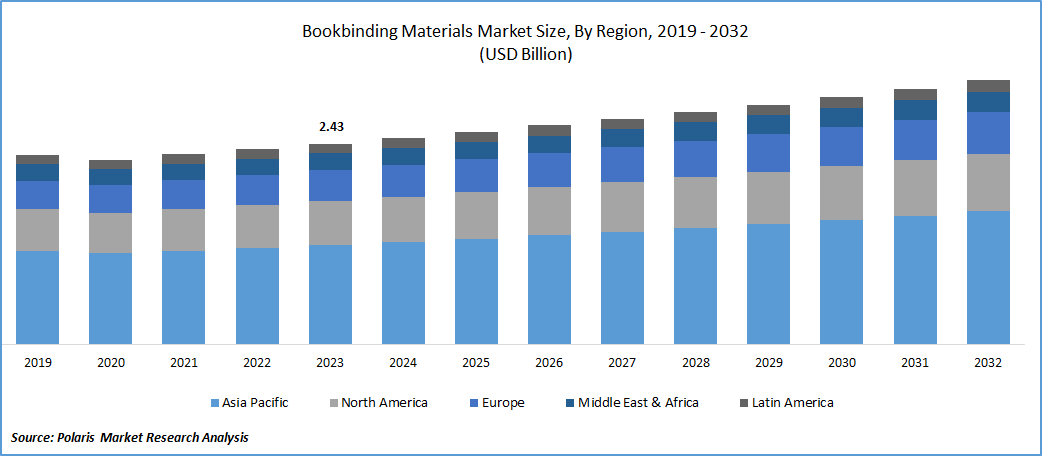
Source: Polaris Market Research Analysis
To Understand More About this Research:Download Sample Report
Currently, as per estimates that there are around 129,864,880 published books in the world at this moment. This number is expected to increase as more books are published in the coming years. As the number of published books increases, so does the demand for bookbinding materials to bind and protect these books also increase.
The increasing popularity of e-books is one of the major restraints of the bookbinding materials market. As more readers switch to digital formats, the demand for physical books and bookbinding materials is likely to decline.
Growth Drivers
-
Rapid Growth of Book Industry Driving the Market Growth
The growth of the market can be related to the growth of the publishing industry. The publishing industry, including both the trade & educational segments, is projected to rise by, nearly, 1.9% yearly, by 2030. As of 2023, the global book publishing revenue reach at USD 129 Bn, jumping from USD 122 Bn in 2018. Book publishing market is valued at USD 143.6 Bn in 2023 and will reach to USD 163.8 Bn, by 2030. The increasing number of books sold and the growing revenue in the book publishing industry indicate a strong demand for bookbinding materials. As the book publishing industry continues to grow, the demand for bookbinding materials such as adhesives, threads, and covers is also expected to increase, driving the growth of the bookbinding materials market.
Source: Polaris Market Research Analysis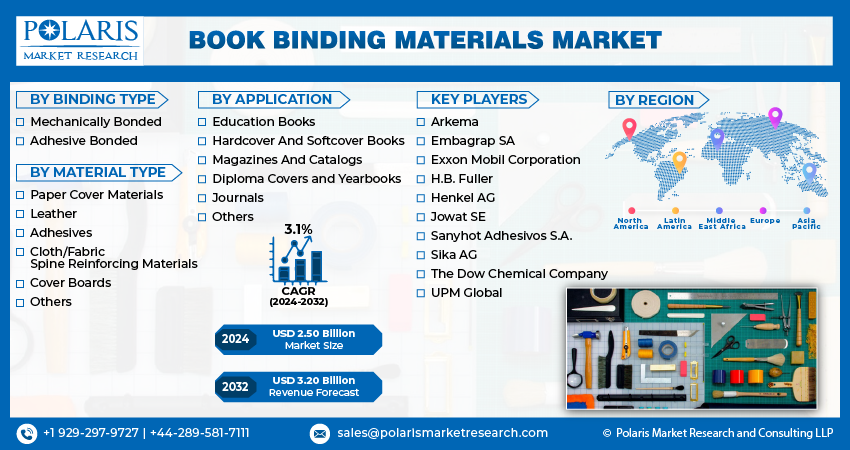
Get Full Segment-Level Forecasts & Insights: Download Sample Report
Report Segmentation
The market is primarily segmented based on Binding Type, Material Type, Application, and Region.
| By Binding Type | By Material Type | By Application | By Region |
|
|
|
|
Source: Polaris Market Research Analysis
To Understand the Scope of this Report:Request Customization
By Binding Type Analysis
-
The adhesive bonded segment held significant market share in 2023
The adhesive bonded segment dominated the market. Adhesive bonded binding is more flexible and versatile than mechanically bonded binding, as it can accommodate different sizes, shapes, and thicknesses of books. The rise of digital printing has led to the development of new materials and technologies for binding, covering, and decorating books. Adhesive bonding plays a crucial role in the manufacturing of books, especially those with soft or flexible covers. The increasing environmental consciousness among consumers has led to a higher demand for sustainable materials, such as those made from recycled materials or bio-based sources. Adhesive bonding can replace traditional mechanical fasteners, reducing material waste and promoting sustainability in bookbinding.
By Material Type Analysis
-
Paper cover material segment accounted for the largest market share in 2023
The paper cover material segment dominated the market with largest market revenue share in 2023. Paper cover materials are made from various types of paper, such as kraft paper, coated paper, and specialty paper. They are widely used in the bookbinding industry due to their affordability, versatility, and ease of customization. Paper covers are generally more cost-effective compared to other materials like leather, fabric, and plastic. This makes them an attractive option for bookbinding, especially for mass-market books. Paper covers can be easily personalized with various decorative techniques, such as embossing, debossing, and marbling, allowing for unique and visually appealing book designs.
By Application Analysis
-
Magazines and catalogs segment accounted for the largest market share in 2023
Magazines and catalogs are popular media platforms for advertising, providing businesses with a wide reach and the opportunity to target specific demographics. This high demand for these publications creates a strong market for book binding materials used in their production. The printing and publishing industry has experienced significant advancements in technology, enabling the production of high-quality books and publications. These advancements have contributed to the growth of the book binding materials market, as publishers can create more visually appealing and durable products.
Source: Polaris Market Research Analysis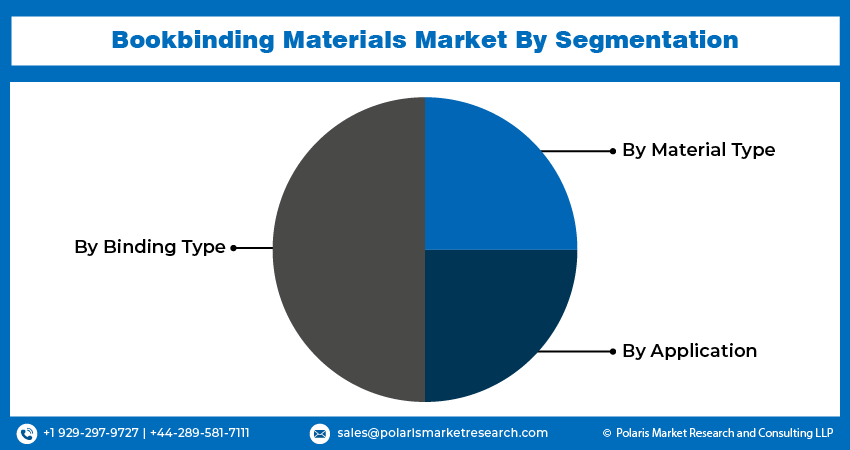
Need Granular Data Across All Market Segments? Request Customization
Regional Insights
-
Asia Pacific region dominated the global market in 2023
The Asia Pacific region dominated the market. Region has experienced a significant increase in the publishing industry, leading to a higher demand for bookbinding materials. Also, increasing urban population and a growing emphasis on education have led to a rise in the demand for books, especially in emerging economies, thereby boosting the bookbinding materials market in the region.
The Europe region is expected to grow at fastest CAGR during the forecast period. The bookbinding industry is witnessing continuous innovation and technological advancements in materials and processes. This includes the development of eco-friendly and sustainable bookbinding materials to align with the growing environmental concerns. The introduction of new and improved materials is driving the market forward. The rise of e-commerce platforms and on-demand printing services has transformed the distribution and production of printed materials. This shift has led to an increased requirement for efficient bookbinding materials to support on-demand printing and the diverse needs of online book sales, further fueling the market growth.
Source: Polaris Market Research Analysis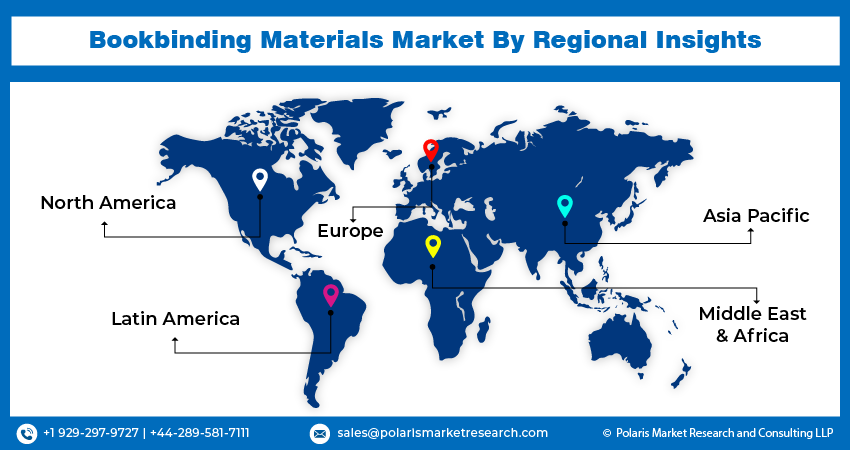
Curious About Regional Market Performance? Request Customization
Key Market Players & Competitive Insights
The global market is highly competitive, with several players operating in the market. The market is characterized by the presence of both large and small players, with each player striving to gain a competitive edge through various strategies such as product innovation, mergers and acquisitions, and partnerships. Increasing demand for high-quality and durable materials led to a focus on the development of advanced bookbinding materials that offer enhanced strength, longevity, and aesthetic appeal. Companies are investing in research and development to introduce innovative materials that cater to the evolving needs of the end users.
Some of the major players operating in the Global Bookbinding Materials Market include:
- Arkema
- Embagrap SA
- Exxon Mobil Corporation
- H.B. Fuller
- Henkel AG
- Jowat SE
- Sanyhot Adhesivos S.A.
- Sika AG
- The Dow Chemical Company
- UPM Global
Recent Developments
In September 2025, 3M Company (United States) introduced an advanced adhesive technology that delivers significantly enhanced bonding strength and long-term durability for bookbinding applications. The innovation underscores 3M’s continued investment in research and development while elevating performance standards within the sector. Such technological advancements are expected to give 3M a competitive advantage by clearly differentiating its offerings in a highly competitive market.
In August 2025, Henkel AG (Germany) announced the launch of a new portfolio of bio-based adhesives specifically developed for the bookbinding industry. This initiative highlights Henkel’s strong commitment to sustainability and reinforces its position as a frontrunner in environmentally responsible adhesive solutions. By leveraging renewable raw materials, the company aims to appeal to eco-conscious customers and strengthen its market presence in an industry increasingly driven by sustainability considerations.
In July 2022, Arkema completed the acquisition of Permoseal. This strategic acquisition bolstered Arkema's position in the dynamic industrial, construction, and DIY markets of South Africa and Sub-Saharan Africa.
In July 2021, Winter & Company, introduced 1st book cloth woven from recycled ocean-bound plastic. This innovative material is the first book cloth of its kind and offers exceptional durability, making it ideal for a wide range of applications, particularly book covers. Unlike traditional book cover materials made from paper or textiles, Toile Ocean is a sustainable and eco-friendly alternative that helps to reduce plastic waste in oceans.
Book Binding Materials Market Report Scope
| Report Attributes | Details |
| Market size value in 2024 | USD 2.50 billion |
| Revenue forecast in 2032 | USD 3.20 billion |
| CAGR | 3.1% from 2024 – 2032 |
| Base year | 2023 |
| Historical data | 2019 – 2022 |
| Forecast period | 2024 – 2032 |
| Quantitative units | Revenue in USD billion and CAGR from 2024 to 2032 |
| Segments covered | By Binding Type, By Material Type, By Application, By Region |
| Regional scope | North America, Europe, Asia Pacific, Latin America; Middle East & Africa |
| Key Companies | Henkel AG, H.B. Fuller, Arkema, The Dow Chemical Company, UPM Global, Sika AG, Jowat SE, Exxon Mobil Corporation, Sanyhot Adhesivos S.A., Embagrap SA, and Other Key Players |
| Customization | Report customization as per your requirements with respect to countries, region, and segmentation. |
Source: Polaris Market Research Analysis
Bookbinding Materials Market FAQ's
The key companies in Bookbinding Materials Market Henkel, H.B. Fuller, Arkema, UPM Global, Sika, Jowat.
The bookbinding materials market is expected to grow at a CAGR of 3.1% during the forecast period.
Bookbinding Materials Market report covering key segments are Binding Type, Material Type, Application, and Region.
The key driving factors in Bookbinding Materials Market are Rapid Growth of Book Industry Driving the Market Growth.
Global Bookbinding Materials Market Size Worth $ 3.20 Billion By 2032.
Download Sample Report of Bookbinding Materials Market
Please fill out the form to request a customized copy of the research report.


