
Bpo Business Analytics Market Insight, Share & Trends, 2026-2034
REPORT DETAILS
Market Statistics
Overview
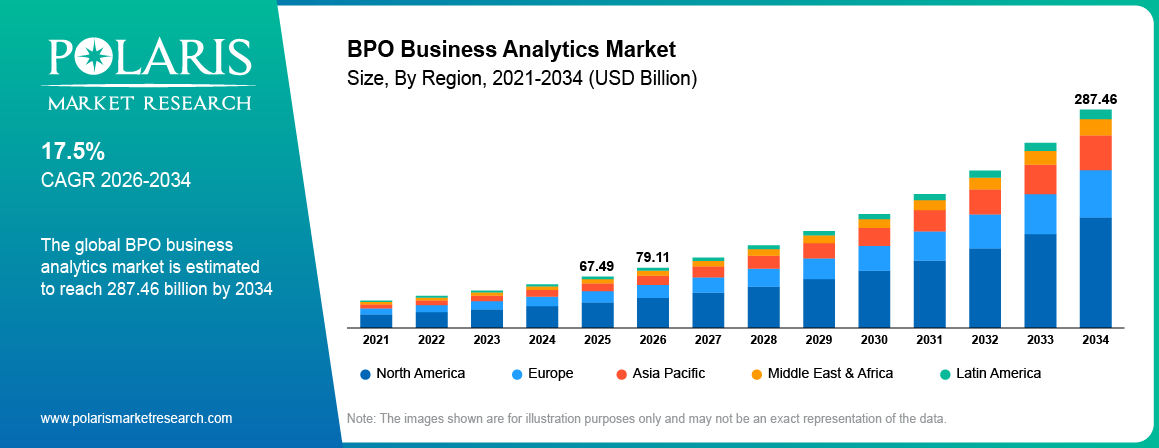
The global BPO business analytics market is estimated around USD 67.49 Billion in 2025, with consistent growth anticipated during 2026–2034. Growth is driven by rising enterprise data generation and increasing adoption of digital transformation across industries. The market is projected to grow at a CAGR of 17.5% during the forecast period.
Key Takeaways:
- North America accounted for the largest regional share of around 38.9% in 2025, driven by strong adoption of advanced analytics solutions and high volume of enterprise data generation across industries.
- By Component, Software segment accounted for the largest share of approximately 62.7% in 2025, supported by increasing use of analytics platforms for processing large datasets and deriving actionable business insights.
- By Deployment, On-Premise segment is projected to grow at a CAGR of 7.2%, driven by data security concerns and preference among regulated industries for controlled analytics environments.
- By Enterprise Size, Large Enterprise segment accounted for the largest share of nearly 69.5% in 2025, supported by high data volumes and adoption of advanced analytics for strategic decision-making.
- By Function, Customer Analytics segment is projected to grow at a CAGR of 9.8%, driven by increasing focus on customer behavior analysis and targeted marketing strategies.
- By Industry Vertical, BFSI segment accounted for the largest share of around 29.7% in 2025, supported by high transaction volumes and demand for advanced analytics in financial operations.
Market Statistics
- 2025 Market Size: USD 67.49 Billion
- 2034 Projected Market Size: USD 287.46 Billion
- CAGR (2026-2034): 17.5%
- North America: Largest market in 2025
Industry Dynamics
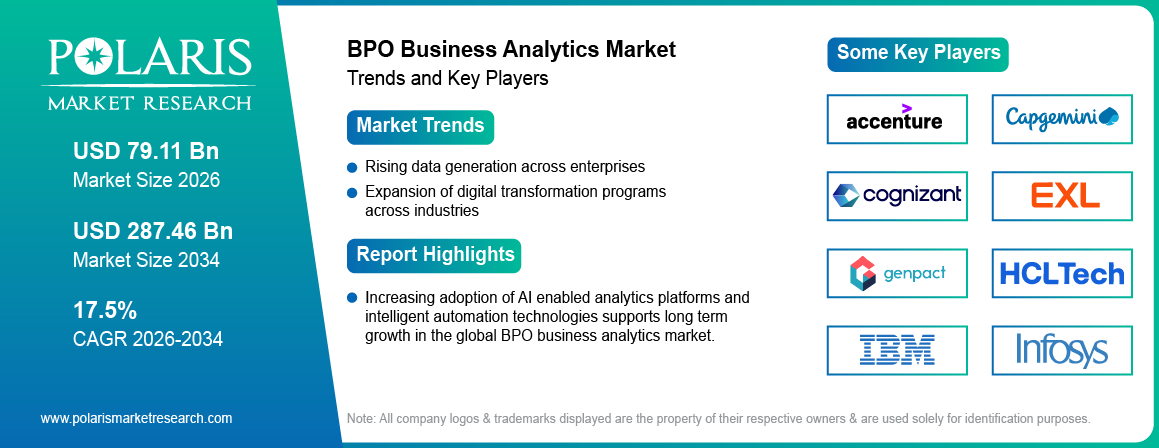
- Rising enterprise data volumes are increasing the adoption of outsourced business analytics services.
- Expansion of digital transformation programs across industries is increasing demand for advanced analytics support services.
- Data privacy regulations and compliance requirements increase operational complexity for analytics outsourcing providers.
- Expansion of AI enabled automation and intelligent analytics technologies creates new opportunities in the global BPO business analytics market.
What is BPO Business Analytics?
The term BPO business analytics industry refers to the delivery of outsourced business analytics and data management services to organizations. The business analytics industry comprises service providers, technology vendors, cloud companies, and consulting organizations that provide efficient management of large volumes of enterprise data. The business analytics industry caters to organizations from different industries that require data analysis to make decisions.
The business analytics industry comprises various service types such as AI data management, predictive analytics, customer analytics, financial analytics, and risk analytics. These types of services are used in marketing optimization, supply chain management, fraud detection, and performance monitoring. The BPO business analytics service providers offer these types of services through integrated digital platforms to global organizations.
Source: Polaris Market Research Analysis
To Understand More About this Research:Download Sample Report
The BPO business analytics industry is unique compared to the general BPO services that are based on transaction processing and administrative support. Generally, the BPO services provide repetitive operational support. On the other hand, the BPO analytics services provide interpretation of the data and performance and decision support. These services help the organization improve efficiency, customer engagement, and overall performance based on the analysis of the data.
Drivers & Opportunities
Rising data generation across enterprises: The growth of enterprise data from the increase in digital platforms, customer transactions, and devices is driving the need for outsourced analytics services. According to the World Economic Forum, the generation of global data is expected to reach 463 exabytes per day by the year 2025. Organizations require specialized service providers for the processing and interpretation of the enormous volume of structured and unstructured data. This is prompting the adoption of BPO business analytics services.
Expansion of digital transformation programs across industries: Digital transformation projects undertaken in the BFSI, retail, and healthcare industries provide a good opportunity for the implementation of advanced data analytics service delivery models. Enterprises are seeking to partner with analytics service providers to assist them in customer insights, operational optimization, and decision-making processes. The growth in digital platforms and cloud-based business models is creating an opportunity for outsourced analytics service delivery models.
Restraints & Challenges
Data privacy regulations and compliance requirements: Data protection regulations and compliance are creating operational challenges for analytics outsourcing service providers. Service providers have to follow best practices in data management and adhere to regional regulations. Data protection regulations are creating operational challenges and increasing the cost of outsourced analytics service delivery models.
Opportunity
Growth of AI enabled automation and intelligent analytics: The adoption of AI and ML technology is providing opportunities for the development of advanced BPO analytics services. The analytics service providers are now integrating AI-enabled automation and intelligent process analytics into outsourced service models. Capita introduced AI Catalyst Stack in October 2025. It is a suite of AI-driven tools that help in automating processes and decision-making and accelerate its transition to an AI-enabled BPO. The technology is used for predictive analysis, automated decisions, and business insights.
Technology & Innovation in BPO Analytics
AI and Machine Learning Transforming Analytics Outsourcing
There is an improvement in the efficiency of outsourced analytics services by the use of artificial intelligence and machine learning. The analytics service providers use predictive modeling techniques to forecast business outcomes. This enables them to aid in strategic planning. Additionally, AI-based systems help in fraud detection in financial transactions. Automation tools aid in the reduction of manual data processing. They increase the speed of analytics operations.
Role of Cloud Platforms in BPO Analytics
Cloud platforms aid in the provision of scalable analytics services to organizations. Cloud-based infrastructure enables analytics service providers to handle large volumes of data in their operations. The application of cloud platforms aids in cost efficiency. This is due to the flexibility in service deployment. Additionally, cloud platforms aid in real-time data processing.
Emerging Technologies
New technologies are strengthening the capabilities of BPO analytics services. Generative AI tools assist in advanced data interpretation and automated report generation. Intelligent automation platforms improve process efficiency across analytics workflows. Data visualization platforms allow enterprises to interpret complex datasets through interactive dashboards and visual analytics tools.
Source: Polaris Market Research Analysis
Get Full Segment-Level Forecasts & Insights: Download Sample Report
Segmental Insights
This report offers detailed coverage of the BPO business analytics market by component, deployment, enterprise size, function, and industry vertical to help readers identify the fastest expanding and most attractive demand segments.
By Component
-
Software
The software segment has the highest market share in 2025, owing to the increasing adoption of analytics platforms in the management of enterprise data. Organizations use software in the form of analytics platforms to process large volumes of data. They use it to derive business insights. Various enterprises across different industries use analytics platforms to improve operations.
-
Services
The services segment is expected to experience the highest growth rate during the forecast period. This is attributed to the increasing need to outsource analytics services. Various enterprises require services in the form of data management, predictive analysis, and performance monitoring. Data-driven decision making is increasing in various industries.
By Deployment
-
Cloud
The cloud segment accounted for the largest market share in 2025, owing to increasing adoption of scalable analytics infrastructure across enterprises. With cloud deployment, organizations can handle large volumes of data. Cloud deployment also allows organizations to support real-time analytics operations. Organizations implement cloud-based analytics solutions to enhance flexibility in their operations and lower infrastructure costs.
-
On-premise
The on-premise segment of the market is expected to grow steadily during the forecast period. This is owing to the security and compliance issues faced by data-sensitive industries. Large organizations and financial institutions prefer to have on-premise analytics infrastructure to have control over data within the organization. This type of deployment suits organizations that have strict data governance.
By Enterprise Size
-
Large Enterprise
The large enterprises segment held the highest market share in 2025, due to the high adoption of advanced analytics platforms for business intelligence. Large enterprises tend to generate huge volumes of data due to their global presence. They use BPO analytics services to handle their complex data infrastructure, as well as strategic decision-making.
-
SMEs
The SMEs segment is expected to register the highest CAGR during the forecast period. This is due to the increasing adoption of outsourced analytics services. Small and medium-sized enterprises use BPO analytics services. They use BPO analytics services to access better data infrastructure. The rise of cloud-based analytics services is also contributing to the growth of BPO analytics services for small and medium-sized enterprises.
By Function
-
Finance Analytics
Finance analytics held the maximum market share in the year 2025. The demand for financial risk analysis, fraud detection, and revenue optimization is increasing. Financial analytics help organizations monitor financial transactions and improve financial planning. Financial services organizations use analytics services for improving their risk management capabilities.
-
Customer Analytics
Customer analytics is expected to have the highest CAGR during the forecast period due to the growing need for analyzing customer behavior and running specific marketing campaigns. Organizations are using customer interaction data for better customer engagement, product placement, and sales force efficiency.
By Industry Vertical
-
BFSI
The BFSI segment held the highest share of the market in 2025 due to the high demand for fraud detection, financial risk monitoring, and customer analytics. Financial institutions, including banks, are generating huge amounts of transactions that require advanced analytics services.
-
Healthcare
The healthcare segment is projected to grow at the fastest CAGR during the forecast period, due to increasing use of analytics for patient data management and healthcare operations. Healthcare organizations adopt analytics platforms to support clinical decision systems and operational performance monitoring.
Source: Polaris Market Research Analysis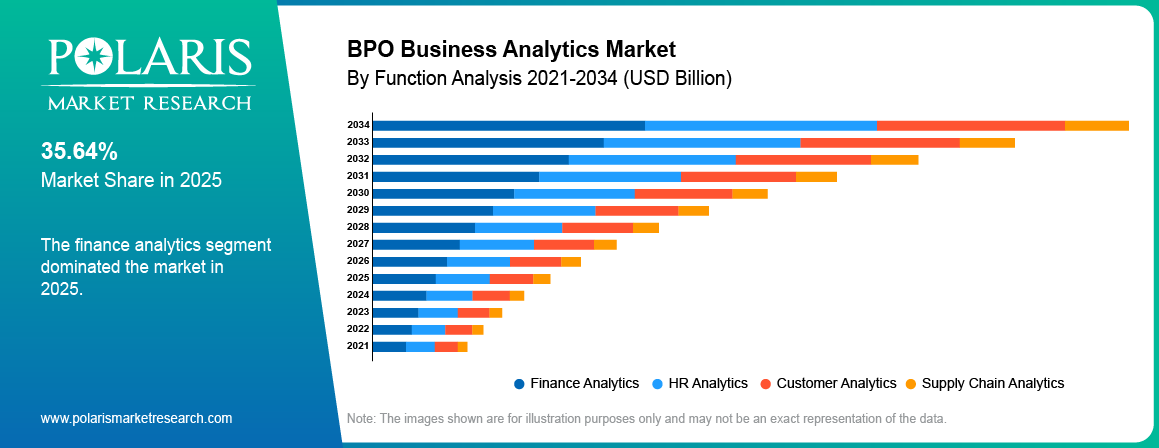
Need Granular Data Across All Market Segments? Request Customization
Regional Analysis
North America Market Assessment
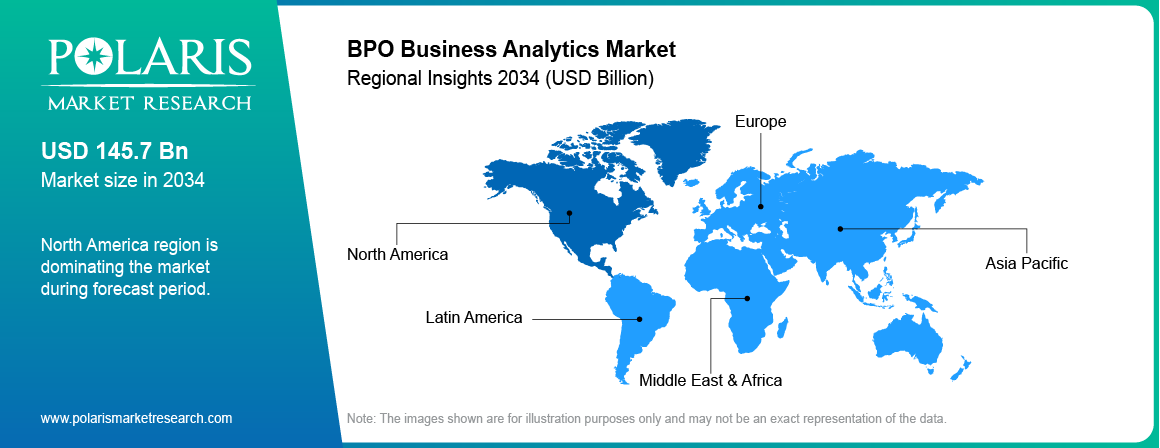
North America BPO business analytics market dominated in 2025, driven by strong adoption of advanced analytics solutions across the US and Canada. Large enterprises in the region produce high volumes of digital and transaction data that need specialized analytics services. PYMNTS reported that digital wallets account for 39% of online transactions and 16% of point-of-sale transactions in the US. The presence of major technology companies and analytics service providers is strengthening demand for outsourced business analytics across industries.
Asia Pacific BPO Business Analytics Market Insights
Asia Pacific BPO business analytics market is projected to grow at the fastest CAGR during the forecast period, owing to rapid digital transformation across enterprises. Countries such as India and China are expanding IT service capabilities and analytics outsourcing operations. The Indian government's Ministry of Electronics and Information Technology reported that India's digital economy is growing rapidly, with the digital economy's productivity five times higher than the other sectors. It is expected that the digital economy will contribute 20% of the country's Gross Value Added by 2029-30. Increasing investments in digital infrastructure and data driven business operations are strengthening the India BPO analytics market and the China BPO analytics market.
Europe BPO Business Analytics Market Overview
Europe was the second largest market for BPO business analytics, driven by increasing enterprise adoption of data driven decision systems. Countries like Germany, France, and the UK are increasing their adoption of analytics services in the financial sector, retail industry, and telecom market. For example, in February 2026, Connect Europe announced that the telecom sector in Europe invested EUR 64.6 billion in 2024.
Source: Polaris Market Research Analysis
Curious About Regional Market Performance? Request Customization
Key Players & Competitive Analysis Report
The competitive environment is influenced by continuous development in advanced data analytics platforms and digital outsourcing services. Companies focus on improving analytics capabilities that support predictive insights, automation, and enterprise data management. Collaboration with technology providers and enterprise clients is strengthening the development of advanced BPO analytics solutions that support data driven decision making and operational efficiency.
Leading companies in the BPO business analytics market are Accenture plc, Tata Consultancy Services (TCS), Genpact Ltd., Infosys Ltd., Wipro Ltd., Capgemini SE, Cognizant Technology Solutions Corp., EXL Service Holdings Inc., IBM Corporation, Tech Mahindra Ltd., HCLTech Ltd., Teleperformance SE, and many more.
Key Players
- Accenture plc
- Capgemini SE
- Cognizant Technology Solutions Corp.
- EXL Service Holdings Inc.
- Genpact Ltd.
- HCLTech Ltd.
- IBM Corporation
- Infosys Ltd.
- Tata Consultancy Services (TCS)
- Tech Mahindra Ltd.
- Teleperformance SE
- Wipro Ltd.
Industry Developments
- November 2025: Konecta partnered with Kraken to launch BPO Partner Program to deliver large-scale customer experience operations and support the global expansion of Kraken’s AI-powered utilities platform.
- June 2025: iQor CXBPO launched Insights iQ, an AI-powered analytics platform that analyzes 100% of customer interactions to deliver real-time predictive insights and improve customer experience, operational efficiency, and revenue opportunities.
BPO Business Analytics Market Segmentation
By Component Outlook (Revenue, USD Billion, 2021-2034)
- Software
- Services
By Deployment Outlook (Revenue, USD Billion, 2021-2034)
- Cloud
- On-premise
By Enterprise Size Outlook (Revenue, USD Billion, 2021-2034)
- Large Enterprise
- SMEs
By Function Outlook (Revenue, USD Billion, 2021-2034)
- Finance Analytics
- HR Analytics
- Customer Analytics
- Supply Chain Analytics
By Industry Vertical Outlook (Revenue, USD Billion, 2021-2034)
- BFSI
- Healthcare
- Retail
- Telecom
- Manufacturing
By Regional Outlook (Revenue, USD Billion, 2021-2034)
- North America
- US
- Canada
- Europe
- Germany
- France
- UK
- Italy
- Spain
- Netherlands
- Russia
- Rest of Europe
- Asia Pacific
- China
- Japan
- India
- Malaysia
- South Korea
- Indonesia
- Australia
- Vietnam
- Rest of Asia Pacific
- Middle East & Africa
- Saudi Arabia
- UAE
- Israel
- South Africa
- Rest of Middle East & Africa
- Latin America
- Mexico
- Brazil
- Argentina
- Rest of Latin America
BPO Business Analytics Market Report Scope
| Report Attributes | Details |
| Market Size in 2025 | USD 67.49 Billion |
| Market Size in 2026 | USD 79.11 Billion |
| Revenue Forecast by 2034 | USD 287.46 Billion |
| CAGR | 17.5% from 2026 to 2034 |
| Base Year | 2025 |
| Historical Data | 2022–2024 |
| Forecast Period | 2026–2034 |
| Quantitative Units | Revenue in USD Billion and CAGR from 2026 to 2034 |
| Report Coverage | Revenue Forecast, Competitive Landscape, Growth Factors, and Industry Trends |
| Segments Covered |
|
| Regional Scope |
|
| Competitive Landscape |
|
| Report Format |
|
| Customization | Report customization as per your requirements with respect to countries, regions, and segmentation. |
Source: Polaris Market Research Analysis
Bpo Business Analytics Market FAQ's
The global market size was valued at USD 67.49 Billion in 2025 and is projected to grow to USD 287.46 Billion by 2034.
North America dominates due to strong adoption of data driven decision systems and presence of major analytics service providers.
Major applications include finance analytics, customer analytics, HR analytics, and supply chain analytics across enterprise operations.
A few of the key players in the market are Accenture plc, Tata Consultancy Services (TCS), Genpact Ltd., Infosys Ltd., Wipro Ltd., Capgemini SE, Cognizant Technology Solutions Corp., EXL Service Holdings Inc., IBM Corporation, Tech Mahindra Ltd., HCLTech Ltd., Teleperformance SE, and others.
Key growth factors include rising enterprise data generation and expansion of digital transformation programs across major industries.
Download Sample Report of Bpo Business Analytics Market
Please fill out the form to request a customized copy of the research report.


