
Building Information Modeling Market Size, Trends & Share, 2026-2034
REPORT DETAILS
Market Statistics
Building Information Modeling (BIM) Market Overview
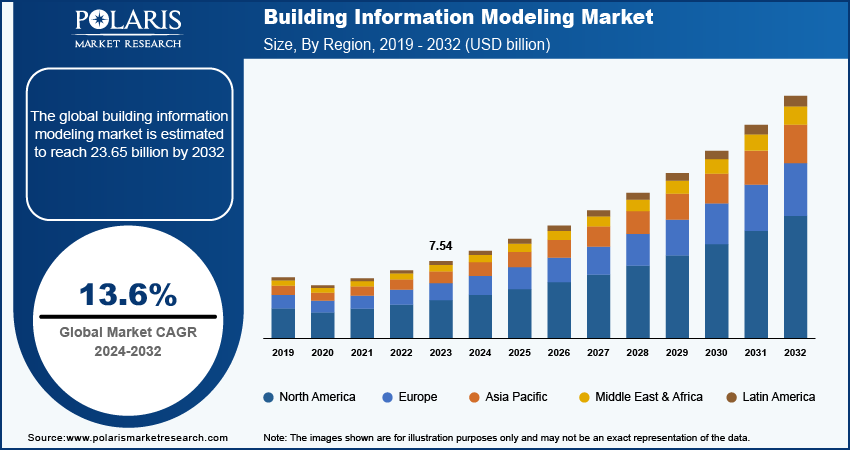
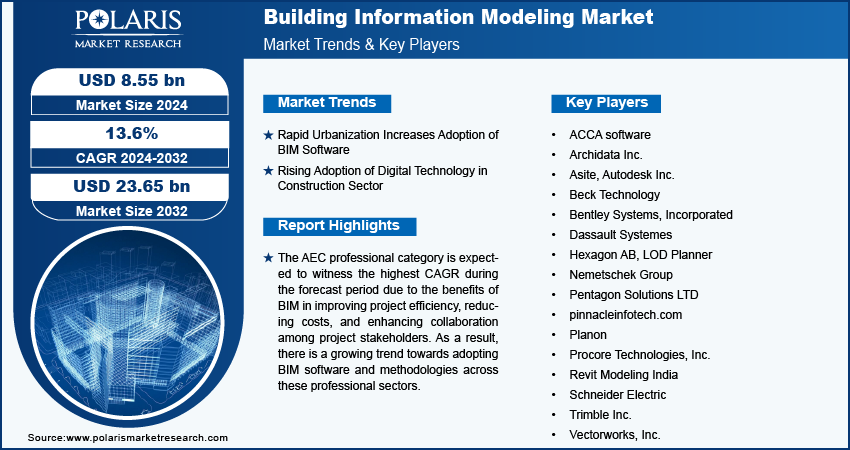
The global building information modeling (BIM) market size was valued at USD 8.70 billion in 2025, growing at a CAGR of 10.3% from 2026 to 2034. Government mandates and supportive policies worldwide, along with increasing investments in smart city development, are expanding BIM demand.
Government-supported digital construction initiatives, public procurement mandates, and increased adoption of cloud-based BIM collaboration platforms are also driving the building information modeling industry. Large infrastructure, transportation, and smart building projects are seeing particularly high adoption. When considering search and the use of the industry in practice, the market is also referred to as the building information modelling market-this reflects UK spelling. It covers the BIM software market, including design, coordination, and data management tools, as well as BIM services such as implementation, system integration, and training support.
Key Insights
- The software market is expected to reach USD 13.41 billion by 2034, growing at a robust pace. This growth can be attributed to increased demand for effective material use, waste reduction, and the implementation of BIM in government projects.
- The cloud-based segment accounted for 66.53% of the market share in 2025. Its demand is driven by reduced hardware requirements and government policies mandating BIM for public projects.
- The construction & design category dominated the market in 2025, accounting for USD 3.49 billion. This growth is attributed to the increasing demand for the timely execution of complex projects at a specific cost.
- In 2025, the market in North America accounted for 40.44% of the total BIM market due to the efficiency of project management and the digitalization of the construction industry.
- The European BIM market is expected to reach USD 6.62 billion in 2034, supported by smart infrastructure investment and governmental BIM regulation.
- The building information modeling market in Asia Pacific accounted for 23.45% of the market in 2025. The growth can be attributed to the rising adoption of efficient construction methods and smart city development.
Note: Figures and projections outlined in this report are the result of Polaris Market Research’s proprietary analytical processes, grounded in the latest available datasets and market observations.
Industry Dynamics
- The growth of smart city development and digital construction initiatives is driving the global adoption of BIM.
- Regulations and directives from governments in regions such as Europe, North America, and Asia are forcing organizations to adopt BIM for infrastructure projects.
- The use of cloud-based systems and collaboration tools has increased efficiency in building information modeling by reducing costs and improving accuracy.
- Using BIM comes with costs that may be a barrier to adoption for some smaller construction companies.
Market Statistics
- 2025 Market Size: USD 8.70 billion
- 2034 Projected Market Size: USD 21.06 billion
- CAGR (2026–2034): 10.3%
- North America: Largest Market Share
AI Impact on Building Information Modeling Market
- BIM accelerates project planning and design by enabling teams to visualize and coordinate work more efficiently.
- It reduces errors and rework in construction, thereby saving money and time.
- BIM enhances collaboration among architects, engineers, and contractors by enabling the sharing of digital models.
- It will also support better facility management and maintenance by providing valid, accurate, current building information.
Building information modeling is a digital representation of a building's or infrastructure's physical and functional details. It provides a shared information resource for a project team, thereby aiding collaboration across the planning, design, construction, operation, and maintenance phases. BIM employs 3D models and data to help stakeholders visualize and understand a project before construction.
BIM encompasses much more than 3D design; it also covers BIM scheduling through 4D BIM and cost planning through 5D BIM, enabling precise quantity takeoff and more effective cost control. Most organizations can manage this process through a Common Data Environment that allows coordination and approvals. BIM is also linked to scan-to-BIM and digital twin integration, helping teams track real-world conditions, reduce errors, and improve overall efficiency.
Building Information Modeling can be applied to office buildings, hospitals, and schools. This is because such projects are complex and involve multiple parties. As such, building information modeling coordination plays a significant role in ensuring easy management. The process reduces clashes and improves constructability during the initial construction phase. Facility management BIM applies to the entire life cycle of the facility, represented by its as-built data.
Source: Polaris Market Research Analysis
To Understand More About this Research:Download Sample Report
What is BIM and How it Works?
Building Information Modeling (BIM) is the use of software tools to create a 3D model of a construction project. It involves a blend of design and data and enables collaboration among all stakeholders in any construction project within a single common digital model.
BIM spans all phases of construction projects. From design and planning, implementation of construction activities, operations, and management, each phase introduces additional data into the modeling process. Therefore, it is a continuously updated repository of construction data that provides reliable information to all stakeholders involved.
Globally, increasing urbanization is driving faster growth in the BIM market. According to a 2022 World Economic Forum study, the urbanized population is expected to grow from 55% in 2022 to 80% in 2050. As a result, there is a growing demand for roads, bridges, and transportation infrastructure, in which BIM for infrastructure provides effective construction planning. Integration of BIM and GIS assists in corridor management, utility management, and environmental risk studies in a densely populated urban region. Increasing urbanization also increases the demand for effective FM, in which asset management BIM assists in real-time monitoring and maintenance activities without affecting occupants.
The competitive environment in urban real estate is pushing the use of BIM. Developers and investors are keen to complete projects quickly and efficiently, while making a profit. This is where BIM technology is particularly beneficial in urban real estate.
Types / Levels of BIM
- 3D BIM: Deals with the visualization of a 3D model of the building, aiding visualization and clash detection.
- 4D BIM: Incorporates 4th dimension of time scheduling in the model, which helps with sequencing of construction and modeling of the timeline of the project.
- 5D BIM: Involves incorporating cost information in the model to help make estimates of the costs involved.
- BIM Maturity Levels: From simple 2D CAD-based procedures (level 0) to highly advanced and collaborative Level 2 & Level 3 BIM, where everyone works off the same cloud-based models
Industry Dynamics
Increasing Investments in Development of Smart Cities Globally
Smart cities integrate connected systems, data analysis, and online platforms to increase efficiency, reduce environmental impacts, and improve living standards. These are similar to BIM in smart cities. The construction of smart cities involves planning, management, and the construction of buildings and smart infrastructure; therefore, BIM software is necessary for architects, engineers, and contractors. The integration of BIM with the digital twin process makes it more important because data analysis enables predictive maintenance. Lastly, BIM software enhances IoT automation of assets, grids, and other systems in smart cities. In relation to these BIM applications, the Government of India allocated USD 19.25 billion (INR 1,64,687 crores) to build 100 smart cities through the Smart Cities Mission.
Smart cities use IoT sensors, smart grids, and automated infrastructure. BIM is the infrastructure in smart cities that enables the management of these automated systems. BIM enables real-time tracking and predictive maintenance for buildings. The increasing investment in smart cities is driving demand for BIM.
Rising Government Regulation and Mandates for BIM Adoption
The governments of the UK, Singapore, and Germany are making it compulsory to use BIM in infrastructure projects. In the UK, BIM Level 2 has been mandated for centrally funded projects. ISO 19650 sets the standard in information management. In Singapore, BIM submission is mandatory for buildings above 5,000 square feet. This is to enhance quick project completion and digital handover.
The government incentives include tax benefits and grants to encourage BIM adoption. Finland and Norway offer financial assistance to organizations to learn about BIM, encouraging many to adopt it. The incentives and regulations imposed on these organizations require them to invest in BIM software. Most governments encourage BIM not only during construction but also during asset management.
Emerging Trends in BIM
These recent advancements in BIM technologies encompass the incorporation of AI into BIM systems for the purposes of facilitating automated design and improving the prediction of outcomes. There has also been a recent addition of digital twin technology to BIM for real-time asset monitoring. Cloud-based BIM software applications have enhanced collaboration between all parties involved despite their different geographical locations. BIM technology has also benefited from augmented reality and virtual reality visualization tools
Source: Polaris Market Research Analysis
Get Full Segment-Level Forecasts & Insights: Download Sample Report
Segmental Insights
By Solution Analysis
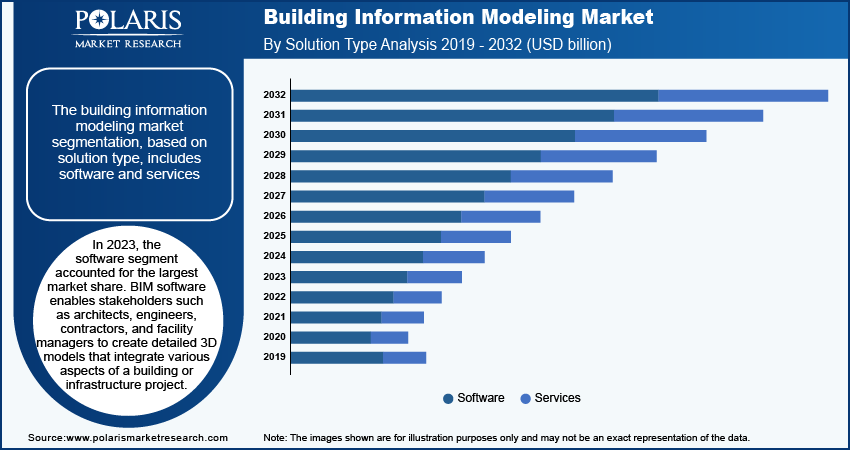
The software segment is expected to reach USD 13.41 billion in 2034. The development of the software segment has been driven by the requirement to increase efficiency and minimize wastage in the construction industry. Conversely, the BIM regulations adopted for public infrastructure construction have also promoted its development. BIM software encompasses authoring tools, coordination tools, collision detection tools, and CDE platforms. Interoperability has been facilitated by the open standards of the IFC and BCF. The advancement of cloud computing technology and AI has facilitated collaborative processes in BIM software. This has now propelled firms to develop BIM software that incorporates AI. In October 2024, ALLPLAN unveiled ALLPLAN 2025 to deliver superior-quality projects with enhanced precision.
Even the services segment is enjoying decent growth due to problems in the construction sector, such as project delays and cost escalations. BIM services can be used to avoid rework, improve coordination, and enable better scheduling, thereby saving both time and money. Sustainability efforts globally are increasing the demand for BIM services.
By Deployment Type Analysis
The cloud-based market dominated with a 66.53% share in 2025, driven by reduced reliance on hardware. The government and relevant authorities are also encouraging the growth of the cloud-based BIM market by ensuring BIM compliance for cloud-based construction projects to improve construction quality and sustainability. The increasing acceptance and development of cloud-based technologies for BIM processes also support the market growth. In January 2025, Solibri announced the launch of cloud-based Solibri CheckPoint for building information modeling workflows.
The on-premises market is forecast to grow rapidly over the forecast period. This is because it enables organizations to have complete control over project data, security parameters, and software applications. Construction firms, architectural agencies, and engineering consultancies are using on-premises BIM to streamline design processes, coordinate multidisciplinary workflows, and ensure seamless integration across the project lifecycle from initial planning and conceptual design to construction and facility management. Data security and confidentiality are major factors driving organizations to invest in on-premises BIM solutions. Governments, defense contractors, and secure facilities prefer and use on-premises solutions. The compliance feature is another reason organizations are shifting to on-premises BIM solutions, especially in certain geographic regions where data-residency policies require data to be stored locally within the country.
By Building Type Analysis
The commercial segment dominated the market, valued at USD 2.88 billion in 2025. The increase in dominance is due to the greater complexity of modern commercial projects. The presence of cloud-based BIM platforms enhanced BIM adoption in commercial projects by enabling real-time collaboration across dispersed teams and making it easier to manage projects globally. This growing population is further driving demand for BIM solutions in commercial building projects. The growing population further complicates the construction of commercial projects such as transit systems, hospitals, schools, and airports. Such projects require an advanced coordination and resource management tool like BIM.
The industry is expected to capture a significant market share by 2034 due to global industrialization across emerging regions such as Asia Pacific, the Middle East, and Latin America. For example, the Indian government's Union Minister of Finance and Corporate Affairs released the "Economic Survey 2023-24" in July 2024. This document revealed that the Indian economy's industrial growth was 9.5% during that period. The development of digital infrastructure for Industry 4.0 is further increasing the use of BIM across industries, as industry developers require smart infrastructure and technology that can be achieved only through a solution integrated with BIM.
By Project Analysis
The preconstruction market is expected to register a 9.8% CAGR during the forecast period. The primary reason for this high growth is the increasing focus on cost reduction in infrastructure development. The government regulations and industry norms are compelling many organizations to adopt BIM. The involvement of BIM in the pre-construction phase of projects has become mandatory in a number of governmental projects to facilitate transparency. The development of smart cities is also compelling the adoption of BIM during the pre-construction phase. BIM encourages collaboration among architects, engineers, contractors, and owners, making it even more sought-after.
The construction segment is estimated to hold a significant market share in 2034. Construction companies are using BIM to complete projects more quickly and at a lower cost. Moreover, the complex nature of the projects is compelling them to adopt digital tools for collaboration. BIM offers a single platform for this, which is why its usage is increasing. Further, the increasing labor shortage in the construction industry is prompting firms to optimize the performance of their limited resource pool, and BIM assists in this context by improving planning accuracy and reducing manual work, thereby driving the adoption of BIM solutions among construction companies.
By Application Analysis
The construction & design industry held the leading market share in 2025, valued at USD 3.49 billion. This is due to the growing need for construction companies to deliver complex projects on time and cost-effectively. The increasing adoption of intelligent buildings and green designs globally has escalated the importance of BIM. The designers are evaluating energy efficiency, daylight availability, and material properties in the early stages of the project to ensure compatibility with green and intelligent buildings. The rising urbanization rate and demand for advanced buildings are driving the adoption of BIM software for the design of complex buildings.
The planning & modeling market is projected to grow significantly over the forecast period. This is because the construction industry is observing increased project complexity, in which, during the planning & modeling phase, the need for such a system becomes the need of the hour to address design complexities. Governments around the world are mandating the use of BIM for public infrastructure projects, thereby increasing demand for planning and modeling. The accuracy obtained through BIM also reduces costs and time, thereby increasing adoption.
By End User Analysis
The AEC professionals market accounted for 46.96% market share in 2025, driven by increased demand for efficient projects in the construction industry. AEC professionals prefer using BIM in their projects because it helps them interpret, simulate, and analyze projects, reducing mistakes even before construction begins. BIM allows AEC professionals to share a common model. This not only reduces conflicts but also allocates resources efficiently and improves decision-making throughout the process. Further, due to increasing investment in the global smart industry, especially in up-and-coming nations, there is growing adoption of BIM tools among ACE professionals. These tools assist ACE professionals in creating smart cities for industries.
The builders & contractors market is expected to demonstrate a robust CAGR over 2025-2034, driven by the need to optimize project outcomes. As competition in the construction market increases, the adoption of advanced solutions by builders and contractors is accelerating. BIM enables builders and contractors to make quick decisions and provides effective risk management solutions. When combined with other digital technologies, such as IoT and augmented reality, builders and contractors are encouraged to do so.
Source: Polaris Market Research Analysis
Need Granular Data Across All Market Segments? Request Customization
Regional Analysis
The North America building information modeling industry accounted for 40.44% of the global market share in 2025, driven by growing demand for efficient construction project management and digital transformation in the architecture, engineering, and construction (AEC) industry. Urbanization and aging infrastructure are driving demand for BIM in the region. There is a need for technology integration for design and facility management. The requirements for sustainability and energy efficiency are also adding to the adoption of BIM. There is a need to manage carbon impact.
US Building Information Modeling Market Insight
The US, in particular, dominated with 79.21% regional market share. This dominance is attributed to mandates requiring BIM for public infrastructure projects and to the promotion of digital transformation in the construction industry. In September 2022, the National Institute of Building Sciences (NIBS) launched the US National BIM Program to promote digital transformation in the construction industry by encouraging the adoption of building information modeling (BIM). As large development projects become increasingly complex, especially in smart cities and sustainable buildings across the country, demand for more advanced BIM solutions to support collaboration and data management is also growing.
Europe BIM Market
The Europe building information modeling market size is expected to reach USD 6.62 billion in 2034. The adoption of smart infrastructure and smart construction mainly drives this. In the UK, Germany, and other European countries, governments are increasingly requiring the adoption of BIM for public infrastructure projects. This rise in the adoption of BIM for public infrastructure projects is mainly driven by improved transparency, cost-effectiveness, and the ability to manage projects throughout their lifecycles. Since January 1st, 2021, the adoption of BIM obligations for public procurement contracts in Germany has also been mandated.
Companies in the construction industry in Western and Northern Europe are also prioritizing BIM technology to meet their stringent sustainability targets. The increasing adoption of green rating systems in Western and Northern Europe, such as BREEAM assessments, is providing technology companies with opportunities to offer sustainable technologies. In addition, the development and investment in smart cities across Europe are driving the building information modeling industry. This is because smart cities are characterized by the integrated delivery of infrastructure, utility, and technology solutions, all of which require building information modeling.
Asia Pacific Building Information Modeling Market Overview
Asia Pacific BIM market accounted for 23.45% in 2025. The reasons for this are the need for faster, more efficient construction and for smart city development. In countries such as Singapore and Australia, governments are enforcing the use of BIM on all public infrastructure projects. The use of BIM will thus be accelerated. Asia has been witnessing a rise in its urban population, with a projected increase of 50% by 2050. Increased spending on transport, energy, and housing infrastructure is also contributing to this factor.
Source: Polaris Market Research Analysis
Curious About Regional Market Performance? Request Customization
Key Players & Competitive Analysis Report
The BIM industry is highly competitive, with intense rivalry among leading firms. Organizations are expanding their product lines and enhancing their ability to remain at the top. Organisations are entering into partnerships and acquiring other firms to gain a competitive advantage. Organizations have also focused on developing advanced technologies such as AI, ML, and the cloud. These technologies make the rivalry between firms even tougher.
A few prominent companies in the building information modeling industry are Autodesk, Bentley Systems, Nemetschek Group, Trimble Inc., Dassault Systèmes, Hexagon AB, AVEVA (Schneider), Procore Technologies, Siemens Digital, Asite, CYPE Ingenieros, and ACCA Software.
Key Players
- ACCA Software
- Asite
- Autodesk
- AVEVA (Schneider)
- Bentley Systems
- CYPE Ingenieros
- Dassault Systèmes
- Hexagon AB
- Nemetschek Group
- Procore Technologies
- Siemens Digital
- Trimble Inc.
Industry Developments
June 2025: Nemetschek Group collaborated with Iowa State University's Iowa Innovative Housing Project to solve the issue of the lack of affordable housing in Iowa. The project uses 3D printing technology and other innovative technologies in construction to decrease the risks associated with construction, reduce materials' usage and waste, and create environmentally friendly and efficient housing solutions. The initiative is led by Iowa State University. (source: nemetschek.com)
June 2025: Dassault Systèmes entered into a five-year partnership agreement with BoConcept, an international brand of furniture stores, for designing 3D rooms and configuring products. (source: 3ds.com)
April 2025: The Conch Group, the China Building Materials Federation, and Huawei jointly launched an AI solution for the cement sector. Developed using Huawei's Pangu AI engine, it improves production optimization, reduces coal use, facilitates anomaly detection, and enhances digital transformation. (Source: huawei.com)
March 2025: IFMA and Autodesk established the BLMI in order to facilitate better data management for buildings. The BLMI is based on open standards, BIM, digital twins, and AI to increase efficiency and reduce costs. (Source: ifma.org)
January 2025: AVEVA partnered with French firm Ingeloop to integrate BIM capabilities into AVEVA E3D Design. The collaboration enabled BCF issue management using Ingeloop’s BCFNode tool, enhancing communication and coordination across 3D design teams. (Source: aveva.com)
Building Information Modeling (BIM) Market Segmentation
By Solution Outlook (Revenue, USD Billion, 2021–2034)
- Software
- Services
By Deployment Type Outlook (Revenue, USD Billion, 2021–2034)
- Cloud-Based
- On-Premises
By Building Type Outlook (Revenue, USD Billion, 2021–2034)
- Commercial
- Industrial
- Residential
- Public Infrastructure
- Others
By Project Outlook (Revenue, USD Billion, 2021–2034)
- Preconstruction
- Construction
- Operation
By Application Outlook (Revenue, USD Billion, 2021–2034)
- Construction & Design
- Planning & Modelling
- Asset Management
- Building System Analysis & Maintenance Scheduling
- Others
By End User Type Outlook (Revenue, USD Billion, 2021–2034)
- Builders & Contractors
- AEC Professionals
- Consultants & Facility Managers
- Others
By Regional Outlook (Revenue, USD Billion, 2021–2034)
- North America
- US
- Canada
- Mexico
- Europe
- Germany
- France
- UK
- Italy
- Spain
- Netherlands
- Russia
- Rest of Europe
- Asia Pacific
- China
- Japan
- India
- Malaysia
- South Korea
- Indonesia
- Australia
- Vietnam
- Rest of Asia Pacific
- Middle East & Africa
- Saudi Arabia
- UAE
- Israel
- South Africa
- Rest of Middle East & Africa
- Latin America
- Brazil
- Argentina
- Rest of Latin America
Building Information Modeling Market Report Scope
| Report Attributes | Details |
| Market Size in 2025 | USD 8.70 billion |
| Market Size in 2026 | USD 9.57 billion |
| Revenue Forecast by 2034 | USD 21.06 billion |
| CAGR | 10.3% |
| Base Year | 2025 |
| Historical Data | 2022–2024 |
| Forecast Period | 2026–2034 |
| Quantitative Units | Revenue in USD billion, 2021–2034 and CAGR from 2026 to 2034 |
| Report Coverage | Revenue Forecast, Market Competitive Landscape, Growth Factors, and Trends |
| Segments Covered |
|
| Regional Scope |
|
| Competitive Landscape | Building Information Modeling Industry Trend Analysis (2025) Company profiles/industry participants profiling include company overview, financial information, product/service benchmarking, and recent developments |
| Report Format | PDF + Excel |
| Customization | Report customization as per your requirements with respect to countries, regions, and segmentation. |
Source: Polaris Market Research Analysis
Building Information Modeling Market FAQ's
By 2034, the global BIM market is expected to reach USD 21.06 billion, registering a significant CAGR of 10.3% from 2026 to 2034.
The fastest growth in adopting BIM is being witnessed in Asia Pacific. The reasons for the growth include rapid urbanization, smart city developments, and government regulations.
Cloud-based BIM platforms, digital twins, AI-enabled design tools, and IoT integration all help improve collaboration, accuracy, and lifecycle management across construction projects.
The segment with the largest market share is construction & design applications, as they help deliver complex projects on time and as needed.
The key players operating in the market include Autodesk, Bentley Systems, Nemetschek Group, Trimble Inc., Dassault Systèmes, Hexagon AB, and AVEVA, among others, that offer advanced BIM software and services globally.
• The industrial segment is expected to witness the fastest growth during the forecast period.
The cloud-based segment dominated the market, driven by reduced hardware requirements, government mandates for BIM compliance in public construction projects, and the growing adoption of cloud-based collaboration platforms that improve coordination across distributed project teams.
Download Sample Report of Building Information Modeling Market
Please fill out the form to request a customized copy of the research report.


