
Capacitive Sensors Market Growth, Drivers, Forecast, 2025-2034
REPORT DETAILS
Market Statistics
Market Overview
The global capacitive sensors market was valued at USD 29.3 billion in 2024 and is expected to grow at a CAGR of 8.50% from 2025 to 2034. Growth is driven by increasing adoption in consumer electronics, automotive, and industrial automation sectors.
Capacitive sensors are devices that detect and measure changes in capacitance, which is the ability of an object to store electrical charge. These sensors are commonly utilized to sense proximity, touch, and position in various electronic applications.
Numerous manufacturing organizations and units operating globally are facing a significant need for automation. This surge in demand is expected to be a vital factor driving the growth of the capacitive market, as projected by potential investors and business leaders. The implementation of automation, particularly in position sensors, helps in enhancing equipment efficiency by monitoring energy levels and machine operating conditions.
For instance, TDK Corporation has unveiled a new series of capacitive touch sensors, extending touch input functionality to diverse consumer and industrial applications. These sensors excel even in challenging environmental conditions and are engineered to deliver superior sensitivity and reliability.
The consumer electronics industry is seeing a surge in demand for multi-touch screens, which offer features like pinch-to-zoom. This trend is expected to drive market growth. Capacitive sensors are increasingly being used in consumer electronic products such as multimedia players, tablets, 5G smartphones, gaming consoles, and multi-touch screens. This has become a key factor contributing to the growth of the market. Moreover, the increasing demand for devices with touch screens is further boosting the demand for capacitive touch sensors.
Source: Polaris Market Research Analysis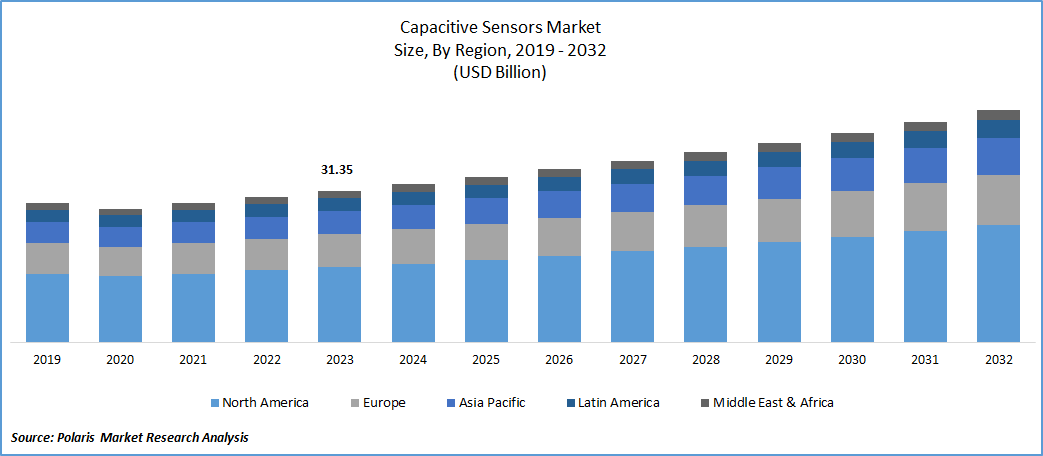
To Understand More About this Research:Download Sample Report
The COVID-19 pandemic has significantly impacted the capacitive sensors market. With widespread lockdowns and supply chain interruptions in 2020, the market encountered challenges such as production slowdowns and reduced demand in various sectors. However, as economies around the world adjusted to the new normal and industries started to recover in 2021, the market for capacitive sensors began to experience a gradual resurgence. Consumer electronics, healthcare devices, and automotive applications saw an increase in touch-based technology integration. The growing emphasis on touchless interfaces was driven by the need to reduce the risk of virus transmission. In the post-pandemic era, the capacitive sensors market is expected to exhibit steady growth. The demand for touch-sensitive controls, particularly in smart devices and industrial automation, is expected to be a key driver for the recovery of the market.
Capacitive sensors are used extensively in the healthcare industry, being employed in various medical devices like glucose meters, electrocardiography (ECG) machines, and blood pressure monitors. The growing demand for advanced medical equipment is anticipated to contribute significantly to the expansion of overall revenue in the forecast period.
Industry Dynamics
High Expansion of Consumer Electronics
The consumerartphones, tablets, smartwatches, and various other consumer electronic devices. The heightened demand for touch-sensitive interfaces, enhanced user experiences, and the proliferation of touch-enabled devices have been key driving factors behind the widespread adoption of capacitive sensors in the consumer electronics sector. Manufacturers have responded to consumer preferences for sleek and intuitiveelectronics industry has witnessed a remarkable surge in the incarnation of capacitive sensors, marking a substantial expansion in this segment. Capacitive sensors, which detect and measure electrical charges, have become integral components in sm designs, pushing for the integration of capacitive touch technology to replace traditional mechanical buttons. This, in turn, is contributing to the ascending growth of the capacitive sensors market.
Moreover, the integration of capacitive sensors has not been limited to traditional consumer electronics; it has extended into emerging technologies such as wearable devices, smart home appliances, and automotive infotainment systems. As these technologies continue to evolve and permeate daily life, the demand for capacitive sensors is anticipated to rise. The versatility of capacitive sensing technology, its responsiveness, and its ability to facilitate multi-touch functionalities have positioned it as a cornerstone in the consumer electronics landscape, setting the stage for ongoing innovation and overall expansion over the forecast period.
Source: Polaris Market Research Analysis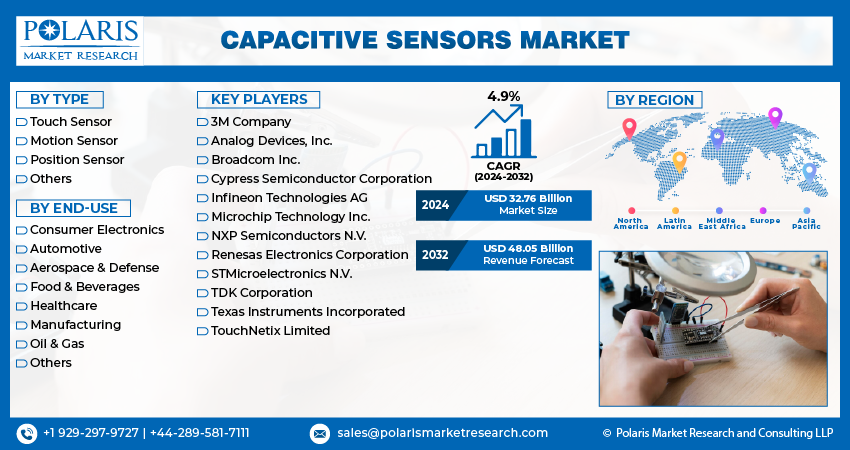
Get Full Segment-Level Forecasts & Insights: Download Sample Report
Report Segmentation
The market is primarily segmented based on type, end-use, and region.
| By Type | By End-Use | By Region |
|
|
|
Source: Polaris Market Research Analysis
To Understand the Scope of this Report:Request Customization
By Type Analysis
The Touch Sensor Segment Accounted for the Largest Revenue Share in 2024
In 2024, the touch sensor segment accounted for the largest revenue share. The expansion of touchscreens in a wide range of devices, including laptops, tablets, and smartphones, has led to significant expansion of the touch sensor market. Apart from their user-friendly interface, touch sensors display low power consumption and high accuracy. Primarily, the automotive industry has witnessed a substantial surge in the adoption of touch sensors, particularly in center consoles and infotainment systems. Projections indicate that the growing demand for electric and autonomous vehicles will further drive the growth of touch sensors within the automotive sector.
On the other hand, the position sensor segment is expected to witness the fastest growth in the capacitive sensors market over the forecast period. Capacitive position sensors are being widely used in machine tools such as surface grinders, lathes, and milling machines to detect errors and improve accuracy. They are also increasingly employed in precision positioning and thickness measurement applications across various fields. In the semiconductor industry, these sensors are crucial for positioning wafers with nanometer precision during exposure.
By End-Use Analysis
The Consumer Electronics Segment Accounted for the Highest Share During the Forecast Period
The consumer electronics segment accounted for the highest share during the forecast period owing to the rising demand for multimedia devices with features such as motion stabilizing and tracking. Moreover, the advent of manufacturing methods like micro-electromechanical systems (MEMS) has significantly reduced the dimensions of sensors. Consequently, they can be utilized in compact consumer gadgets like smartphones, walkmans, and tablets. Moreover, the rising interest in entertainment applications like virtual reality (VR), augmented reality (AR), and wearable devices act as a key driver for the growth of this segment.
On the other hand, the automotive segment is anticipated to experience the fastest growth during the forecast period. Capacitive sensors are arranged for the execution in human-machine interface (HMI) scenarios, including tasks like navigation control and managing illumination. Additionally, governmental initiatives facilitating the use of position sensors in autonomous vehicles contribute to the growth of this segment.
Source: Polaris Market Research Analysis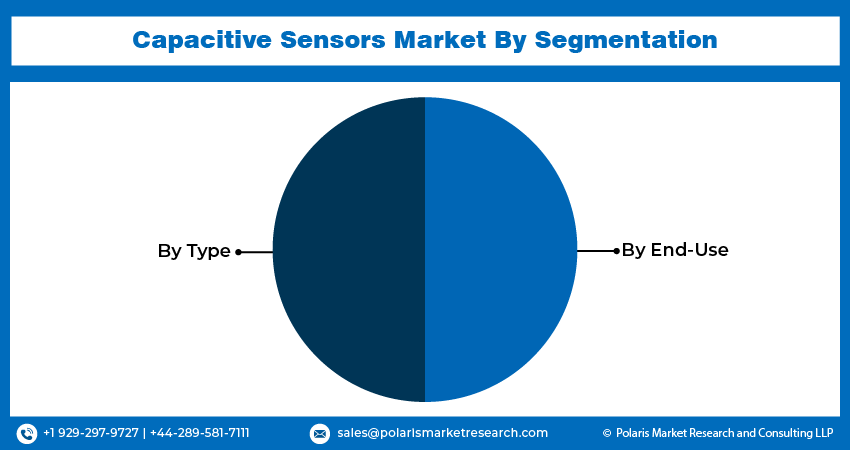
Need Granular Data Across All Market Segments? Request Customization
Regional Insights
Asia Pacific Accounted for the Largest Market in 2024
In 2024, Asia Pacific capacitive sensors market accounted for the largest share. The significant growth in the use of touchscreens in 5G smartphones and tablets, associated with the increasing demand for automation in various regional businesses, is the key driver for the market. The capacitive sensors market in the region is expected to experience substantial growth, particularly with the contributions of countries such as China and India. China, boasting numerous electronic manufacturers and witnessing a surge in touchscreen popularity in smartphones and tablets, is poised for an expanded market in capacitive sensors. Similarly, the demand for automation across various sectors, including the automotive and healthcare industries, is expected to drive the growth of the capacitive sensors market in India.
North America capacitive sensors market is projected to witness fastest CAGR over the forecast period. The growing prevalence of touchscreens in automotive systems and the rising demand for automation in the region are key factors driving the increased adoption of capacitive sensors. In North America, the United States is expected to lead in revenue generation from these sensors. Additionally, the region's heightened focus on energy conservation is projected to encourage the widespread application of capacitive sensors, particularly in HVAC and lighting control systems.
Source: Polaris Market Research Analysis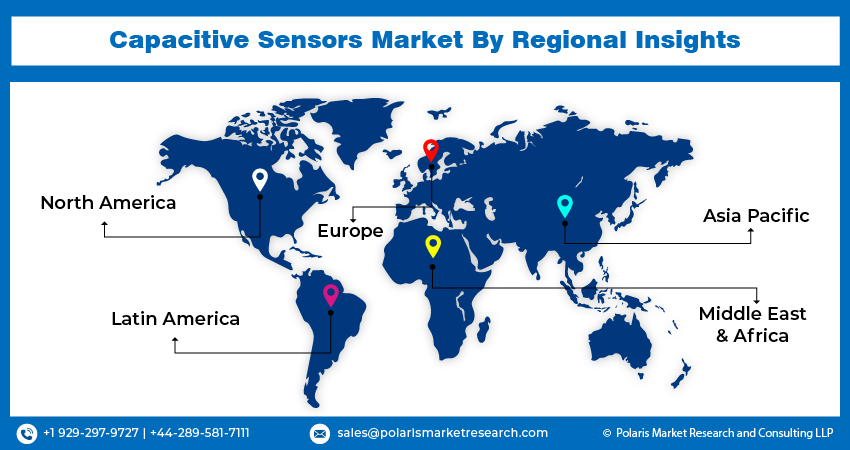
Curious About Regional Market Performance? Request Customization
Key Market Players & Competitive Insights
The market is characterized by intense competition, with established players relying on advanced technology, high-quality products, and a strong brand image to drive revenue growth. These companies employ various strategies such as research and development, mergers and acquisitions, and technological innovations to expand their product portfolios and maintain a competitive edge in the capacitive sensors market.
Some of the major players operating in the global capacitive sensors market include
- 3M Company
- Analog Devices, Inc.
- Broadcom Inc.
- Cypress Semiconductor Corporation
- Infineon Technologies AG
- Microchip Technology Inc.
- NXP Semiconductors N.V.
- Renesas Electronics Corporation
- STMicroelectronics N.V.
- TDK Corporation
- Texas Instruments Incorporated
- TouchNetix Limited
Recent Developments
- October 2025: Infineon Technologies earmarked USD 1.2 billion to build a capacitive sensor plant in Dresden, Germany. The 22-nm facility is set for Q2 2026 start-up, serving battery management and autonomous-drive systems for EVs.
- September 2025: STMicroelectronics partnered with Mercedes-Benz Group to develop pressure-sensitive capacitive touch panels for 2026 EQS and EQE models, enabling force-based controls for climate and infotainment functions.
- August 2025: Texas Instruments gained FDA breakthrough device status for a medical-grade capacitive array measuring glucose via skin impedance. The approval accelerates progress toward a non-invasive continuous glucose monitor potentially launching in late 2026.
- November 2023: Balluff launched a new capacitive level sensor with IO-Link technology. Designed for non-contact level detection, the sensor can detect product levels through plastic or glass containers, offering enhanced diagnostics and configuration via IO-Link.
- July 2022: Fujitsu developed an innovative technology that uses millimeter-wave sensors to accurately determine the positions of human bodies based on point cloud data.
- February 2022: Sony unveiled the latest PS VR2 along with an updated design image of the PlayStation VR2 Sense controller, which uses a capacitive sensor and IR LED for position tracking.
- November 2021: IP Group and CoMotion launched the nanotech startup Somalytics at the University of Washington to develop a compact, flexible, and highly responsive paper carbon nanotube capacitive sensor. This technology is highly valuable for various consumer and industrial applications due to its heightened sensitivity to the human body.
Capacitive Sensors Market Report Scope
| Report Attributes | Details |
| Market size value in 2025 | USD 31.8 billion |
| Revenue forecast in 2034 | USD 66.6 billion |
| CAGR | 8.50% from 2025 – 2034 |
| Base year | 2024 |
| Historical data | 2020 – 2023 |
| Forecast period | 2025 – 2034 |
| Quantitative units | Revenue in USD billion and CAGR from 2025 to 2034 |
| Segments Covered | By Type, By End-Use, By Region |
| Regional scope | North America, Europe, Asia Pacific, Latin America, Middle East & Africa |
| Customization | Report customization as per your requirements with respect to countries, region, and segmentation |
Source: Polaris Market Research Analysis
Capacitive Sensors Market FAQ's
The key companies in Capacitive Sensors Market include 3M Company, Analog Devices, Inc., Broadcom Inc., Cypress Semiconductor Corporation
The global capacitive sensors market is expected to grow at a CAGR of 8.50% during the forecast period.
Capacitive Sensors Market report covering key segments are type, metal, biomaterial, end-use, and region.
The key driving factors in Capacitive Sensors Market are increasing demand of automation across the industries will drive he growth of the market
Capacitive Sensors Market Size Worth $ 66.6 Billion By 2034 | CAGR: 8.50%.
Capacitive sensors are devices that detect and measure changes in capacitance the ability of an object to store electrical charge commonly used to sense proximity, touch, and position in electronic applications.
Key trends include the surging demand for multi-touch screens in consumer electronics like smartphones and tablets, and the growing need for industrial automation driving widespread adoption of capacitive position sensors across manufacturing sectors.
Download Sample Report of Capacitive Sensors Market
Please fill out the form to request a customized copy of the research report.


