
Caprolactam Market Size, Trends, Industry Analysis, 2026-2034
REPORT DETAILS
Market Statistics
Caprolactam Market Overview
The global caprolactam market size was valued at USD 24.65 billion in 2025. The market is projected to grow at a CAGR of 4.7% from 2026 to 2034. Market growth is supported by rising demand for nylon-based products across the textile, automotive, and industrial sectors.
Key Insights
- By end-product, the nylon 6 resins segment is expected to witness rapid growth at 5.2% CAGR. This is due to the wide usage of these resins across sectors such as automotive and electronics.
- Based on application, the textile yarns segment led the market in 2025 with 34.3% revenue share. This is because it functions as the fundamental building block in the production of nylon 6.
- Asia Pacific led the global market in 2025 with approximately 57.70% revenue share. This is due to high demand for caprolactam products across major economies in the region.
- North America is expected to register considerable growth of 3.9% over the forecast period. The regional market is driven by its strong manufacturing base and advanced technological capabilities.
- By application, the engineering resins and films segment is expected to grow at a CAGR of 5.3% during 2026–2034. This is driven by rising demand in automotive and electrical components.
Note: Figures and projections outlined in this report are the result of Polaris Market Research’s proprietary analytical processes, grounded in the latest available datasets and market observations
Market Statistics
- 2025 Market Size: USD 24.65 billion
- 2034 Projected Market Size: USD 37.13 billion
- CAGR (2026–2034): 4.7%
- Asia Pacific: Largest Market in 2025
Industry Dynamics
- Technological advancements in the production process of caprolactam are driving market growth.
- The market is benefiting from the increasing use of nylon 6 fibers and resins across sectors.
- The growing technical textiles market is expected to present several market opportunities.
- Competition from bio-based alternatives may hinder market growth.
What is Caprolactam?
Caprolactam is an important chemical that is mainly used as a raw material in the production of nylon 6. Caprolactam is a cyclic amide that has six carbon atoms and is a clear, colorless liquid with a pungent smell. Caprolactam is mainly used as a raw material in the production of nylon 6, in which its molecules undergo ring-opening polymerization to produce a long chain of polyamide. The caprolactam market is seeing strong growth. It is mainly due to the rising demand for nylon 6 across industries such as automotive, textiles, and electronics. Nylon 6 has high strength and is chemically resistant. So, it’s widely used in fibers, resins, and engineering plastics.
From an industry perspective, the caprolactam production process is slowly transforming. Companies are seeking greener and more efficient methods. Companies are adopting caprolactam manufacturing technology that consumes less energy and produces less pollution. Improved catalysts and more efficient methods are also contributing to increased production and reduced waste. Tougher regulations and increased customer demand for greener materials are encouraging companies to develop more sustainable caprolactam.
The global caprolactam market is experiencing steady growth, led mainly by the increasing use of nylon 6 fibers and resins, which account for the largest share of the total demand. The market is growing rapidly in the Asia Pacific region, where there are huge production capacities, favorable feedstock prices, and a well-established textile and engineering plastics industry. Moreover, the increasing demand for light, strong, and cost-effective polymer materials across various end-use industries is fueling global caprolactam demand.
Source: Polaris Market Research Analysis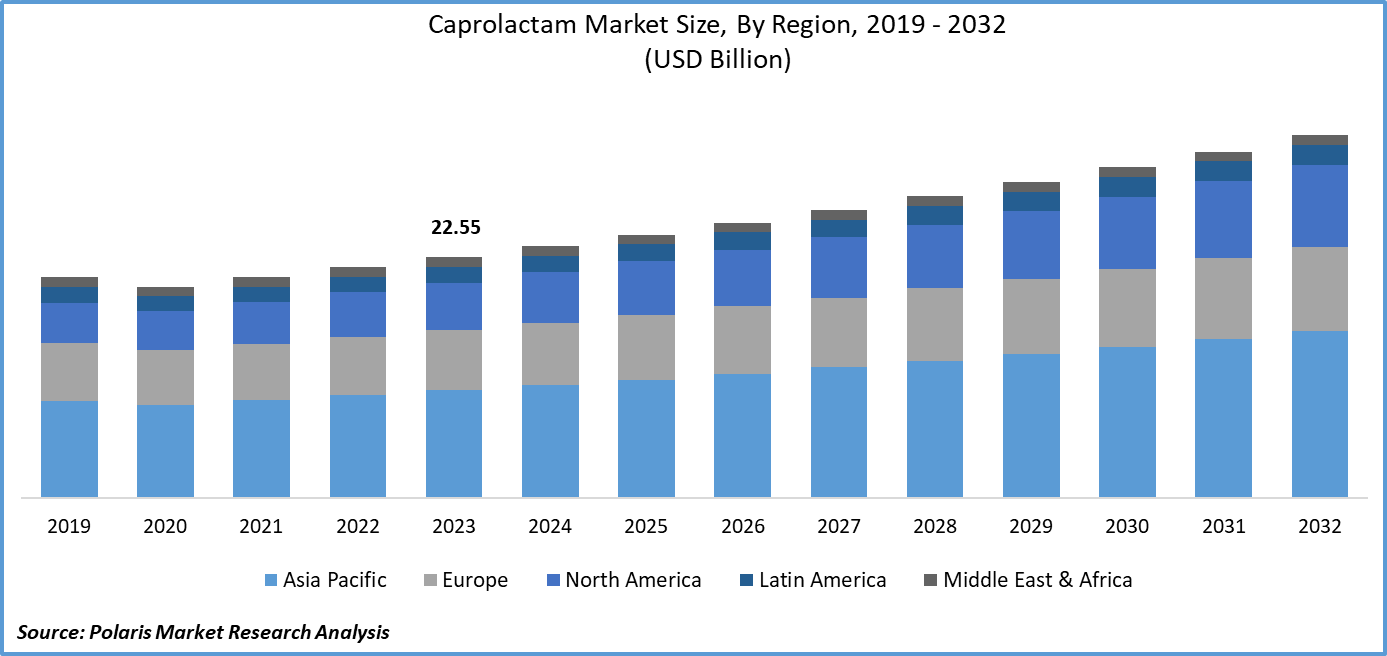
Want a Deeper Look at Key Market Players? Download Sample Report
Technological advancements in the production process of caprolactam, such as the development of eco-friendly and economical production processes, are also adding to the growth of the market. Organizations are increasingly adopting eco-friendly methods and R&D investments to improve the efficiency of the production process and quality of the product. Along with this, the rising focus on lightweight and fuel-efficient materials in the automotive and aerospace sectors is also encouraging the use of nylon 6 composites, thereby leading to an increase in the demand for caprolactam.
What are the Key Drivers Driving the Market Demand?
Ongoing Technological Advancements are Driving Caprolactam Market Growth
The caprolactam market is being aided in its growth by continuous technological advancements that are making the production process more efficient and sustainable. There have been improvements in manufacturing processes, catalysts, and process optimization that are helping manufacturers achieve higher yields with lower energy consumption. Specifically, there have been developments in catalytic technology that are allowing for the cleaner production of caprolactam.
Advances in the sourcing and purification of raw materials are also enhancing the quality of the materials used in caprolactam production. Progress in polymerization technology and polymer engineering is broadening nylon 6's applications, thereby increasing demand for caprolactam as a major raw material. These advances are improving production efficiency, reducing costs, and promoting innovation, thereby fueling the growth of the caprolactam market.
Increased nylon 6 demand across automotive and industrial applications is also contributing to the caprolactam market expansion. Nylon 6 has high mechanical strength and is thermally stable. It can also resist chemicals. This makes it suitable for lightweight automotive components and engineering plastics. Nylon 6 is also used for high-performance fibers. As the production of nylon 6 increases worldwide, the consumption of caprolactam is expected to grow.
Which Factor is Restraining the Demand for Caprolactam?
Competition from Bio-Based Alternatives Is Hindering the Caprolactam Market Growth
The caprolactam market is experiencing increased competition from bio-based alternatives. Bio-based alternatives are obtained from renewable resources such as biomass and plant-based feedstocks. These alternatives have a lower carbon footprint. They also cut the use of fossil fuels. So, their use is becoming increasingly popular. This is in line with the sustainability goals of various consumers and industries.
Moreover, the emergence of bio-based technologies has also resulted in the development of affordable and scalable production methods for bio-based caprolactam substitutes. This has further increased the level of competition. As a result, the caprolactam market faces challenges from the competition posed by the bio-based substitutes. The producers of conventional caprolactam are forced to innovate and modify their production methods in order to cope with the rapidly changing market environment shaped by the sustainability-driven preferences of consumers.
Apart from the substitution pressures, the other constraint that affects the caprolactam market is the fluctuations in the caprolactam raw material prices, particularly benzene and cyclohexane. Since these raw materials are linked to crude oil, the fluctuations in the prices have a direct impact on the feedstock prices. Although there are bio-based caprolactam substitutes that are gaining popularity, their commercialization is still hindered by cost and scalability challenges, which allows traditional caprolactam to continue to lead the market.
Source: Polaris Market Research Analysis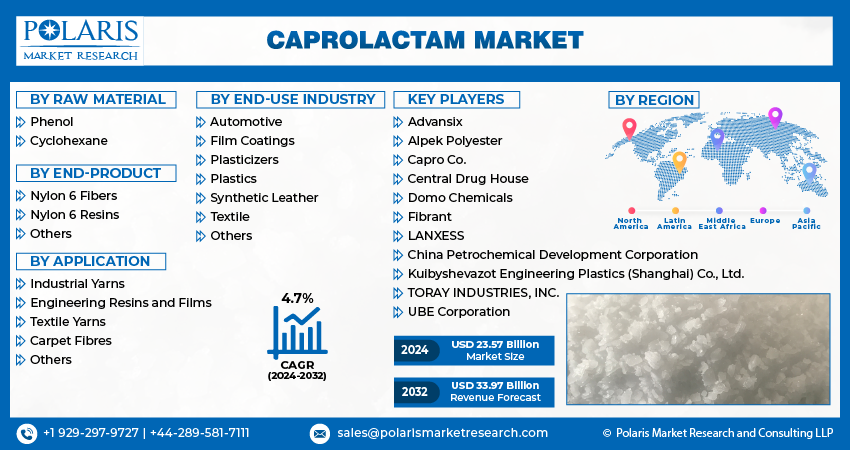
Get Full Segment-Level Forecasts & Insights: Download Sample Report
Segmentation Insights
By End-Product Insights
Based on end-product category analysis, the market has been segmented into nylon 6 fibers, nylon 6 resins, and others. The nylon 6 resins market is expected to have substantial growth in the coming years. This is due to its extensive use across industries such as automotive, textiles, electronics, and packaging. Nylon 6 has excellent mechanical properties, durability, and chemical resistance. With the increasing demand for lightweight and high-performance materials in industries such as automotive and consumer electronics, the use of nylon 6 resins as a material of choice is expected to increase.
In addition, advances in processing technology and polymer engineering methods are increasing the flexibility and usability of nylon 6 resins, thereby boosting their demand for new and innovative applications. Furthermore, the growing concern for sustainability and environmental stewardship is increasing demand for nylon 6 resins, as these materials are recycled and reused across various applications, thereby meeting the criteria of the circular economy. Thus, the nylon 6 resins market segment of caprolactam is expected to experience substantial growth in the coming years.
Caprolactam Market Product Segmentation Overview
| Segment | Market Position | Growth Trend (2026–2034) | Key Uses | Key Drivers |
| Nylon 6 Fibers | Significant share | Steady growth | Textile yarns, carpets, industrial fabrics | High strength, durability, textile demand |
| Nylon 6 Resins | Fastest growing | CAGR of 5.2% | Automotive parts, electrical components, packaging | Lightweight materials demand, engineering plastics usage |
| Others | Smaller share | Moderate growth | Films, specialty applications | Niche demand, limited application scope |
Source: Polaris Market Research Analysis
By Application Insights
Based on application category analysis, the market has been segmented on the basis of industrial yarns, engineering resins and films, textile yarns, carpet fibers, and others. In 2025, the textile yarns category reinforced its leadership position in the caprolactam market, as it is a basic building material for the manufacture of nylon 6, a polymer. Textile yarns produced using nylon 6 fibers have numerous applications in the manufacturing of different textile products such as clothing, upholstery, carpets, and industrial textiles.
The natural properties of nylon 6, such as abrasion, water, and chemical resistance, make it the most suitable material for applications that demand high-performance materials. In addition, advances in textile technology, including melt spinning and solution spinning, have enabled the production of nylon 6 yarns with specific properties tailored to the application's requirements.
Source: Polaris Market Research Analysis
Need Granular Data Across All Market Segments? Request Customization
Real-World Applications of Caprolactam
- Textile Fibers: Used in clothing and home fabrics. Handles repeated use well.
- Carpets: Used in homes and offices. Holds shape under heavy traffic.
- Automotive Parts: Used in under-the-hood components. Handles heat and reduces weight.
- Industrial Yarns: Used in ropes and tire cords. Withstands load and friction.
- Engineering Plastics: Used in electrical parts. Provides strength and insulation.
Regional Insights
The Asia Pacific caprolactam market is led by China's caprolactam production. The regional market benefits from large-scale integrated manufacturing facilities. The region also has strong downstream textile industries. Europe’s market growth is increasingly shaped by environmental regulations and emissions control requirements. The North America caprolactam market is supported by advanced manufacturing technologies and rising demand for sustainable engineering plastics.
Asia Pacific
In 2025, the Asia Pacific region was identified as the leading market in the global caprolactam market, driven by the presence of some of the world's largest economies, including China, Japan, South Korea, and India, which drive demand for caprolactam products. The Asia Pacific market has been driven by the rapid growth of industries such as automotive, textiles, and electronics, which require substantial amounts of nylon 6, a major derivative of caprolactam. In addition, Asia Pacific has a strong manufacturing base and supply chain infrastructure, which facilitates the production and distribution of caprolactam and its derivatives.
North America
The North America caprolactam market is also expected to register considerable growth in the global market during the forecast period due to the strong manufacturing base and advanced technological capabilities in the automotive, aerospace, and electronics industries, which are major consumers of materials produced from caprolactam. In addition, rising investments in infrastructure development, especially in construction, are expected to boost demand for nylon 6-based materials such as carpets, flooring, and insulation. Thus, the North America market outlook is expected to be favorable during the forecast period.
Source: Polaris Market Research Analysis
Curious About Regional Market Performance? Request Customization
Competitive Landscape
The caprolactam industry is competitive, and major chemical companies are strong manufacturers and distributors of caprolactam due to their large production capacities and global presence. Some of the key players in the industry are BASF SE, China Petrochemical Development Corporation, and AdvanSix Inc. In addition, several regional and niche manufacturers contribute to the market's competitive landscape by offering specialized products.
List of Key Companies
- Advansix
- Alpek Polyester
- Capro Co.
- Central Drug House
- China Petrochemical Development Corporation
- Domo Chemicals
- Fibrant
- Kuibyshevazot Engineering Plastics (Shanghai) Co., Ltd.
- LANXESS
- TORAY INDUSTRIES, INC.
- UBE Corporation
Recent Developments
- June 2025: Lunan Chemical launched a 300,000-ton caprolactam project. The expansion supports large-scale production and improves supply capacity. Source: bloominglobal.com
- November 2024: Sumitomo Chemical has transferred its caprolactam production technology, based on the vapor-phase Beckmann rearrangement process, to HighChem. This will help HighChem license the innovative, byproduct-free process for producing nylon 6 raw material on a global platform. Source: sumitomo-chem.co.jp
- December 2023: NACAG, an industry organization in the chemical industry, took an important step to mitigate N2O emissions during caprolactam production. The company accepted abetment technology, with the first measures being implemented in Thailand. NACAG broadened its activities to include caprolactam production. The organization now provides technical cooperation and financial mechanisms. Source: nitricacidaction.org
Report Coverage
The caprolactam market report emphasizes on key regions across the globe to provide a better understanding of the product to the users. Also, the report provides market insights into recent developments and trends and analyzes the technologies that are gaining traction around the globe. Furthermore, the report covers in-depth qualitative analysis pertaining to various paradigm shifts associated with the transformation of these solutions.
The report provides a detailed analysis of the market while focusing on various key aspects such as competitive analysis, raw material, end-product, application, end-use industry, and their futuristic growth opportunities.
Caprolactam Market Segmentation
By Raw Material Outlook (Revenue, USD Billion, 2021–2034)
- Phenol
- Cyclohexane
By End-Product Outlook (Revenue, USD Billion, 2021–2034)
- Nylon 6 Fibers
- Nylon 6 Resins
- Others
By Application Outlook (Revenue, USD Billion, 2021–2034)
- Industrial Yarns
- Engineering Resins and Films
- Textile Yarns
- Carpet Fibres
- Others
By End-Use Industry Outlook (Revenue, USD Billion, 2021–2034)
- Automotive
- Film Coatings
- Plasticizers
- Plastics
- Synthetic Leather
- Textile
- Others
By Regional Outlook (Revenue, USD Billion, 2021–2034)
- North America
- US
- Canada
- Europe
- Germany
- France
- UK
- Italy
- Spain
- Netherlands
- Russia
- Rest of Europe
- Asia Pacific
- China
- Japan
- India
- Malaysia
- South Korea
- Indonesia
- Australia
- Vietnam
- Rest of Asia Pacific
- Middle East & Africa
- Saudi Arabia
- UAE
- Israel
- South Africa
- Rest of Middle East & Africa
- Latin America
- Mexico
- Brazil
- Argentina
- Rest of Latin America
Future Outlook
Source: Polaris Market Research Analysis
Bio-based caprolactam is gaining attention as firms shift toward renewable feedstocks. Focus on sustainable polymers is increasing due to strict environmental regulations. Recycling of nylon 6 is expanding, supporting circular economy trends. Advanced materials development is fueling use in high-performance applications. Innovation in production procedures is improving efficiency and reducing emissions. Overall, the market is projected to move toward more sustainable and high-value applications.Caprolactam Market Report Scope
| Report Attributes | Details |
| Market Size in 2025 | USD 24.65 billion |
| Market Size in 2026 | USD 25.71 billion |
| Revenue Forecast by 2034 | USD 37.13 billion |
| CAGR | 4.7% |
| Base Year | 2025 |
| Historical Data | 2021–2024 |
| Forecast Period | 2026–2034 |
| Quantitative Units | Revenue in USD billion, and CAGR from 2026 to 2034 |
| Report Coverage | Revenue Forecast, Market Competitive Landscape, Growth Factors, and Trends |
| Segments Covered |
|
| Regional Scope |
|
| Competitive Landscape | Caprolactam Industry Trend Analysis (2025) Company profiles/industry participants profiling include company overview, financial information, product/service benchmarking, and recent developments |
| Report Format | PDF + Excel |
| Customization | Report customization as per your requirements with respect to countries, regions, and segmentation. |
Source: Polaris Market Research Analysis
Caprolactam Market FAQ's
Key applications of caprolactam include textile yarns, automotive components, engineering plastics, and industrial fibers.
The market growth is driven by the rising demand for nylon 6 in automotive and textiles. The market is also benefiting from technological advancements in eco-friendly production methods.
Asia Pacific leads the market for caprolactam. This is due to the rapid growth of industries such as automotive, textiles, and electronics.
The global caprolactam market was valued at USD 24.65 billion in 2025. It is projected to reach USD 37.13 billion by 2034, growing at a 4.7% CAGR.
Caprolactam is primarily used for manufacturing nylon 6 fibers and engineering plastics. These products are used across automotive, textiles, electronics, and industrial applications.
Caprolactam is a chemical used to make nylon 6. It is a key raw material for fibers and plastics.
Made mainly from benzene or cyclohexane. It goes through chemical reactions like oxidation and rearrangement.
Used to produce nylon 6. Further used in fibers, resins, and engineering plastics.
Used in textiles, automotive, electronics, and industrial products. Also used in carpets and packaging.
Download Sample Report of Caprolactam Market
Please fill out the form to request a customized copy of the research report.


