
Car Wash Services Market Demand Insights, Growth Report 2026-2034
REPORT DETAILS
Market Statistics
What is the Current Market Size?
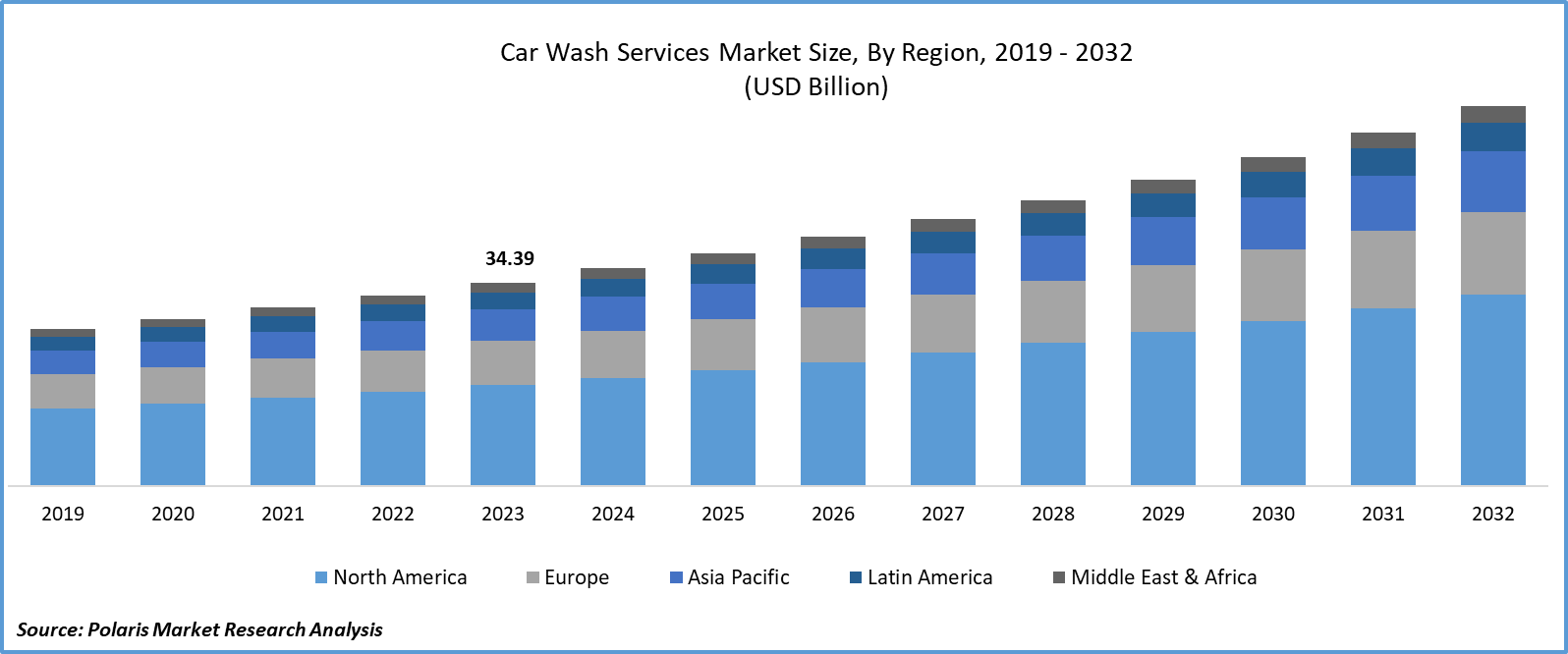
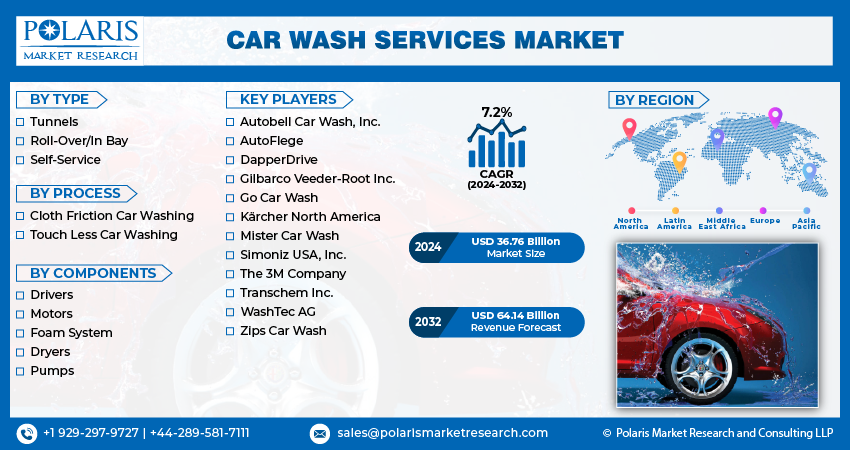
Global car wash services market size was valued at USD 36.30 Billion in 2025 and industry is projected to grow to USD 62.90 Billion by 2034, exhibiting a compound annual growth rate (CAGR) of 6.30% during the forecast period (2026 - 2034). The car wash services market is experiencing robust growth driven by technological developments in the car wash industry, such as sophisticated water recycling systems, hybrid and touch-free washing technologies, and cost-effective innovations. Additionally, car detailing service centers are seeing an increase in business due to growing advancements in technology and increased consumer knowledge of vehicle care. The world market for auto detailing services is also experiencing a new trend toward on-demand services, with top service providers operating internationally coming up with innovative ways to serve customers better.
Market Statistics
- 2025 Market Size: USD 36.30 billion
- 2034 Projected Market Size: USD 62.90 billion
- CAGR (2026-2034): 6.30%
- North America: Largest market in 2025
Source: Polaris Market Research Analysis
To Understand More About this Research:Download Sample Report
Moreover, the rising environmental consciousness among consumers seeking eco-friendly car wash products is driving the market expansion. Protecting the resale value and being environmentally responsible can both be accomplished by using automatic car wash systems. The automatic car washes conserve water, lessen the contamination of groundwater, and preserve vehicle paint. This in turn is driving the market globally. For instance, in June 2024, Express Wash Concepts (EWC) opened its 16th Green Clean Express Auto Wash, bringing its total network to 97 express wash locations throughout the United States.
Market Trends:
Increasing Sale of Passenger Vehicles is Driving the Car Wash Services Market Growth
Market CAGR for car wash services is being driven by the growing number of vehicles on the road leading to an increased demand for car wash services. As more people own cars, the need for regular cleaning and maintenance also rises. With a majority of the population having passenger vehicles, the demand for car wash services is increasing. Due to the cheap and easy availability of washing centers, washing cars on their own by owners has been suppressed, resulting in increasing demand for the car wash service market. This is further fueled by the growing consumer preference for convenient and time-efficient solutions. Moreover, modern vehicles are often equipped with sophisticated paint and surface coatings that necessitate regular maintenance for preservation.
According to the International Organization of Motor Vehicle Manufacturers (OICA), the global sales of passenger cars went from 5.47 billion in 2020 to 6.52 billion in 2023 and the global sales of commercial vehicles went from 2.49 billion in 2020 to 2.74 billion in 2023.
The Increasing Popularity of Membership Focused Car Wash Services
The car wash services market is experiencing significant growth, driven by the increasing popularity of membership focused on car wash services. The businesses are capitalizing on the growing trend of memberships and subscriptions for recurring services. This offers a convenient and cost-effective solution for car owners who prioritize maintaining a clean vehicle through regular washes. Memberships grant customers access to discounted car washes on a recurring basis, providing them with the flexibility of numerous washes for a fixed monthly fee. Further, customer convenience is enhanced by allowing access to services at various locations. These memberships are typically structured into different tiers, enabling customers to select the most suitable plan based on their specific requirements and budget. Furthermore, some membership plans may include the option to have multiple vehicles cleaned, catering to a broader range of customers driving the car wash services market revenue.
For instance, in June 2023, Spark Car Wash, an express car wash operator in the Northeastern United States, secured $30 million with GoPoint Ventures. This funding supports Spark's expansion efforts, allowing the company to enhance its existing locations and introduce contemporary, membership-focused car wash facilities in a region with opportunities for growth.
Government & Regulatory Impact Analysis
| Jurisdiction / agency | Key regulatory instrument or guidance (vehicle / car washing) | Main regulatory requirements for car washes | Operational impact on car wash services |
| Arizona DOT (USA) | “Best Practices for ADOT Vehicle and Equipment Wash” manual. | Requires containment of wash water, minimal use of biodegradable detergents, prohibition of vehicle maintenance in wash bays, and protection of sewers and storm drains from pollutants. | Pushes commercial and fleet washes to invest in contained wash bays, drainage controls, and staff procedures to limit chemicals and prevent discharges to soil or storm drains. |
| North Dakota DEQ (USA) | “Vehicle and Equipment Washing Services” guidance under state water‑quality law. | Treats vehicle wash water as process wastewater; prohibits polluting state waters; directs wash water to sanitary sewer or on‑site treatment, not to storm drains or septic systems. | Requires car washes to connect to sanitary sewers or install compliant treatment systems; disallows simple discharge to ground or septic, increasing compliance and infrastructure costs. |
| Local stormwater programs (multiple US cities/counties) | Source control and stormwater BMP manuals for vehicle washing (e.g., Portland Source Control Manual; municipal BMP sheets). | Mandate designated wash pads, impermeable paving, curbing, and routing of wash water to sanitary systems or approved treatment; prohibit discharges to storm drains; require employee training on stormwater rules. | Car washes must design or retrofit bays with berms, sumps, and sewer connections, implement staff training, and document BMP use to maintain permits or local approvals. |
| U.S. EPA (national) | NPDES stormwater BMP fact sheets for vehicle maintenance and washing; municipal vehicle washing BMP guidance; WaterSense “Vehicle Washes” technical guidance. | Clarify that vehicle wash water is non‑stormwater discharge requiring control; recommend or require routing to sanitary sewer, using biodegradable detergents, limiting water use, and evaluating recycling or reclaim systems for professional car washes. | Encourages or effectively compels commercial car washes to adopt reclaim/recycle systems, water‑efficient equipment, and BMP‑based operating procedures to meet discharge and conservation expectations. |
| Various local governments (USA) | Stormwater ordinances and guidance that direct the public to use commercial car washes rather than home driveway washing. | Promote commercial car washes because they route wastewater to sanitary sewers and treatment plants; discourage residential driveway washing that sends pollutants directly to storm drains. | Indirectly benefits compliant commercial car washes by steering demand toward regulated facilities and away from uncontrolled residential washing, reinforcing the need for proper sewer connections and BMPs. |
Source: Polaris Market Research Analysis
Source: Polaris Market Research Analysis
Get Full Segment-Level Forecasts & Insights: Download Sample Report
Segment Insights:
Car Wash Services Type Insights:
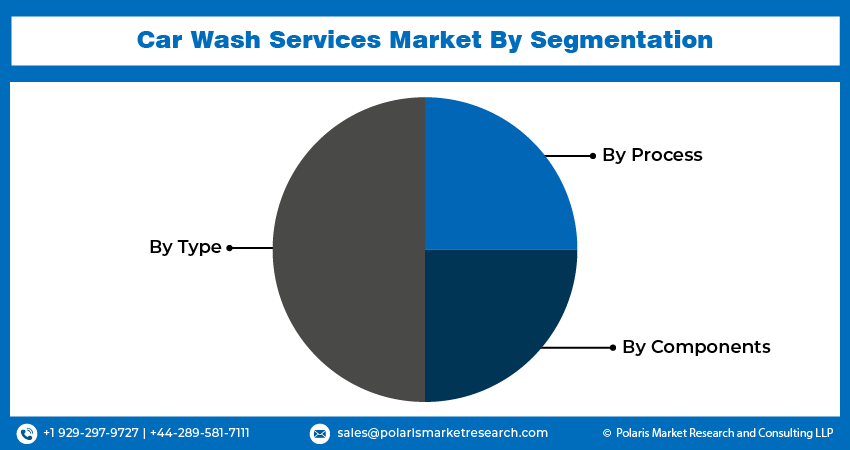
The car wash services market segmentation, based on type includes tunnels, rollover/in bay, and self-services. In 2025, the roll-over/in-bay segment dominated the car wash services market, owing to their accessibility, affordability, ease of use, low running costs, low water usage, and little installation space requirements. Water usage for in-bay services typically ranges from 10 to 50 gallons per car, whereas tunnel services use 14 to 60 gallons per car. Additionally, customers prefer robotic in-bay services as they are more rapid and less expensive than manual ones, customers prefer thereby driving them to drive the car wash services market share.
According to the International Carwash Association 2023 report, In-Bay Automatic / Roll-over locations in Europe were 50,000 out of the total 69,000 and the In-Bay Automatic / Roll-over in Australia were 1,600 out of total 1,950.
Car Wash Services Components Insights:
The car wash services market segmentation, based on components includes drivers, motors, foam system, dryers, pumps. The foam system is expected to witness the highest CAGR during the forecast period. Foam systems in car washing are often associated with touchless or frictionless car wash methods. Touchless car wash systems use high-pressure water and specialized cleaning solutions to remove dirt and grime without physical contact with the vehicle.
For instance, in August 2021, Kärcher expanded their self-service vehicle cleaning capabilities with the introduction of a new power foam and power foam lance. The power foam lance rapidly covers the entire vehicle surface with voluminous foam, effectively breaking down dirt resulting in a thorough and gentle cleaning of the car. The system also offers up to three additional wash programs: Power foam, Power rim foam, and Power wax.
Car Wash Services Market, Segmental Coverage, 2021 - 2034 (USD Billion)
Source: Polaris Market Research Analysis
Need Granular Data Across All Market Segments? Request Customization
Source: Secondary Research, Primary Research, PMR Database and Analyst Review
Regional Insights:
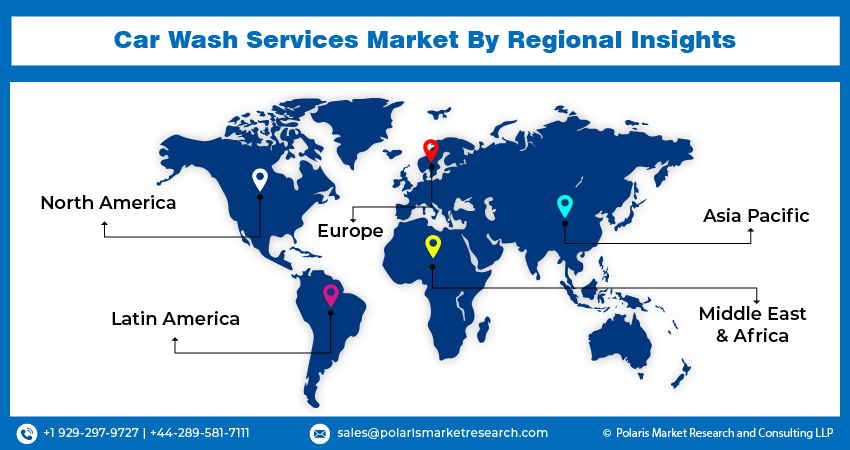
By region, the study provides the market insights into North America, Europe, Asia-Pacific and Rest of the World. North America car wash services market held the largest market share in 2025. North America tends to adopt new technologies relatively quickly. The introduction of advanced car wash technologies and innovations in this region can attract customers seeking efficient and modern car washing services. The economic prosperity of North America, particularly in the United States and Canada, supports a robust automotive industry and related services, including car washing. This results in significant growth for the car wash services market in North America.
According to a survey conducted by the International Car Wash Association, 84% of Americans maintain their cars, 64% of Americans claim that their cars are good in terms of cleanliness and shape. This has created opportunities chances for auto detailing service providers to expand their businesses and fulfill the increasing demand from customers. In the US, 97% of consumer’s employ auto detailing services to prolong the life of their vehicles and preserve their aesthetic appeal.
Further, the major countries studied in the market report are The US, Canada, German, France, the UK, Italy, Spain, China, Japan, India, Australia, South Korea, and Brazil.
CAR WASH SERVICES MARKET, REGIONAL COVERAGE, 2021 - 2034 (USD Billion)
Source: Polaris Market Research Analysis
Curious About Regional Market Performance? Request Customization
Source: Secondary Research, Primary Research, PMR Database and Analyst Review
The Asia Pacific region is projected to witness the fastest CAGR in car wash services market during the forecast period owing to the growing demand for car wash services in emerging countries like China and India. This region’s market is growing due to disposable income and evolving lifestyles which propel the car wash services market further. Growing awareness of the necessity for auto maintenance and the number of cars on the road are other factors contributing to the market's revenue growth. The region's affordable labor pool is another factor propelling the market's revenue expansion, enabling car wash service providers to bill fair prices for their services. Hence, it is estimated that the market will grow during the forecast period.
Key Market Players & Competitive Insights
Leading market players experiencing intense competition, primarily due to factors such as convenience, service quality, pricing, and environmental concerns which will help the car wash services market, grow even more. The market is composed of major chains and independent operators, each offering unique advantages such as speedy service, environmentally-friendly practice with important market developments including new product launches, contractual agreements, mergers and acquisitions, higher investments, and collaboration with other businesses. To expand and survive in a more competitive and rising market climate, car wash services industry must offer cost-effective services.
Technological advancements, including automated wash systems and mobile scheduling apps, are revolutionizing customer expectations and operational efficiencies in the car wash services industry to benefit clients and increase the market sector. In recent years, the car wash services industry has offered technically equipped solutions and services to meet the rising consumer demands. Major players in the car wash services market, including Autobell Car Wash, Inc., AutoFlege, DapperDrive, Gilbarco Veeder-Root Inc., Go Car Wash, Kärcher, Mister Car Wash, Simoniz USA, Inc., The 3M Company, Transchem Inc., WashTec AG, Zips Car Wash.
GO Car Wash is a car wash company headquartered in the United States, founded by Imperial Capital in 2019. The company has a global presence with over 134 sites. GO Car Wash offers modern and efficient car wash facilities, with unlimited membership plans and a variety of services, including exterior and interior cleaning, detailing, and maintenance. In December 2023, Imperial Capital announced its investment in GO Car Wash ("GO"), a car wash platform, with the goal of expanding GO's operations in both existing and new markets through innovation and evolution.
Kärcher is a company that produces a wide range of cleaning equipment, including high-pressure cleaners, floor care equipment, parts cleaning systems, wash water treatment, military decontamination equipment, and window vacuum cleaners. The company has 150 subsidiaries in 80 countries. Kärcher is a major supplier of cleaning systems to both NATO and the US Military. In March 2024, Inchcape Singapore partnered with Karcher to unveil an innovative, sustainable car wash solution that significantly reduces water consumption. This initiative is expected to save up to 7.5 million liters of water annually across all Inchcape facilities in Singapore.
Key Companies
- Autobell Car Wash, Inc.
- AutoFlege
- DapperDrive
- Gilbarco Veeder-Root Inc.
- Go Car Wash
- Kärcher
- Mister Car Wash
- Simoniz USA, Inc.
- The 3M Company
- Transchem Inc.
- WashTec AG
- Zips Car Wash
Industry Developments
- March 2025, IMO Car Wash celebrated its 60th anniversary by unveiling new technologies aimed at improving the overall car washing experience. As part of this milestone, the company introduced Graphene G60, an advanced wash formula that incorporates carbon weave technology to deliver a self-cleaning effect. The product is currently undergoing testing at selected locations.
- February 2025, Super Star Car Wash expanded its footprint in Texas with the opening of its 20th site in Mesquite, increasing its total number of locations nationwide to 109. To mark the occasion, the company is providing free car washes for a limited period along with a special promotional offer on its unlimited wash membership.
- March 2024: Flagstop Car Wash completed the acquisition of a three-unit platform in the greater Richmond metropolitan area. These units have undergone conversion to the Flagstop dedicated to providing the community with car wash services. This strategic acquisition served to bolster the Company's presence and solidify its position as a market leader.
- March 2024: Coastal Investment Company, LLC, and Madison Capital Group, LLC collaborated to introduce Go Wash It, prioritizes proactive maintenance by employing real-time monitoring of equipment and detergent levels to minimize the downtime and guarantees optimal efficiency and reliability.
- February 2024: Enmarket introduced monthly subscription car washing options to customers through its Marketwash mobile app. The initiative aims to deliver a contactless and frictionless car care solution, establishing Enmarket as a leader among top convenience retailers.
Market Segmentation:
Car Wash Services Type Outlook
- Tunnels
- Roll-Over/In Bay
- Self-Service
Car Wash Services Process Outlook
- Cloth Friction Car Washing
- Touch Less Car Washing
Car Wash Services, Components Outlook
- Drivers
- Motors
- Foam System
- Dryers
- Pumps
Car Wash Services Regional Outlook
- North America
- US
- Canada
- Europe
- Germany
- France
- UK
- Italy
- Spain
- Netherlands
- Russia
- Rest of Europe
- Asia-Pacific
- China
- Japan
- India
- Malaysia
- South Korea
- Indonesia
- Australia
- Vietnam
- Rest of Asia-Pacific
- Middle East & Africa
- Saudi Arabia
- UAE
- Israel
- South Africa
- Rest of Middle East & Africa
- Latin America
- Mexico
- Brazil
- Argentina
- Rest of Latin America
Report Scope:
| Report Attributes | Details |
| Market size value in 2025 | USD 36.30 billion |
| Market size value in 2026 | USD 38.56 billion |
| Revenue Forecast in 2034 | USD 62.90 billion |
| CAGR | 6.30% from 2026 – 2034 |
| Base year | 2025 |
| Historical data | 2021 – 2024 |
| Forecast period | 2026 – 2034 |
| Quantitative units | Revenue in USD billion and CAGR from 2026 to 2034 |
| Report Coverage | Revenue Forecast, Market Competitive Landscape, Growth Factors, and Trends |
| Segments covered |
|
| Regional scope |
|
| Competitive Landscape |
|
| Report Format |
|
| Customization | Report customization as per your requirements with respect to countries, region, and segmentation. |
Source: Polaris Market Research Analysis
Car Wash Services Market FAQ's
The Car Wash Services market size was valued at USD 36.30 Billion in 2025
The global market is projected to grow at a CAGR of 6.30% during the forecast period, 2026-2034
North America had the largest share of the global market in 2025.
The key players in the market are Autobell Car Wash, Inc., AutoFlege, DapperDrive, Gilbarco Veeder-Root Inc., Go Car Wash, Kärcher, Mister Car Wash, Simoniz USA, Inc., The 3M Company, Transchem Inc., WashTec AG, Zips Car Wash
The roll-over/in-bay segment category dominated the market in 2025
The foam system had the largest share of the global market in 2025.
Download Sample Report of Car Wash Services Market
Please fill out the form to request a customized copy of the research report.


