
Carbon Footprint Management Market Share, Size, Trends, Industry Analysis Report, 2026 - 2034
REPORT DETAILS
Market Statistics
Market Overview
The global carbon footprint management market size was valued at USD 11.6 billion in 2025, registering a CAGR of 7.0% from 2026 to 2034. Global climate change concerns propel the demand for carbon footprint management. It is also fueled by international agreements and policies driving stricter emission targets.
Key Insights
- The enterprise tier segment dominated the market share in 2025. The dominance is driven by the rising adoption of comprehensive platforms among organizations. The platforms help them track, report, and mitigate emissions across their global operations.
- The transportation segment is projected to grow at a rapid pace in the coming years, propelled by global initiatives to decarbonize logistics, aviation, and automotive industries.
- North America dominated the global market share in 2025. Stringent regulatory frameworks and rapid corporate adoption of decarbonization strategies boost the market dominance.
- The U.S. market is growing, due to the rising renewable energy deployment and the expansion of decarbonization initiatives across industries.
- The market in Asia Pacific is projected to grow at a fast pace from 2026 to 2034, propelled by national net-zero commitments from countries such as China, Japan, and South Korea.
- The market in India is growing rapidly, fueled by government-led initiatives, stricter carbon policies, and rising investor focus on ESG standards.
Industry Dynamics
- Global climate change concerns are accelerating emission reduction initiatives. Rising awareness of environmental risks and climate-related disasters is pushing organizations to adopt carbon footprint management solutions. Also, enterprises prioritize continuous GHG emissions tracking and carbon footprint reporting. The strategy emphasizes sustainability governance, procurement requirements, and investor-grade ESG disclosures.
- International agreements and policies are enforcing stricter targets. Frameworks such as the Paris Agreement, carbon pricing mechanisms (e.g., ETS and carbon levies), and emissions disclosure mandates. These frameworks increase demand for audit-ready carbon accounting platforms. They support consistent emissions factors, traceable calculations, and verifiable reporting outputs. As companies focus on monitoring and reducing emissions, demand for compliance solutions is rising.
- AI-enabled analytics platforms enable real-time monitoring, predictive insights, and automated reporting. The platforms help organizations meet ESG goals and optimize sustainability strategies. AI also enables anomaly detection (flagging outliers in activity data) and automated emissions factor matching. It also facilitates MRV-style controls that improve data integrity for assurance and internal audits. Thus, rising adoption of AI-based analytics platforms would create lucrative market opportunities.
- High implementation costs and complicated system integration hold back market growth. The need for expertise and large upfront investments also restrict adoption among small and medium-sized enterprises, as well as in cost-sensitive markets.
- Organizations struggle with low supplier response rates, inconsistent data formats, and limited primary activity data for value-chain accounting. As a result, data unavailability continues to be a major concern.
Market Statistics
- 2025 Market Size: USD 11.6 Billion
- 2034 Projected Market Size: USD 21.0 Billion
- CAGR (2026–2034): 7.0%
- North America: Largest Market Share
AI Impact on Carbon Footprint Management Market
- AI automatically analyzes complex operational data from sensors, IoT devices, and ERP systems. It helps calculate emissions accurately. Also, AI is used for precise carbon tracking
- The technology is used to identify optimization opportunities. It is pinpointing inefficiencies in energy use, production, and logistics to recommend actionable, high-impact reduction strategies.
- AI powers predictive forecasting, modeling the impact of different reduction initiatives and future scenarios to guide strategic de-carbonization planning.
- It ensures automated compliance and reporting, streamlining the creation of auditable reports for evolving regulatory frameworks like carbon tax disclosures.
- The technology strengthens audit-ready reporting. It is maintaining calculation traceability and flagging data gaps. It is used to generate evidence packs to support internal controls and third-party assurance.
Source: Polaris Market Research Analysis
To Understand More About this Research:Download Sample Report
What Is Carbon Footprint Management?
The carbon footprint management industry includes software platforms, analytical tools, and consulting solutions. It is designed to measure, monitor, and reduce greenhouse gas (GHG) emissions across various industries. These solutions are common in manufacturing, energy, transportation, construction, and business environments. Organizations use these solutions to track emissions, improve energy use, and implement sustainability strategies. Carbon footprint management solutions are integrated with data analytics, AI integration, and cloud-based platforms. These technologies are used to enhance accuracy, scalability, and real-time reporting. This helps meet strict environmental regulations and supports global climate efforts. These solutions offer clear reporting, simplified carbon accounting, and practical insights. They also help boost operational efficiency, enhance corporate sustainability performance, and speed up progress toward net-zero goals.
Rising government regulations and the introduction of carbon taxes are driving the use of carbon footprint management solutions across industries. Regulatory authorities worldwide are enforcing stricter emission control rules. They require clear reporting and implement carbon pricing to promote sustainable business practices. These policies push organizations to invest in better carbon management platforms that help track, measure, and reduce greenhouse gas (GHG) emissions. The increasing focus on meeting national and international climate goals is speeding up the adoption of these solutions in energy-intensive sectors like manufacturing, transportation, and utilities.
The growing use of corporate ESG (Environmental, Social, and Governance) frameworks drives market growth. Companies in various sectors are incorporating ESG strategies into their operations to improve transparency, attract investors, and build trust with stakeholders. According to a 2022 Harvard Business Review report, more companies are committing to sustainability. Over 700 of the world’s 2,000 largest publicly traded companies have set net-zero targets. Notably, 59 firms on the FTSE 100 plan to reach net-zero emissions by 2050. This shows how companies are taking on climate responsibility. Businesses use tools to measure and report their carbon footprints. These tools help reduce their environmental impact and reach long-term decarbonization goals. These efforts reflect the growing demand for corporate sustainability plans that include carbon management practices. This factor is driving the market growth around the world.
How Does Carbon Footprint Management Work?
Carbon footprint management platforms follow a structured carbon footprint tracking workflow.
(1) emissions data collection from ERP, utility bills, fleet telematics, and procurement systems
(2) emissions calculation using standardized emission factors
(3) Scope 1/2/3 classification and allocation
(4) dashboards and KPI tracking
(5) automated ESG and compliance reporting
(6) reduction planning with scenario modeling, abatement tracking, and progress monitoring toward net-zero goals. The end-to-end approach improves carbon accounting consistency. It also supports decision-making across energy, operations, finance, and procurement teams.
Market Dynamics
Global Climate Change Concerns Accelerating Urgency for Emission Reduction Initiatives: Rising global climate change challenges are increasing the need for organizations and governments to adopt strict carbon footprint management solutions. Escalating greenhouse gas (GHG) emissions increased the need for monitoring and reduction strategies in various industries. The International Monetary Fund (IMF) reported that global GHG emissions grew by 2.5% in the first quarter of 2024. This was an increase from a 0.6% rise in the fourth quarter of 2023. It marked the largest quarterly growth since late 2022. This rise highlights the urgent need for industries to use carbon management systems that enable real-time tracking, clear reporting, and effective mitigation strategies. The increasing frequency of extreme weather events and growing public awareness are driving market demand. Also, investor scrutiny is accelerating the adoption of emission management platforms worldwide.
International Agreements and Policies Driving Stricter Emission Targets: Rising global climate accords and policy frameworks are further accelerating the carbon footprint management industry. International agreements like the Paris Climate Accord and commitments from annual Conferences of the Parties (COP) are pushing countries to set stricter emission reduction goals and create clear reporting systems. According to The European Financial Review, Europe leads in ESG adoption, with 93% of organizations reporting that they actively use it. These policies are driving companies in energy, transportation, and heavy industries to adopt digital carbon management platforms to meet changing regulatory requirements.

Source: Polaris Market Research Analysis
Get Full Segment-Level Forecasts & Insights: Download Sample Report
Segmental Insights
By Type
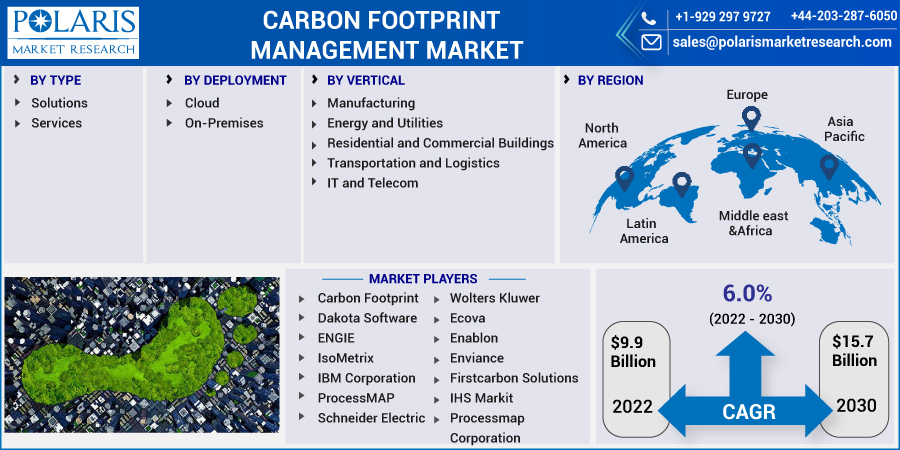
Based on type, the segmentation includes basic tier, mid-tier, and enterprise tier solutions. The enterprise tier segment dominated the market in 2025. It is attributed to the large organizations adopting comprehensive platforms to track, report, and mitigate emissions across global operations. These solutions are integrated with ERP, supply chain, and energy management systems. It provides complete visibility and helps meet strict regulations. Enterprise platforms led as they allow for multi-entity reporting and cover global operations. Additionally, workflow-based data validation and reporting that is ready for audits improve compliance with ESG disclosures and programs.
The mid-tier segment is expected to see steady growth. Medium-sized companies want cost-effective and scalable solutions that balance functionality and affordability. This demand for carbon footprint management solutions among medium-sized businesses fuels segment growth. The basic tier segment continues to support smaller businesses and startups. These entities focus on straightforward reporting and monitoring features. It provides an entry point into carbon management practices as awareness of sustainability grows.
By Deployment
Based on deployment, the market is segmented into on-premise and cloud-based solutions. The on-premise segment held the largest share in 2025. Strong use among large companies drives the segment's leadership. It is also influenced by heavily regulated industries like manufacturing, energy, and utilities. On-premise deployment provides more control over sensitive environmental data. It allows for tailored integration with current enterprise systems and adherence to strict regulatory requirements. Therefore, organizations in these sectors tend to favor this deployment type. On-premise is mainly adopted when data residency, security policies, and deep ERP integration are necessary.
The cloud-based segment is projected to record the fastest growth during the forecast period. The growth is driven by its scalability, faster deployment, cost-effectiveness, and real-time monitoring capabilities. Enterprises prefer cloud platforms to track emissions and generate automated sustainability reports, Using this deployment, they can integrate advanced analytics for better decision-making without heavy IT infrastructure investments. The growing shift toward digital sustainability platforms boosts the segment growth. Also, rising adoption of ESG (Environmental, Social, and Governance) frameworks across industries fuels demand for cloud-based carbon footprint management.
By End-Use
Based on end-use, the segmentation includes energy and utilities, manufacturing, transportation, IT and telecommunication, and residential and commercial buildings. Energy and utilities held the largest share in 2025. The dominance is driven by the sector’s high emission intensity. A growing focus on shifting to renewable energy sources fuels segment growth. Regulatory rules and carbon taxes are pushing utilities to use better monitoring systems to track Scope 1, 2, and 3 emissions more effectively.
The transportation sector is projected to record significant growth during the forecast period, propelled by global initiatives to decarbonize logistics, aviation, and automotive industries. Manufacturing is still an important end-use, driven by the need to lower industrial emissions and switch to low-carbon production practices. IT and telecommunications companies are investing more in footprint management solutions to achieve their corporate ESG goals, cut data center emissions, and satisfy investor demands for sustainability. Adoption is growing in logistics and operations that rely heavily on fleets. This is due to telematics that track emissions, improve route planning, and fulfill reporting requirements throughout supply chains.

Source: Polaris Market Research Analysis
Need Granular Data Across All Market Segments? Request Customization
Regional Analysis
North America held the largest share of the market in 2025. This was due to strong rules and high adoption of decarbonization strategies by companies. The U.S. Environmental Protection Agency’s (EPA) Greenhouse Gas (GHG) Reporting Program is pushing mandatory emission disclosures. It forces organizations to use updated carbon accounting and reporting tools. There is a growing focus on Environmental, Social, and Governance (ESG) performance metrics. Fortune 500 companies are accelerating their net-zero commitments. This boosts investments in carbon management software and services. The region is seeing more use of AI and cloud solutions to monitor and reduce emissions in the manufacturing, energy, and transport sectors.
U.S. Carbon Footprint Management Market Insights
The U.S. represents the largest market in North America. It is attributed to the rising renewable energy deployment. Also, the expansion of decarbonization initiatives across industries lead to the dominance. Large-scale projects in solar, wind, and hydrogen sectors are increasing the need for precise carbon accounting solutions. These solutions help meet legal requirements and corporate climate goals. In August 2022, the U.S. federal government introduced the Inflation Reduction Act (IRA). It provided significant tax credits and long-term financial incentives to boost renewable energy development in the next decade. This policy change drives the adoption of carbon footprint management solutions among utilities, industrial manufacturers, and technology companies that want to improve reporting accuracy and meet strict sustainability standards. U.S. organizations are placing greater importance on carbon accounting platforms that offer consistent emissions factors, traceable calculations, and standardized reporting outputs for internal management and external sustainability disclosures.
Asia Pacific Carbon Footprint Management Market Outlook
Asia Pacific is expected to grow the fastest during the forecast period. This growth comes from net-zero commitments from countries like China, Japan, and South Korea. Rapid industrialization, urbanization, and rising energy use are boosting the demand for carbon management platforms to track, report, and cut emissions. Local businesses and multinational companies invest in solutions. It helps them meet changing sustainability rules and global supply chain needs. Increased cooperation among governments, technology providers, and industry players is also shaping the carbon management landscape in the region.
India Carbon Footprint Management Market Trends
India is expected to emerge as a high-growth market in Asia Pacific. The growth is fueled by government-led initiatives and stricter carbon policies. Also, rising investor focus on ESG standards fuels the market growth. In July 2024, the Indian government introduced detailed regulations for its compliance carbon market under the Carbon Credit Trading Scheme (CCTS). The new regulations explained the design elements of the compliance mechanism. This was an important step in India’s carbon pricing framework. These changes encourage businesses in the energy, utilities, and industrial sectors to adopt carbon footprint management solutions as they get ready for mandatory carbon trading and reporting requirements. This boosts the demand for enterprise carbon footprint management software as companies prepare for compliance mechanisms, verification workflows, and standardized reporting formats.
Europe Carbon Footprint Management Market Dynamics
Europe had a significant market share in 2025. The strong climate policies and strict compliance requirements lead to the largest share. The European Green Deal and EU-wide carbon neutrality goals for 2050 boost the use of carbon accounting platforms in various industries. The growth of the EU Emissions Trading System (EU ETS), along with limits on emissions for different sectors, pushes businesses to adopt thorough solutions for tracking, auditing, and reducing carbon footprints. Investments in smart city projects, green infrastructure, and transport electrification across the region propel the need for effective carbon management tools. Vendors are working more closely with companies to provide tailored solutions that help meet changing EU sustainability rules while supporting long-term decarbonization strategies.

Source: Polaris Market Research Analysis
Curious About Regional Market Performance? Request Customization
Key Players & Competitive Analysis
The global carbon footprint management market is highly competitive. Leading players such as Accuvio Limited, Carbon Trust Advisory Limited, and Dakota Software Corporation drive innovation in sustainability reporting and emissions reduction technologies. Accuvio Limited specializes in cloud-based carbon and sustainability reporting platforms. These platforms enable enterprises to streamline compliance and ESG advisory disclosures. Carbon Trust Advisory Limited provides strategic consulting and verification services to help organizations meet decarbonization targets and improve climate resilience. Dakota Software Corporation leverages its expertise in EHS (environment, health, and safety) software. The software integrates carbon tracking and regulatory compliance tools into corporate sustainability workflows.
The market is expanding rapidly due to the imposition of stringent global emission regulations. Also, increasing investor scrutiny on ESG performance and accelerating corporate net-zero commitments boost the market growth. Companies are focusing on developing better solutions. The solutions combine real-time carbon accounting, predictive maintenance, and AI-driven sustainability insights. These platforms support compliance with local frameworks such as the EU ETS, the US EPA’s GHG reporting, and India’s CCTS. They help businesses improve energy use and manage carbon offsets. It also assists in achieving transparency in supply chain emissions.
Prominent companies operating in the carbon footprint management market include Accuvio Limited, Carbon Trust Advisory Limited, Dakota Software Corporation, Ecova, Inc., Enablon S.A., ENGIE SA, Enviance, Inc., IBM Corporation, Intelex Technologies ULC, IsoMetrix South Africa (Pty) Ltd, Microsoft Corporation, ProcessMAP Corporation, SAP SE, Schneider Electric SE, and Wolters Kluwer N.V.
Key Players
- Accuvio Limited
- Carbon Trust Advisory Limited
- Dakota Software Corporation
- Ecova, Inc.
- Enablon S.A.
- ENGIE SA
- Enviance, Inc.
- IBM Corporation
- Intelex Technologies ULC
- IsoMetrix South Africa (Pty) Ltd
- Microsoft Corporation
- ProcessMAP Corporation
- SAP SE
- Schneider Electric SE
- Wolters Kluwer N.V.
Carbon Footprint Management Industry Developments
In October 2025, Ormat began operating the 35 MW Ijen geothermal plant in East Java. Developed with Medco Power Indonesia, it’s the region’s first geothermal facility and is planned to expand to 110 MW under a 30-year PPA.
In June 2025, ePS Packaging and Carbon Quota announced a partnership. They will include the automated carbon calculator in ePS’s software suite for the packaging and print industries. This integration allows for data-driven sustainability and dependable emission tracking in production processes.
In January 2025, the Stock Exchange of Thailand (SET) collaborated with the Department of Climate Change and Environment (DCCE) and the Export-Import Bank (EXIM Bank). They introduced “SET Carbon,” a carbon footprint management platform. It would strengthen Thailand’s carbon data management capabilities.
In January 2024, the United Nations reached an agreement at COP29 to create a global carbon trading market. This initiative will allow countries and companies to trade emission-reduction credits. It seeks to fund climate projects in developing nations and support carbon offsetting.
Buyer Checklist
| Evaluation Area | What to Check | Enterprise Benefits |
| System Integrations | Native connectors for ERP, EHS, procurement, energy, and logistics systems (SAP, Oracle, Salesforce, IoT, utility feeds) | Ensures automated, auditable data flows across business units and reduces manual data collection costs |
| Emission Factors Library | Coverage of global standards (GHG Protocol, DEFRA, EPA, IEA), frequent updates, regional customization | Guarantees accurate Scope 1, 2, and 3 calculations across geographies and regulatory frameworks |
| Audit Trail & Data Lineage | Version control, change logs, calculation traceability, timestamped records | Enables regulatory compliance, external audits, and investor-grade ESG reporting |
| Supplier Portal | Secure supplier onboarding, data submission workflows, validation rules, progress dashboards | Accelerates Scope 3 data collection and improves supplier engagement and transparency |
| Assurance & Verification Support | Built-in audit workflows, third-party assurance integrations, ISO/CSRD readiness | Reduces compliance risk and supports third-party verification and regulatory disclosures |
| Role-Based Access Control (RBAC) | Configurable user roles by region, function, and data sensitivity | Protects data integrity and ensures governance across large enterprise teams |
| APIs & Data Export | REST APIs, real-time data access, BI tool compatibility, carbon accounting exports | Enables enterprise-wide analytics, automation, and integration into sustainability reporting systems |
| Scalability & Multi-Entity Support | Multi-site, multi-subsidiary, and multi-currency support | Supports global enterprises and M&A-driven reporting expansion |
| Regulatory & Framework Alignment | CSRD, SEC climate rules, TCFD, SBTi, CDP compatibility | Ensures future regulatory readiness and standardized ESG disclosures |
| Data Security & Compliance | ISO 27001, SOC 2, GDPR, encryption standards | Protects sensitive operational and supplier emissions data |
Source: Polaris Market Research Analysis
Carbon Footprint Management Market Segmentation
By Type Outlook (Revenue, USD Billion, 2021–2034)
- Basic Tier
- Mid-Tier
- Enterprise Tier
By Deployment Outlook (Revenue, USD Billion, 2021–2034)
- On Premise
- Cloud
By End-Use Outlook (Revenue, USD Billion, 2021–2034)
- Energy and Utilities
- Manufacturing
- Transportation
- IT and Telecommunication
- Residential and Commercial Buildings
By Regional Outlook (Revenue, USD Billion, 2021–2034)
- North America
- U.S.
- Canada
- Europe
- Germany
- France
- UK
- Italy
- Spain
- Netherlands
- Russia
- Rest of Europe
- Asia Pacific
- China
- Japan
- India
- Malaysia
- South Korea
- Indonesia
- Australia
- Vietnam
- Rest of Asia Pacific
- Middle East & Africa
- Saudi Arabia
- UAE
- Israel
- South Africa
- Rest of Middle East & Africa
- Latin America
- Mexico
- Brazil
- Argentina
- Rest of Latin America
Carbon Footprint Management Market Report Scope
| Report Attributes | Details |
| Market Size in 2025 | USD 11.6 billion |
| Market Size in 2026 | USD 12.2 billion |
| Revenue Forecast in 2034 | USD 21.0 billion |
| CAGR | 7.0% from 2026 to 2034 |
| Base Year | 2025 |
| Historical Data | 2022–2024 |
| Forecast Period | 2026–2034 |
| Quantitative Units | Revenue in USD billion, 2021–2034 and CAGR from 2026 to 2034 |
| Report Coverage | Revenue Forecast, Market Competitive Landscape, Growth Factors, and Trends |
| Segments Covered |
|
| Regional Scope |
|
| Competitive Landscape |
|
| Report Format |
|
| Customization | Report customization as per your requirements with respect to countries, regions, and segmentation. |
Source: Polaris Market Research Analysis
Carbon Footprint Management Market FAQ's
The global carbon footprint management market was valued at USD 11.6 billion in 2025. It is projected to reach USD 21.0 billion by 2034 due to sustainability regulations.
Cloud-based deployment holds the largest market share. It is due to scalability, cost-effectiveness, real-time tracking, and ease of integration across global operations and remote accessibility features.
Energy and utilities, manufacturing, transportation, and IT and telecom sectors are leading in adoption. High emission rates and the need for regulatory compliance are pushing this adoption forward. It is also fueled by corporate sustainability commitments.
North America dominated global market share in 2025. Asia Pacific reports highest growth. Government initiatives and expanding industrial carbon reduction programs drive the regional market growth.
Strict environmental rules and corporate net-zero commitments drive growth. ESG reporting requirements and improvements in AI-powered tracking boost the growth.
The cloud segment is projected to witness the fastest growth during the forecast period, driven by its scalability, cost-effectiveness, and real-time monitoring capabilities.
Download Sample Report of Carbon Footprint Management Market
Please fill out the form to request a customized copy of the research report.


