
Cognitive Radio Market Share, Global Analysis Report, 2025-2034
REPORT DETAILS
Market Statistics
The global Cognitive Radio Market was valued at USD 9.5 billion in 2024 and is expected to grow at a CAGR of 16.20% from 2025 to 2034. The rapid evolution of wireless communication technologies and the need for dynamic spectrum management in defense and commercial applications are major growth catalysts.
The integration of cognitive radios with emerging technologies like 5G and the Internet of Things (IoT) is creating new opportunities for spectrum optimization and efficient wireless communication. This integration enables smarter utilization of available radio frequencies, leading to improved network performance. Additionally, cognitive radio (CR) networks are placing increasing emphasis on security and privacy. The advancements in machine learning (ML) and artificial intelligence (AI) are playing a crucial role in augmenting the capabilities of cognitive radio systems. These technologies allow adaptive and secure spectrum management, enabling networks to dynamically optimize their use of available frequencies based on real-time conditions and demands.
Source: Polaris Market Research Analysis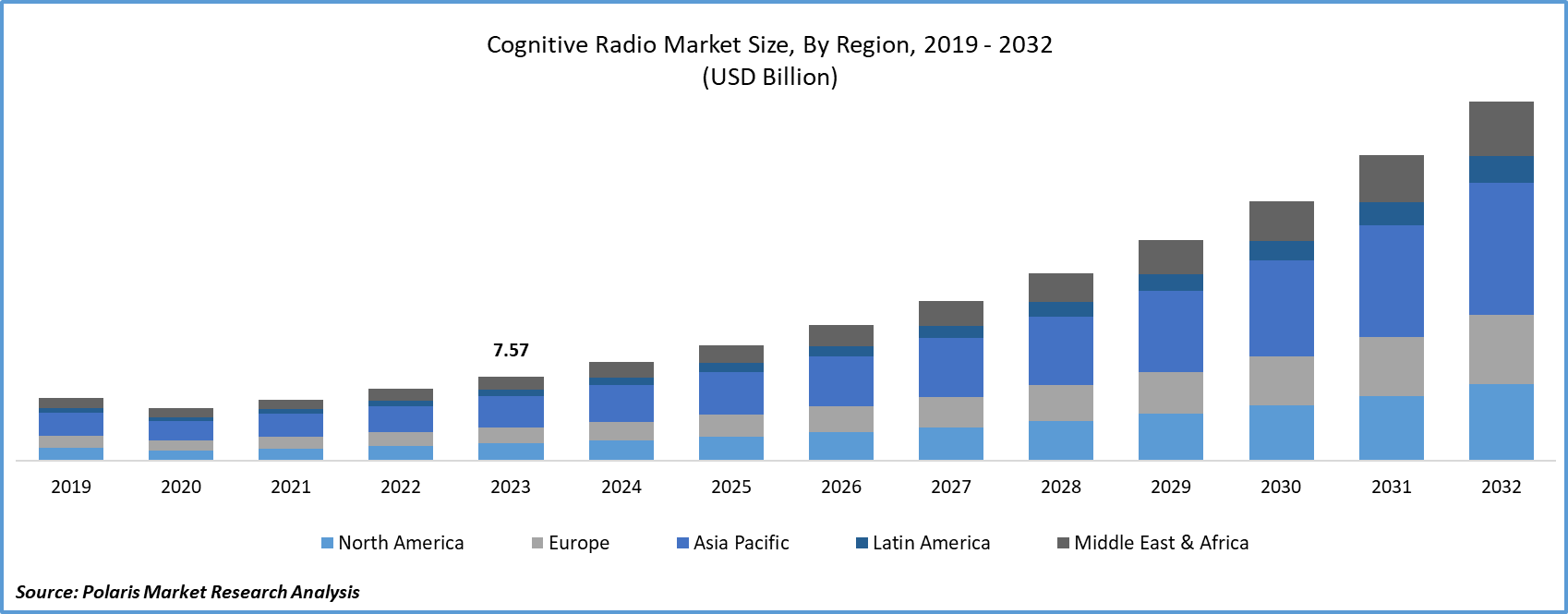
To Understand More About this Research: Download Sample Report
The combination of cognitive radio with 5G and IoT not only enhances spectrum efficiency but also improves the overall reliability and performance of wireless communication systems. Consequently, the market is expected to witness substantial growth as these technological advancements continue to evolve, offering diverse applications across various industries and sectors.
The heightened focus on security and privacy within cognitive radio (CR) networks represents a significant advancement in the CR industry. As the number of connected devices increases and communication systems become more complex, the implementation of robust security measures has become essential. Cognitive radios, in conjunction with the progress in machine learning (ML) and artificial intelligence (AI), are evolving to deliver adaptive and secure spectrum management.
The onset of the COVID-19 pandemic has led to a significant rise in the adoption of digital technologies to address the challenges posed by the global health crisis. During this period, there has been a growing demand for digital solutions, driving the increased uptake of wireless technologies. Various critical applications, particularly in the healthcare sector, relied heavily on high-speed wireless communication networks, placing considerable demand on the market.
The research study provides a comprehensive analysis of the industry, assessing the market on the basis of various segments and sub-segments. It sheds light on the competitive landscape and introduces cognitive radio market key players from the perspective of market share, concentration ratio, etc. The study is a vital resource for understanding the growth drivers, opportunities, and challenges in the industry.
These communication technologies played a pivotal role in addressing the pandemic's challenges through functionalities like contact tracing, crowd monitoring, support for medical professionals, facilitation of telemedicine, assistance in virtual learning, and more. Consequently, cognitive radio (CR) technologies are gaining substantial traction as they are instrumental in implementing intelligent healthcare monitoring solutions.
Source: Polaris Market Research Analysis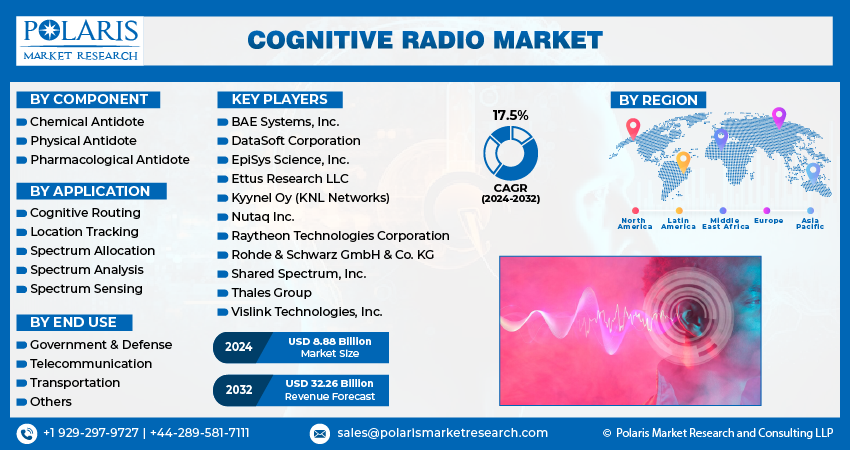
Get Full Segment-Level Forecasts & Insights: Download Sample Report
Industry Dynamics
Growth Drivers
-
Rising adoptive and responsive radio frequency utilization
The cognitive radio market is undergoing a notable shift towards solutions that provide dynamic spectrum access and management (DSM). This shift reflects the industry's move toward more adaptive and responsive radio frequency utilization. Dynamic spectrum access allows cognitive radios to adjust their operating frequencies intelligently and autonomously in response to the dynamic and changing radio frequency environment.
With dynamic spectrum access, cognitive radios can efficiently use available spectrum resources by assessing real-time conditions and adapting to the varying demands on the radio frequency spectrum. This flexibility is a key feature that distinguishes cognitive radios from traditional radio systems. Instead of relying on fixed frequency assignments, cognitive radios can dynamically allocate spectrum resources based on immediate needs and the prevailing environmental conditions.
Report Segmentation
The market is primarily segmented based on component, application, end use and region.
| By Component | By Application | By End Use | By Region |
|
|
|
|
Source: Polaris Market Research Analysis
To Understand the Scope of this Report: Request Customization
By Component Analysis
-
Software segment accounted for the largest market share in 2024
The software segment has the largest market share, driven predominantly by the adoption of software-based cognitive radio (CR) in key sectors such as telecommunications, defense, and government. Cognitive radios offer flexibility and a unique Network Resource Management (NRM) framework that addresses various challenges related to NRM, allowing for more efficient and dynamic management of network resources.
The services segment is expected to grow rapidly due to the increasing demand for expertise in deploying and optimizing cognitive radio (CR) systems. Businesses are recognizing the advantages that CR technology offers, leading to a surge in demand for essential services such as consulting and system integration. System integration services play a critical role in ensuring that CR systems integrate seamlessly with existing infrastructures and operate cohesively within the broader network environment. Specialized expertise and support in the deployment and optimization phases contribute to the significant growth anticipated in the services segment. Businesses recognize the importance of these services in unlocking the full potential of CR technology, which is driving the demand for expertise in the field.
By Application Analysis
-
Spectrum sensing segment held the significant market share in 2024
The spectrum sensing segment held a significant market share in 2024. It is primarily driven by its pivotal role in enhancing the efficiency of wireless communication. In the evolving landscape of cognitive radio (CR), the prominence of spectrum sensing underscores its fundamental contribution to addressing the increasing demands for spectrum efficiency and overcoming communication challenges. This trend is anticipated to propel the growth of the spectrum sensing segment throughout the forecast period.
The spectrum allocation segment is expected to gain a substantial growth rate. Growth is driven by the growing imperative for the effective utilization of the radio frequency spectrum. In the context of advancing technology and the introduction of 5G and beyond, spectrum allocation has emerged as a crucial facilitator for delivering high-performance and dependable wireless communication services. The robust growth projection underscores the pivotal role of the segment in meeting the evolving demands of an increasingly connected and data-intensive world.
By End Use Analysis
-
Telecommunication segment held the significant market share in 2024
The telecommunication segment held a significant market share in 2024. This dominance is due to acute spectrum scarcity issues, particularly in the lower frequency bands. In these bands, the demand for wireless services has been consistently on the rise. Cognitive Radios (CRs) play a crucial role in mitigating this challenge by dynamically adapting to available frequencies, minimizing interference, and optimizing spectrum utilization. This adaptability makes CRs indispensable for ensuring the efficiency and high-quality delivery of wireless data services, especially in the era of 4G and 5G networks. Consequently, the telecommunication segment is expected to drive market growth significantly throughout the forecast period.
Source: Polaris Market Research Analysis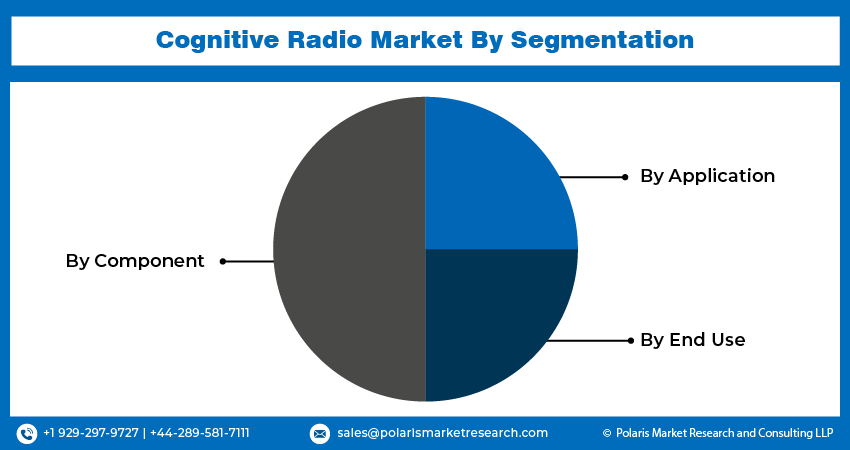
Need Granular Data Across All Market Segments? Request Customization
Regional Insights
-
North America dominated the global market in 2024
North America dominated the global market. The region’s growth is due to the widespread adoption of Cognitive Radios (CRs) within defense and government organizations. The robust growth can be attributed to the substantial presence of major technology companies that offer sophisticated CR solutions tailored for diverse applications. The prevalence of these advanced CR technologies in the region, particularly within defense and government sectors, has significantly contributed to the overall market expansion.
The Asia Pacific will grow at a substantial pace during the forecast period. This growth is driven by an increasing number of smartphone users and the advent of 5G technology in the telecommunications sector. The rising prevalence of advanced transportation sources, which often rely on efficient wireless communication, is another significant factor contributing to the expansion of the market in the region. The convergence of these technological trends is expected to propel the adoption of CR solutions and drive market growth in the region.
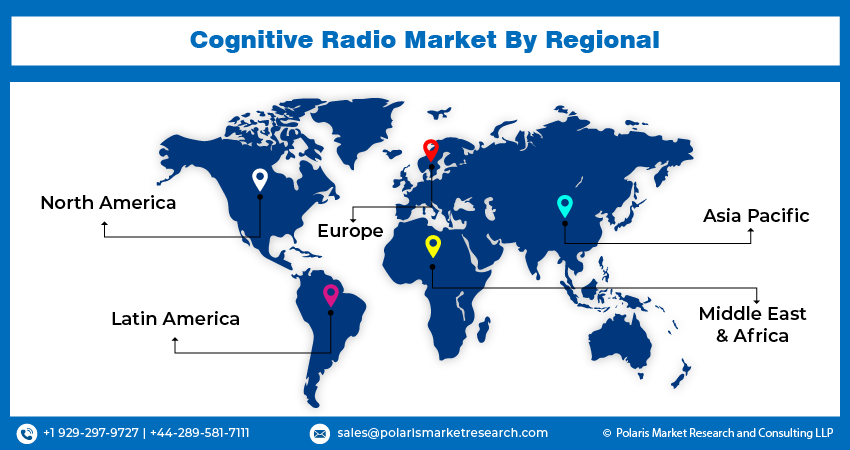
Source: Polaris Market Research Analysis
Curious About Regional Market Performance? Request Customization
Key Market Players & Competitive Insights
The cognitive radio market is fragmented and is anticipated to witness competition due to several players' presence. Major service providers in the market are constantly upgrading their technologies to stay ahead of the competition and to ensure efficiency, integrity, and safety. These players focus on partnership, product upgrades, and collaboration to gain a competitive edge over their peers and capture a significant market share.
Some of the major players operating in the global market include:
- BAE Systems, Inc.
- DataSoft Corporation
- EpiSys Science, Inc.
- Ettus Research LLC
- Kyynel Oy (KNL Networks)
- Nutaq Inc.
- Raytheon Technologies Corporation
- Rohde & Schwarz GmbH & Co. KG
- Shared Spectrum, Inc.
- Thales Group
- Vislink Technologies, Inc.
Recent Developments
- In May 2025, Motorola Solutions announced its acquisition of Silvus Technologies for USD 4.4 billion a strategic move to integrate high-speed, mission-critical mobile ad-hoc network (MANET) tech into its portfolio and strengthen its communications offerings for defense, public safety, and enterprise customers
-
In June 2024, Rohde & Schwarz joined the AI-RAN Alliance with partners including NVIDIA, Ericsson, and Nokia to advance AI-driven optimization of next-generation wireless networks and enhance RAN performance and edge AI services.
- In August 2023, Raytheon's BBN division has been chosen to lead a team dedicated to the development of multi-hop mobile ad hoc networks (MANETs) for the U.S. Department of Defense (DOD). This technology aims to empower deployed service members with the 5G devices to establish direct communication, eliminating the need for a complex 5G infrastructure.
Cognitive Radio Market Report Scope
| Report Attributes | Details |
| Market size value in 2025 | USD 11.04 billion |
| Revenue forecast in 2034 | USD 42.61 billion |
| CAGR | 16.20% from 2025 – 2034 |
| Base year | 2024 |
| Historical data | 2020 – 2023 |
| Forecast period | 2025 – 2034 |
| Quantitative units | Revenue in USD billion and CAGR from 2025 to 2034 |
| Segments covered | By Services, By End Use, By Region |
| Regional scope | North America, Europe, Asia Pacific, Latin America; Middle East & Africa |
| Customization | Report customization as per your requirements with respect to countries, region and segmentation. |
Source: Polaris Market Research Analysis
We strive to offer our clients the finest in market research with the most reliable and accurate research findings. We use industry-standard methodologies to offer a comprehensive and authentic analysis of cognitive radio market. Besides, we have stringent data-quality checks in place to enable polyisobutylene market for you.
cognitive radio market FAQ's
The cognitive radio market report covering key segments are component, application, end use and region.
Cognitive Radio Market Size Worth $42.61 Billion By 2034
The global cognitive radio market is expected to grow at a CAGR of 16.20% during the forecast period.
North America is leading the global market
key driving factors in cognitive radio market are Rising adoptive and responsive radio frequency utilization
The software segment held the largest market share in 2024, driven by widespread adoption of software-defined cognitive radio in telecom, defense, and government sectors, offering flexible Network Resource Management (NRM) and dynamic spectrum optimization.
AI and machine learning enable adaptive, real-time spectrum management and enhanced network security, while 5G integration boosts spectrum efficiency and reliability, accelerating cognitive radio adoption across telecom and transportation sectors.
Download Sample Report of cognitive radio market
Please fill out the form to request a customized copy of the research report.


