
Cookies Market Size, Share Global Analysis Report, 2025-2034
REPORT DETAILS
What is Cookies Market Size?
The global cookies market was valued at USD 35.44 billion in 2024 and is expected to grow at a CAGR of 4.4% during the forecast period. The growth is driven by introduction new flavor variants, rise in disposable income, & the increasing acceptance of the chocolate cookies as the gifting option.
Key Insights
- The drop cookies segment is expected to witness significant growth during the forecast period due to increase in product launches by market players.
- The offline dominated with largest share in 2024 due to expansion of retail channel in urban and rural areas.
- North America dominated with largest share in 2024 due to high consumption of sandwich biscuits.
- Asia Pacific is projected to accounted for a significant share in the global market driven by large population size.
Industry Dynamics
- The growth in the product launch with innovative flavors is fueling the market growth.
- The rising disposable income is driving the growth.
- The expansion of retail network is boosting the industry growth.
- The growing consumer shift toward healthier, low-sugar, and clean-label snack alternatives is limiting the demand for traditional high-calorie cookie products.
Market Statistics
- 2024 Market Size: USD 35.44 Billion
- 2034 Projected Market Size: USD 54.54 Billion
- CAGR (2025-2034): 4.4%
- Largest Market: North America
Source: Polaris Market Research Analysis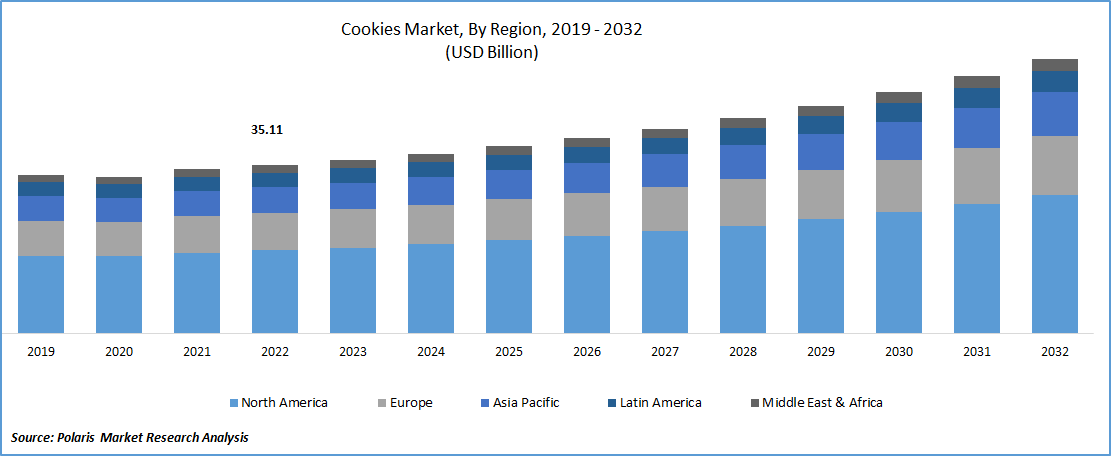
To Understand More About this Research : Download Sample Report
Cookies are ready-to-use snacks that can be consumed at any time of the day, providing flexibility and convenience to individuals. They are offered in a wide variety of price ranges, flavors, sizes, and quantities, making them appealing to a large population. Furthermore, attractive packaging enhances their convenience for storage and transportation, further contributing to their popularity among consumers. Overall, these factors collectively stimulate market growth
The key players have introduced a range of healthier cookie options in response to consumers' increasing focus on healthier food choices to address concerns related to poor diet, obesity, and overall health. These include oat-meal, vegan, sugar-free, gluten-free cookies. Moreover, the introduction of digestive cookies in industry has provided consumers with a healthy snacking option that aids digestion. To attract customers and stay competitive, bakery manufacturers are focusing on unique packaging & introducing new flavor variants. These efforts aim to capture consumers' attention and offer unique experiences, further driving the demand for chocolate cookies. Rising income levels in emerging economies like China & India is another key factor expected to fuel the product demand in the coming years. Furthermore, chocolate cookies are gaining popularity as a gifting option. People are increasingly considering chocolate cookies as a delightful present for various occasions, such as birthdays, holidays, & celebrations. This trend is projected to contribute to the overall growth of the market.
Industry Dynamics
What Factors are Driving the Cookies Market Growth?
Cookies typically contain oats and digestive ingredients as their primary ingredients. Some cookies are specifically formulated to be gluten-free and have a high energy content. In response to changing consumer demands, the cookies market is witnessing the introduction of new flavors infused with exotic add-ons. Additionally, cookies prepared through a shortened baking process are marketed as fat-free and protein-rich products. There is an increasing demand for gluten-free cookies in developed regions due to growing concerns about gluten-related disorders and lactose intolerance. As a result, manufacturers are expected to see a rise in the demand for gluten-free options. Regulations promoting organic labeling in the food and beverage industry are pushing manufacturers to improve label standards for their finished goods. This drive towards transparency and organic certification is expected to have a positive impact on market growth.
Source: Polaris Market Research Analysis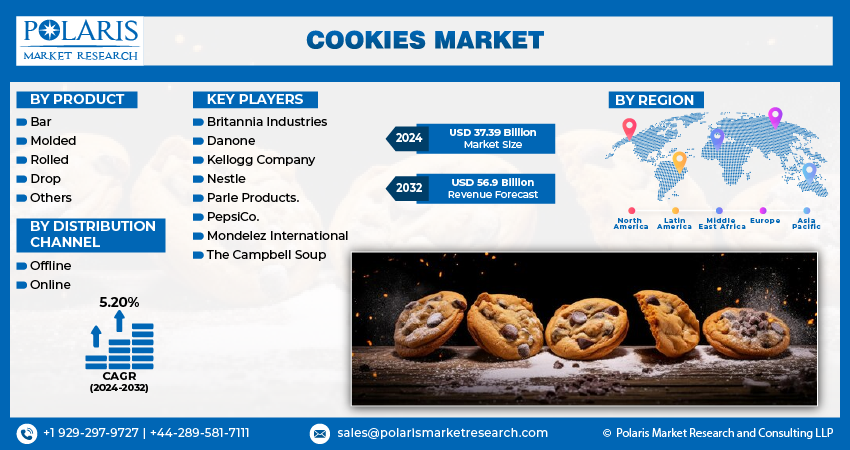
Get Full Segment-Level Forecasts & Insights: Download Sample Report
Report Segmentation
The market is primarily segmented based on product, distribution channel, and region.
| By Product | By Distribution Channel | By Region |
|
|
|
Source: Polaris Market Research Analysis
To Understand the Scope of this Report : Request Customization
Which Segment by Product is Expected to Witness Fastest Growth?
Drop cookies is expected to have faster growth for the market. Growth opportunities for this segment are expected to arise from new product launches by renowned companies like Dunkin & Oreo. These companies are leveraging online channels and supermarket distribution to introduce their products to consumers, thereby stimulating market growth. Bar cookies segment expected to garner largest share. This segment's success is attributed to the increasing consumer preference for bar cookies, driven by the various health benefits they provide, including improved blood circulation and heart health.
Why Offline Segment Accounted for Largest Market Share?
Offline segment holds the largest market share. This share is primarily due to significant presence of supermarkets & convenience stores as prominent sales channels in developing economies such as China & India. The disposable income in this developing countries are rising, leading to increase in demand for day to day food and grocery items, which is fueling the expansion of the offline retail channels.
Source: Polaris Market Research Analysis
Need Granular Data Across All Market Segments? Request Customization
Regional Insights
How North America Captured Largest Market Share?
North America dominated with the largest share in 2024. The consumption of sandwich biscuits, particularly among the working-class population in the United States & Canada, is expected to be a key driver for further growth in the regional market. Additionally, the availability of a wide range of flavors such as buttercream, chocolate, & peanut butter is anticipated to contribute significantly to market expansion.
What are the Reasons for Asia Pacific's Significant Growth?
Asia Pacific is projected to have a higher growth rate for the market due to region's rapidly improving economy, which has resulted in increased disposable income levels among consumers. Additionally, urbanization and changing lifestyles have further fueled the demand for various products, including cookies. These factors collectively contribute to the overall growth of the market in the coming years. The increasing income levels among individuals in the region are a significant driver for the growing demand for premium cookies. Notably, the younger population has shown a greater inclination towards purchasing cookies.
Source: Polaris Market Research Analysis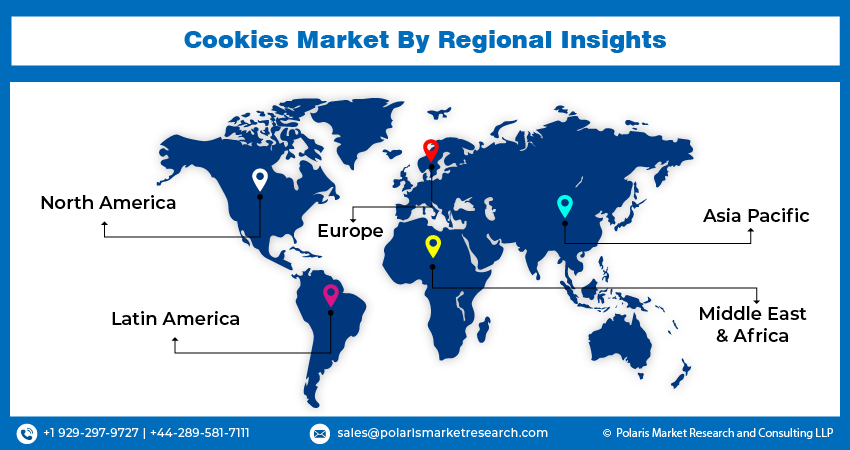
Curious About Regional Market Performance? Request Customization
Key Market Players & Competitive Insights
Product innovation and strategic business partnerships with distributors in developing countries such as China, India, & Bangladesh are expected to be crucial for success in the cookie market.
Nestle recently introduced a new product named Pumpkin Cobbler Cookies, showcasing their commitment to innovation. Additionally, Starbucks and Nestle have formed a partnership to offer packaged and consumer goods under the Starbucks brand.
Moreover, Britannia is actively working on the development of healthy, low-fat cookies to cater to the Indian market. These initiatives highlight the importance of innovative product offerings and strategic partnerships in driving growth and capturing market opportunities.
Some of the major players operating in the global market include:
- Britannia Industries
- Danone
- Kellogg Company
- Nestle
- Parle Products.
- PepsiCo.
- Mondelez International
- The Campbell Soup
Recent Developments
-
August 2025, Puff Cookies launched new products, including its first-ever Cookie Skillet and festive seasonal cut-out cookies, expanding its retail presence to over 5,500 locations across the US and strengthening its position in the cookie dough market through innovative, convenient offerings.
-
June 2025, ITC launched Sunfeast Mom’s Magic ‘SHINES’, a new shiny butter cookie with a delicate sugar glaze, with an rich, flaky texture and indulgent flavor. The brand also released a TVC featuring Nadhiya Moidu to celebrate the launch across select Indian states.
-
In January 2022, Mondelez International completed acquisition of Chipita Global, a prominent player in the Central & Eastern European market specializing in croissants & baked snacks.
-
In April 2022, Mondelez International successfully acquired Ricolino, the confectionery business of Grupo Bimbo. This strategic move has enhanced company's presence & influence in the crucial Mexican market, particularly in the core snacking category.
-
In July 2022, to compete with its rivals, Britannia Good Day, a well-known cookie brand in India, introduced a new product called Good Day Harmony biscuit. This range of cookies is available in 4 delightful variants: Hazelnut, Cashew, Pista, & Almond.
-
In August 2022, General Mills has introduced a fresh variant of Pillsbury mini soft-baked cookies exclusively for convenience stores. These cookies are crafted using a combination of soft butter & shortening, and they are available in 4 delicious homemade-inspired flavors.
Cookies Market Report Scope
| Report Attributes | Details |
| Market size in 2024 | USD 35.44 billion |
| Market size in 2025 | USD 36.97 billion |
| Revenue forecast in 2034 | USD 54.54 billion |
| CAGR | 4.4% from 2024 - 2032 |
| Base year | 2024 |
| Historical data | 2020 - 2023 |
| Forecast period | 2025 - 2034 |
| Quantitative units | Revenue in USD billion and CAGR from 2025 to 2034 |
| Segments covered | By Product, By Distribution Channel, By Region |
| Regional scope | North America, Europe, Asia Pacific, Latin America, Middle East & Africa |
| Key companies | Kellogg Company, Nestle, PepsiCo; Britannia Industries; The Campbell Soup, Mondelez International; Danone; and Parle Products. |
Source: Polaris Market Research Analysis
Cookies Market FAQ's
Britannia,Industries,Danone,Kellogg Company,Nestle,Parle Products are key companies in legal Cookies market.
The global cookies market is expected to grow at a CAGR of 4.4% during the forecast period.
product, distribution channel, and region key segments covered.
Increasing demand for gluten-free cookies are key driving factors in legal Cookies market.
Cookies Market Size Worth $ 54.54 Billion by 2034.
Download Sample Report of Cookies Market
Please fill out the form to request a customized copy of the research report.


