
DevOps Market Demand, Share Analysis Report, 2026-2034
REPORT DETAILS
Market Statistics
What is the Current Market Size?
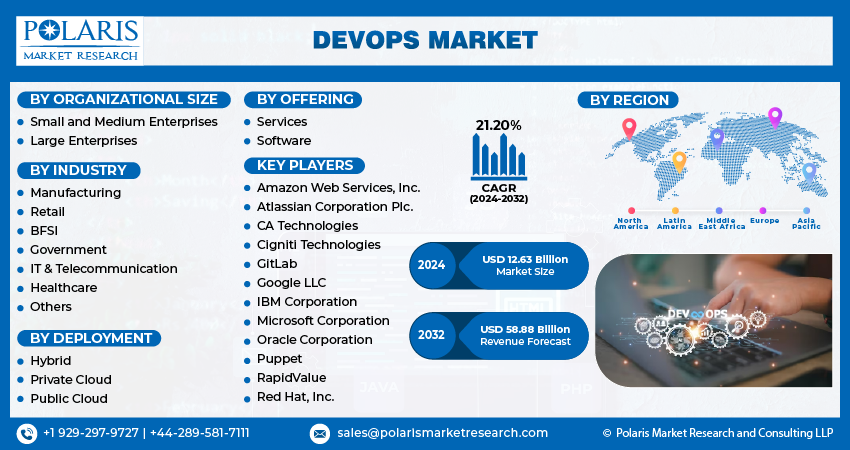
The global DevOps market size was valued at USD 15.27 billion in 2025 and is expected to grow at a CAGR of 21.6% during the forecast period. Key factors driving demand include the growing adoption of DevOps tools, the ongoing transition to hybrid cloud, and improved operational efficiency.
The global DevOps market is growing rapidly as enterprises adopt faster, more reliable software delivery. Organizations are adopting CI/CD pipelines, automation, and cloud-native technologies to survive in a competitive world. The move towards hybrid and multicloud infrastructure is also fuelling the global DevOps market growth. As a result, the global DevOps market is expected to expand steadily, with a strong DevOps market forecast over the coming years.
Key Insights
- The cloud DevOps market is driven by the use of public clouds, where companies deploy DevOps automation tools to accelerate growth, improve teamwork, and reduce costs, indicating a high rate of DevOps adoption.
- In 2025, the public cloud segment dominated the market, driven by the increasing adoption of artificial intelligence (AI) and machine learning (ML), which are providing a significant boost.
- The IT & Telecommunications segment accounted for the largest market share. This is due to the expansion of industries such as healthcare, manufacturing, banking, insurance, and finance, which are transitioning towards automated software deployment.
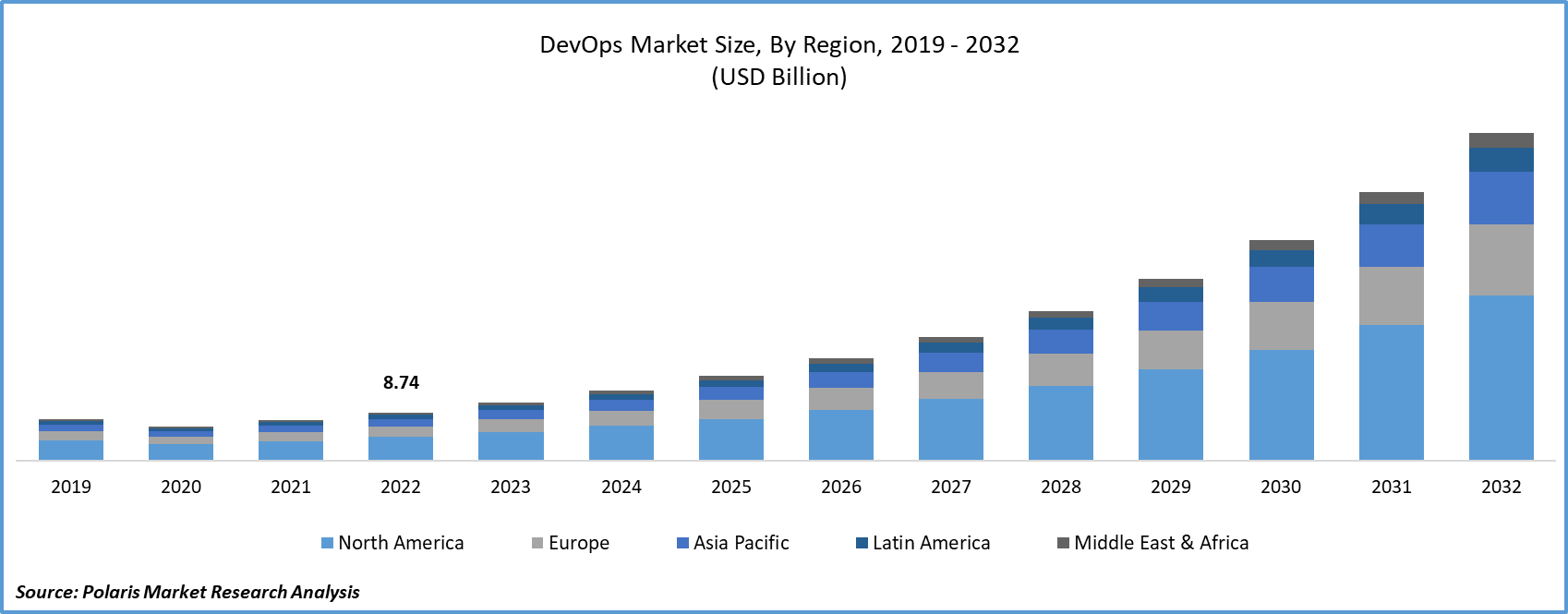
- North America held the largest revenue share in 2025, driven by widespread adoption across industries such as IT & telecommunications, retail, and BFSI.
- The Asia Pacific market is predicted to register the fastest growth. This is due to the increased adoption of DevOps solutions by small and medium enterprises.
Industry Dynamics
- The DevOps sector is driven by the need for rapid release cycles and more reliable, high-quality deployments. The growing adoption of DevOps tools is fueling the DevOps software market.
- The surging popularity of DevOps tools stems from their ability to streamline development within collaborative teams while minimizing errors, thereby driving demand.
- The growing demand for greater operational flexibility, improved client satisfaction, and IoT integration is driving market expansion.
- Cultural change and breaking down silos create challenges between development and operations teams. Despite the high adoption rate, implementation challenges in the DevOps industry and ever-growing skills supply gaps for DevOps are potential drawbacks.
- The adoption of cloud and hybrid solutions, the growing DevSecOps trend, and the integration of AI in DevOps are creating new DevOps market opportunities. Organizations are adopting AI-powered monitoring solutions to improve DevOps reliability.
Market Statistics
- 2025 Market Size: USD 15.27 billion
- 2034 Projected Market Size: USD 88.39 billion
- CAGR (2026-2034): 21.6%
- North America: Largest market in 2025
Source: Polaris Market Research Analysis
Want a Deeper Look at Key Market Players? Download Sample Report
AI Impact on the Industry
- Enhance developer speed and efficiency by automating repetitive tasks, such as testing and code integration.
- System data analysis to prevent outages enables proactive issue resolution.
- Continuous scanning for vulnerabilities and anomalies enhances security within the software pipeline.
- AI in DevOps is transforming DevOps automation practices through its capabilities for predicting failures, intelligent testing, and automated resolution. Artificial intelligence-powered DevOps tools monitor system data to prevent failures, improve system performance, and increase system security.
What Does the Current Market Landscape Look for DevOps Landscape?
DevOps tools offer a variety of benefits, including improved agility, enhanced quality, and reduced production issues. The major types of DevOps tools are configuration management, API-related, monitoring and collaboration, and build automation. It improves process efficiency by automating tasks and enabling the team to achieve optimal results more quickly. Moreover, it frees up time that would otherwise be spent on low-value tasks. As automation escalates, industry leaders give technical teams the freedom to focus on innovative initiatives that deliver added value to organizations.
In the initial phases of DevOps adoption, key domains such as application deployment, integration, and version control become clearer. Once the collective value of collaboration and sharing is appreciated, new process and tool adoption improves. Further, there are distinct difficulties associated with implementing DevOps, including the lack of a universally accepted definition, a gap in standardization for adopting development and operations paradigms, and the fact that every DevOps implementation has its own context. The increasingly complex nature of the IT infrastructure, including physical, virtual, and cloud computing resources, has made IT processes more complex. In response, DevOps steps in, relieving humans of substantial management tasks through automation. This is one of the reasons why organizations are striving for extensive DevOps automation and advanced container orchestration while selecting cloud hosting for their workloads. The collaboration between development and operations accelerates an organization's ability to deliver applications and enhance customer services. SDO performance becomes critical, enabling teams and organizations to optimize software for results. Applying DevOps during technology changes strengthens overall performance and quality.
DevOps is a combination of the terms "development" and "operations" that’s meant to unite people, processes, and technology. It aims to improve the speed, security, and efficiency of software development and delivery compared to traditional processes. Coming from an agile approach to software development, DevOps builds on the cross-functional practice of deploying applications in a fast, iterative manner. It aims to shorten the system development lifecycle and offer continuous delivery with high-quality software.
The fundamental principles of DevOps include automating the software development life cycle. It also includes collaboration and communication. However, the other principles include continuous improvement and the ability to meet user needs. Various industries use the DevOps concept. These include manufacturing, retail, BFSI, government, IT, and healthcare.
Industry Dynamics
Growth Drivers
What are the Factors Driving the Expansion of DevOps Market?
DevOps tools are growing in popularity because they assist collaboration and minimize errors. They offer increased security and stability for software deployment. Major trends in this market include Platform-as-a-Service (PaaS) and containerization technologies. The virtualization of these services is emerging as a significant trend, simplifying DevOps implementation.
The market is demanding greater operational flexibility, better client satisfaction, and integration with IoT. DevOps focuses on collaboration, automation, and communication between developers and IT operations teams. It is actually an integration of two established approaches: Agile Development and Agile System Administration. DevOps tools significantly enhance the development process, improving quality, reducing errors, and strengthening security and operational procedures.
Source: Polaris Market Research Analysis
Get Full Segment-Level Forecasts & Insights: Download Sample Report
Segmental Insights
Deployment Analysis
Which Segment by Deployment Dominated the Market in 2025?
The public cloud segment dominated the market in 2025. This is due to the increasing adoption of cloud technologies and frameworks, alongside enterprises' digital transformations aimed at automating business processes and unlocking significant operational potential. Technologies such as artificial intelligence and machine learning are giving the market a tremendous boost. These can handle large amounts of data and perform repetitive tasks, which help experts identify key work and point out problems to provide solutions.
The dominance of the public cloud segment is driven by surging demand for cloud-based solutions in system architectures and web servers across industries. Public cloud offerings include accessibility, remote access, rapid deployment, and a range of enterprise benefits such as scalability and flexibility, all of which contribute to its widespread adoption.
Industrial Analysis
Why IT & Telecommunication Segment Accounted for the Largest Share of the Market?
The IT & Telecommunication segment accounted for the largest market share during the forecast period. This is due to the expansion of industries such as healthcare, manufacturing, banking, insurance, and finance, which are transitioning towards automated software deployment to achieve greater precision, efficiency, and reduced maintenance expenses. The IT & telecommunication sector has claimed the lion's share of the market in recent years. It is projected to maintain its leading position over the next five years, driven by the escalating demand for swift delivery services. Currently, industries such as IT & telecom, BFSI, and retail are the primary end users of DevOps tools. The market is poised for growth in these segments, fueled by the uptick in online and mobile transactions and the increasing need for an enhanced customer experience.
Organizational Size Analysis
Which Segment by Operational Size Captured the Highest Share?
The Large Enterprises segment accounted for the largest market share in 2025. Large companies are more likely to use DevOps to handle critical business activities effectively. Large enterprises have been at the forefront of embracing DevOps to elevate quality and efficiency, streamline processes, expedite time-to-market, and trim down costs associated with IT operations, including software development, delivery, and maintenance. However, in small and medium-sized enterprises (SMEs), several challenges, such as a shortage of skilled workers, a preference for traditional methods, and the need for standardized DevOps tools, have impeded the widespread adoption of DevOps practices.
Source: Polaris Market Research Analysis
Need Granular Data Across All Market Segments? Request Customization
Regional Insights
What are the Factors for the Regional Growth?
North America accounted for the highest revenue share in 2025. It is mainly due to the adoption of machine learning models across diverse sectors, such as information technology & telecommunications, retail, and BFSI. Organizations in these industries are constantly challenged to deliver software faster, with greater reliability, and with higher operational efficiency, thereby making DevOps a key strategic initiative rather than just an option. The high concentration of the largest cloud companies and innovative technology organizations has adopted a culture of continuous integration and delivery in the North American workspace. Furthermore, the availability of talent working in agile environments and those with automation competency has been a significant enabler.
In Europe, numerous banks have incorporated DevOps into their software processes, resulting in a 25% increase in the efficiency of application updates, such as internet banking. This shift has reduced the workload for IT operations teams, enabling them to focus on delivering value to the company's business operations. Projections indicate that the Latin America (LATAM) and Middle East & Africa (MEA) markets are poised for substantial growth.
The Asia Pacific DevOps industry is anticipated to experience the highest Compound Annual Growth Rate (CAGR) in the forecast period, driven by the growing need for automated software solutions in Small and Medium Enterprises (SMEs) across countries such as Singapore, Japan, and China. This region has witnessed more SMEs adopting DevOps solutions. The development of enhanced infrastructure, smart devices, and digital services in emerging APAC countries has also led to an increased adoption of DevOps.

Source: Polaris Market Research Analysis
Curious About Regional Market Performance? Request Customization
Key Market Players & Competitive Insights
The market is very competitive. Large firms embrace better technology and higher quality, creating brands that help improve their revenues. Mergers and innovations help large firms improve their offerings, and they continue to perform better through research and development, mergers, and acquisitions.
The DevOps competitive landscape encompasses cloud hyperscalers, niche DevOps tool providers, and enterprise software. The main companies competing in DevOps are distinguished by their integrated platforms, security offerings, and AI-based automation, whereas Niche companies specializing in DevOps platforms focus on CI/CD and container orchestration.
Some of the major players operating in the global market include:
- Amazon Web Services, Inc.
- Atlassian Corporation Plc.
- CA Technologies
- Cigniti Technologies
- GitLab
- Google LLC
- IBM Corporation
- Microsoft Corporation
- Oracle Corporation
- Puppet
- RapidValue
- Red Hat, Inc.
Recent Developments
July 2025: IBM and DBmaestro collaborated to make DBmaestro’s advanced database DevSecOps and observability suite available through IBM’s solutions portfolio, empowering customers to achieve end-to-end DevOps automation, real-time database visibility, and unmatched agility, security, and innovation.
December 2022: Copado launched the DevOps Exchange for enterprise SaaS offerings. The pre-built tools from the Copado community improve the Copado DevOps offering for Salesforce.
May 2022: IT service management firm Claranet has successfully acquired Geko Cloud in Spain, bolstering its cloud and DevOps offerings within the region. This acquisition enables Claranet to provide advanced cloud consulting services, container-as-a-service, digital modernization, cloud infrastructure management, and microservices to its clientele.
DevOps Market Segmentation
By Organizational Size
- Small and Medium Enterprises
- Large Enterprises
By Industry
- Manufacturing
- Retail
- BFSI
- Government
- IT & Telecommunication
- Healthcare
- Others
By Deployment
- Hybrid
- Private Cloud
- Public Cloud
By Offering
- Services
- Software
By Region
- North America
- US
- Canada
- Mexico
- Europe
- Germany
- France
- UK
- Italy
- Spain
- Netherlands
- Russia
- Rest of Europe
- Asia Pacific
- China
- Japan
- India
- Malaysia
- South Korea
- Indonesia
- Australia
- Vietnam
- Rest of Asia Pacific
- Middle East & Africa
- Saudi Arabia
- UAE
- Israel
- South Africa
- Rest of Middle East & Africa
- Latin America
- Brazil
- Argentina
- Rest of Latin America
DevOps Market Report Scope
| Report Attributes | Details |
| Market Size in 2025 | USD 15.27 Billion |
| Market Size in 2026 | USD 18.44 Billion |
| Revenue Forecast by 2034 | USD 88.39 Billion |
| CAGR | 21.6% from 2026 to 2034 |
| Base Year | 2025 |
| Historical Data | 2021–2024 |
| Forecast Period | 2026–2034 |
| Quantitative Units | Revenue in USD billion, 2021–2034, and CAGR from 2026 to 2034 |
| Report Coverage | Revenue Forecast, Market Competitive Landscape, Growth Factors, and Trends |
| Segments Covered |
|
| Regional Scope |
|
| Competitive Landscape |
|
| Report Format |
|
| Customization | Report customization as per your requirements with respect to countries, regions, and segmentation. |
Source: Polaris Market Research Analysis
devops market FAQ's
The global DevOps market was USD 15.27 billion in 2025 and is anticipated to grow aggressively from 2034 onwards. The rising demand for automation and hybrid clouds is one such key factor behind this growing trend.
The Public Cloud Segment dominates the market due to its ease of access, scalability, and faster deployment. Also, the use of hybrid and private clouds is increasing.
The major drivers of the DevOps market are faster application delivery, CI/CD and automation, containerization, microservices, operational efficiency, and AI-based DevOps solutions.
The IT and Telecommunications industry has the largest market share, followed by BFSI, retail, healthcare, and manufacturing. These sectors use DevOps to ensure agility, time-to-market, and customer experience.
Key players in the DevOps market are Microsoft, IBM, AWS, Google, Atlassian, Oracle, GitLab, Cisco, and Red Hat. Microsoft has made continuous efforts to improve DevOps practices through best practices, related research papers, communities, and blogs.
• The IT & Telecommunication segment accounted for the largest market.
Download Sample Report of devops market
Please fill out the form to request a customized copy of the research report.


