
Digital Content Creation Market Size, Share Global Analysis Report, 2025-2034
REPORT DETAILS
Market Statistics
Market Overview
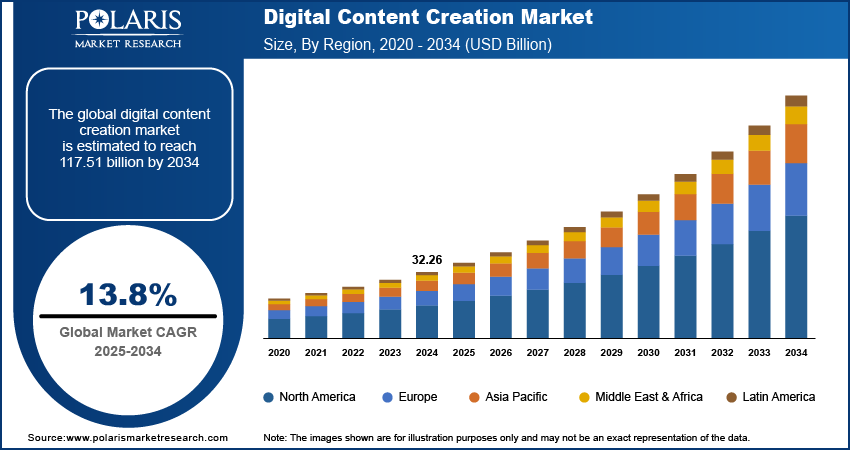
The global digital content creation market size was valued at USD 32.26 billion in 2024 and is expected to exhibit a CAGR of 13.8% during 2025–2034. Fueled by increasing digital consumption, the e-commerce revolution, influencer-driven content demand, creation tools enabled by AI, and high-impact branding needs, the world's digital content creation market is growing rapidly and continually.
Key Insights
- In 2024, the tools segment captured the largest portion of the digital content creation market on a global basis, fueled by the increased utilization of sophisticated software to create, edit, and manage content.
- Media & entertainment and retail & e-commerce industries were the leaders of the market in 2024, owing to increased demand for immersive and personalized digital experiences.
- In 2024, North America accounted for the highest market share, driven by the strong presence of the tech industry, sophisticated digital infrastructure, and increasing demand for premium quality digital content.
- The market in Asia Pacific is expected to witness robust growth over the forecast period, with growing internet penetration, rising use of smartphones, and surging demand for online entertainment.
Industry Dynamics
- Rising internet access, widespread social media use, and the surge in video streaming platforms have significantly accelerated digital content consumption.
- Companies are increasingly using content-oriented approaches to drive branding and engagement, mainly driving demand in the digital content creation space.
- E-commerce expansion is driving the digital content creation business because companies rely more and more on quality images, videos, and interactive media to attract and engage internet shoppers.
- The main hindrance to the digital content creation economy is the expense and advancement of specialized tools and technologies, restricting their access to small creators and companies.
Market Statistics
2024 Market Size: USD 32.26 billion
Source: Polaris Market Research Analysis
2034 Projected Market Size: 117.51 billionSource: Polaris Market Research Analysis
CAGR (2025-2034): 13.8%Source: Polaris Market Research Analysis
North America: Largest Market ShareAI Impact on Digital Content Creation Market
- AI accelerates content production by automating processes such as writing, editing videos, and image creation.
- It assists in personalizing content for user behavior and tastes.
- AI applications enhance SEO by optimizing content through keywording and structuring.
- Virtual assistants and chatbots improve customer engagement through content.
Source: Polaris Market Research Analysis
To Understand More About this Research: Download Sample Report
The digital content creation market focuses on producing, managing, and distributing digital media, including videos, graphics, blogs, social media content, and animations. Increasing demand for online engagement, advanced content creation tools, AI-driven automation, and the growing influence of digital marketing boost the market growth.
The rise of influencers and short-form video platforms is fueling content production needs, significantly contributing to the digital content creation market growth. Moreover, advanced AI tools streamline content creation, enhancing efficiency and personalization, further driving market expansion.
Businesses focus on content-driven strategies for branding and engagement, which is significantly driving the digital content creation market demand. Furthermore, there is an increasing demand for high-quality digital content as companies leverage innovative content formats to enhance audience interaction and brand visibility. This strategic focus continues to boost the market size, making digital content creation essential for competitive differentiation.
Market Dynamics
Rising Digital Consumption
Increased internet penetration, widespread adoption of social media, and the growing popularity of video streaming platforms have propelled digital consumption. According to the University of Maineas, in April 2023, the global social media user base reached ∼4.8 billion, which constitutes 59.9% of the world’s population and 92.7% of individuals with internet access. Over the period from April 2022 to April 2023, social media platforms collectively added 150 million users, marking a year-on-year growth rate of 3.2%. This increase translates to an average of about 410,000 new users joining each day. Businesses and content creators are focusing on producing high-quality digital content to capture audience attention and enhance engagement as consumers spend more time online. The shift toward mobile-first experiences, short-form videos, and interactive media pushes brands to invest in compelling and visually engaging content. Additionally, the surge in digital advertising and personalized content strategies has improved the demand for digital content. Thus, the rising digital consumption boosts the digital content creation market development.
Growth of E-Commerce
The rise of e-commerce is driving growth in the digital content creation market as businesses increasingly rely on high-quality visuals, videos, and interactive media to attract and engage online shoppers. The Census Bureau reports that US retail e-commerce sales for Q3 2024 reached USD 300.1 billion, marking a 2.6% increase from Q2 2024. As a result, online retailers increasingly rely on digital content for product promotions, branding, and customer engagement. High-quality visuals, videos, and interactive content enhance the shopping experience, influencing purchasing decisions and improving conversion rates. Additionally, personalized and AI-driven content strategies help businesses stand out in a competitive digital marketplace. As consumer reliance on online shopping continues to grow, e-commerce platforms are investing in innovative content formats, such as live shopping, augmented reality (AR), and influencer collaborations, to drive traffic and sales. Thus, the growth of e-commerce boosts the digital content creation market growth.
Source: Polaris Market Research Analysis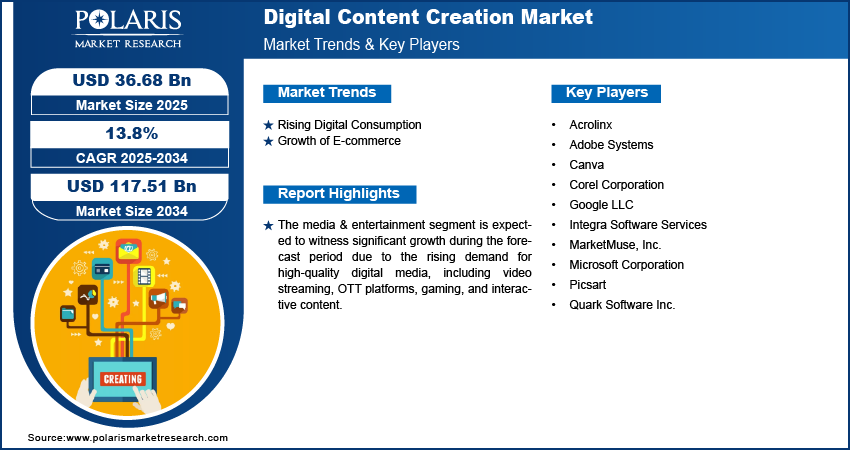
Get Full Segment-Level Forecasts & Insights: Download Sample Report
Segment Insights
Market Assessment by Component Outlook
The global digital content creation market segmentation, based on component, includes tools and services. In 2024, the tools segment accounted for a larger market share due to the increasing adoption of advanced software solutions for content generation, editing, and management. The rising demand for AI-powered design, video editing, and automation tools has significantly contributed to market growth, enabling faster and more efficient content production. Businesses and creators are investing in high-end tools for graphics, animation, and interactive media to enhance audience engagement, further driving market expansion. Additionally, the shift toward cloud-based and subscription-based content creation platforms has increased accessibility, solidifying the dominance of the tools segment.
Market Evaluation by End User Outlook
The global digital content creation market segmentation, based on end user, includes retail & e-commerce, automotive, healthcare & pharmaceutical, media & entertainment, travel & tourism, and others. The media & entertainment segment is expected to witness significant growth during the forecast period due to the rising demand for high-quality digital media, including video streaming, OTT platforms, gaming, and interactive content. The surging online video consumption, fueled by the rising use of platforms such as YouTube, Netflix, and TikTok, propels the need for advanced content creation tools. Additionally, the adoption of AI-driven video editing, animation, and VFX technologies allows content producers to deliver immersive experiences. The rise of virtual production and augmented reality (AR) further enhances market expansion, driving innovation in the industry.
Source: Polaris Market Research Analysis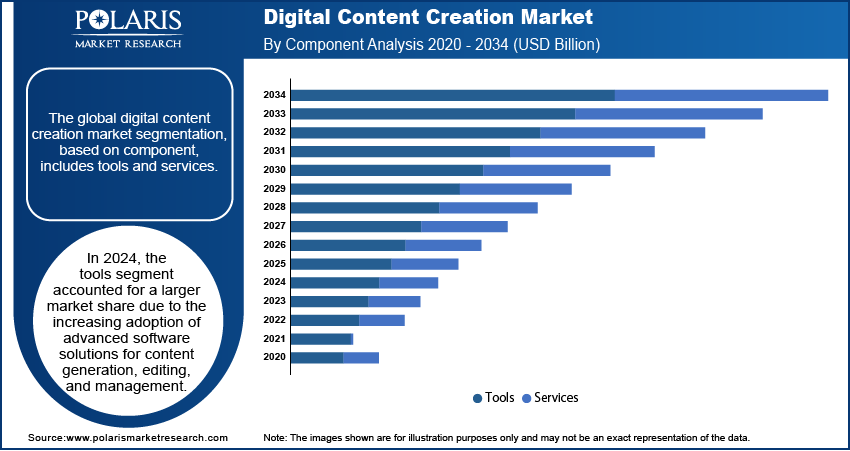
Need Granular Data Across All Market Segments? Request Customization
Regional Analysis
By region, the study provides digital content creation market insights into North America, Europe, Asia Pacific, Latin America, and the Middle East & Africa. In 2024, North America accounted for the largest share due to the strong presence of leading technology companies, advanced digital infrastructure, and high demand for premium digital content. The region's dominance is fueled by the rapid adoption of AI-powered content creation tools, growing investments in streaming platforms, and the increasing use of digital marketing strategies by businesses. IBM is transforming content creation and digital marketing by utilizing Adobe Firefly's generative AI. This approach enhances marketing strategies and streamlines the creative process through advanced AI algorithms for dynamic content generation. Additionally, the rise of influencer marketing, social media engagement, and immersive content such as AR/VR contributed to market growth. The presence of major entertainment, media, and e-commerce players further expands the North America digital content creation market expansion.
The Asia Pacific digital content creation market is expected to witness significant growth during the forecast period due to the rapid expansion of internet connectivity, increasing smartphone penetration, and the rising demand for digital entertainment. For instance, according to the Global System for Mobile Communications, mobile penetration in Asia Pacific is expected to reach 70% by 2030, Northeast Asia and Oceania will have the highest rates at 82% and 79%, respectively. The surge in social media usage, short-form video platforms, and streaming services has significantly contributed to market growth, driving the need for high-quality digital content. Additionally, the growing adoption of AI-driven content creation tools, cloud-based solutions, and localization strategies for diverse audiences is boosting the Asia Pacific digital content creation market development. The growing e-commerce sector and digital marketing investments are also fueling market expansion in the region.
Source: Polaris Market Research Analysis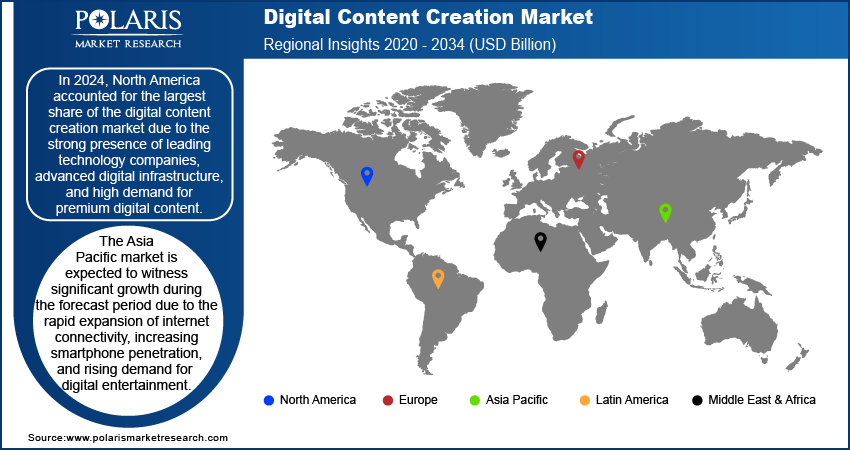
Curious About Regional Market Performance? Request Customization
Key Players & Competitive Analysis Report
The competitive landscape of the digital content creation market is characterized by the presence of key players focusing on innovation, AI-driven solutions, and cloud-based content creation tools to gain a competitive edge. Major companies are investing in advanced technologies such as generative AI, automation, and real-time collaboration to enhance content production efficiency. The market is highly dynamic, with continuous developments in video editing, graphic design, animation, and interactive media. Strategic partnerships, acquisitions, and product launches are common growth strategies adopted by industry leaders to expand their market share. Additionally, rising demand for personalized content and digital marketing solutions has intensified market competition, driving the need for scalable and cost-effective content creation platforms. Businesses prioritize engaging and data-driven content strategies, which are creating new growth opportunities for established companies and emerging startups.
Microsoft Corporation is engaged in the development and marketing of software, services, and hardware, specializing in personal computing and cloud solutions. The company was founded in 1975 by Bill Gates and Paul Allen and is headquartered in Washington, USA. Microsoft’s product portfolio includes operating systems such as Windows, productivity applications such as Microsoft Office and Microsoft 365, server applications, and a range of hardware products, including the Surface line of PCs and Xbox gaming consoles. The services provided by Microsoft encompass cloud-based solutions through Azure, consulting services, and support for its software products. The company operates globally with a presence in over 100 countries, providing to individual consumers, businesses, and government entities. Microsoft generates revenue through software licensing, hardware sales, and subscription services. Moreover, in the context of the digital content creation market, Microsoft plays a significant role by offering tools that enhance productivity and creativity. Products such as Microsoft Office Suite, which includes Word, PowerPoint, and Excel, are widely used for content creation across various sectors.
Picsart, Inc. is engaged in the development of a creative platform that empowers users to express themselves through innovative photo and video editing tools. The company was founded in 2011 by Hovhannes Avoyan and a team of Armenian programmers and is headquartered in Miami, Florida, with an additional presence in Yerevan, Armenia. Its product portfolio includes a suite of applications such as the Picsart Photo & Video Editor, Picsart Animator, and Picsart Color, which provide users with extensive editing capabilities and creative features. The services offered by Picsart encompass a freemium model that allows users access to basic features for free while providing premium options through subscription plans such as Picsart Gold. This model supports a diverse user base ranging from casual creators to professional artists. Furthermore, in the digital content creation market, Picsart plays a crucial role by offering tools that facilitate creativity and collaboration among users. The platform enables individuals to create visually appealing content and adopts a community where users share their work, gain inspiration, and engage in creative dialogue. Picsart’s features such as AI-driven enhancements and customizable templates continue to innovate and expand its offerings, fulfilling the evolving needs of digital creators worldwide.
List of Key Companies
- Acrolinx
- Adobe Systems
- Canva
- Corel Corporation
- Google LLC
- Integra Software Services
- MarketMuse, Inc.
- Microsoft Corporation
- Picsart
- Quark Software Inc.
Digital Content Creation Industry Developments
In March 2025, Adobe launched an advanced generative video engine to accelerate enterprise video production with AI-driven editing and automation.
In January 2025, Starbox launched StarboxAI-IntelliContentCreate, a sophisticated AI-driven platform designed for content generation. This innovative tool aims to enhance the advertising capabilities of 180 Degrees Brandcom, streamlining content production processes and offering advanced solutions to meet the evolving demands of the advertising sector.
In April 2024, Microsoft and Axel Springer expanded their partnership across AI, advertising, content, and Azure services.
In October 2022, Walmart launched a platform for content creators to enhance collaboration and engagement. This initiative allows direct partnerships with creators and offers tools for creating, promoting, and distributing content, empowering them to leverage Walmart's extensive reach and resources.
Digital Content Creation Market Segmentation
By Component Outlook (Revenue USD Billion 2020–2034)
- Tools
- Services
By Content Format Outlook (Revenue USD Billion 2020–2034)
- Textual
- Graphical
- Video
- Audio
By Deployment Outlook (Revenue USD Billion 2020–2034)
- On-Premise
- Cloud
By Enterprise Size Outlook (Revenue USD Billion 2020–2034)
- Large Size Enterprises
- Small and Medium Sized Enterprises
By End User Outlook (Revenue USD Billion 2020–2034)
- Retail & E-commerce
- Automotive
- Healthcare & Pharmaceutical
- Media & Entertainment
- Travel & Tourism
- Others
By Regional Outlook (Revenue USD Billion 2020–2034)
- North America
- US
- Canada
- Europe
- Germany
- France
- UK
- Italy
- Spain
- Netherlands
- Russia
- Rest of Europe
- Asia Pacific
- China
- Japan
- India
- Malaysia
- South Korea
- Indonesia
- Australia
- Vietnam
- Rest of Asia Pacific
- Middle East & Africa
- Saudi Arabia
- UAE
- Israel
- South Africa
- Rest of Middle East & Africa
- Latin America
- Mexico
- Brazil
- Argentina
- Rest of Latin America
Digital Content Creation Market Report Scope
| Report Attributes | Details |
| Market Size Value in 2024 | USD 32.26 billion |
| Market Size Value in 2025 | USD 36.68 billion |
| Revenue Forecast by 2034 | USD 117.51 billion |
| CAGR | 13.8% from 2025 to 2034 |
| Base Year | 2024 |
| Historical Data | 2020–2023 |
| Forecast Period | 2025–2034 |
| Quantitative Units | Revenue in USD Billion, and CAGR from 2025 to 2034 |
| Report Coverage | Revenue Forecast, Market Competitive Landscape, Growth Factors, and Trends |
| Segments Covered |
|
| Regional Scope |
|
| Competitive Landscape |
|
| Report Format |
|
| Customization | Report customization as per your requirements with respect to countries, regions, and segmentation. |
Source: Polaris Market Research Analysis
digital content creation market FAQ's
The global digital content creation market size was valued at USD 32.26 billion in 2024 and is projected to grow to USD 117.51 billion by 2034.
The global market is projected to register a CAGR of 13.8% during the forecast period.
In 2024, North America accounted for the largest share due to the strong presence of leading technology companies, advanced digital infrastructure, and high demand for premium digital content.
A few of the key players in the market are Microsoft Corporation; Picsart; Adobe Systems; Corel Corporation; Acrolinx; Google LLC; Integra Software Services; MarketMuse, Inc.; Quark Software Inc.; and Canva.
In 2024, the tools segment accounted for a larger market share due to the increasing adoption of advanced software solutions for content generation, editing, and management
The media & entertainment segment is expected to witness significant growth during the forecast period due to the rising demand for high-quality digital media, including video streaming, OTT platforms, gaming, and interactive content.
Download Sample Report of digital content creation market
Please fill out the form to request a customized copy of the research report.


