
Digital Oilfield Market Growth Drivers & Opportunities, 2024-2032
REPORT DETAILS
Market Statistics
Digital Oilfield Market size was valued at USD 29.13 billion in 2023. The market is anticipated to grow from USD 30.91 billion in 2024 to USD 50.14 billion by 2032, exhibiting a CAGR of 6.2% during the forecast period.
Key factors responsible for the market growth include the rising need for collaboration between processes involved in oilfields, such as reservoir and workforce management, the emergence of IoT, AI, digital twins, and cloud technology, and the need to reduce human-borne errors. The need to maximize production efficiency and minimize operating costs, along with the growing worldwide need for eneroilfieldfavoring the digital oilfield market.
Businesses are using digital solutions more often to increase safety throughout their operations, minimize downtime, and maximize performance. Due to regulatory pressures, environmental concerns, and the drive towards sustainability, oil and gas businesses are also investing in digital technology to reduce their environmental impact and increase operational sustainability.
Source: Polaris Market Research Analysis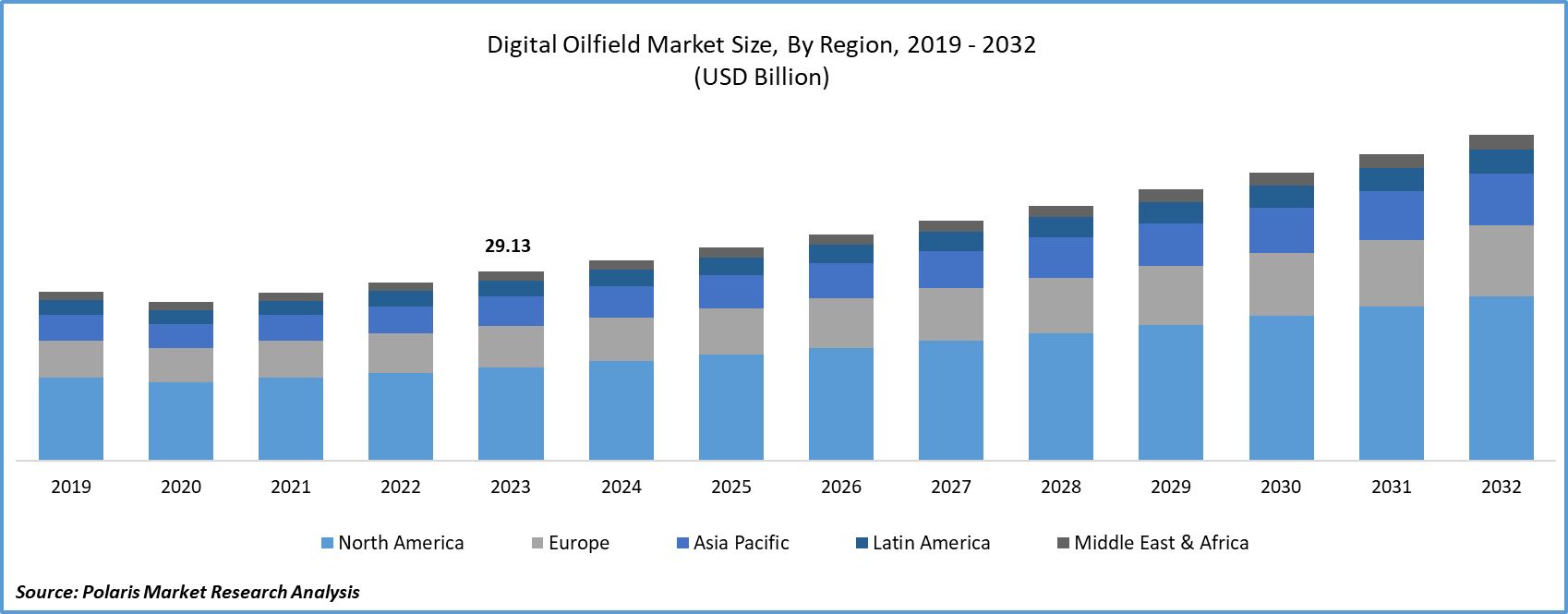
To Understand More About this Research: Download Sample Report
Due to the increased use of digitally connected infrastructure and increased geopolitical tensions, the oil and gas sector is increasing its spending on cybersecurity. A majority (62%) of oil and gas professionals surveyed said that their organizations increased cybersecurity spending in 2023 compared to the previous year.
Growth Factors
Increasing Demand for Maximizing Production from Mature Oil Fields Surge the Market Demand
Digital oilfield solutions are becoming increasingly in demand as the requirement to extract as much oil as possible from older oil fields grows. Businesses seek to extract as much oil as they can from these established fields, and digital technology makes this process go more smoothly.
Businesses can plan and manage interventions considerably more quickly and effectively with digital oilfields, allowing them to extract more oil for less money and effort. The market for digital oilfield solutions is growing because of this enhanced efficiency. Businesses are using digital technologies to improve efficiency and profitability as they look to extract as much as possible from old oil fields.
Enhanced Data Analytics Capabilities Surge the Digital Oilfield Market Demand
Enhanced data analytics capabilities have driven the surge in demand for digital oilfield solutions. Oil and gas companies can use advanced analytical tools to gain useful insight from vast amounts of data generated by various sources in the oil field, such as sensors, equipment, or production processes. These insights will allow operators to improve the efficiency of production, detect potential equipment failure before it occurs, and make data-driven decisions with a view to maximizing reservoir capacity. The integration of data analysis technologies into the digital oilfields market is projected to drive significant growth.
Restraining Factors
Limited Accessibility to Remote Oilfield Locations Impedes Market Growth
The need for digital oilfield technologies is significantly hampered by the difficulty of accessing remote oilfield areas. Numerous oil and gas activities are in difficult or isolated locations, like distant land-based fields or offshore rigs. It is challenging to successfully install and sustain digital solutions in these locations due to the absence of dependable internet connectivity and infrastructure. The real-time monitoring and control capabilities of digital oilfield technologies need to be improved by consistent data transfer and communication with remote assets.
Source: Polaris Market Research Analysis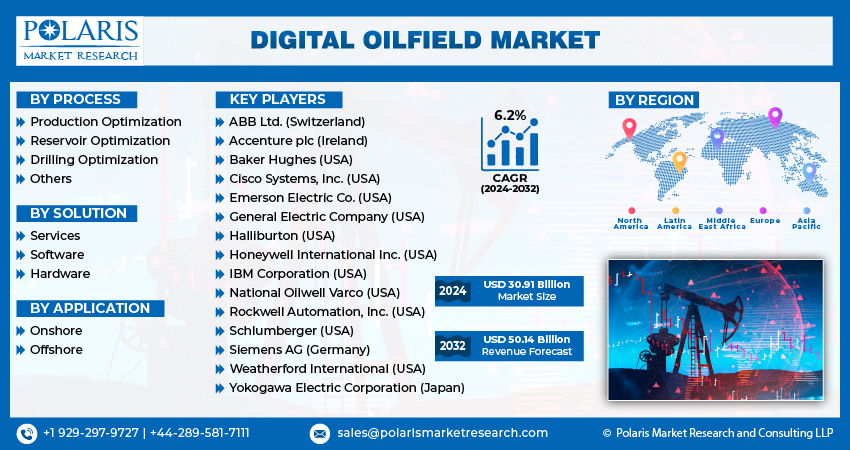
Get Full Segment-Level Forecasts & Insights: Download Sample Report
Report Segmentation
The market is primarily segmented based on substrate, solution, application, and region.
| By Process | By Solution | By Application | By Region |
|
|
|
|
Source: Polaris Market Research Analysis
To Understand the Scope of this Report: Request Customization
By Process Insights
Drilling Optimization Segment Is Expected to Witness the Highest Growth During the Forecast Period
The drilling optimization segment will grow rapidly over the forecast period, mainly driven by its crucial role in improving operational efficiency and cutting costs in oil and gas exploration and production; the drilling optimization segment occupies a significant position in the digital oilfield market. Drilling operations can be optimized and better decisions made because of digital technologies' ability to monitor and analyze drilling processes in real-time.
The production optimization segment led the industry market with substantial revenue share, largely attributable to its ability to optimize output and enhance efficiency in oil and gas operations. Production optimization methods allow businesses to optimize resource allocation, limit downtime, and discover and address operational inefficiencies by utilizing real-time data analytics, monitoring, and control systems. This segment's notable market share in the digital oilfield market is a result of its emphasis on increasing production performance, which is in line with industry objectives of optimizing yields while minimizing costs.
By Solution Insights
Software Segment Accounted for the Largest Market Share in 2023
The software segment accounted for the largest market in 2023. Segment’s growth is primarily due to its ability to offer complete solutions for data analysis, visualization, and management accounts for a large portion of its market share in the digital oilfield industry. Oil and gas firms may monitor assets in real time, integrate many data sources, and enhance operational procedures with the help of digital oilfield software.
The services segment is expected to grow rapidly. This is due to its end-to-end solutions for digital transformation projects, which include advice, implementation, maintenance, and support. Businesses frequently need more internal knowledge and resources to implement and oversee sophisticated digital technology, which fuels the need for specialist services.
Source: Polaris Market Research Analysis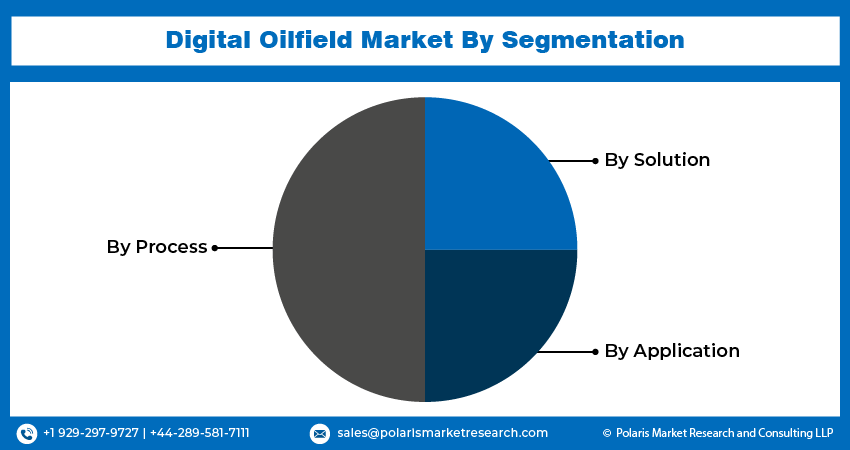
Need Granular Data Across All Market Segments? Request Customization
Regional Insights
Asia Pacific Region Dominated the Global Market in 2023
The Asia Pacific region dominated the global market in 2023. The region's large oil and gas reserves require digital solutions to optimize production and extraction processes. In addition, energy demand is increasing due to rapid urbanization and industrialization in countries that need efficient oil and gas extraction. As a result of government measures to support technological breakthroughs and energy sector expenditure, the region is experiencing increased use of digital oilfield technology.
The North American region is expected to be the fastest-growing region, with a healthy CAGR during the projected period. Many oil and gas companies, a highly advanced technological infrastructure as well, and significant investments in digital innovation are located within the area. In addition, the growing focus of the region's businesses on optimizing production efficiency and reducing operating costs is driving the adoption of electronic solutions. Strict legislation and environmental concerns have further accelerated the region's growth.
Source: Polaris Market Research Analysis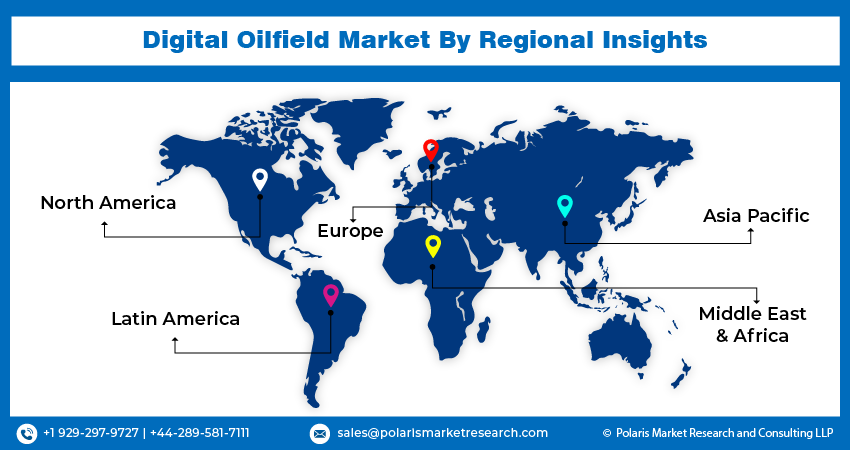
Curious About Regional Market Performance? Request Customization
Key Market Players & Competitive Insights
The digital oilfield market is fragmented and is anticipated to witness competition due to several players' presence. Major Companies are collaborating with technology providers to access cutting-edge digital solutions.
Some of the major players operating in the global market include
- ABB Ltd. (Switzerland)
- Accenture plc (Ireland)
- Baker Hughes (USA)
- Cisco Systems, Inc. (USA)
- Emerson Electric Co. (USA)
- General Electric Company (USA)
- Halliburton (USA)
- Honeywell International Inc. (USA)
- IBM Corporation (USA)
- National Oilwell Varco (USA)
- Rockwell Automation, Inc. (USA)
- Schlumberger (USA)
- Siemens AG (Germany)
- Weatherford International (USA)
- Yokogawa Electric Corporation (Japan)
Recent Developments in the Industry
- In June 2025 , Huawei accelerated AI-driven transformation in oil and gas, advancing digital oilfield initiatives. By integrating AI, 5G, cloud, and big data, it modernized upstream operations into intelligent systems. In collaboration with Changqing Oilfield, Huawei enabled unstaffed wellsites and real-time analytics to boost efficiency, safety, and decision-making.
- In January 2024 , SLB partnered with Geminus AI. Through this collaboration, Geminus AI will enable SLB to deploy the first physics-informed AI model builder for oil and gas operations. The model builder combines physics-based techniques with processed data to create highly accurate, scalable AI models.
- In September 2023 , Halliburton unveiled Intelevat, a data science-driven platform that supports the design, construction, and operation of customized electrical submersible pump (ESP) monitoring solutions for operators.
- In January 2022 , Petrofac, secured a 5-year contract from NEO Energy for well management & operator services.
- In December 2021, Weatherford International secured a 3-year digital oilfield contract from Kuwait Oil Company. This contract aims to support KOC's digital transformation strategy in the North Kuwait Heavy Oilfield by implementing Weatherford's Integrated Enterprise Excellence Platform.
Report Coverage
The Digital Oilfield market report emphasizes on key regions across the globe to provide better understanding of the product to the users. Also, the report provides market insights into recent developments, trends and analyzes the technologies that are gaining traction around the globe. Furthermore, the report covers in-depth qualitative analysis pertaining to various paradigm shifts associated with the transformation of these solutions.
The report provides detailed analysis of the market while focusing on various key aspects such as competitive analysis, process, solution, application, and their futuristic growth opportunities.
Digital Oilfield Market Report Scope
| Report Attributes | Details |
| Market size value in 2024 | USD 30.91 billion |
| Revenue Forecast in 2032 | USD 50.14 billion |
| CAGR | 6.2% from 2024 – 2032 |
| Base year | 2023 |
| Historical data | 2019 – 2022 |
| Forecast period | 2024 – 2032 |
| Quantitative units | Revenue in USD billion and CAGR from 2024 to 2032 |
| Segments covered |
|
| Regional scope |
|
| Competitive Landscape |
|
| Report Format |
|
| Customization | Report customization as per your requirements with respect to countries, region, and segmentation. |
Source: Polaris Market Research Analysis
Digital Oilfield Market FAQ's
The global digital oilfield market size is expected to reach USD 50.14 billion by 2032
Key players in the market are ABB Ltd., Accenture plc, Baker Hughes, Cisco Systems, Inc
Asia Pacific contribute notably towards the global Digital Oilfield Market
Digital Oilfield Market exhibiting a CAGR of 6.2% during the forecast period.
The Digital Oilfield Market report covering key segments are process, solution, application, and region.
Download Sample Report of Digital Oilfield Market
Please fill out the form to request a customized copy of the research report.


