
Education Technology SaaS Tools Market Share, Growth Analysis Report, 2025-2034
REPORT DETAILS
Market Statistics
Market Overview
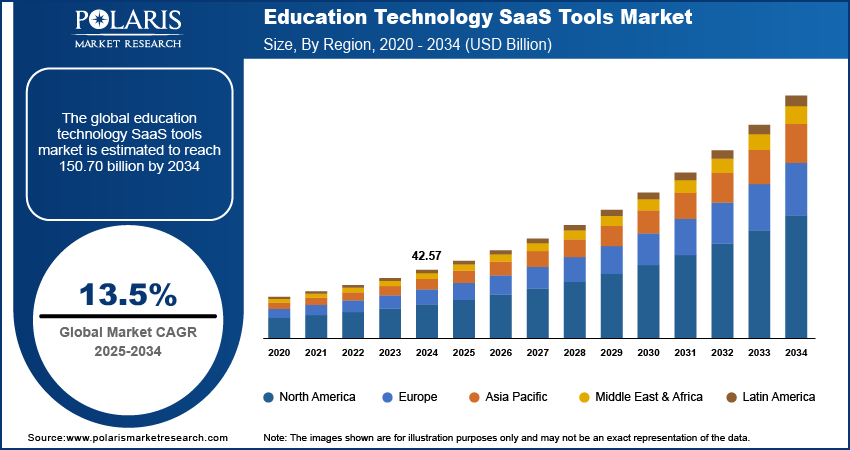
The education technology SaaS tools market size was valued at USD 42.57 billion in 2024, growing at a CAGR of 13.5% from 2025 to 2034. The growing preference for digital learning and the rise of microlearning and gamification are a few of the key factors driving market growth.
Key Insights
- The learning management systems segment accounted for the largest market share in 2024, owing to the rapid shift towards online education.
- The individual segment is projected to witness rapid growth, primarily driven by the growing popularity of lifelong learning.
- North America dominated the market in 2024 due to the region’s robust education sector and major investments in technology integration.
- Asia Pacific is anticipated to register a significant CAGR during the projection period. Increasing education investments and the rapidly expanding education sector in emerging economies drive the regional market growth.
Industry Dynamics
- The expanding internet connectivity globally, which allows more learners to access educational resources online, is fueling market growth.
- Rising government investments toward the digitization of education are driving the demand for education technology SaaS tools.
- The use of artificial intelligence for personalized learning and other educational tasks is creating several market opportunities.
- High Subscription costs and high reliance on the internet are present market challenges.
Market Statistics
2024 Market Size: USD 42.57 billion
Source: Polaris Market Research Analysis
2034 Projected Market Size: USD 150.70 billionSource: Polaris Market Research Analysis
CAGR (2025-2034): 13.5%Source: Polaris Market Research Analysis
North America: Largest Market in 2024AI Impact on Education Technology SaaS Tools Market
- AI-powered analytics track student performance in real time. This enables personalized learning paths that adapt to individual needs.
- Machine learning algorithms recommend content, exercises, and resources tailored to each learner. These algorithms help improve engagement and knowledge retention.
- AI-driven virtual tutors and chatbots provide instant assistance, answering queries and offering feedback 24/7.
- Natural language processing and predictive analytics help educators identify learning gaps, optimize course design, and enhance overall educational outcomes.
Source: Polaris Market Research Analysis
To Understand More About this Research: Download Sample Report
Education technology software as a service (EdTech SaaS) refers to cloud-based applications designed to enhance teaching and learning experiences. These tools provide educational institutions with flexible, scalable, and cost-effective solutions to meet the evolving needs of students and educators.
The growing preference for digital learning is driving the education technology SaaS tools market demand. Digital learning enhances flexibility by allowing students to access educational resources anytime and anywhere. SaaS tools provide platforms that facilitate this flexibility, making them increasingly appealing to institutions and learners.
The increasing popularity of certification and crash courses among working individuals is projected to fuel the market. SaaS models often provide more affordable access to high-quality educational resources compared to traditional courses, which makes certification programs more accessible to working individuals looking to invest in their professional development. SaaS tools connect learners with industry professionals and experts through webinars, mentorship programs, and networking opportunities, enriching the learning experience and providing valuable insights. This helps maintain motivation among busy professionals and encourages them to opt for SaaS tools for certification and upgrading their skills.
The education technology SaaS tools market growth is driven by the rise of microlearning and gamification. Microlearning and gamification are tools of the SaaS education model. They provide content in short, focused segments and introduce elements such as points, badges, and leaderboards to make learning more interactive and enjoyable, thereby attracting a large number of learners.
Market Dynamics
Expanding Internet Connectivity
Expanding internet connectivity worldwide is estimated to drive the global education technology SaaS tools market. According to a published report, 63% of the world's population was having internet connectivity in 2023. Improved internet access enables more learners, especially in remote or underserved areas, to access educational resources online, which ultimately boosts demand for ed-tech SaaS tools as they provide the necessary platforms for delivering content to these users.
Increasing Government Investment in Digitization of Education
The increasing government investment in the digitization of education is projected to fuel the education technology SaaS tools market. Governments across the globe are focusing on improving digital infrastructure, such as high-speed internet and access to devices. This creates a favorable environment for SaaS tools as more users gain the ability to access these platforms. Furthermore, increased funding for digital education initiatives allows government schools and institutions to allocate budgets specifically for SaaS tools, leading to higher adoption rates of these technologies.
For instance, the Government of India launched the National Digital Education Architecture (NDEAR) program under New Education Policy 2020 to create a unifying national digital infrastructure to energize and catalyze the education ecosystem.
Source: Polaris Market Research Analysis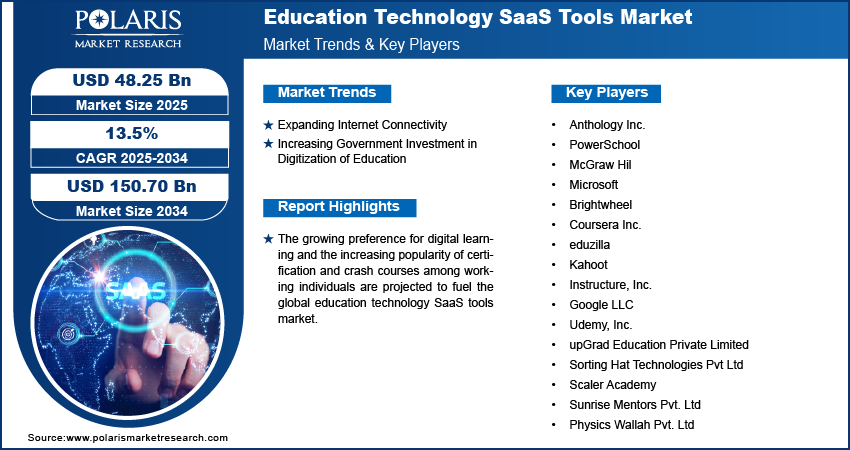
Get Full Segment-Level Forecasts & Insights: Download Sample Report
Segment Insights
Market Assessment By Software
Based on software, the global education technology SaaS tools market is categorized into classroom management systems, document management systems, learning and gamification, learning management systems, student collaboration systems, student information and administration systems, student response systems, and talent management systems. The learning management systems segment dominated the market in 2024 due to the rapid shift toward online education and the increasing integration of digital tools in traditional classrooms. Institutions find comprehensive solutions to streamline course delivery, track student progress, and facilitate remote learning, which LMS offers. Furthermore, LMS platforms increasingly incorporated features such as interactive content, mobile accessibility, and analytics tools, enhancing user engagement and providing valuable insights into learning outcomes. These advancements not only attracted more institutions to adopt LMS but also contributed as a critical component in the educational era.
The student collaboration systems segment is also projected to grow at a robust pace in the coming years owing to the rise of social learning theories, which emphasize peer interaction and teamwork. Additionally, advancements in technology, such as integration with artificial intelligence and virtual reality, enhance collaborative experiences, making learning more interactive and immersive. The demand for student collaboration systems continues to rise as educators prioritize engagement and collaboration in their teaching methodologies.
Market Assessment by End User
In terms of end users, the global education technology SaaS tools market is bifurcated into business and individual. The business segment accounted for a major market share in 2024 due to the increasing recognition of the importance of employee training and development. Organizations have increasingly turned to digital learning platforms to enhance workforce skills and ensure compliance with industry standards. The rise of remote work and the need for continuous professional development have accelerated the adoption of SaaS solutions that provide flexible, scalable training programs. Companies seek tools that offer comprehensive features such as performance tracking, personalized learning paths, and integration with existing HR systems, leading segment dominant position.
The individual segment is also estimated to grow at a rapid pace during the forecast period owing to the increasing popularity of lifelong learning and the desire for skills that align with career aspirations. Individuals now seek platforms that offer tailored learning paths, interactive content, and real-time feedback to enhance their educational experiences. The proliferation of online courses, boot camps, and micro-credentialing programs empowers learners to acquire specific skills quickly, meeting the demands of the job market. Furthermore, the rise of mobile technology allows individuals to engage with educational content on their terms, promoting a culture of self-directed learning, thereby propelling demand for ed-tech SaaS tools as these tools provide a platform for self-directed learning.
Source: Polaris Market Research Analysis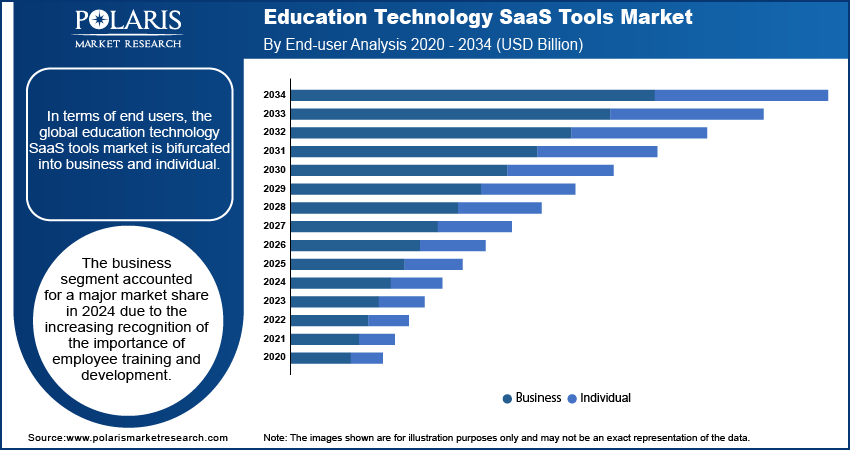
Need Granular Data Across All Market Segments? Request Customization
Regional Insights
By region, the study provides the education technology SaaS tools market insights into North America, Europe, Asia Pacific, Latin America, and the Middle East & Africa. North America held the largest education technology SaaS tools market share in 2024 due to the robust education sector and significant investment in technology integration. US schools, colleges, and universities increasingly adopted digital platforms to enhance learning experiences and improve administrative efficiency. The country’s strong emphasis on innovation and research in education technology, combined with a high level of internet penetration and access to advanced devices, contributed to the growth of this segment. Additionally, the increasing demand for personalized learning solutions, data analytics, and mobile accessibility propelled the adoption of various software tools, including SaaS tools, among educational institutions.
Source: Polaris Market Research Analysis
Curious About Regional Market Performance? Request Customization
The education technology SaaS tools market in Asia Pacific is expected to grow with a significant CAGR over the forecast period due to the rapid expansion of the education sector in countries such as India and China, the growing population, and increasing investment in education. Governments in the region are implementing initiatives to enhance digital literacy and promote the use of technology in classrooms. Additionally, the rise of online learning platforms and mobile education applications in the region propels demand for education technology SaaS tools. For instance, in July 2023, the Government of India launched a mobile education application, ULLAS, to promote universal access to basic literacy.
Key Market Players & Competitive Insights
Major market players are investing heavily in research and development in order to expand their offerings, which will help the education technology SaaS tools market grow even more. Market participants are also undertaking a variety of strategic activities to expand their global footprint, with important market developments including innovative launches, international collaborations, higher investments, and mergers and acquisitions between organizations. To expand and survive in a more competitive and rising market environment, the education technology SaaS tools industry must offer innovative solutions.
The education technology SaaS tools market is fragmented, with the presence of numerous global and regional market players. Major players in the education technology SaaS tools market include Anthology Inc., PowerSchool; McGraw Hil; Microsoft; Brightwheel; Coursera Inc.; eduzilla; Kahoot; Instructure, Inc.; Google LLC; Udemy, Inc.; upGrad Education Private Limited; Sorting Hat Technologies Pvt Ltd; Scaler Academy; Sunrise Mentors Pvt. Ltd.; and Physics Wallah Pvt. Ltd.
Coursera Inc., founded in 2012 by Stanford professors Andrew Ng and Daphne Koller, is a major online education platform that provides access to a wide range of courses, certifications, and degrees from top universities and companies around the world. The company has grown to offer over 7,000 courses from more than 300 partners as of 2023. In May 2022, Coursera announced new tools and features to support the learning, teaching, and program administration experiences.
Udemy Inc., established in 2010 by Eren Bali, Gagan Biyani, and Oktay Caglar, is a prominent online learning platform that allows instructors to create and sell courses on a wide range of topics. It has grown to offer over 250,000 courses taught by more than 75,000 instructors in 75 languages to over 73 million learners as of June 2024. In February 2024, Udemy announced a series of generative AI-enabled offerings designed to support personalized learning and enhanced skills development.
List of Key Companies
- Anthology Inc.
- PowerSchool
- McGraw Hil
- Microsoft
- Brightwheel
- Coursera Inc.
- eduzilla
- Kahoot
- Instructure, Inc.
- Google LLC
- Udemy, Inc.
- upGrad Education Private Limited
- Sorting Hat Technologies Pvt Ltd
- Scaler Academy
- Sunrise Mentors Pvt. Ltd
- Physics Wallah Pvt. Ltd
Education Technology SaaS Tools Industry Developments
In August 2024, the University of South Wales will upgrade its Student Information System to Ellucian SaaS to modernize operations, streamline administration, improve data integration, and enhance the student experience in line with its 2030 strategy.
June 2024: Coursera Inc., a global online learning platform, announced the launch of a new suite of Academic Integrity features to help universities verify learning in an age of AI-assisted cheating.
March 2024: Coursera Inc., a prominent online learning platform, introduced a course builder to help organizations quickly create and launch custom courses at scale.
July 2023: Anthology, a major provider of education solutions that support the entire learner lifecycle, announced a host of new features powered by Artificial Intelligence (AI) designed to help instructors create more engaging learning experiences more quickly and provide granular, easy-to-action insight on learners’ progress
December 2020: Sorting Hat Technologies Pvt Ltd, also known as Unacademy, launched the Educator App on iOS to expand its consumer base and revenue.
Education Technology SaaS Tools Market Segmentation
By Software Outlook
- Classroom Management System
- Document Management System
- Learning and Gamification
- Learning Management System
- Student Collaboration System
- Student Information and Administration System
- Student Response System
- Talent Management System
By End User Outlook
- Business
- Individual
By Sector Outlook
- Preschool
- K-12
- Higher Education
- Others
By Regional Outlook
- North America
- US
- Canada
- Europe
- Germany
- France
- UK
- Italy
- Spain
- Netherlands
- Russia
- Rest of Europe
- Asia Pacific
- China
- Japan
- India
- Malaysia
- South Korea
- Indonesia
- Australia
- Rest of Asia Pacific
- Middle East & Africa
- Saudi Arabia
- UAE
- Israel
- South Africa
- Rest of Middle East & Africa
- Latin America
- Mexico
- Brazil
- Argentina
- Rest of Latin America
Education Technology SaaS Tools Market Report Scope
| Report Attributes | Details |
| Market Size Value in 2024 | USD 42.57 billion |
| Market Size Value in 2025 | USD 48.25 billion |
| Revenue Forecast in 2034 | USD 150.70 billion |
| CAGR | 13.5% from 2025 to 2034 |
| Base Year | 2024 |
| Historical Data | 2020 – 2023 |
| Forecast Period | 2025 – 2034 |
| Quantitative Units | Revenue in USD Billion and CAGR from 2025 to 2034 |
| Report Coverage | Revenue Forecast, Market Competitive Landscape, Growth Factors, and Industry Trends |
| Segments Covered |
|
| Regional Scope |
|
| Competitive Landscape |
|
| Report Format |
|
| Customization | Report customization as per your requirements with respect to countries, regions, and segmentation. |
Source: Polaris Market Research Analysis
education technology saas tools market FAQ's
The global education technology SaaS tools market size was valued at USD 42.57 billion in 2024 and is projected to grow to USD 150.70 billion by 2034.
The global market is projected to grow at a CAGR of 13.5% during the forecast period, 2024-2032.
North America held the largest share of the global market.
The key players in the market are Anthology Inc.; PowerSchool; McGraw Hil; Microsoft; Brightwheel; Coursera Inc.; eduzilla; Kahoot; Instructure, Inc.; Google LLC; Udemy, Inc.; upGrad Education Private Limited; Sorting Hat Technologies Pvt Ltd; Scaler Academy; Sunrise Mentors Pvt. Ltd.; and Physics Wallah Pvt. Ltd.
The learning management system software segment is projected for significant growth in the global market.
The business segment dominated the education technology SaaS tools market in 2024.
Download Sample Report of education technology saas tools market
Please fill out the form to request a customized copy of the research report.


