
Embedded AI Market Size, Industry Demand, Global Analysis, 2024-2032
REPORT DETAILS
Market Statistics
Market Overview
The embedded AI market size was valued at USD 9.13 billion in 2023 and is projected to grow from USD 10.37 billion in 2024 to USD 29.26 billion by 2032, exhibiting a CAGR of 13.8 % during 2024–2032.
Embedded artificial intelligence (AI) refers to the integration of AI capabilities directly into connected devices and systems, enabling them to perform complex tasks autonomously without relying on constant internet connectivity. This technology is increasingly important in various fields, including the Internet of Things (IoT), robotics, and industrial applications.
The growing number of data centers worldwide drives the global embedded AI market. According to data published by the United States International Trade Commission, there were nearly 8,000 data centers globally in 2021. The massive amounts of data generated by multiple data centers create demand for sophisticated analytics. Embedded AI can process and analyze this data efficiently, providing valuable insights for businesses. This increases the adoption of embedded AI in data centers.
The rising adoption of connected IoT devices is projected to fuel the global embedded AI market growth during the forecast period. Many IoT applications require devices to operate autonomously, such as smart home systems or industrial sensors. Embedded AI empowers these devices to learn from their environments and make independent decisions without human intervention, which increases their demand for IoT devices.
Source: Polaris Market Research Analysis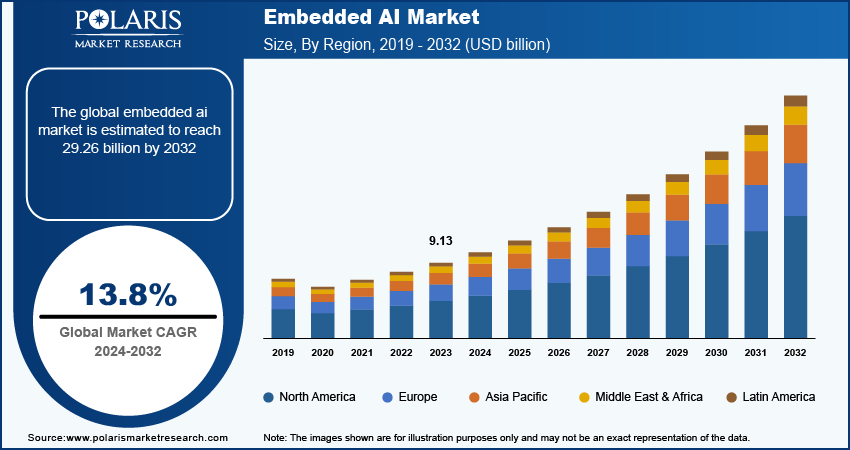
To Understand More About this Research: Download Sample Report
The embedded AI market is driven by the growing preference for intelligent and autonomous systems for personalized experience in various sector such as retial & e-commerce, healthcare & life sciences, and others. Personalized experiences rely on analyzing user data to understand behaviors and preferences. Embedded AI processes this data locally, enabling faster insights and improving the relevance of recommendations or actions.
Market Drivers Analysis
Growing Investments in R&D Activities
Increased R&D funding fosters innovation in AI algorithms and technologies. This leads to the development and introduction of sophisticated embedded AI solutions that are integrated into various devices and applications. For instance, in May 2023, Cognex Corporation, a player in industrial machine vision, introduced an embedded AI-based vision system with applications for OEMs in life sciences. Thus, rising investments in R&D activities drive the market embedded AI market growth.
Increasing Popularity of Autonomous Vehicles
The popularity of autonomous vehicles is increasing across the world. These vehicles rely heavily on embedded AI to process vast amounts of data from sensors and cameras in real time. This capability is essential for navigation and improving vehicle safety by enabling advanced driver-assistance systems such as lane-keeping assistance, adaptive cruise control, and collision avoidance. Hence, as the adoption of autonomous vehicles increases, the demand for embedded AI also spurs.
Source: Polaris Market Research Analysis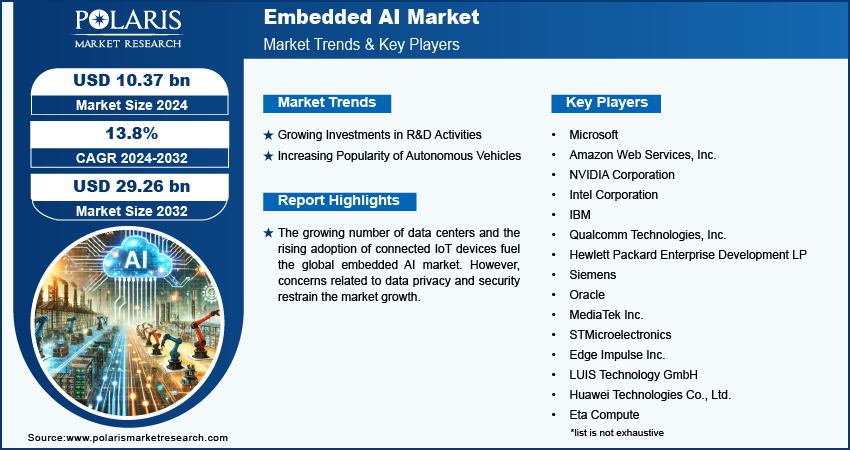
Get Full Segment-Level Forecasts & Insights: Download Sample Report
Market Segment Insights
Embedded AI Market Breakdown By Offering
In terms of offering, the global embedded AI market is segmented into hardware, software, and services. The hardware segment accounted for a major share of the market in 2023 due to the advancements in processing power and energy efficiency. Manufacturers are focusing on developing specialized hardware, such as AI accelerators and edge computing devices, as more devices incorporate AI capabilities to support complex computations directly on-site. This shift enhances performance while reducing latency, making systems more responsive. Additionally, the demand for compact and efficient chips is propelling the segment's growth.
The software segment is estimated to grow at a robust pace in the coming years, owing to the increasing demand for advanced algorithms and machine learning capabilities. Companies are investing heavily in software solutions that enable devices to process data locally, enhancing functionality and efficiency. This trend is particularly evident in sectors such as automotive and healthcare, where software-driven insights enhance safety features and patient monitoring systems. Furthermore, the growing emphasis on data privacy and security has prompted organizations to seek robust software solutions that operate independently of cloud-based systems, further propelling the segment growth.
Embedded AI Market Breakdown By Industry Verticals
Based on industry verticals, the global embedded AI market is segmented into BFSI, energy & utilities, government & defense, healthcare & life sciences, IT/ITeS, automotive, retail & eCommerce, telecommunications, and others. The automotive segment held the largest market share in 2023 due to the rapid advancements in autonomous driving technology and smart vehicle features. Manufacturers increasingly integrate intelligent systems to enhance vehicle safety, improve navigation, and provide advanced driver-assistance systems (ADAS). Consumers demand vehicles that offer a seamless blend of connectivity, convenience, and security, prompting automakers to adopt innovative technologies such as embedded AI that analyze data from various sensors in real time.
The healthcare & life sciences segment is expected to register a significant CAGR during the forecast period owing to the increasing need for personalized patient care and efficient healthcare delivery. The rise of telemedicine and remote monitoring solutions further fuels this demand as professionals seek to enhance patient engagement and ensure timely interventions. Additionally, the ongoing need for operational efficiency in healthcare facilities encourages the adoption of smart systems such as embedded AI that streamline processes and reduce costs.
Source: Polaris Market Research Analysis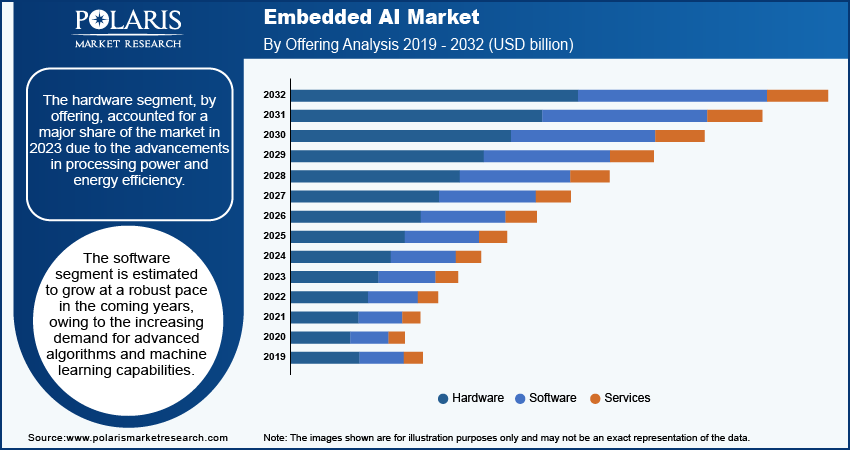
Need Granular Data Across All Market Segments? Request Customization
Market By Regional Outlook
By region, the study provides embedded AI market insights into North America, Europe, Asia Pacific, Latin America, and the Middle East & Africa. North America accounted for a major market share in 2023, with the US being the leading country. The regional market growth is attributed to its robust technology ecosystem, significant investments in research and development, a strong presence of key players, and a high demand for intelligent solutions across various industries. The US market benefits from advanced infrastructure, allowing companies to rapidly deploy innovative applications in sectors such as automotive, healthcare, and finance. Furthermore, the growing emphasis on automation and data-driven decision-making among enterprises drives the adoption of intelligent technologies, making North America a critical hub for advancements in embedded AI.
Source: Polaris Market Research Analysis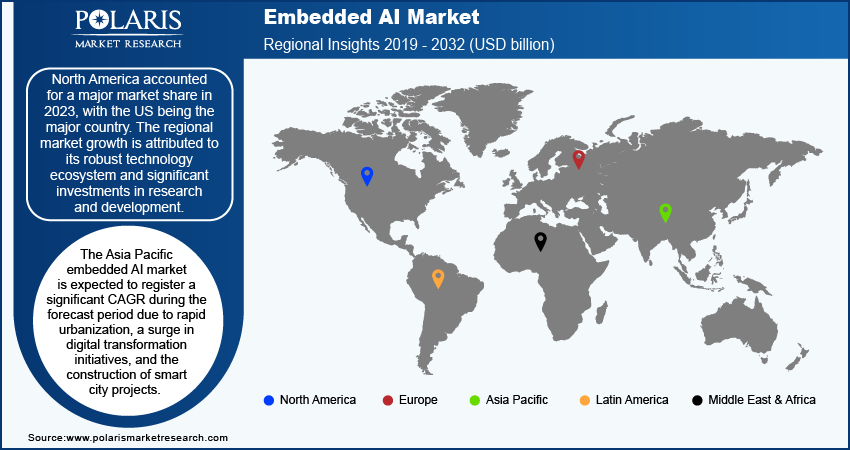
Curious About Regional Market Performance? Request Customization
The Asia Pacific embedded AI market is expected to register a significant CAGR during the forecast period due to rapid urbanization, a surge in digital transformation initiatives, and the construction of smart cities. The government's support for technological innovation and a growing middle-class population in India contribute to the rising need for personalized services in healthcare and e-commerce. Further, embedded AI is integrated into vehicles to provide advanced systems such as ADAS. As per a published report by the China Association of Automobile Manufacturers, China produced 23.836 million cars in 2022. Thus, the growing production of advanced automobiles propels the market growth in the region.
Key Players and Competitive Insights
Prominent market players are investing heavily in research and development to expand their offerings, which will drive the embedded AI market growth during the forecast period. Market participants are also undertaking a variety of strategic activities, including innovative launches, international collaborations, higher investments, and mergers and acquisitions between organizations, to expand their global footprint. To expand and survive in a more competitive and rising market environment, the embedded AI industry must offer innovative solutions.
The embedded AI market is fragmented, with the presence of numerous global and regional market players. A few major players in the market are Microsoft; Amazon Web Services, Inc.; NVIDIA Corporation; Intel Corporation; IBM; Qualcomm Technologies, Inc.; Hewlett Packard Enterprise Development LP; Siemens; Oracle; MediaTek Inc.; STMicroelectronics; Edge Impulse Inc.; LUIS Technology GmbH; Huawei Technologies Co., Ltd.; Eta Compute; SensiML Corporation; SiMa Technologies, Inc.; Salesforce; Safran Electronics & Defense; MIPS; Cognex Corporation; and Graphcore.
Amazon Web Services, Inc., established in 2006, is a global cloud computing platform and a subsidiary of Amazon.com, Inc. The company offers a vast range of on-demand cloud services, including databases, networking, analytics, computing power, storage options, and machine learning. AWS has integrated artificial intelligence (AI) across its services to enhance functionality and user experience. This includes a variety of pre-trained AI services that are easily incorporated into applications for various purposes. In July 2024, Amazon Web Services, Inc. announced an expanded partnership with Workday, Inc. to help organizations drive productivity, improve decision-making, and develop generative AI solutions.
IBM is an American multinational technology company headquartered in Armonk, New York. IBM has embedded AI across its products and services to enhance functionality and improve user experiences. In July 2024, IBM launched a GenAI innovation center in Kochi. The center aims to accelerate AI innovation, boost productivity, and strengthen GenAI expertise in India.
Key Companies in Embedded AI Market
- Microsoft
- Amazon Web Services, Inc.
- NVIDIA Corporation
- Intel Corporation
- IBM
- Qualcomm Technologies, Inc.
- Hewlett Packard Enterprise Development LP
- Siemens
- Oracle
- MediaTek Inc.
- STMicroelectronics
- Edge Impulse Inc.
- LUIS Technology GmbH
- Huawei Technologies Co., Ltd.
- Eta Compute
- SensiML Corporation
- SiMa Technologies, Inc.
- Salesforce
- Safran Electronics & Defense
- MIPS
- Cognex Corporation
- Graphcore.
Industry Developments
June 2025: China began mass production of its first industrial-scale non-binary artificial intelligence chip, developed by Beihang University, marking a significant advancement in alternative AI computing architectures.
Source: Polaris Market Research Analysis
Source: Polaris Market Research Analysis
May 2025: Innatera announced the launch of *Pulsar*, the world’s first mass-market neuromorphic microcontroller designed for sensor-edge applications, enabling ultra-low-power, real-time AI processing at the edge.Source: Polaris Market Research Analysis
Source: Polaris Market Research Analysis
March 2025: Qualcomm finalized its acquisition of Edge Impulse, strengthening its embedded AI software ecosystem and expanding its capabilities in edge AI development and deployment.Source: Polaris Market Research Analysis
February 2025: NXP Semiconductors acquired Kinara for USD 307 million, a strategic move to enhance its automotive AI and neural processing portfolio.Source: Polaris Market Research Analysis
Source: Polaris Market Research Analysis
January 2025: Groq entered into a partnership with GlobalFoundries to scale up manufacturing of its Language Processing Units (LPUs), supporting broader adoption of high-performance AI inference hardware.Source: Polaris Market Research Analysis
Source: Polaris Market Research Analysis
December 2024: Syntiant completed the USD 150 million acquisition of Knowles’ Consumer MEMS Microphones business, expanding its edge AI and sensor technology footprint.September 2024: Salesforce, a cloud-based customer relationship management (CRM) software company, launched pre-built AI tools for the healthcare sector.
June 2024: Safran Electronics & Defense, an international company that designs and supplies high-tech solutions for the aerospace, defense, and space industries, announced the launch of ACE-embedded AI solutions for forces in the field. The AEC is designed to deliver enhanced situational awareness, decision support, and reduced cognitive load of military forces.
May 2024: MIPS, a developer of efficient and configurable IP compute cores, announced to showcase new embedded and edge AI Innovations at Computex 2024.
Market Segmentation
By Offering Outlook (Revenue – USD Billion, 2019–2032)
- Hardware
- Software
- Services
By Data Type Outlook (Revenue – USD Billion, 2019–2032)
- Sensor Data
- Image and Video Data
- Numeric Data
- Categorial Data
- Other
By Industry Verticals Outlook (Revenue – USD Billion, 2019–2032)
- BFSI
- Energy & Utilities
- Government & Defense
- Healthcare & Life Sciences
- IT/ITeS
- Automotive
- Retail & eCommerce
- Telecommunications
- Others
By Regional Outlook (Revenue – USD Billion, 2019–2032)
- North America
- US
- Canada
- Europe
- Germany
- France
- UK
- Italy
- Spain
- Netherlands
- Russia
- Rest of Europe
- Asia Pacific
- China
- Japan
- India
- Malaysia
- South Korea
- Indonesia
- Australia
- Rest of Asia Pacific
- Middle East & Africa
- Saudi Arabia
- UAE
- Israel
- South Africa
- Rest of Middle East & Africa
- Latin America
- Mexico
- Brazil
- Argentina
- Rest of Latin America
Embedded AI Report Scope
| Report Attributes | Details |
| Market Size Value in 2023 | USD 9.13 billion |
| Market Size Value in 2024 | USD 10.37 billion |
| Revenue Forecast by 2032 | USD 29.26 billion |
| CAGR | 13.8 % from 2024 to 2032 |
| Base Year | 2023 |
| Historical Data | 2019–2022 |
| Forecast Period | 2024–2032 |
| Quantitative Units | Revenue in USD billion and CAGR from 2024 to 2032 |
| Report Coverage | Revenue Forecast, Market Competitive Landscape, Growth Factors, and Trends |
| Segments Covered |
|
| Regional Scope |
|
| Competitive Landscape |
|
| Report Format |
|
| Customization | Report customization as per your requirements with respect to countries, regions, and segmentation. |
Source: Polaris Market Research Analysis
Embedded AI Market FAQ's
The global embedded AI market size was valued at USD 9.13 billion in 2023 and is projected to grow to USD 29.26 billion by 2032.
The global market is projected to register a CAGR of 13.8 % during the forecast period.
North America held the largest share of the global market in 2023.
A few key players in the market are Microsoft; Amazon Web Services, Inc.; NVIDIA Corporation; Intel Corporation; IBM; Qualcomm Technologies, Inc.; Hewlett Packard Enterprise Development LP; Siemens; Oracle; MediaTek Inc.; STMicroelectronics; Edge Impulse Inc.; LUIS Technology GmbH; Huawei Technologies Co., Ltd.; Eta Compute; SensiML Corporation; SiMa Technologies, Inc.; Salesforce; Safran Electronics & Defense; MIPS; Cognex Corporation; and Graphcore.
The software segment is projected for significant growth in the global market during the forecast period.
The automotive segment dominated the market in 2023.
Download Sample Report of Embedded AI Market
Please fill out the form to request a customized copy of the research report.


