
Engineered Stone Market Size, Share, Global Analysis Report, 2025-2034
REPORT DETAILS
Market Statistics
The global Engineered Stone Market was valued at USD 18.30 billion in 2024 and is projected to grow at a CAGR of 5.5% from 2025 to 2034. Rising demand for durable, aesthetic countertop materials in residential and commercial construction is supporting growth.
There is a global increase in construction activities across various sectors, including residential, commercial, and infrastructure projects. This surge in construction projects directly contributes to the demand for construction materials, such as quartz-based engineered stone. Popularity of quartz-based engineered stone is on the rise. This material offers several advantages, including durability and aesthetic appeal, making it a preferred choice for architects, designers, and homeowners. Its versatility and visual appeal make it suitable for a wide range of applications in construction and interior design.
Source: Polaris Market Research Analysis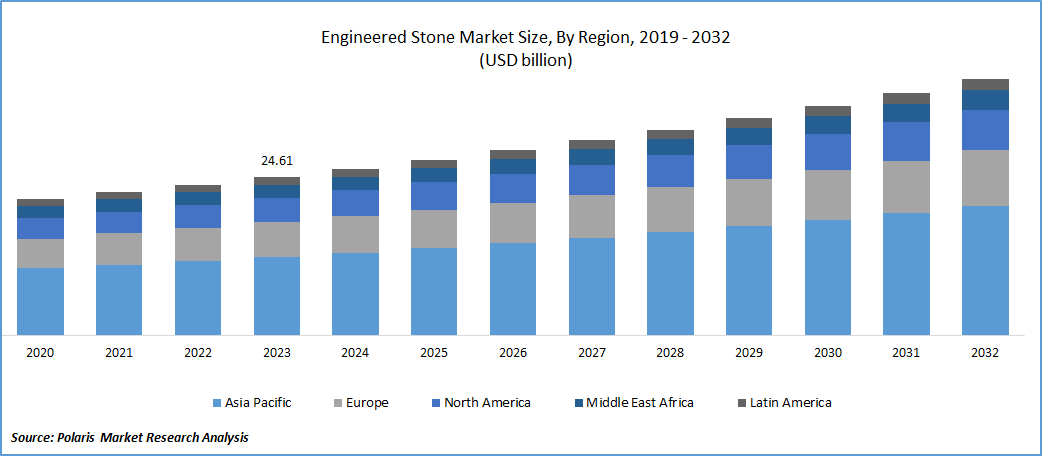
To Understand More About this Research, Download Sample Report
Engineered stone tiles are crafted by combining different aggregates with epoxy and other materials. These tiles come in a wide range of colors, shapes, and sizes, offering versatility in design. One of the notable features of these tiles is their customization potential, allowing them to be tailored according to specific application needs. In the future, with the rise of hybrid work setups, home design specifications are expected to change. There will be a greater need for adaptable homes that can serve as both offices and classrooms when necessary. This shift is likely to lead to a higher demand for engineered stones in interior design.
What makes engineered stone tiles environmentally friendly is their composition. Approximately 94% of their content comprises crushed waste stone that is typically left behind in quarries. By utilizing this leftover material, engineered stone tiles contribute to reducing quarry waste, making them a sustainable choice in construction and design. This eco-friendly approach aligns with the growing emphasis on environmentally conscious practices, making engineered stone tiles a popular option for environmentally aware consumers and businesses.
There is a growing demand for substitutes to natural stone that are both aesthetically pleasing and durable. Quartz-based engineered stone fits this requirement perfectly, offering the elegance of natural stone while being more resilient and easier to maintain. This demand for durable and visually appealing alternatives further boosts the market for quartz-based engineered stone.
Significant shift towards green construction practices and the use of eco-friendly materials. As sustainability becomes a central focus in construction projects, the utilization of environmentally friendly materials like quartz-based engineered stone aligns with these green initiatives. This increased adoption of green construction materials adds to the market growth, as environmentally conscious consumers and businesses seek sustainable options for their projects.
Breton has pioneered a patented process that is widely utilized in the production of engineered stone worldwide. The creation of visually appealing and aesthetically pleasing structures is a significant factor motivating the widespread use of engineered stone. This material has gained popularity in household applications, including vanities, kitchen countertops, walls, and flooring, owing to its sophisticated and elegant look.
Engineered stone is gaining traction in the market. One of its significant advantages is its relatively lower cost when compared to alternate natural stone products. This affordability makes it an attractive choice for various applications in both residential and commercial construction projects. In addition to its cost-effectiveness, engineered stone offers remarkable longevity in comparison to other natural stone alternatives. Its durability ensures that structures made from this material remain intact and visually appealing over an extended period, making it a practical and economical choice for consumers and businesses alike.
Product innovations, technological advancements, and the introduction of regulatory policies have been detailed in the report to enable businesses to make more informed decisions. Furthermore, the impact of the COVID-19 pandemic on the Engineered Stone Market demand has been examined in the study. The report is a must-read for anyone looking to develop effective strategies and stay ahead of the curve.
Source: Polaris Market Research Analysis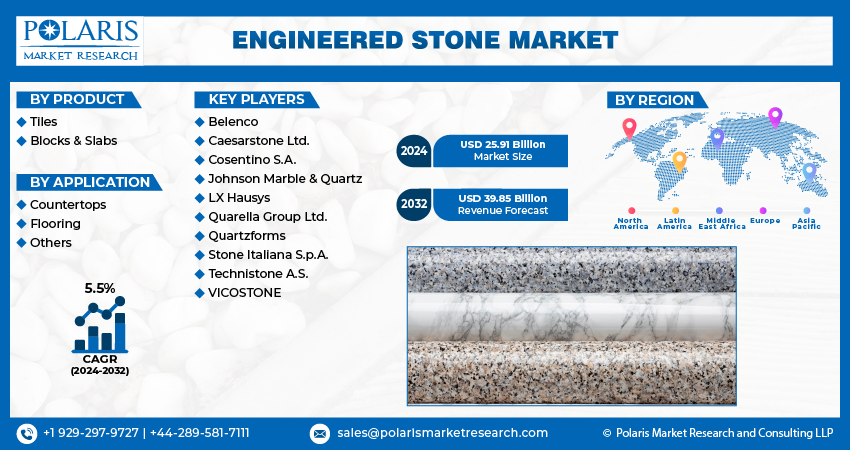
Get Full Segment-Level Forecasts & Insights: Download Sample Report
Growth Drivers
Growing residential and commercial construction sectors further fuels the demand for engineered stone globally
The rapid growth in the residential and commercial construction sectors further fuels the demand for engineered stone globally. As construction activities escalate, there is a continuous need for high-quality, durable, and aesthetically pleasing materials. Engineered stone fits these criteria, making it a preferred option for architects, designers, and builders in both residential and commercial projects.
Moreover, engineered stone possesses specific properties, such as non-porousness and durability, which make it particularly suitable for specialized environments like hospital food facilities and canteens. Its non-porous nature ensures that it is resistant to stains and easy to clean, making it ideal for spaces where hygiene is a top priority. Additionally, its durability allows it to withstand heavy use, making it a practical choice for commercial buildings where foot traffic and wear are common concerns.
Report Segmentation
The market is primarily segmented based on product, application, and region.
| By Product | By Application | By Region |
|
|
|
Source: Polaris Market Research Analysis
To Understand More About this Research, Request Customization
By Product Analysis
Blocks & slabs segment held the largest share
Blocks & slabs segment dominated the market. This dominance can be attributed to the material's easy installation and maintenance. Unlike natural stone, it is highly resistant to stains from common food substances like oil, wine, & juices, making it ideal for the kitchen applications. These stones can be manufactured in large sizes & its non-porous quality allows them to use in wet areas. Rising demand for stylish counter-tops to enhance the aesthetics of interior spaces is expected to drive the market further.
Tiles segment will grow at significant pace. This demand is attributed to the tiles' easy installation process and their long-term durability. Customers find them appealing due to the convenience in both setting them up and their ability to withstand wear and tear over an extended period, making them a popular choice in various construction and design projects.
By Application Analysis
Countertops segment accounted for the largest market share in 2024
Countertops segment accounted for the largest market share. This demand is primarily due to engineered stone slabs being more cost-effective than their natural counterparts while offering a wider range of choices in terms of shape, design, color, & texture. It contains polymeric resins which are not stable under the UV exposure, leading to discoloration and break-down of resin binder. Continuous exposure to UV rays causes the binding agents to be hardened, resulting in reduced flexural strength. Consequently, these stones are not suitable for the outdoor use due to the risk of deterioration caused by prolonged exposure to the sunlight.
Flooring segment will exhibit robust growth rate. These flooring is gaining popularity, particularly in areas like kitchens, bathrooms, and below-grade basements, owing to its water resistance and non-porous structure. It is also being preferred in regions with high foot traffic due to its excellent wear resistance.
Source: Polaris Market Research Analysis
Need Granular Data Across All Market Segments? Request Customization
Regional Insights
Asia Pacific region accounted for the largest share of global market in 2024
APAC region emerged as the largest region. This achievement can be attributed to the increasing use of the product in constructing and decorating both residential and non-residential interiors within rapidly expanding economies of the region.
North America will grow at the substantial pace. This growth is spurred by stricter mining regulations in the region and significant investments in revamping old building structures. In the United States, the market is anticipated to experience steady growth due to the nation's booming construction sector. The demand for energy-efficient construction solutions is also contributing to this growth.
Source: Polaris Market Research Analysis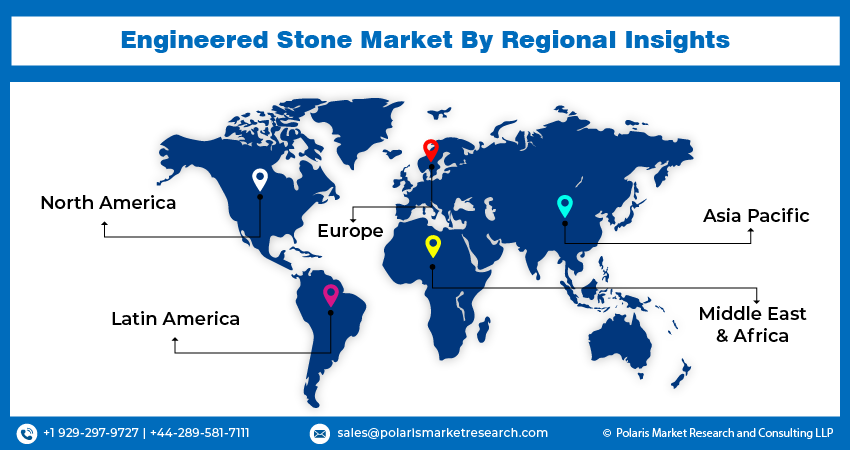
Curious About Regional Market Performance? Request Customization
Key Market Players & Competitive Insights
Prominent companies are actively employing diverse marketing tactics, including offering installation, post-installation, and customization services, as well as expanding their range of products.
Some of the major players operating in the global market include:
- Belenco
- Caesarstone Ltd.
- Cosentino S.A.
- Johnson Marble & Quartz
- LX Hausys
- Quarella Group Ltd.
- Quartzforms
- Stone Italiana S.p.A.
- Technistone A.S.
- VICOSTONE
Recent Developments
- In Febraury 2025, MAPEI launched its Manufactured Stone Veneer Systems (MSVS), offering advanced mortars, barriers, and accessories that ensure code compliance, durability, sustainability, and improved installation efficiency for residential and commercial projects.
- In March 2022, Hafele launched the Terra Quartz surfaces collection, specifically crafted for various home applications, renowned for its strength, flexibility, and adaptability. These surfaces are notably thick at 20 mm, primarily composed of Quartz, ensuring exceptional durability, and allowing for creative customization.
- In March 2022, The Engineered Stone Group completed the acquisition of MTI Baths and Aquatica. MTI Baths is renowned for producing high-quality engineered stone, acrylic, and hydrotherapy bathtubs, as well as solid surface products in the U.S.
Engineered Stone Market Report Scope
| Report Attributes | Details |
| Market size Value in 2025 | USD 19.5 billion |
| Revenue Forecast in 2034 | USD 31 billion |
| CAGR | 5.50% from 2025 – 2034 |
| Base Year | 2024 |
| Historical Data | 2020 – 2023 |
| Forecast Period | 2025 – 2034 |
| Quantitative Units | Revenue in USD million/billion and CAGR from 2025 to 2034 |
| Segments Covered | By Product, By Application, By Region |
| Regional Scope | North America, Europe, Asia Pacific, Latin America, Middle East & Africa |
| Customization | Report customization as per your requirements with respect to countries, region and segmentation. |
Source: Polaris Market Research Analysis
Quality Assured
We strive to offer our clients the finest in market research with the most reliable and accurate research findings. We use industry-standard methodologies to offer a comprehensive and authentic analysis of the Engineered Stone Market. Besides, we have stringent data-quality checks in place to enable data-driven decision-making for you.
Browse Our Top Selling Reports
Hydrogen Hubs Market Size, Share 2024 Research Report
Therapeutic Hypothermia Systems Market Size, Share 2024 Research Report
Digestive Health Supplements Market Size, Share 2024 Research Report
Europe Digestive Health Supplements Market Size, Share 2024 Research Report
Lidocaine Hydrochloride Market Size, Share 2024 Research Report
Engineered Stone Market FAQ's
The global engineered stone market size is expected to reach USD 31 billion by 2034
Belenco,Caesarstone Ltd.,Cosentino S.A. are the top market players in the market
Asia Pacific region contribute notably towards the global Engineered Stone Market.
expected to grow at a CAGR of 5.50% during the forecast period.
product, application, and region are the key segments in the Engineered Stone Market
Download Sample Report of Engineered Stone Market
Please fill out the form to request a customized copy of the research report.


