
Finasteride Market Size, Growth, Global Industry Report 2026-2034
REPORT DETAILS
Market Statistics
What is Finasteride Market Size?
Global finasteride market size was valued at USD 106.06 million in 2025 and is anticipated to exhibit a CAGR of 2.8% during the forecast period.
Market Statistics
- 2025 Market Size: USD 106.06 Million
- 2034 Projected Market Size: USD 135.98 Million
- CAGR (2026-2034): 2.8%
- Largest Market: North America
Market Overview
The rising demand for finasteride medication in the marketplace is highly influenced by the presence of a larger number of people suffering from hair loss. In the world, hair loss is becoming a significant factor causing psychological distress among males and females. Approximately two-thirds of men are expected to witness hair loss symptoms by the age of 35. The growing number of companies developing superior hair loss treatment medications, specifically for men, is anticipated to fuel significant demand potential for finasteride.
- For instance, in July 2023, Happy Head, a telemedicine provider, introduced a new hair loss medication formula using latanoprost, minoxidil, and finasteride, constituting 0.005%, 8.0%, and 0.3%, respectively.
Moreover, the uptick in the consumption of finasteride medication in the global space is showcasing a positive outlook. For instance, in November 2023, HanAll Biopharma announced that its monthly sales of 1 mg-based hair loss pills, finasteride, witnessed more than one million sales.
Source: Polaris Market Research Analysis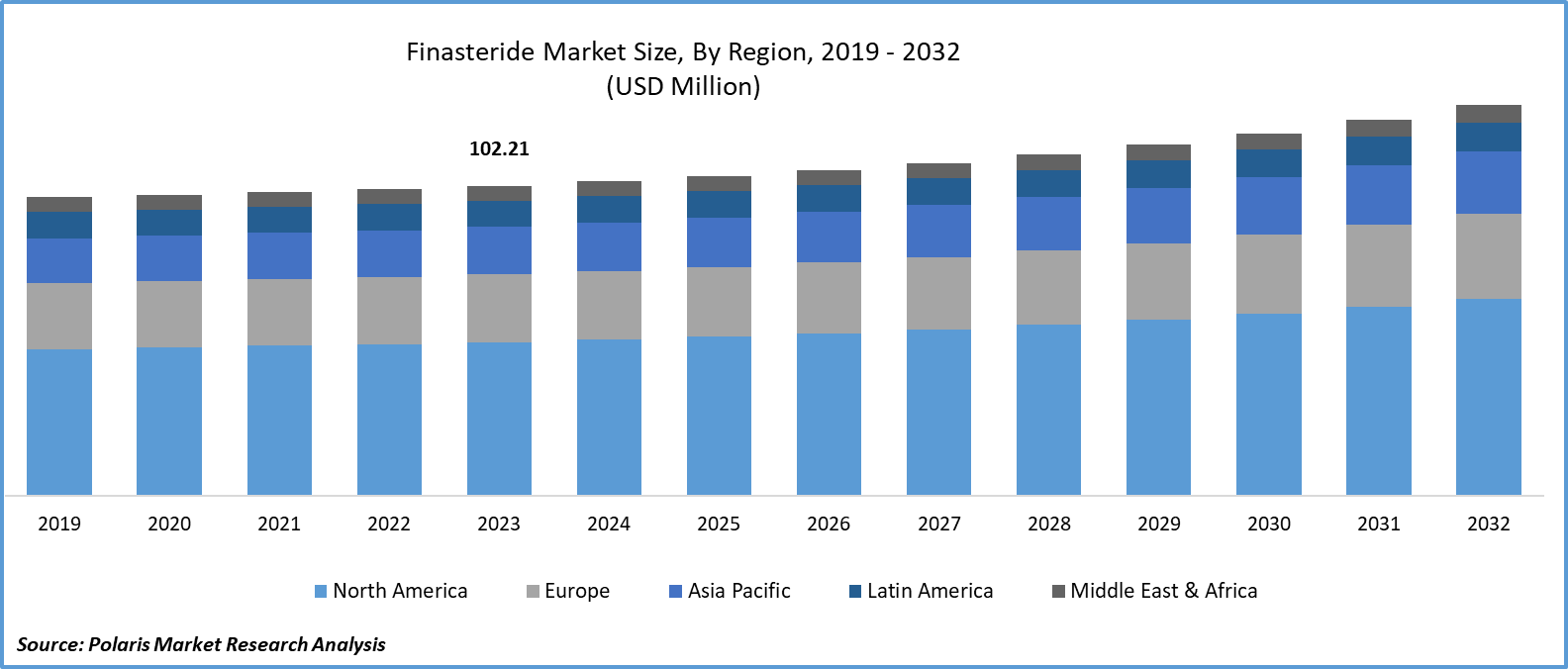
To Understand More About this Research: Download Sample Report
However, the existence of prominent substitutes and alternatives to finasteride in terms of hair loss and benign prostatic hyperplasia applications is expected to restrain market growth in the coming years.
The research report offers a quantitative and qualitative analysis of the finasteride market to enable effective decision-making. It covers the key trends and growth opportunities anticipated to have a favorable impact on the market. Besides, the study covers segment and regional revenue forecasts for market assessment.
Growth Drivers
Rising clinical trials are unraveling the true potential of finasteride, driving the market growth
The presence of several clinical trials demonstrating the effectiveness of finasteride medication in dealing with hair loss and benign prostatic hyperplasia is gaining adoption by healthcare providers. According to a clinical study, the patients in the finasteride group registered a 25% relative decrease in the overall risk of prostate cancer from 24–18%. These types of studies are expected to promote the adoption of finasteride medication in the marketplace.
The growing development of compound hair care medicine is boosting the market growth
Pharmaceutical companies are showing enormous interest in developing advanced therapies, and rising innovations with combination therapies are expected to foster the demand for finasteride in the marketplace. For instance, in November 2023, Mangoceuticals widened its male health product portfolio with the incorporation of a combined hair growth treatment, Grow by MangoRx. It is a combination of biotin, vitamin D3, fenasteride, and minoxidil.
Restraining Factors
The adverse effects of finasteride medication restrain the market growth
The ongoing studies exploring side-effects associated with the oral intake of finasteride pills and enhanced awareness about the numerous medicinal ingredients with the improved availability of the internet are anticipated to lower the demand for finasteride. Based on the existing clinical trials, adverse effects of finasteride include decreased libido, rash, ejaculation issues, erectile dysfunction, and rash.
Key Trends in Finasteride
| Trend | Description | Examples/Drivers |
| Generic Dominance | Low-cost versions post-patent expiry expand access. | Price competition, 60%+ market share in NA/EU |
| Topical Formulations | Minoxidil combinations reduce systemic side effects. | Hair loss focus, improved adherence |
| Telemedicine Growth | Online prescriptions via digital dermatology platforms. | Convenience, APAC expansion |
| Combination Therapies | Dutasteride/minoxidil pairings for enhanced efficacy. | BPH/hair loss dual treatment |
| Emerging Markets | India/China demand from hyperlipidemia awareness. | Healthcare access, projected USD 4.6B by 2035 |
Source: Polaris Market Research Analysis
Source: Polaris Market Research Analysis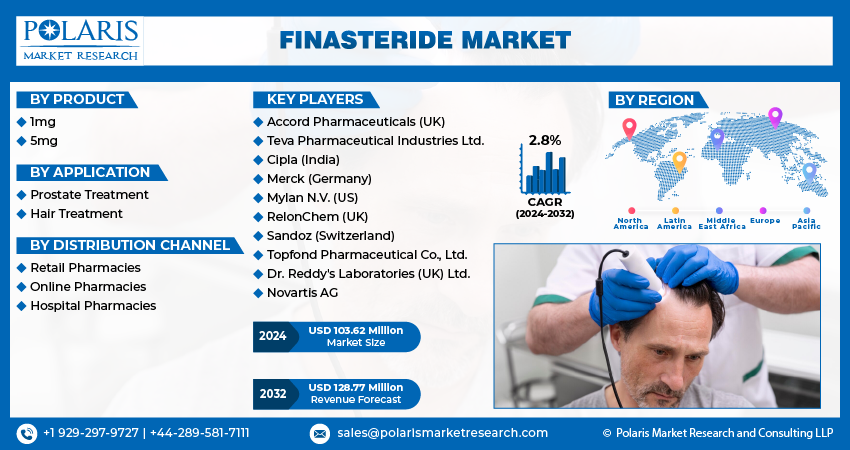
Get Full Segment-Level Forecasts & Insights: Download Sample Report
Report Segmentation
The market is primarily segmented based on product, application, distribution channel and region.
| By Product | By Application | By Distribution Channel | By Region |
|
|
|
|
Source: Polaris Market Research Analysis
To Understand the Scope of this Report: Request Customization
By Product Analysis
1mg segment is expected to witness the highest growth during the forecast period
The 1mg segment is expected to witness the highest CAGR during the projected period, primarily driven by the rising number of people suffering from hair loss. The 1 mg dose of finasteride medication is mostly used for the treatment of hair loss among men. As more people show interest in opting for hair care treatments driven by societal perception, professional image, and more, there will be significant demand for finasteride medication in the coming years.
The 5 mg segment led the market with a substantial market size in 2023, largely attributable to its ability to offer effective treatment for prostatic hyperplasia. The growing prevalence of this disease among the larger population is likely to boost the demand for 5-mg-based finasteride in the foreseeable future, as it is approved for benign prostatic hyperplasia by the US Food and Drug Administration.
By Application Analysis
Prostate treatment segment garnered the largest market share in 2025
The prostate treatment garnered the largest market share in 2025 and is likely to retain its market position throughout the forecast period. This can be influenced by the rising utility of finasteride in prostate treatment over hair loss. In this, the prostate enlargement sub-segment received the highest growth due to the superior performance of finasteride in treating prostate enlargement health issues, which is the cause of difficulty in urination among males.
Prostate cancer segment is projected to grow at healthy rate, driven by the increased risk of developing prostate cancer among patients with benign prostatic enlargement. This is driving the demand for the finasteride treatment for benign prostatic enlargement, with the objective of lowering the significance of prostate cancer in the population.
By Distribution Channel Analysis
Retail pharmacies segment held a substantial market revenue share in 2025
The retail pharmacies segment held a substantial market revenue in 2025, which is augmented owing to the prevalence of consumers purchasing their medication at retail outlets. The higher familiarity and increased trust among the retailers are the main contributing factors leading to higher revenue for finasteride in retail pharmacies.
However, the rising number of telemedicine providers with user-friendly interfaces and e-commerce portal penetration with enhanced internet connections is likely to promote the demand for finasteride in online pharmacies. The growing prominence of offers by e-commerce companies is positively driving sales. For instance, in January 2023, Amazon introduced a new drug subscription monthly scheme with a $5 fee, enabling people to consume as many drugs as they can at a flat price.
Source: Polaris Market Research Analysis
Need Granular Data Across All Market Segments? Request Customization
Regional Insights
North America region registered the largest share of the global market in 2025
The North American region registered the largest share of the global market in 2025. Region’s growth is due to the rising number of males population suffering from androgenic alopecia. The presence of established players engaged in the production process of finasteride is optimally boosting the expansion of the finasteride market in this region.
Based on market analysis, Asia Pacific will grow at a rapid pace, owing to the increasing healthcare investment in the major countries to promote the availability of prominent drugs, including finasteride, to the population. The significant rise in the penetration of hair loss and benign prostatic enlargement within the male population is projected to boost demand for finasteride in the coming years. According to the statistics unveiled by the health tech company Traya in 2023, approximately 50.31% of Indian men under the age of 25 are witnessing hair loss problems in India.
Source: Polaris Market Research Analysis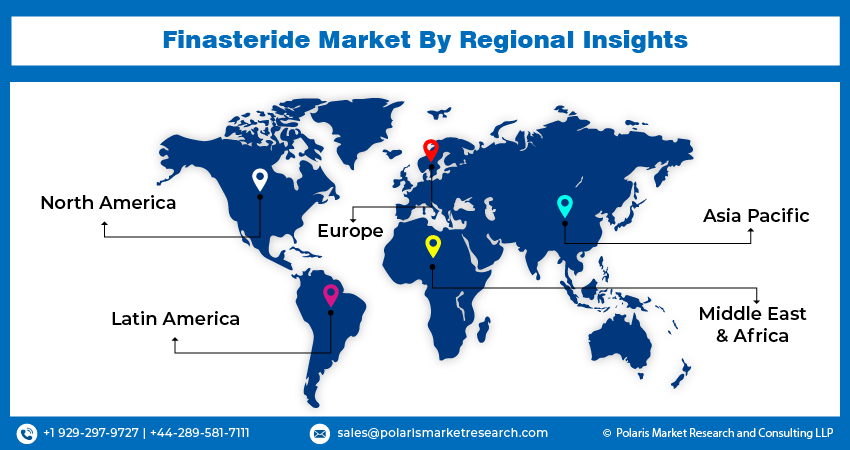
Curious About Regional Market Performance? Request Customization
Key Market Players & Competitive Insights
Strategic agreements to drive the competition
Based on market research, finasteride market is fairly consolidated with the presence of a few larger players with a large market revenue in the global market. The growing patent agreements, collaborations, and partnerships are expected to bolster market expansion. For instance, in April 2023, Blue Water purchased Entadfi, an enlarged prostate drug from Veru that is developed by combining finasteride and tadalafil, for $100 million.
Some of the major players operating in the global market include:
- Accord Pharmaceuticals (UK)
- Teva Pharmaceutical Industries Ltd.
- Cipla (India)
- Merck (Germany)
- Mylan N.V. (US)
- RelonChem (UK)
- Sandoz (Switzerland)
- Topfond Pharmaceutical Co., Ltd.
- Dr. Reddy's Laboratories (UK) Ltd.
- Novartis AG
Recent Developments in the Industry
- In January 2023, Happy Head, a healthcare provider focusing on haircare and treatments, introduced its first all-in-one hair growth super capsule with a combination of Vitamin D, Minoxidil, and Finasteride.
Report Coverage
The finasteride market report emphasizes key regions across the globe to provide a better understanding of the product to the users. Also, the market report provides market insights into recent developments and trends and analyzes the technologies that are gaining traction around the globe. Furthermore, the market research report covers an in-depth qualitative analysis pertaining to various paradigm shifts associated with the transformation of these solutions.
The report provides a detailed analysis of the market while focusing on various key aspects such as competitive analysis, product, application, distribution channel, and their futuristic growth opportunities.
Finasteride Market Report Scope
| Report Attributes | Details |
| Market Size in 2025 | USD 106.06 Million |
| Market Size in 2026 | USD 108.64 Million |
| Revenue Forecast in 2034 | USD 135.98 Million |
| CAGR | 2.8% from 2026 – 2034 |
| Base Year | 2025 |
| Historical Data | 2021 – 2024 |
| Forecast Period | 2026 – 2034 |
| Quantitative Units | Revenue in USD million and CAGR from 2026 to 2034 |
| Segments Covered |
|
| Regional Scope |
|
| Competitive Landscape |
|
| Report Format |
|
| Customization | Report customization as per your requirements with respect to countries, region and segmentation. |
Source: Polaris Market Research Analysis
Finasteride Market FAQ's
The global finasteride market size is expected to reach USD 135.98 million by 2034
Key players in the market are Accord Pharmaceuticals, Actavis, Cipla, Henan Topfond, Merck, Mylan N.V
North America contribute notably towards the global Finasteride Market
Finasteride Market exhibiting a CAGR of 2.8% during the forecast period.
The Finasteride Market report covering key segments are product, application, distribution channel and region.
Download Sample Report of Finasteride Market
Please fill out the form to request a customized copy of the research report.


