
Fingerprint Sensor Market Trends Analysis | Industry Report, 2024-2032
REPORT DETAILS
Market Statistics
Market Outlook
The fingerprint sensor market size was valued at USD 3.90 billion in 2023. The market is anticipated to grow from USD 4.14 billion in 2024 to USD 6.77 billion by 2032, exhibiting a CAGR of 6.3% during 2024–2032.
The increasing concerns over data security and identity theft drive the global fingerprint sensor market. According to a report published by the Bureau of Justice Statistics, about 23.9 million US residents aged 16 and above experienced identity theft in 2021. The rise in identity theft and fraud is encouraging organizations to invest in fingerprint sensors to ensure that only authorized individuals access their systems and data. This helps in preventing unauthorized transactions and reducing the risk of fraudulent activities.
Source: Polaris Market Research Analysis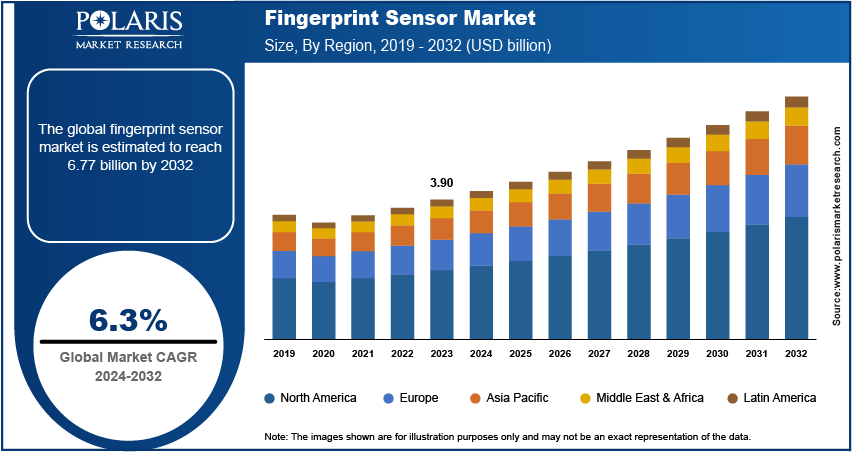
To Understand More About this Research: Download Sample Report
The growing demand for an attendance register system fuels the global fingerprint sensors market. Fingerprint sensors are widely utilized as an attendance register system in organizations as they provide highly accurate and reliable identification. They help in precisely recording the attendance of individuals without the risk of human error or manipulation, ensuring that records are trustworthy.
Fingerprint Sensor Drivers
Increasing Adoption of Smartphones and Tablets
There is an increasing adoption of smartphones and tablets across the world. According to the GSMA’s annual State of Mobile Internet Connectivity Report 2023, over half (54%) of the global population, some 4.3 billion people, now own a smartphone. Manufacturers of smartphones and tablets are incorporating fingerprint sensors in their devices to offer a secure method of unlocking devices and authenticating transactions, providing an extra layer of protection against unauthorized access. Hence, as the adoption of these devices increases, the demand for fingerprint sensors spurs.
Surging Popularity of Smart Homes
Smart homes feature various connected devices, including smart locks, security systems, and home automation hubs. Fingerprint sensors provide a high level of security for these systems by ensuring that only authorized individuals can access and control them. This reduces the risk of unauthorized entry and enhances the overall security of smart homes. Therefore, the increasing popularity of smart homes propels the global fingerprint sensor market.
Market Restraints
Rising Adoption of Substitute Products, Such as Facial Recognition
Consumers and businesses now prefer facial recognition systems over fingerprint sensors due to their convenience and the fact that it doesn’t require physical contact. Thus, the growing adoption of substitute products, such as facial recognition, hinders the demand for fingerprint sensors.
Source: Polaris Market Research Analysis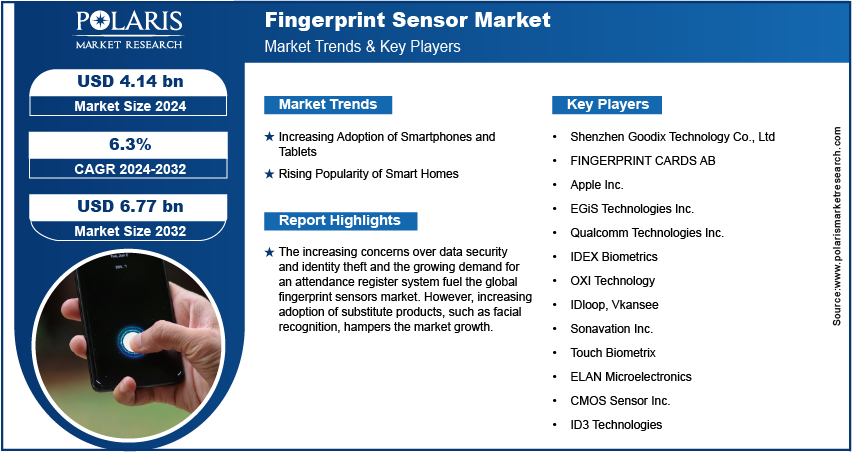
Get Full Segment-Level Forecasts & Insights: Download Sample Report
Report Segmentation
The fingerprint sensor market is primarily segmented on the basis of type, technology, application, and region.
| By Type | By Technology | By Application | By Region |
|
|
|
|
Source: Polaris Market Research Analysis
By Type Analysis
Swipe Sensor Acquired Larger Market Share in 2023
The swipe sensor segment accounted for a larger market share in 2023 due to their robust performance and reliability, along with their widespread adoption in various consumer devices such as smartphones and security systems. These sensors require users to swipe their fingers across a designated area, capturing a high-resolution fingerprint image with precision. Additionally, their durability and ease of integration into existing devices contribute to the dominant market share.
The area and touch sensors segment is expected to grow at a robust pace in the coming years, owing to their ability to offer superior accuracy and faster authentication times. They provide seamless and contactless interactions, improving user experience and operational efficiency. Moreover, area sensors are more affordable due to technological advancements and economies of scale, making them a preferred choice for consumers and manufacturers. The trend toward higher security and convenience in consumer electronics and enterprise solutions is likely to drive the segment in the future.
By Technology Analysis
Capacitive Segment Accounted for Largest Market Share in 2023
The capacitive segment accounted for the largest market share in 2023 due to its high accuracy and reliability in various applications. These sensors work by measuring the capacitance variation caused by the presence of a finger, providing detailed and precise biometric data. Their widespread adoption in smartphones, tablets, and security systems is attributed to their durability, low false acceptance rates, and resistance to environmental factors such as dust and moisture. The technology's ability to deliver quick and accurate readings at a relatively low cost has cemented its leading position in the market.
The optical segment is projected to register a significant CAGR during the forecast period owing to the advancements in image processing and the increasing demand for high-resolution and secure biometric systems. Optical sensors are increasingly integrated into smartphones and access control systems owing to their ability to provide detailed and accurate fingerprint images while remaining less sensitive to environmental conditions.
Source: Polaris Market Research Analysis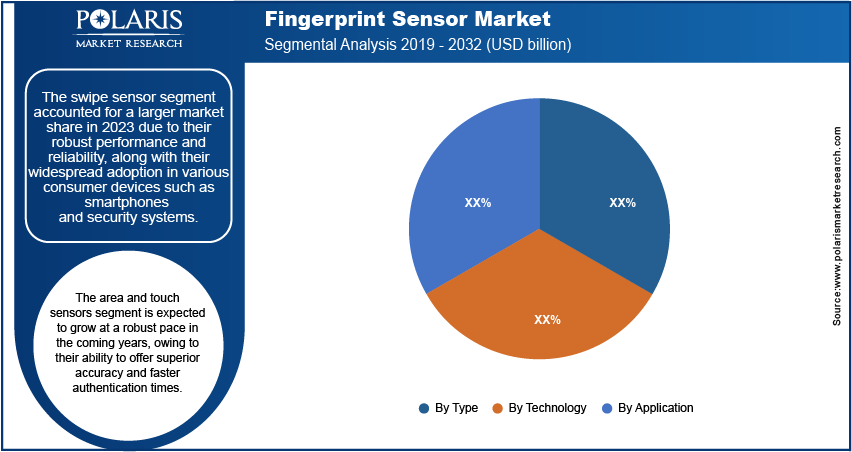
Need Granular Data Across All Market Segments? Request Customization
Regional Insights
Asia Pacific Market to Grow at a Significant CAGR in Coming Years
Asia Pacific held the largest share in the fingerprint sensor market and is estimated to continue its dominance during the forecast period owing to the rapid adoption of biometric technologies in countries such as China and India, which are experiencing significant growth in consumer electronics and security applications. The large population base and increasing smartphone penetration contribute to the high demand for biometric systems. The region's focus on enhancing security infrastructure and the development of smart cities further drive the integration of advanced biometric technologies. Moreover, the penetration of mobile payments has propelled. According to the China Internet Network Information Center (CNNIC), the number of mobile payment business transactions reached USD 41.284 billion in China in 2023, amounting to 144.60 trillion yuan, representing a year-on-year increase of 19.1%. Thus, all these factors mentioned above boost the Asia Pacific fingerprint sensor market growth.
Source: Polaris Market Research Analysis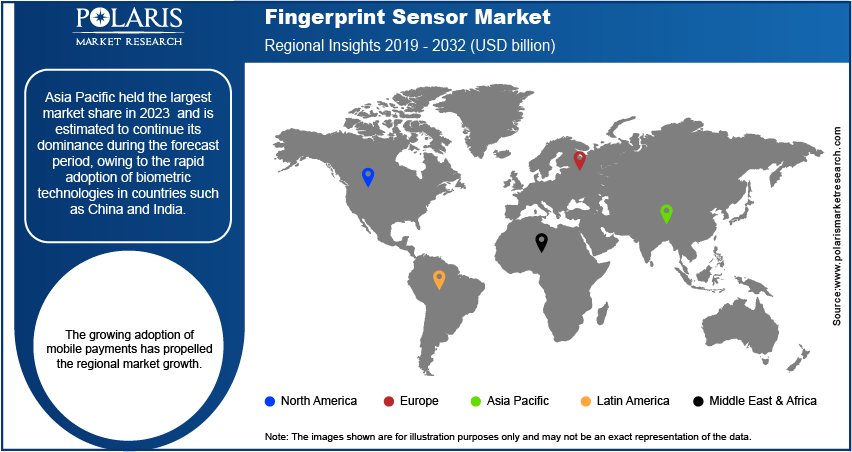
Curious About Regional Market Performance? Request Customization
Key Market Players and Competitive Insights
Major market players are investing heavily in research and development to expand their offerings, which will drive the fingerprint sensor market growth during the forecast period. Market participants are also undertaking a variety of strategic activities to expand their global footprint, with important market developments, including innovative launches, international collaborations, higher investments, and mergers and acquisitions between organizations. Major players in the fingerprint sensor market include Shenzhen Goodix Technology Co., Ltd.; Fingerprint Cards AB; Apple Inc.; Egis Technology; Qualcomm Technologies, Inc.; IDEX Biometrics ASA; and OXI Technology.
List of Key Comapnies
- Shenzhen Goodix Technology Co., Ltd.
- FINGERPRINT CARDS AB
- Apple Inc.
- EGiS Technologies Inc.
- Qualcomm Technologies Inc.
- IDEX Biometrics ASA
- OXI Technology
- IDloop
- Sonavation Inc.
- Touch Biometrix
- Vkansee
- ELAN Microelectronics
- CMOS Sensor Inc.
- ID3 Technologies
Recent Developments in the Industry
- June 2025: NEXT Biometrics secured a NOK 6.3 million purchase order for its newly launched FAP 20 Basalt L1 Slim ultra-thin fingerprint sensor. The product received Level 1 certification for Aadhaar, supporting secure national ID and payment devices. Deliveries started in Q3 2025, with potential repeat orders reaching NOK 25 million annually.
- February 2025: Fingerprint Cards AB partnered with CardLab to introduce a next-generation biometric smart card, “Access,” featuring its advanced T-Shape fingerprint sensor. The solution enhances security and user convenience by replacing passwords with fast, reliable biometric authentication for secure access systems.
- July 2024: Goodix and Samsung adopted new fingerprint enrollment methods to improve user convenience and security on their latest devices. Goodix developed a “sliding enrollment” feature for in-display fingerprint sensors, first launched on the iQOO Neo 9s Pro Plus.
- March 2024: SmartMetric, Inc. (OTC: SMME) received U.S. Patent Office approvals granting exclusive rights to biometric fingerprint sensor technology for credit cards, covering EMV-enabled cards with integrated fingerprint sensors embedded directly on the card surface.
- May 2024: Goodix Technology announced that its proprietary ultrasonic fingerprint solution made its debut in the newly launched vivo X100 Ultra. The company claims that this innovative solution features a unique architecture and proprietary algorithms that provide a seamless and secure unlocking experience for mobile devices.
- February 2023: IDloop developed a contactless 3D fingerprint scanner with microscopic resolution. The technology helps quickly compare fingerprints against existing databases collected with contact-based scanners.
Report Coverage
The fingerprint sensor market report emphasizes key regions across the globe to provide a better understanding of the product to the users. Also, the report provides market insights into recent developments and trends and analyzes the technologies that are gaining traction around the globe. Furthermore, it covers an in-depth qualitative analysis pertaining to various paradigm shifts associated with the transformation of these solutions.
The report provides a detailed analysis of the market while focusing on various key aspects such as competitive analysis, type, technology, application, and futuristic opportunities.
Fingerprint Sensor Market Report Scope
| Report Attributes | Details |
| Market Size Value in 2024 | USD 4.14 billion |
| Revenue Forecast in 2032 | USD 6.77 billion |
| CAGR | 6.3% from 2024 to 2032 |
| Base Year | 2023 |
| Historical Data | 2019–2022 |
| Forecast Period | 2024–2032 |
| Quantitative Units | Revenue in USD billion and CAGR from 2024 to 2032 |
| Segments Covered |
|
| Regional Scope |
|
| Competitive Landscape | Fingerprint Sensor Market Industry Trend Analysis (2023) Company Profiles/Industry participants profiling includes company overview, financial information, product/service benchmarking, and recent developments |
| Report Format | PDF + Excel |
| Customization | Report customization as per your requirements with respect to countries, regions, and segmentation. |
Source: Polaris Market Research Analysis
Fingerprint Sensor Market FAQ's
The global fingerprint sensor market size was valued at USD 3.90 billion in 2023 and is projected to grow to USD 6.77 billion by 2032.
The global market is projected to grow at a CAGR of 6.3% during the forecast period.
Asia Pacific held the largest share of the global market in 2023.
Shenzhen Goodix Technology Co., Ltd.; FINGERPRINT CARDS AB; Apple Inc.; EGiS Technologies Inc.; Qualcomm Technologies Inc.; IDEX Biometrics ASA; OXI Technology; IDloop; Sonavation Inc.; Touch Biometrix; Vkansee; ELAN Microelectronics; CMOS Sensor Inc.; and ID3 Technologies are among the key market players.
The area and touch sensor type segment is projected for significant growth in the global market during 2024–2032.
The capacitive segment dominated the market in 2023.
Download Sample Report of Fingerprint Sensor Market
Please fill out the form to request a customized copy of the research report.


