
Global Fitness App Market Size, Industry Share, Analysis Report, 2026-2034
REPORT DETAILS
Market Statistics
Fitness App Market Overview
The fitness app market size was valued at USD 12.91 billion in 2025. According to our fitness app industry analysis, the fitness app market CAGR is projected to be 13.5% from 2026 to 2034. The market is fueled by factors such as health consciousness, smartphone usage, and personalized training and nutritional plans.
Key Takeaways
- North America held the largest market share of 38.10% in 2025. This is due to the high number of smartphone users and the region's level of health awareness.
- Asia Pacific is expected to see a high growth rate of 14.6% CAGR, with the India fitness app market at the core. The Asia Pacific fitness app market growth is fueled by urbanization and an increase in disposable income.
- The workout & exercise apps segment led the market in 2025 with 45.38% share. This is due to the growing demand for personalized training and real-time tracking.
- The Android platform dominated the market in 2025 with 70.15% share. The Android platform is affordable with worldwide accessibility.
Note: Figures and projections outlined in this report are the result of Polaris Market Research’s proprietary analytical processes, grounded in the latest available datasets and market observations.
Industry Dynamics
- The demand for fitness apps is rising as awareness of fitness's significance grows. Moreover, demand is increasing as users seek workout plans tailored to their age groups. Short-form workout plans and training plans have become important for users who need nutrition-tracking apps and are focused on results.
- The expansion of the market is supported by AI-powered personalization and wearables integration. The market is also driven by the growing popularity of remote coaching and digital fitness communities. Retention is an important factor for profitability.
- The market is facing challenges such as data privacy concerns and user retention issues. The differences in the standard regulations of the regions may impact the sustainability of the fitness app providers’ profitability.
- Advances in real-time analytics, gamification in fitness apps, and cross-platform compatibility are improving user experiences. They are driving habit formation and extending the scope of preventive healthcare apps and lifestyle management apps.
Market Statistics
2025 Market Size: USD 12.91 billion
2034 Projected Market Size: USD 40.26 billion
CAGR (2026-2034): 13.5%
North America: Largest market in 2025
Source: Polaris Market Research Analysis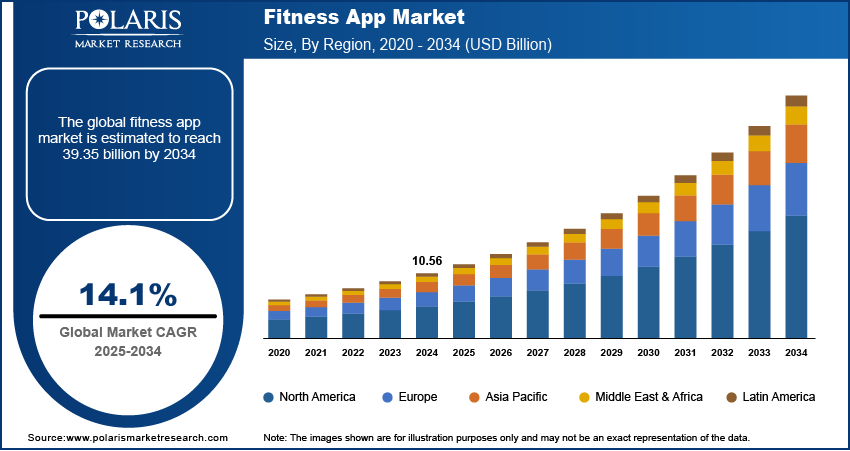
To Understand More About this Research:Download Sample Report
AI Impact on Fitness App Market
- AI uses user behavior, physical metrics, and preferences to improve personalization. Personalization is helping to develop effective plans for workouts and diet. To gain user trust, features such as risk alerts and disclaimers have been incorporated by leading apps to avoid any misconceptions regarding health-related information.
- The integration of AI technology is helping to provide adaptive coaching. The coaching is based on performance data, user fatigue, and trends. It allows for dynamic changes to user workouts.
- AI analytics can be used to identify patterns concerning user health and fitness goals. This helps identify trends in user inactivity and burnout, thereby helping resolve these issues.
- AI increases user engagement through gamification, reminders, and chatbots. This improves user retention in fitness apps. The features of user engagement also enable apps to increase their revenue by ensuring more people subscribe to their apps, helping retain subscribers rather than losing them, and providing features such as personalized workout plans and performance analytics.
What is a Fitness App?
A fitness app is a mobile or web-based application. These apps help users track, manage, and improve their physical health and wellness activities. They offer features such as workout plans, step counting, calorie tracking, heart rate monitoring, sleep analysis, and personalized coaching. Fitness apps are widely used for exercise guidance and weight management. They also offer activity monitoring and overall lifestyle improvement
The global fitness app market primarily deals with digital platforms that provide tools for improving physical well-being, delivering customized workout plans, tracking activities, monitoring nutrition, and cultivating mindfulness. Such apps are using emerging technologies like artificial intelligence, machine learning, deep learning, and wearable technology to give users a unique experience.
The market has grown significantly due to increased health awareness and technological advancements. Moreover, the market benefits from increased demand for home fitness. As the number of people suffering from lifestyle-related diseases rises, demand for home fitness, which provides users with real-time health insights, is growing. For example, noncommunicable diseases (NCDs), or chronic diseases, caused 43 million deaths in 2021, according to data published by the World Health Organization.
The increasing rates of obesity worldwide are also contributing to the growth of the fitness app market. According to the World Health Organization, in 2022, 1 in 8 people in the world were living with obesity. Fitness apps provide personalized solutions to address obesity. Fitness apps provide workout routines, calorie counting, and diet plans. Fitness apps empower users to achieve their weight-loss goals and overcome obesity. These apps also provide AI technology to analyze the data and provide a customized solution to the user. Thus, the growth of the fitness app market is directly proportional to the rise in obesity worldwide.
Market Dynamics
Advancements in Wearable Technology
Advancements in technology are fueling the market revenue. High-end wearables like smartwatches, fitness bands, and health trackers use fitness apps to measure heart rates, steps taken, calories burned, sleep cycles, and even stress levels. As wearable technology advances, more people are inclined to use fitness and health tracking apps to gain insights into their fitness. When fitness apps are compatible with other wearable devices, it is less likely that the user will change the fitness app. This is the reason why wearable device compatibility is a key advantage over other fitness apps.
Rising Smartphone Penetration in Emerging Nations
The increasing smartphone user base in developing countries like India is driving the market growth. According to data released by the World Economic Forum, India had a smartphone user base of more than 700 million, including 425 million users in rural areas, in January 2023. Smartphone adoption provides users with the ability to easily install fitness apps that can be used to track physical activities, monitor health, and access fitness plans. Smartphones provide users with access to features like GPS tracking and video-based fitness plans. These features can be used to track physical activities and provide a better user experience. In addition, the availability of high-speed internet has helped fitness apps reach a wider audience across various demographics. In emerging markets, an app also needs local payment systems, affordable plans, and local languages to ensure that high download numbers translate into recurring revenue.
Source: Polaris Market Research Analysis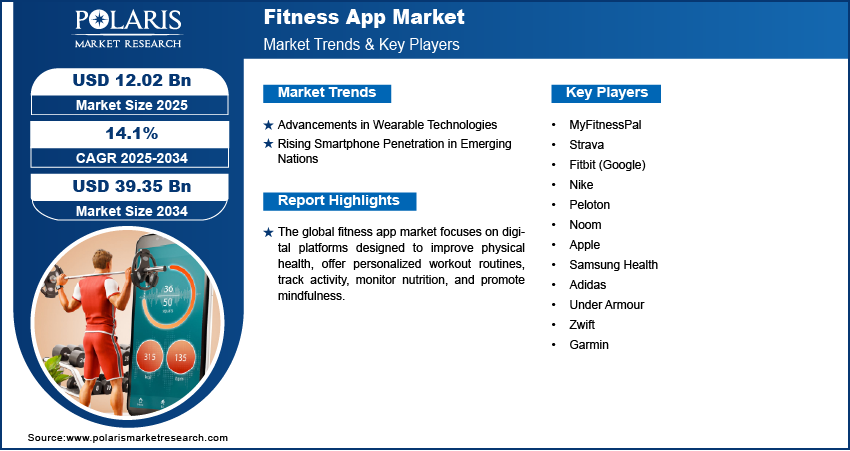
Get Full Segment-Level Forecasts & Insights: Download Sample Report
Segment Assessment
By Type Insights
The fitness app market by type segmentation includes workout & exercise apps, disease management, lifestyle management, nutrition & diet, and medication adherence. The workout & exercise apps held the largest fitness app market share in 2025. This is because they can offer their users personalized workouts, videos, and tracking. In addition, the incorporation of game features, such as challenges, competitions, and rewards, has helped users embrace workout & exercise apps. In addition, the rising popularity of the concept of hybrid fitness, which combines virtual and physical training, has made the segment the market leader. Workout/exercise apps tend to display clear short-term benefits such as tracking progress, streaks, or performance metrics. This is beneficial in that it promotes habit formation while encouraging them to use the app frequently.
Type and Key Functions
| Type | Key Functions |
| Workout & Exercise Apps | Guided workouts, strength training, yoga sessions, cardio tracking, fitness coaching |
| Disease Management | Monitoring chronic conditions, tracking symptoms, health reminders, progress reporting |
| Lifestyle Management | Sleep tracking, stress management, mindfulness, habit building, wellness improvement |
| Nutrition & Diet | Calorie counting, meal planning, diet recommendations, hydration tracking, weight management |
| Medication Adherence | Medicine reminders, dosage tracking, prescription management, refill alerts, health compliance |
Source: Polaris Market Research Analysis
By Platform Insights
In terms of platform, the fitness app market is segregated into Android, iOS, wearable devices, and web-based platforms. The Android segment dominated the market share in 2025. This is because of its adoption and affordability. Fitness app developers have focused on building feature-based Android fitness apps. This is because of the open-source nature of the operating system, allowing the apps to support various devices. The affordability of Android-based fitness devices has also helped various income groups access fitness and workout apps. Wearable first experiences are becoming more prominent, especially as smartwatches collect data, helping improve user understanding over time. This allows for accurate personalization and enables features such as premium insights.
Platform and Application Areas
| Platform | Key Application Segmentation |
| Android | Workout tracking, calorie counting, step monitoring, diet planning, virtual fitness coaching |
| iOS | Personalized training programs, health data integration, yoga & meditation apps, premium wellness subscriptions |
| Wearables | Real-time heart rate monitoring, sleep tracking, activity tracking, connected fitness devices, performance analytics |
Source: Polaris Market Research Analysis
By Application Insights
The fitness app market by application segmentation includes personal use, commercial use, and rehabilitation & healthcare. The personal use category leads the market. This is attributed to the demand for ease, a plan, and tracking functions to assist with weight loss, strength training, and general wellness. Commercial use is also trending, with gyms, personal training, and online training studios now including the apps as part of their membership offerings to retain members and encourage their use over time. Rehabilitation and healthcare apps use is rising, with apps considered to assist with other healthcare recommendations.
Source: Polaris Market Research Analysis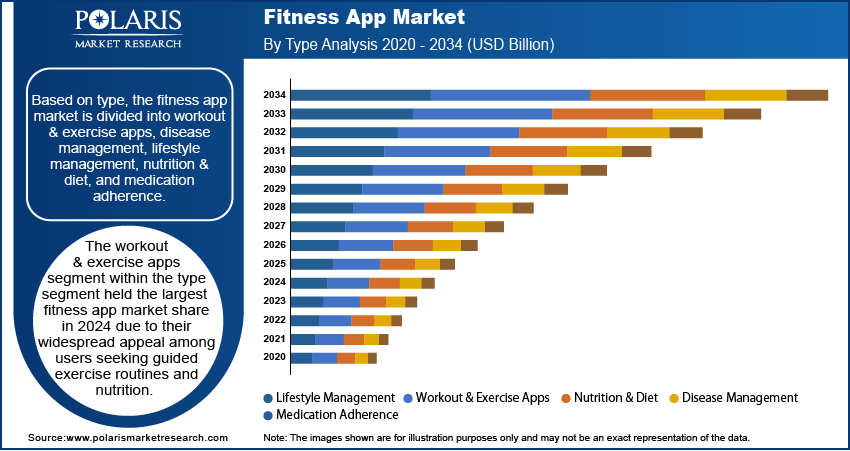
Need Granular Data Across All Market Segments? Request Customization
Regional Insights
By region, the report covers North America, Europe, Asia Pacific, Latin America, and the Middle East & Africa. The North America fitness app market dominated the global market in 2025 due to its high rate of smartphone penetration, increasing awareness of health and fitness, and a technologically advanced ecosystem. The region is reaping the benefits of the fitness culture, which has adopted wearables such as Apple Watch, Fitbit, and Garmin, as well as fitness apps like Peloton and Nike Training Club. The regional market is further driven by high disposable incomes, rising innovation and product launches, and investments in health mobile apps and subscription fitness apps. These trends are meeting the rising demand for individualized interactive fitness experiences, thereby fueling the wearable fitness devices market in the region. Going forward, the main differentiating factors in the competitive landscape in North America will be the provision of connected ecosystems, higher levels of personalization, and the achievement of results to justify the subscription model.
The Asia Pacific fitness app market is expected to grow rapidly during the forecast period. India dominates the regional market due to increasing urbanization and high disposable income. Rising use of smartphones, along with the growth in internet subscriptions, is also contributing to the expansion of the fitness app market in the Asia Pacific region. For instance, according to data published by the Global System for Mobile Communications, 1.8 billion people in the Asia Pacific, or 63% of the population, had subscribed to mobile services by the end of 2023. Moreover, the growth in the number of fitness centers in countries such as India and China is contributing to the regional market expansion. The growth in APAC is driven by the large number of mobile-first users, the rise of digital payments and the affordability of Android devices. The regional market also benefits from localized fitness content strategies that help drive user engagement across diverse linguistic and cultural groups.
Source: Polaris Market Research Analysis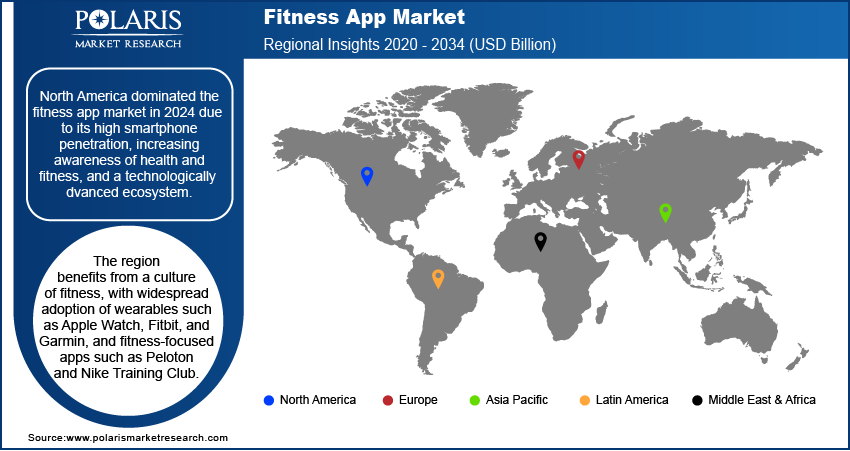
Curious About Regional Market Performance? Request Customization
Key Market Players & Competitive Analysis Report
Major players in the market are investing heavily in R&D to expand their product portfolios. They are also engaging in several strategic initiatives to increase their presence globally. Some of the key developments in the market include the launch of new and innovative products, increased investments, and mergers between organizations.
Competitive strategies in the fitness app market typically fall into several categories:
- Ecosystem bundling and hardware integration, such as platforms connected with wearables
- Content studios and class-led programming
- Community features and social competition
- Weight management and nutrition-focused programs
- Performance and endurance tracking.
Companies strengthen their market position by ensuring device compatibility, offering personalized coaching, building community features, and providing clear reporting on user outcomes.
Apple Inc. is a multinational technology company based in Cupertino, California. Apple has achieved remarkable milestones in the fitness app market with the Fitness application and Apple Fitness+, a subscription service. Apple was founded in 1976, starting as an Apple computer manufacturer. Today, Apple is one of the largest technology companies in the world. It specializes in consumer electronics, computer software, and services. Apple’s dedication to innovative products with user-friendly interfaces has enabled the company to capture major market share worldwide. Apple Fitness, which began as Apple Activity in 2015, is an exercise companion for Apple Watch users. However, with the latest iOS updates, the application is available to all iPhone users. This is irrespective of whether they own an Apple Watch.
Garmin is a well-known company in the global technology industry. It is known for providing advanced GPS navigation and wearable devices. Garmin was founded in 1989 and is based in Schaffhausen, Switzerland. It has made a strong presence in the different markets it has chosen to operate in. Some of the markets include fitness, outdoor, aviation, marine, and automotive. In the fitness segment, Garmin has made tremendous progress in providing the best fitness apps and devices. Garmin has developed the Garmin Connect app, which allows users to track their overall health and fitness activities. Using this app, users can track different parameters. These include steps taken, calories burned, heart rate, sleep, and stress levels.
List of Key Companies
- Adidas
- Apple
- Fitbit (Google)
- Garmin
- MyFitnessPal
- Nike
- Noom
- Peloton
- Samsung
- Strava
- Under Armour
- Zwift
Data Privacy, Compliance & Trust
The increasing role of fitness apps in handling sensitive user health and biometric data makes issues of user consent, limited data collection, and privacy settings essential for creating trust and ensuring the long-term viability of such applications. Data privacy issues may impact the usage of such applications if users are unsure of how their data is being shared with third parties, advertisers, or employers, and with other connected devices and ecosystems, as the privacy and data protection policies may vary in different regions, prompting the need for improved security and privacy settings.
Industry Developments
March 2026: MyFitnessPal announced the acquisition of Cal AI. It is a fast-growing, AI-powered nutrition app. With this deal, companies aim to serve consumers across the full health and fitness spectrum. (Source: globenewswire.com)
March 2025: Mindbody announced its new partnership with Rokt. The company stated that the alliance will focus on offering more relevant ads to its membership community. Rokt's AI-powered Brain will be used to create a more seamless experience. (Source: prnewswire.com)
Market Segmentation
By Type Outlook (Revenue, USD Billion, 2021–2034)
- Workout & Exercise Apps
- Disease Management
- Lifestyle Management
- Nutrition & Diet
- Medication Adherence
By Platform Outlook (Revenue, USD Billion, 2021–2034)
- Android
- iOS
- Wearable Devices
- Web-Based Platforms
By Application Outlook (Revenue, USD Billion, 2021–2034)
- Personal Use
- Commercial Use
- Rehabilitation & Healthcare
By Regional Outlook (Revenue, USD Billion, 2021–2034)
- North America
- US
- Canada
- Europe
- Germany
- France
- UK
- Italy
- Spain
- Netherlands
- Russia
- Rest of Europe
- Asia Pacific
- China
- Japan
- India
- Malaysia
- South Korea
- Indonesia
- Australia
- Vietnam
- Rest of Asia Pacific
- Middle East & Africa
- Saudi Arabia
- UAE
- Israel
- South Africa
- Rest of Middle East & Africa
- Latin America
- Mexico
- Brazil
- Argentina
- Rest of Latin America
Fitness App Market Report Scope
| Report Attributes | Details |
| Market Size in 2025 | USD 12.91 billion |
| Market Size in 2026 | USD 14.62 billion |
| Revenue Forecast by 2034 | USD 40.26 billion |
| CAGR | 13.5% |
| Base Year | 2025 |
| Historical Data | 2021–2024 |
| Forecast Period | 2026–2034 |
| Quantitative Units | Revenue in USD billion, and CAGR from 2026 to 2034 |
| Report Coverage | Revenue Forecast, Market Competitive Landscape, Growth Factors, and Trends |
| Segments Covered |
|
| Regional Scope |
|
| Competitive Landscape | Fitness App Industry Trend Analysis (2025) Company profiles/industry participants profiling include company overview, financial information, product/service benchmarking, and recent developments |
| Report Format | PDF + Excel |
| Customization | Report customization as per your requirements with respect to countries, regions, and segmentation. |
Source: Polaris Market Research Analysis
Fitness App Market FAQ's
The market was valued at USD 12.91 billion in 2025 and is projected to reach USD 14.62 billion in 2026, growing at a CAGR of 13.5% through 2034.
The global fitness app market is forecast to reach USD 40.26 billion by 2034, driven by AI integration, wearable adoption, and rising health awareness.
The market is projected to grow at a CAGR of 13.5% between 2026 and 2034.
North America held the largest market share in 2025, driven by high smartphone penetration, strong health awareness, and an advanced digital infrastructure.
Asia Pacific is expected to see the highest growth, with India at the core. Rising urbanisation, smartphone adoption, and a young population embracing digital fitness are key drivers.
Download Sample Report of Fitness App Market
Please fill out the form to request a customized copy of the research report.


