
Genealogy Products & Services Market Size, Shre, Future Outlook 2025-2034
REPORT DETAILS
Market Statistics
The global genealogy products & services market was valued at USD 4.57 billion in 2024 and is expected to grow at a CAGR of 11.5% during the forecast period. The rapidly growing proliferation of preventive healthcare across the globe due to the increase in the number of consumers becoming increasingly aware of its benefits and the emergence of genetic testing in preventive healthcare for the effective diagnosis of various rare diseases are major factors expected to drive the global market.
Key Insights
- By Application, the household segment held the largest share. This is due to the peculiar behavior of people and families, wanting to study and document their genealogies to pass on to future generations.
- By Category, the DNA testing subsegment held the largest share. This is primarily driven by the rapid technological advancements that have made DNA tests to assess one’s ethnic background and to discover previously unknown relations more economically favorable and accessible.
- By Region, North America held the largest share. This is due to the advanced region's developed healthcare system, high level of consumer awareness, and the presence of key industry players in the region.
Industry Dynamics
- The ever-growing popularity of seeking and tracing ancestry and family lineage is the primary driving force. People have a keen interest in delving into their past, learning family narratives, and weaving a narrative that fosters a profound sense of belonging.
- Innovation, particularly the use of DNA testing technology, has advanced and facilitated the discovery and comprehension of one’s genetic lineage. The utilization of advanced technology, particularly in sequencing and artificial intelligence tools, enables the generation of customized genetic health and ancestry information through intricate evaluations and response tailoring.
- The persistent increase in the digitization of historical records and repositories has also been of great importance. A number of historical documents, including census records, birth and death certificates, and even obituaries, are increasingly available for online access.
Market Statistics
- 2024 Market Size: USD 4.57 billion
- 2034 Projected Market Size: USD 13.56 billion
- CAGR (2025-2034): 11.5%
- North America: Largest market in 2024
Source: Polaris Market Research Analysis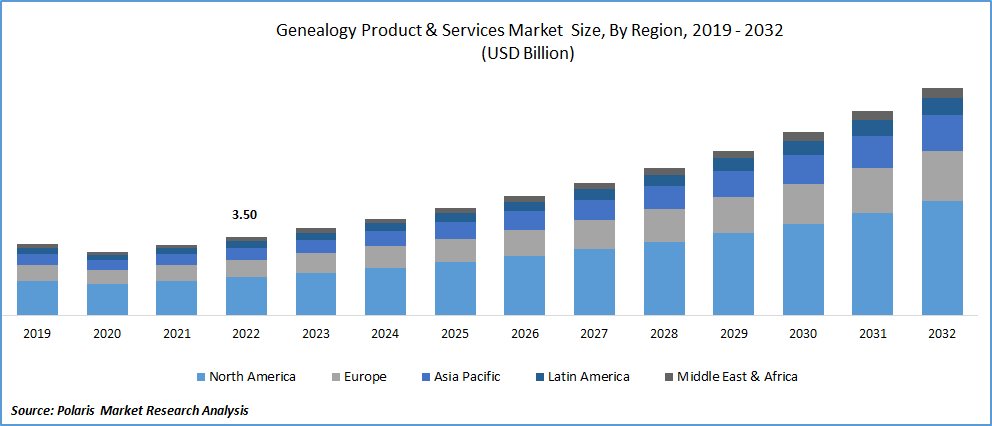
To Understand More About this Research: Download Sample Report
AI Impact on the Market
- AI immensely assists genealogists by analyzing historical records and assists them by spatially connecting fragments over various data streams within a fraction of a second. This would otherwise take a larger system of parallel distributed processing, a lot more time to do.
- AI tools perform digitalization on historical documents to ‘hand write’ them as well as translate their contents. This overcomes a significant hurdle for records shrouded in mystery for many because of the language or scripts they were penned.
- The AI further organizes family photos by improving their resolution, panorama, and restoration processes. Further, its colorization technology for converting black and white images and ‘living’ photos done by ‘animating’ features is widely used.
Besides this, the continuous increase in the prevalence of chronic disorders all over the world, a growing development of pharmacogenomics, and a surge in people's awareness about the potential and benefits of genealogy research are further anticipated to create lucrative growth opportunities for the genealogy products & services market soon.
- For instance, as per a report by the Department of Biotechnology India, chronic or non-communicable diseases are on a significant rise and account for almost 73% of all deaths. Also, in India, these diseases account for about 53% of total deaths & 44% of disability-adjusted life-years lost.
Moreover, there has been a rising focus among leading product & service providers on research & development activities and efforts to launch new educational and academic courses to make people aware and educate them about genealogy and its potential in the treatment of several types of diseases, thereby boosting the adoption of genealogy and generating huge growth potential.
- For instance, in December 2022, The Cobb Country Genealogical Society announced its annual genealogy course for researchers. The 2023 series, of course, is named “Genealogy JumpStart,” and it includes classes of interest of all genealogists.
Some of the major genealogy companies operating worldwide are experimenting with VR and AR technologies in order to create immersive experiences so that users can virtually explore their ancestral homelands or view historical documents in an augmented-reality setting. At the same time, it eliminates the need to travel from one place to another to gather such information and experiences.
Source: Polaris Market Research Analysis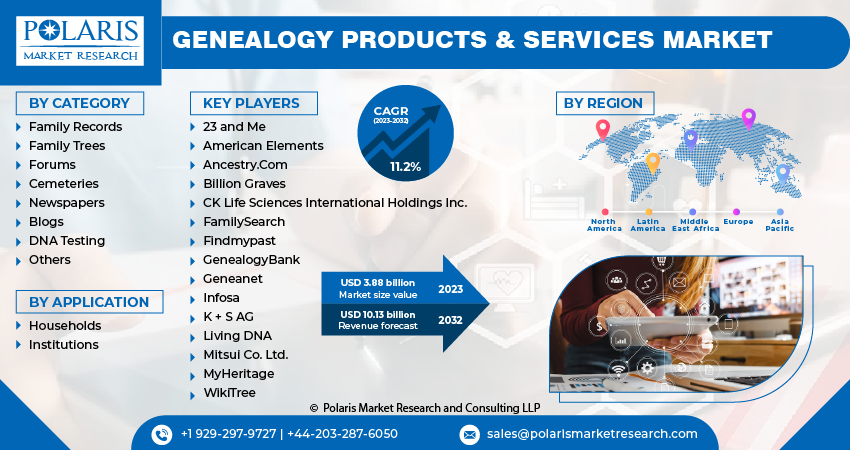
For Specific Research Requirements: Request for Customized Report
However, the high cost associated with genealogy products & services like DNA testing kits, as well as subscription fees for genealogical services and its limited reach to few developed regions, are among the factors expected to restrain the global genealogy products & services market growth.
Growth Drivers
Growing advances in DNA testing technology and online accessibility to these product services are driving the market.
The global genealogy product and services market is experiencing rapid growth, fueled by significant advancements in DNA testing technology and the increasing accessibility of genetic information. The availability of advanced at-home testing kits has made it convenient and affordable for individuals to uncover detailed insights into their ancestry and health.
For instance, in June 2023, Maury Povich announced the launch of its at-home DNA test kits named ‘The Results Are In.’ It includes materials to collect DNA samples and instructions and materials to send the sample back to the lab and provide results in as little as 1-2 days.
Moreover, the proliferation of online platforms and widespread internet access has further accelerated market expansion. These platforms empower individuals to research their family histories, create comprehensive family trees, and access extensive genealogical databases. The ease of connecting with distant relatives and exploring one's heritage online has become a significant driver for market growth.
As DNA testing technology continues to advance and as more people embrace the opportunity to explore their genetic heritage, the genealogy product and services market is poised for sustained positive growth. This trend reflects the increasing importance of personal genomics and the enduring human curiosity to understand one's origins and heritage.
Report Segmentation
The market is primarily segmented based on category, application, and region.
| By Category | By Application | By Region |
|
|
|
Source: Polaris Market Research Analysis
To Understand the Scope of this Report: Request Customization
By Category Analysis
The family records segment accounted for a notable market share in 2024
The family records segment accounted for the notable market share. The growth of the segment market is highly attributable to an increased number of individuals and families concerned about preserving their family history for their upcoming and future generations. Besides this, major genealogy companies are adopting effective marketing and promotional strategies that also drive interest and engagement in family records and genealogy products and services and boost the segment market growth.
The family trees segment is projected to exhibit a significant growth rate over the next coming years on account of growing technological advancements and improvements in DNA testing that have allowed individuals to create and research family trees and the rising trend and popularity of heritage tourism all over the world.
Source: Polaris Market Research Analysis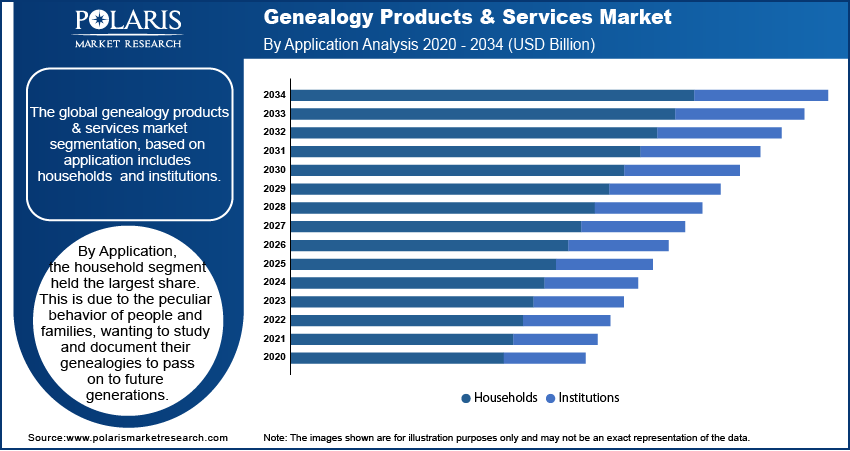
Need Granular Data Across All Market Segments? Request Customization
By Application Analysis
The households segment is expected to witness the highest growth during the projected period.
The household segment is projected to grow at the highest growth rate during the projected period, which is majorly driven by the exponential rise in the number of families and individuals becoming extremely curious about their ancestral roots coupled with its growing popularity worldwide due to the ability to help people connect with there they may not have known existed. Furthermore, there has been a significant surge in the number of genealogy websites and online platforms that have resulted in easier access for households to their genealogical information; thereby, the segment market is likely to gain significant traction soon.
The institutions segment led the industry market with a substantial share in terms of revenue in 2024, which is largely accelerated by increasing investments in research & development activities focusing on developing personalized solutions to cater to individuals’ specific needs and requirements. Also, several leading institutions are collaborating with genealogy companies and organizations for the development of research tools, specialized databases, and educational resources.
Regional Insights
North America region dominated the global market in 2024
The North American region dominated the global market. The regional market growth can be mainly attributed to the region’s well-developed and established healthcare infrastructure and rapid adoption of advanced or innovative novel technologies in the healthcare space. Besides this, the high availability of advanced as well as affordable genealogy products and a growing number of people opting for genetic testing are also anticipated to foster the region’s market.
For instance, according to a report published by PubMed Central, there were 129,624 genetic tests developed and submitted to the genetic testing registry in the United States as of November 2022. Two hundred laboratories performed 37,124 clinical tests in the US on the interactive database.
Asia Pacific will grow at a rapid pace, owing to the presence of some of the most populous countries, resulting in a large number of people suffering from disorders and a growing rate of urbanization that led to a more aware population of the availability and potential benefits of genealogy products and services.
For instance, according to our findings, India’s population has grown by over 1 billion people since 1950. It is estimated to be around 1.4 billion people, and it is expected that India’s population will surpass 1.5 billion by the end of this decade.
Source: Polaris Market Research Analysis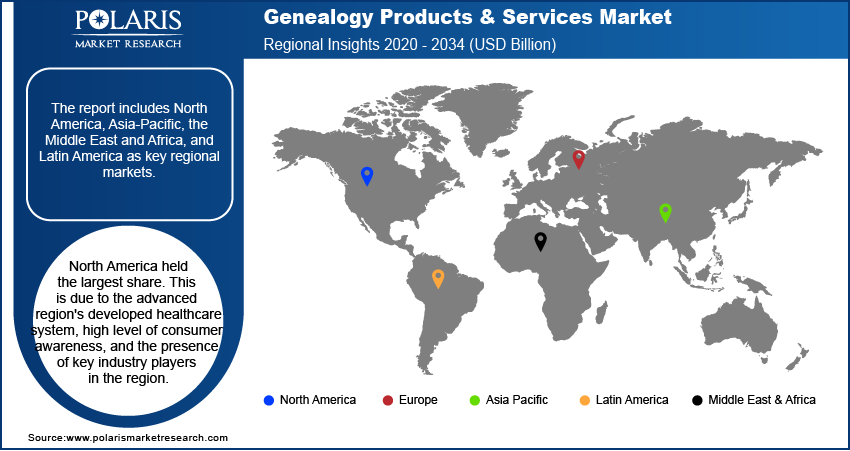
Curious About Regional Market Performance? Request Customization
Key Market Players & Competitive Insights
The genealogy products & services market is highly fragmented, with several leading market players extensively focusing on the diversification of their product offerings to expand their business scope at a global level and boost their revenue potential. Key product & service providers are also focusing on several business development strategies like collaborations, partnerships, and acquisitions & mergers to cater to a wider customer base globally.
Some of the major players operating in the global market include:
- 23 and Me
- American Elements
- Ancestry.Com
- Billion Graves
- CK Life Sciences International Holdings Inc.
- FamilySearch
- Findmypast
- GenealogyBank
- Geneanet
- Infosa
- K + S AG
- Living DNA
- Mitsui Co. Ltd.
- MyHeritage
- WikiTree
Recent Developments
- In August 2025, Ancestry acquired Scottsdale-based iMemories as part of its strategy to enhance AI-driven storytelling, enabling users to preserve, organize, and transform their family memories into engaging digital narratives more efficiently.
- In April 2025, Ancestry beta-launched an AI transcription tool that enables users to generate transcriptions of handwritten records, enhancing accessibility to historical documents.
- In December 2022, RGD announced that they had added genealogical research tools to the list of their products & services, which will provide critical and useful information on a family’s history, factual evidence of the cause of death through generations, and also help in identifying the origin of family or discover unknown family members.
- In March 2023, The Strathclyde Institute for Genealogical Studies was established with the aim of providing academic excellence to create new courses & new research opportunities. The institute will also work with experts, organizations, and many other faculties to develop solutions for people who have an interest in family history.
Genealogy Products & Services Market Report Scope
| Report Attributes | Details |
| Market size value in 2024 | USD 4.57 billion |
| Market size value in 2025 | USD 5.09 billion |
| Revenue Forecast in 2034 | USD 13.56 billion |
| CAGR | 11.5% from 2025 – 2034 |
| Base year | 2024 |
| Historical data | 2020 – 2023 |
| Forecast period | 2025 – 2034 |
| Quantitative units | Revenue in USD billion and CAGR from 2025 to 2034 |
| Segments Covered | By Category, By Application, By Region |
| Regional scope | North America, Europe, Asia Pacific, Latin America; Middle East & Africa |
| Customization | Report customization as per your requirements with respect to countries, region and segmentation. |
Source: Polaris Market Research Analysis
genealogy products and services market FAQ's
The global genealogy products & services market size is expected to reach USD 10.13 billion by 2032.
Key players in the genealogy products & services market are CL Life Sciences International Holdings, Geneanet, Living DNA, Mitsui Co., WikiTree, Ancestry.com.
North American contribute notably towards the global genealogy products & services market.
The global genealogy products & services market is expected to grow at a CAGR of 11.2% during the forecast period.
The genealogy products & services market report covering key segments are category, application, and region.
Download Sample Report of genealogy products and services market
Please fill out the form to request a customized copy of the research report.


