
Generative AI Coding Assistants Market Trends Analysis Report, 2024-2032
REPORT DETAILS
Market Statistics
Generative AI Coding Assistants Market Overview
The generative AI coding Assistants market size was valued at USD 18.08 million in 2023. The market is projected to grow from USD 22.58 billion in 2024 to USD 138.36 million by 2032, exhibiting a CAGR of 25.4% during 2024–2032.
The generative AI coding assistants market is rapidly evolving, driven by advancements in artificial intelligence and natural language processing. AI tools enable developers to automate coding tasks, enhance productivity, and improve code quality by offering features such as code generation, debugging, and optimization. The market is characterized by a diverse range of players, from established tech giants to innovative startups, all competing to capture a significant share of this growing market. Moreover, the rising preference for remote work and the increasing complexity of software projects have accelerated the adoption of these solutions across various industries, such as information and communication technology and semiconductors. As organizations seek to streamline their coding processes and boost efficiency, the generative AI coding assistants market is expected to witness substantial growth in the coming years. In July 2024, C3 AI announced the launch of C3 Generative AI for Government Programs. A generative AI application is designed to assist state, federal, and local governments in efficiently providing accurate information about various government programs, including healthcare, employment, and financial Assistants. This application simplifies access to and understanding of complex government processes, enabling hundreds of millions of citizens and residents to navigate services more efficiently.
Source: Polaris Market Research Analysis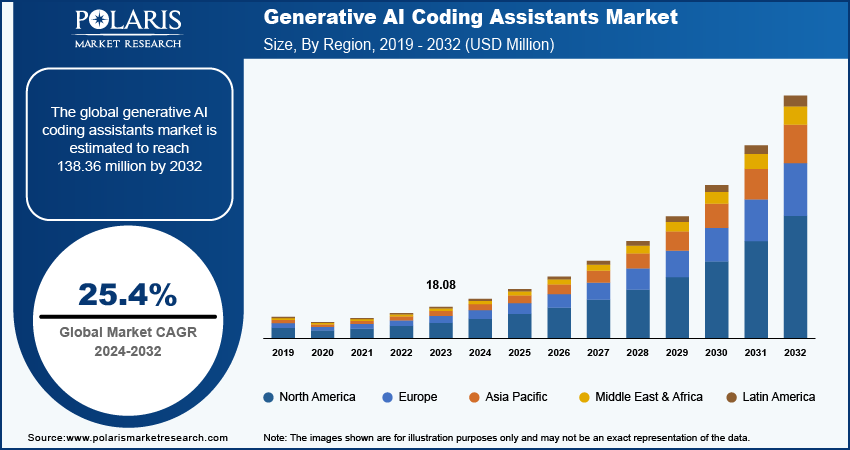
For Specific Research Requirements: Download Sample Report
Generative AI Coding Assistants Market Trends
Adoption of AI in Enterprise Solutions
Large enterprises are increasingly adopting AI tools such as generative AI coding assistants to streamline software development processes. AI tools significantly enhance productivity by automating repetitive coding tasks, debugging, and providing real-time code suggestions. As a result, businesses can deliver high-quality software faster while minimizing human error and reducing development costs. Additionally, AI coding assistants help teams manage more complex projects efficiently, allowing developers to focus on innovation and critical problem-solving, thus making AI adoption an essential strategy for improving overall operational efficiency. In May 2024, Google introduced a custom generative AI model called Gemini, designed to simplify search tasks such as researching, planning, and brainstorming based on user queries. The model integrates advanced features such as multi-step reasoning, planning, and multimodality while leveraging Google’s powerful Search systems. By combining these capabilities, Gemini enhances user experience by providing more intuitive and contextually relevant results, making complex searches easier and more efficient. Thus, the rising adoption of AI in enterprise solutions is expected to drive the AI coding Assistants market growth in the coming years.
Advancements in Natural Language Processing (NLP)
Advancements in AI and Natural Language Processing (NLP) have significantly improved the capabilities of coding assistants. Modern NLP algorithms can accurately interpret natural language descriptions and convert them into executable code, making them more versatile across various programming languages and domains. AI streamlines complex coding tasks and reduces manual efforts, making coding assistants more accessible to developers. The improvements in AI and machine learning models enable these tools to offer precise and context-aware code generation, improving efficiency in software development and debugging processes. For instance, OpenAI Codex, a linage of GPT-3, is trained on millions of lines of source code and natural language, excelling in generating functional code in over a dozen programming languages. OpenAI Codex simplifies coding by understanding natural language commands and mapping tasks to existing code libraries, making programming more accessible. Codex is available in private beta and continues to evolve with a focus on safety.
Source: Polaris Market Research Analysis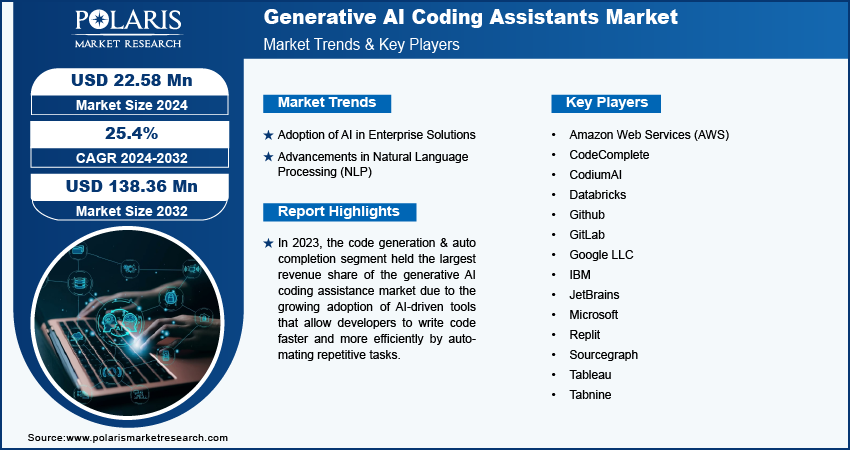
Get Full Segment-Level Forecasts & Insights: Download Sample Report
Market Segment Insights
Generative AI Coding Assistants Breakdown by Function Outlook
The global generative AI coding Assistants market segmentation, based on function, includes code generation & auto completion, debugging and error detection, code refactoring and optimization, code explanation, and others. In 2023, the code generation & auto completion segment held the largest revenue share of the market due to the growing adoption of AI-driven tools that allow developers to write code faster and more efficiently by automating repetitive tasks. AI tools speed up the development process and reduce errors, allowing developers to focus on more complex tasks. Additionally, the increasing demand for higher productivity in software development and the ability to generate accurate code snippets from natural language descriptions are significant factors driving the growth of this segment.
The code refactoring and optimization segment is expected to register at a significant CAGR during the forecast period due to increasing demand for maintaining high-quality, efficient, and scalable code. AI-powered tools in this segment help streamline code improvements, reduce technical debt, and enhance long-term system performance, making them crucial in large-scale software projects.
Generative AI Coding Assistants Breakdown by Deployment Outlook
The global generative AI coding Assistants market, based on deployment, is bifurcated into cloud and on-premises. In 2023, the cloud segment dominated the market due to its flexibility, scalability, and ease of integration with existing development environments. Cloud-based coding assistants allow real-time collaboration among developers, facilitate automatic updates, and reduce infrastructure costs. As organizations are increasingly adopting remote work models and seeking cost-effective solutions, the preference for cloud deployment is expected to grow in the coming years.
The on-premises segment is projected to experience significant growth due to rising concerns about data security and compliance among organizations. Many enterprises prefer on-premises solutions for greater control over their coding environments, especially in industries with strict regulations, such as finance and healthcare. Additionally, on-premises tools allow for customization and integration with existing IT infrastructure, enhancing operational efficiency. As companies prioritize security and control, demand for on-premises generative AI coding Assistants is expected to increase during the forecast period.
Source: Polaris Market Research Analysis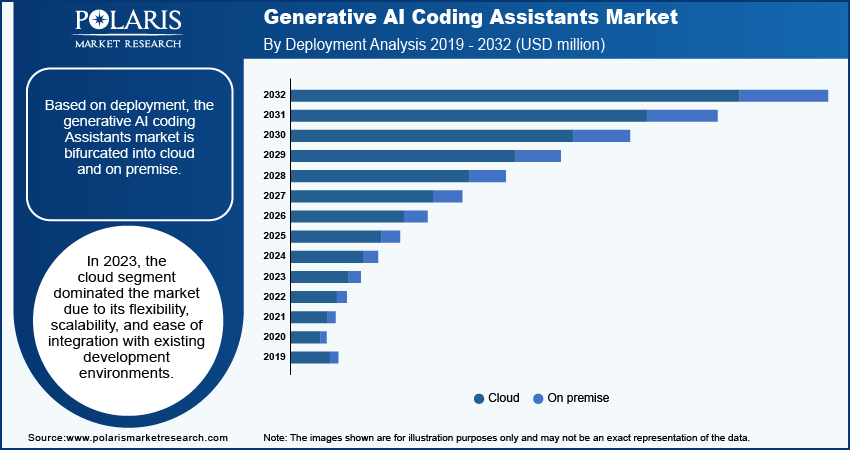
Need Granular Data Across All Market Segments? Request Customization
Generative AI Coding Assistants, by Regional Outlook
By region, the study provides market insights into North America, Europe, Asia Pacific, Latin America, and the Middle East & Africa. In 2023, North America captured a substantial share of the generative AI coding Assistants market, driven by significant investments from leading tech companies and startups. The region’s robust technology ecosystem has been pivotal in accelerating the adoption of AI-driven solutions. Additionally, North America's highly skilled workforce and advanced IT infrastructure foster innovation and rapid adoption of generative AI tools among enterprises. The growing emphasis on enhancing software development efficiency, associated with the rising need for high-quality code and cost reduction, further drives market growth in the region. Moreover, the growing partnerships between technology firms and research institutions are accelerating AI advancements, positioning North America as a key contributor in the sector. In January 2024, Microsoft launched new generative AI and data solutions designed to enhance the entire shopper journey through Microsoft Cloud for Retail. The AI and data solutions provide copilot experiences that enable retailers and brands to incorporate personalization and creativity into their marketing and retail media ad campaigns.
Source: Polaris Market Research Analysis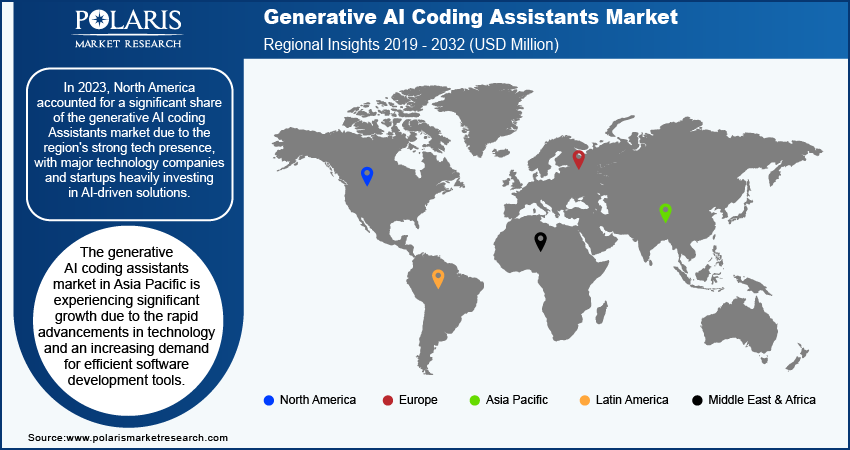
Curious About Regional Market Performance? Request Customization
The generative AI coding assistants market in Asia Pacific is experiencing significant growth due to the rapid advancements in technology and an increasing demand for efficient software development tools. As businesses from various sectors aim to enhance innovation and streamline processes, the adoption of AI-driven coding solutions, such as generative AI coding assistants, is expected to rise across the region in the coming years.
Key Players and Competitive Insights
The competitive landscape of the generative AI coding assistants market is characterized by a diverse mix of regional and global players striving to capture market share through innovation, strategic partnerships, and geographical expansion. Key industry leaders leverage their robust research and development capabilities along with extensive distribution networks to provide advanced coding solutions tailored for various applications, such as software development, data analysis, and automation. These companies emphasize product innovation, focusing on enhancing coding accuracy, efficiency, and user experience to meet the evolving demands of developers and organizations. Additionally, smaller regional firms are emerging with specialized tools that serve specific coding needs or local market preferences. A few common competitive strategies by market players are mergers and acquisitions, collaborations with tech partners, and investments in emerging markets. The strategies are aimed at strengthening market presence and expanding product offerings. IBM, Amazon Web Services (AWS), CodeComplete, CodiumAI, Github, GitLab, Google LLC, JetBrains, Replit, Sourcegraph, Tabnine, Tableau, and Databricks are among the major market players.
International Business Machines Corporation (IBM) is an American technology company based in Armonk, New York. The company operates in more than 175 countries and focuses on advanced technologies such as computer chips, quantum computing, artificial intelligence, and data infrastructure. In October 2023, IBM introduced Watson Code Assistant, a generative AI tool designed to help enterprise developers and IT operators code faster and more accurately using simple language prompts.
Amazon Web Services (AWS), a subsidiary of Amazon, offers APIs and on-demand cloud computing platforms to businesses, governments, and individuals on a metered basis. In April 2024, AWS introduced Amazon Q, a generative AI-powered assistant designed to accelerate software development by utilizing the company's internal data. Amazon Q generates accurate codes and tests and debugs them while providing multi-step planning to implement new code based on developer requests. Additionally, it connects to enterprise data repositories, helping employees answer business questions, summarize data, analyze trends, and engage in discussions about the information.
Key Companies in Generative AI Coding Assistants Market
- Amazon Web Services (AWS)
- CodeComplete
- CodiumAI
- Databricks
- Github
- GitLab
- Google LLC
- IBM
- JetBrains
- Microsoft
- Replit
- Sourcegraph
- Tableau
- Tabnine
Generative AI Coding Assistants Industry Development
In March 2025, Databricks signed a five-year, $100 million partnership with Anthropic to deliver advanced AI tools to enterprises. Through this collaboration, Anthropic’s Claude models will be integrated into the Databricks data platform, enabling organizations to build more powerful AI agents using their own corporate data.
In August 2024, Tableau, a Salesforce subsidiary, launched its first AI assistant, Einstein Copilot, to help analysts work with data more efficiently. The AI tool assists with data preparation and visualization and offers guidance on data models. Additionally, Viz Extensions expands Tableau's visualization capabilities for exploring insights and presenting information in new designs.
In September 2024, Tabnine revealed AI agents designed for Atlassian Jira, featuring a function called "Validate and Implement Jira Issues with One Click." This feature allows users to implement a Jira issue by generating code based on the requirements specified within those issues with a single click. Additionally, the Jira Validation Agent checks that the generated code accurately reflects the outlined requirements, providing suggestions and guidance if discrepancies are found.
In June 2024, Databricks launched Databricks Assistant and AI-Generated Comments across all cloud platforms. The tool is designed to boost productivity in enterprise data management, with over 150,000 users benefiting each month by generating code, troubleshooting errors, and creating visualizations and dashboards. A notable feature, Databricks Assistant Autocomplete, offers real-time code suggestions as user’s type, utilizing Unity Catalog metadata and additional context to provide relevant completions for SQL and Python.
Generative AI Coding Assistants Market Segmentation
By Function Outlook (Revenue, USD Million, 2019–2032)
- Code Generation & Auto Completion
- Debugging and Error Detection
- Code Refactoring and Optimization
- Code Explanation
- Others
By Deployment Outlook (Revenue, USD Million, 2019–2032)
- Cloud
- On-Premises
By Application Outlook (Revenue, USD Million, 2019–2032)
- Individual Developers & Freelancers
- Small and Medium-Sized Enterprises (SMEs)
- Large Enterprises
- Educational Institutions & Students
- Others
By Regional Outlook (Revenue, USD Million, 2019–2032)
- North America
- US
- Canada
- Europe
- Germany
- France
- UK
- Italy
- Spain
- Netherlands
- Russia
- Rest of Europe
- Asia Pacific
- China
- Japan
- India
- Malaysia
- South Korea
- Indonesia
- Australia
- Vietnam
- Rest of Asia Pacific
- Middle East & Africa
- Saudi Arabia
- UAE
- Israel
- South Africa
- Rest of Middle East & Africa
- Latin America
- Mexico
- Brazil
- Argentina
- Rest of Latin America
Generative AI Coding Assistants Market Report Scope
| Report Attributes | Details |
| Market Size Value in 2023 | USD 18.08 million |
| Market Size Value in 2024 | USD 22.58 million |
| Revenue Forecast by 2032 | USD 138.36 million |
| CAGR | 25.4% from 2024 to 2032 |
| Base Year | 2023 |
| Historical Data | 2019–2022 |
| Forecast Period | 2024–2032 |
| Quantitative Units | Revenue in USD million and CAGR from 2024 to 2032 |
| Report Coverage | Revenue Forecast, Market Competitive Landscape, Growth Factors, and Trends |
| Segments Covered |
|
| Regional Scope |
|
| Competitive Landscape |
|
| Report Format |
|
| Customization | Report customization as per your requirements with respect to countries, regions, and segmentation. |
Source: Polaris Market Research Analysis
generative ai coding assistants market FAQ's
The global generative AI coding Assistants market size was valued at USD 18.08 million in 2023 and is projected to grow to USD 138.36 million by 2032
The global market is projected to register a CAGR of 25.4% during the forecast period.
In 2023, North America accounted for a significant market share due to the region's strong tech presence, with major technology companies and startups heavily investing in AI-driven solutions.
A few key players in the market are IBM, Amazon Web Services (AWS), CodeComplete, CodiumAI, Github, GitLab, Google LLC, JetBrains, Replit, Sourcegraph, Tabnine, Tableau, and Databricks.
In 2023, the code generation & auto completion segment held the largest revenue share of the market due to the growing adoption of AI-driven tools that allow developers to write code faster and more efficiently by automating repetitive tasks.
In 2023, the cloud segment dominated the market due to its flexibility, scalability, and ease of integration with existing development environments.
Download Sample Report of generative ai coding assistants market
Please fill out the form to request a customized copy of the research report.


