
Sepsis Diagnostics Market Share, Size, Industry Analysis Report, 2026-2034
REPORT DETAILS
Market Statistics
Market Overview
The sepsis diagnostics market size was valued at USD 692.70 million in 2025. It is projected to exhibit a CAGR of 7.9% from 2026 to 2034. Rising number of sepsis cases and the need for early diagnosis are supporting market growth. Increasing use of advanced diagnostic tests and better healthcare facilities is also contributing to overall market growth.
Key Insights
- North America held the largest share of the sepsis diagnostics market in 2025, accounting for 49.80% of revenue, due to strong healthcare facilities and early use of diagnostic technologies.
- Asia Pacific is expected to grow at a CAGR of 8.2% during 2026–2034, supported by rising healthcare spending and a growing patient population.
- In the product segment, assay kits & reagents are projected to grow at a CAGR of 8.7% during the forecast period, supported by their continued use in routine sepsis testing.
- Point-of-care testing is growing at a faster pace under the testing type, as it provides quick results and helps in faster treatment decisions.
- By technology, the microbiology segment dominated the market in 2025, accounting for 49.82% of revenue, supported by its established role in pathogen identification across clinical settings.
Market Statistics
- 2025 Market Size: USD 692.70 Million
- 2034 Projected Market Size: USD 1,371.18 Million
- CAGR (2026–2034): 7.9%
- North America: Largest market in 2025
Industry Dynamics
- Advancements in molecular diagnostics enhance the precision and turnaround time of sepsis detection. Compared to older methods, techniques like PCR and NGS allow for faster identification of pathogens.
- Biomarker-based testing boosts early-stage detection and clinical monitoring. Biomarkers like procalcitonin and CRP improve diagnostic accuracy and assist in treatment decisions.
- Point-of-care testing facilitates rapid, bedside diagnostics. It helps with timely intervention and improves clinical outcomes.
- Multiplex assays allow for the simultaneous detection of multiple pathogens. This increases efficiency in managing complicated sepsis cases.
- High implementation costs and infrastructure requirements may slow adoption. This is more evident in resource-limited healthcare settings.
Source: Polaris Market Research Analysis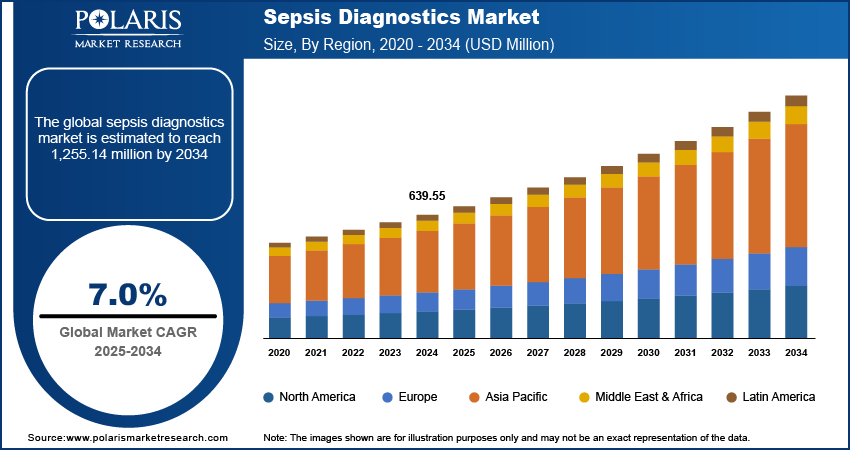
To Understand More About this Research:Download Sample Report
Impact of AI on Sepsis Diagnostics Market
- Artificial intelligence (AI) is becoming an important part of the sepsis diagnostics market. It helps analyze patient data, lab results, and biomarker patterns to detect sepsis risk early.
- AI supports medical practitioners in prioritizing testing and making faster decisions. It does not replace microbiology or molecular tests but improves how promptly useful insights are identified.
- Machine learning helps find patterns in clinical data. This supports early detection and better risk stratification in sepsis cases.
- Software-based diagnostics are gaining importance with the improvement of digital infrastructure. Hospitals and labs are using more data-driven tools for better diagnosis.
- Vendors are combining tests with analytics, automation, and alert systems. This boosts workflow efficiency and strengthens overall diagnostic value.
The market covers diagnostic technologies, consumables, instruments, assays, and software for sepsis detection and monitoring. Sepsis is a life-threatening condition triggered by a dysregulated response to infection. These solutions support early identification, confirmation, and monitoring. Sepsis diagnostics are used in hospitals, emergency departments, ICUs, pathology labs, and reference labs. They help identifying infection sources and assessing severity. They also support timely treatment decisions. Source: Polaris Market Research Analysis Source: Polaris Market Research Analysis Source: Polaris Market Research Analysis Source: Polaris Market Research Analysis
Key market drivers include the increasing incidence of infections and the rising focus on early intervention. Advances in molecular sepsis testing help with faster and more dependable diagnosis. The use of point-of-care sepsis diagnostics is improving access to rapid testing. These factors are shaping key sepsis diagnostics market trends and supporting market growth.
The market is seeing increased adoption of advanced technologies. The use of AI in sepsis diagnostics is advancing for early risk detection and clinical support. Adoption of multiplex assays is rising, along with demand for biomarker-based sepsis testing. These technologies improve precision and reduce time to results. Source: Polaris Market Research Analysis Source: Polaris Market Research Analysis
Market Dynamics
Advancements in Molecular Diagnostics
Molecular diagnostic technologies are improving the detection and management of sepsis. These methods allow for quicker and more accurate identification of pathogens. Techniques such as digital PCR, sepsis diagnostics, and NGS sepsis diagnostics deliver results more quickly than conventional methods. This supports timely clinical decisions, especially in critical cases. Their ability to detect genetic material and resistance markers strengthens antimicrobial resistance detection. These developments are expanding the use of molecular diagnostics for sepsis and backing demand for rapid sepsis diagnostics. Source: Polaris Market Research Analysis Source: Polaris Market Research Analysis
Increased Adoption of Biomarker-Based Testing
Biomarker-based testing is emerging as a main element within the sepsis diagnostics market. It helps early recognition, risk stratification, and longitudinal monitoring of patients. Biomarkers such as procalcitonin, CRP, interleukins, and lactate are increasingly embedded in clinical workflows. Tests such as the procalcitonin sepsis test, CRP sepsis diagnostics, and lactate testing for sepsis help distinguish systemic infection from other inflammatory responses. They also provide insight into disease progression. The growing use of biomarker panels for sepsis is strengthening the overall sepsis biomarkers market. Source: Polaris Market Research Analysis Source: Polaris Market Research Analysis
Rising Demand for Point-of-Care Testing
The growing need for rapid and decentralized diagnostics is driving the adoption of point-of-care (poc) diagnostics. These solutions enable testing closer to the patient, reducing delays linked to sample transport and centralized labs. Bedside sepsis testing helps with quicker assessment of infection markers. It is widely used in emergency care, where timely decisions are critical. Fast sepsis testing and quick screening are key to better initial assessments and patient care. The use of portable sepsis diagnostic devices is rising across different care settings. Source: Polaris Market Research Analysis Source: Polaris Market Research Analysis
Clinical Urgency and Time-to-Treatment Optimization
Reducing the time between patient admission and treatment is a main focus in the sepsis diagnostics market. Delays in diagnosis can lead to longer treatment cycles and inefficient resource use. Faster early sepsis diagnosis helps improve outcomes. Tools such as sepsis triage tools support patient prioritization in critical settings. Improving time-to-antibiotic sepsis is becoming essential in clinical practice. There is a rising demand for rapid sepsis decision-making and a more structured sepsis diagnostic workflow. Source: Polaris Market Research Analysis Source: Polaris Market Research Analysis
AI-Enabled Risk Stratification and Decision Support
Artificial intelligence is becoming an important factor in the sepsis diagnostics market. AI in sepsis diagnostics helps analyze patient data, lab results, and biomarker patterns. This supports machine learning sepsis detection and enables early risk identification. Tools for sepsis risk stratification help clinicians prioritize testing and treatment. They also support clinical decision support for sepsis and improve predictive sepsis analytics. AI does not replace core diagnostic methods but improves workflow speed and data interpretation. Source: Polaris Market Research Analysis Source: Polaris Market Research Analysis
Antimicrobial Stewardship and Hospital Workflow Efficiency
Sepsis diagnostics are now evaluated beyond accuracy and speed. Healthcare providers are focusing on antimicrobial stewardship diagnostics to improve treatment use. These tools support better sepsis treatment optimization and reduce unnecessary antibiotic exposure. They help guide antibiotic de-escalation diagnostics and improve clinical confidence. The focus on efficient hospital workflow for sepsis is increasing. As a result, demand for effective sepsis management tools is growing. Source: Polaris Market Research Analysis Source: Polaris Market Research Analysis
Source: Polaris Market Research Analysis
Get Full Segment-Level Forecasts & Insights: Download Sample Report
Segment Insights
Product-Based Insights
The sepsis diagnostics market is segmented into instrument, blood culture media, assay kits & reagents, software, and related solutions. Among these, assay kits & reagents for sepsis hold the largest share and are projected to grow at a CAGR of 8.7% during the forecast period. They are largely used in routine testing across different workflows. These sepsis diagnostic products are used regularly, which supports repeat demand. Products such as blood culture media and other sepsis diagnostic consumables are essential in testing processes. Their wide use across systems strengthens the demand for sepsis testing kits. Source: Polaris Market Research Analysis Source: Polaris Market Research Analysis
Technology-Based Insights
By technology, the market segmented into microbiology, molecular diagnostics, immunoassays, flow cytometry, and others. Microbiology sepsis testing holds the largest share, accounting for 49.82% of revenue in 2025. Techniques such as blood culture sepsis diagnostics are widely used for confirmation. These sepsis diagnostic technologies help with accurate pathogen confirmation in sepsis. Despite a longer turnaround time, culture-based sepsis testing remains trusted in clinical practice. Its strong adoption across hospitals and labs helps its leading position. Source: Polaris Market Research Analysis Source: Polaris Market Research Analysis
Immunoassays and flow cytometry are used in specific diagnostic settings. Immunoassay sepsis diagnostics support biomarker analysis in sepsis and help track disease progression. Flow cytometry sepsis testing is used for detailed immune assessment in complex cases. These methods contribute to advanced sepsis diagnostics by adding more clinical insights. They also support immune profiling in sepsis, helping improve understanding of patient response.
Testing Type-Based Insights
Based on testing type, the market is segmented into laboratory testing and point-of-care testing. Laboratory sepsis testing holds the larger share. Centralized sepsis diagnostics in hospital labs support detailed analysis and confirmation. Hospital lab sepsis testing uses advanced systems and skilled staff for precise results.
This sepsis diagnostic infrastructure boosts complex workflows and large sample volumes. It also enables high-throughput sepsis testing, making labs essential in clinical practice. Point-of-care sepsis testing is expected to grow at a faster pace. It supports faster diagnosis in urgent settings. Bedside sepsis diagnostics and portable sepsis analyzers help deliver quick results. These tools are widely used in emergency care. Emergency sepsis testing supports faster decisions and improves patient triage. The use of rapid triage diagnostics is increasing in ICUs and remote settings.
The role of both testing types is becoming more aligned. Lab vs point-of-care sepsis testing is now seen as working together rather than competing. Labs support confirmation and complex analysis. Point-of-care tools support speed and early action. The shift toward an integrated sepsis diagnostic workflow is growing. Providers are adopting interoperable sepsis platforms across different sepsis testing settings. This approach strengthens the value of complementary sepsis diagnostics in the market.
End User-Based Insights
By end user, the market is segmented into hospitals and clinics, pathology and reference laboratories, research institutes, and others. Hospitals’ sepsis diagnostics hold the largest share. Clinics’ sepsis testing also supports early case identification. Most sepsis diagnosis in hospitals requires fast testing and immediate decisions. These settings rely on critical care sepsis diagnostics for timely treatment. Strong demand and regular use support hospital procurement of sepsis tests. Source: Polaris Market Research Analysis Source: Polaris Market Research Analysis Source: Polaris Market Research Analysis Source: Polaris Market Research Analysis
Pathogen-Based Insights
Based on pathogen, the market is segmented into bacterial sepsis, fungal sepsis, and others. Bacterial sepsis diagnostics hold the largest share. Bacterial infections are the most common cause of sepsis cases. This drives demand for sepsis pathogen testing across clinical settings. The bacterial sepsis market is supported by the need for fast pathogen identification in sepsis. Hospitals depend on advanced sepsis detection tools for timely diagnosis.
The differentiation between gram-positive and gram-negative bacteria is crucial for making treatment decisions. Diagnosing gram-positive and gram-negative sepsis helps determine the best therapies. These diagnostic methods also allow for quicker identification of antimicrobial resistance in clinical settings. The use of multiplex pathogen panels is increasing for quicker results. These tools improve sepsis pathogen differentiation and support targeted treatment.
Fungal sepsis diagnostics represent a smaller but critical segment. These cases are complex and often seen in high-risk patients. Invasive fungal infection testing is important in such conditions. These solutions support sepsis diagnostics for critical care settings. Demand for specialized sepsis testing is increasing in complex cases. This segment also backs growth in complex infection diagnostics.
Clinical Workflow and Diagnostic Pathway
Sepsis diagnostics are part of a broader sepsis diagnostic workflow. The process starts with suspicion and moves toward treatment decisions. Patients often present with non-specific symptoms. These include fever, low blood pressure, or mental changes. Clinicians need to determine, swiftly, whether an infection is the underlying problem. This supports early sepsis diagnosis and timely care. Hospitals rely on structured hospital sepsis pathway models to guide actions. Tools such as sepsis triage tools help prioritize patients. This makes an efficient sepsis clinical workflow essential in practice. Source: Polaris Market Research Analysis Source: Polaris Market Research Analysis
Source: Polaris Market Research Analysis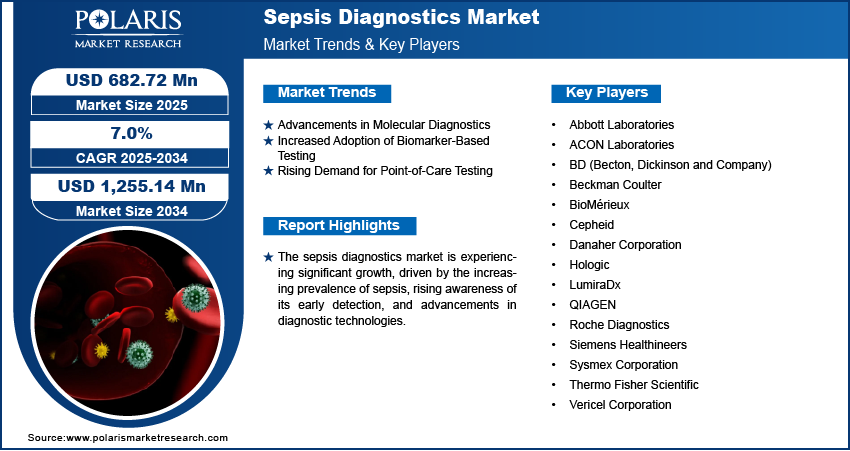
Need Granular Data Across All Market Segments? Request Customization
Regional Insights
The study covers North America, Europe, Asia Pacific, Latin America, and the Middle East & Africa. Source: Polaris Market Research Analysis Source: Polaris Market Research Analysis Source: Polaris Market Research Analysis Source: Polaris Market Research Analysis Source: Polaris Market Research Analysis Source: Polaris Market Research Analysis Source: Polaris Market Research Analysis Source: Polaris Market Research Analysis Source: Polaris Market Research Analysis Source: Polaris Market Research Analysis
Source: Polaris Market Research Analysis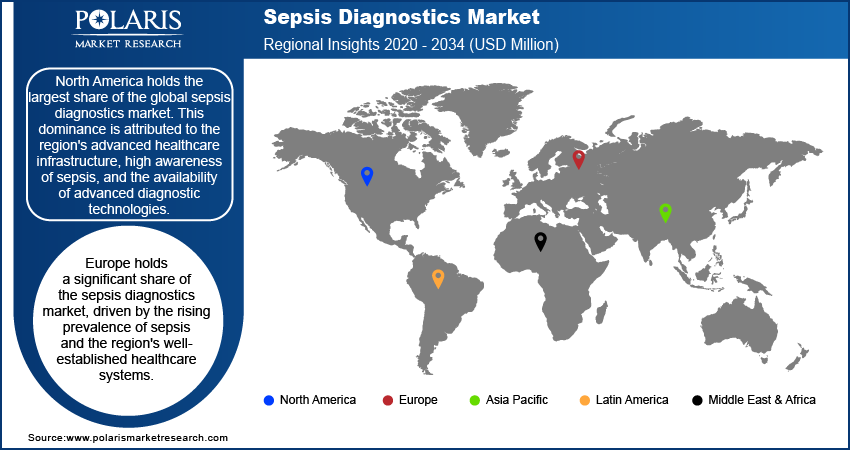
Curious About Regional Market Performance? Request Customization
Key Players and Competitive Insights
Key players operating in the sepsis diagnostics market include Thermo Fisher Scientific, Abbott Laboratories, BioMérieux, Danaher Corporation, Roche Diagnostics, Siemens Healthineers, BD, QIAGEN, Sysmex Corporation, Beckman Coulter, Hologic, LumiraDx, Cepheid, ACON Laboratories, and Vericel Corporation. These sepsis diagnostics companies shape the current sepsis diagnostics competitive landscape through ongoing product development and market presence. Source: Polaris Market Research Analysis Source: Polaris Market Research Analysis Source: Polaris Market Research Analysis Source: Polaris Market Research Analysis Source: Polaris Market Research Analysis Source: Polaris Market Research Analysis Source: Polaris Market Research Analysis Source: Polaris Market Research Analysis Source: Polaris Market Research Analysis Source: Polaris Market Research Analysis
List of Key Companies
- Abbott Laboratories
- ACON Laboratories
- BD (Becton, Dickinson and Company)
- Beckman Coulter
- BioMérieux
- Cepheid
- Danaher Corporation
- Hologic
- LumiraDx
- QIAGEN
- Roche Diagnostics
- Siemens Healthineers
- Sysmex Corporation
- Thermo Fisher Scientific
- Vericel Corporation
Industry Developments
Recent sepsis diagnostics industry developments show continued investment in faster and more precise solutions. Companies are advancing rapid sepsis testing launches to improve response time in clinical settings. Investment in point-of-care sepsis solutions is increasing, especially in critical care and emergency settings. These changes reflect ongoing improvements in diagnostics and shifting healthcare needs. The market is moving with broader sepsis innovation trends, focusing on speed, accuracy, and practical use.
- In January 2025, Cytovale reached a major milestone, positioning itself as a leading player in the sepsis diagnostics market, driven by rising demand for its FDA-cleared IntelliSep test for rapid sepsis detection.
- In October 2024, Trinity Biotech acquired a 12.5% equity stake in Novus Diagnostics, valuing the company at USD 2.5 million. The investment is intended to support the accelerated development and commercialization of Novas Diagnostics’ point-of-care solutions.
Regulatory, Quality, and Adoption Considerations
The success of sepsis diagnostics depends on more than speed and accuracy. Regulation and proper validation matter for adoption. Hospitals prefer solutions that fit existing systems and support smooth workflow integration. Tests must fit into existing systems without adding complexity. These factors influence overall sepsis diagnostics adoption barriers in clinical settings. Source: Polaris Market Research Analysis Source: Polaris Market Research Analysis
Market Segmentation
By Product Outlook (Revenue, USD Million, 2021-2034)
- Instrument
- Blood Culture Media
- Assay Kits & Reagents
- Software
By Technology Outlook (Revenue, USD Million, 2021-2034)
- Microbiology
- Molecular Diagnostics
- Immunoassays
- Flow Cytometry
- Others
By Testing Type Outlook (Revenue, USD Million, 2021-2034)
- Laboratory Testing
- Point-of-Care Testing
By End User Outlook (Revenue, USD Million, 2021-2034)
- Hospitals & Clinics
- Pathology & Reference Laboratories
- Research Institutes
- Others
By Pathogen Outlook (Revenue, USD Million, 2021-2034)
- Bacterial Sepsis
- Gram Positive Bacteria
- Gram Negative Bacteria
- Fungal Sepsis
- Others
By Regional Outlook (Revenue, USD Million, 2021-2034)
- North America
- US
- Canada
- Europe
- Germany
- France
- UK
- Italy
- Spain
- Netherlands
- Russia
- Rest of Europe
- Asia Pacific
- China
- Japan
- India
- Malaysia
- South Korea
- Indonesia
- Australia
- Vietnam
- Rest of Asia Pacific
- Middle East & Africa
- Saudi Arabia
- UAE
- Israel
- South Africa
- Rest of Middle East & Africa
- Latin America
- Mexico
- Brazil
- Argentina
- Rest of Latin America
Report Scope
The sepsis diagnostics market report provides revenue forecasts, competitive analysis, and key sepsis diagnostics industry trends. It includes detailed sepsis diagnostics segmentation across product, technology, testing type, end user, pathogen, and region. The report also covers the outlook up to the sepsis diagnostics forecast for the 2034 period.
The sepsis diagnostics report scope is designed to support strategic planning and market entry decisions. It helps with competitive benchmarking, partnership evaluation, and regional opportunity assessment for stakeholders in the sepsis diagnostics market.
| Report Attributes | Details |
| Market Size in 2025 | USD 692.70 Million |
| Market Size in 2026 | USD 745.46 Million |
| Revenue Forecast by 2034 | USD 1371.18 Million |
| CAGR | 7.9% from 2026 to 2034 |
| Base Year | 2025 |
| Historical Data | 2021-2024 |
| Forecast Period | 2026-2034 |
| Quantitative Units | Revenue in USD million and CAGR from 2026 to 2034 |
| Report Coverage | Revenue Forecast, Market Competitive Landscape, Growth Factors, and Trends |
| Segments Covered |
|
| Regional Scope |
|
| Competitive Landscape |
|
| Report Format |
|
| Customization | Report customization as per your requirements with respect to countries, regions, and segmentation |
Source: Polaris Market Research Analysis
Why Market Estimates Vary Across Reports
Public estimates for the sepsis diagnostics market often differ across sources. This is mainly due to differences in sepsis diagnostics market methodology and how each firm defines the market. Some reports use a broader sepsis diagnostics report scope, including biomarker assays, software, and related tools. Others follow a narrower approach focused on specific testing categories. Source: Polaris Market Research Analysis Source: Polaris Market Research Analysis
How is the report valuable for an organization?
Workflow/Innovation Strategy
The report provides clear and structured insights into the sepsis diagnostics market across key segments. It helps organizations understand where opportunities are emerging and helps make better strategy and planning decisions. It also gives a practical view of how diagnostic workflows are changing, helping teams align their approach with current market needs.
Growth/Marketing Strategy
The report highlights key growth areas and strategic directions in the market. New entrants can look at opportunities in rapid testing, AI-based diagnostics, and point-of-care solutions. Established players can focus on expanding their offerings and strengthening clinical value. It supports long-term planning by giving useful insights into partnerships, innovation, and regional expansion.
Sepsis Diagnostics Market FAQ's
The sepsis diagnostics market size was valued at USD 692.70 million in 2025. It is projected to reach USD 1,371.18 million by 2034. It is growing at a CAGR of 7.9% during the forecast period.
Growth is driven by the rising burden of sepsis. There is more focus on early diagnosis. Advances in molecular and biomarker testing support growth. Demand for rapid point-of-care testing is increasing.
North America held the largest share in 2025. This is due to strong healthcare systems. Awareness is high. Adoption of advanced diagnostics is early.
Assay kits and reagents led the market. They are widely used in routine testing. They support continuous demand across hospitals and labs.
Microbiology dominates the market. Blood culture testing is widely used. It supports pathogen identification and clinical decisions.
Molecular diagnostics is the fastest-growing segment. It provides faster results. It improves accuracy. It supports early treatment.
Sepsis diagnostics include tests, instruments, assays, and software. They help identify infection. They assess severity. They support treatment decisions.
Key trends include AI in diagnostics. Biomarker panels are expanding. Molecular testing is growing. Point-of-care use is increasing. Workflow integration is improving.
Diagnostic manufacturers, investors, and distributors should buy this report. Hospital procurement teams and strategy leaders can use it. Research institutions and organizations exploring this market can benefit.
Point-of-care testing reduces time to results. It helps in faster triage. It supports quick treatment decisions in emergency and critical care.
Download Sample Report of Sepsis Diagnostics Market
Please fill out the form to request a customized copy of the research report.


