
Hot-Melt Adhesives Market Growth, Industry Share, Trends, 2026-2034
REPORT DETAILS
Market Statistics
Hot-Melt Adhesives Market Overview
The global hot-melt adhesives market size was valued at USD 9.56 billion in 2025. It is projected to grow at a CAGR of 3.1% from 2026 to 2034. Rising construction activities are driving the hot-melt adhesives market growth, as the demand for versatile and efficient bonding solutions increases across various construction applications.
Key Takeaways
- North America led with a 27.90% revenue share in 2025. The expansion of production plants by key companies contributes to the regional market dominance.
- Asia Pacific is projected to register a significant CAGR of 5.8% . The growing automotive sector in emerging economies contributes to the regional market development.
- China is anticipated to account for a 5.4% CAGR. The rapid expansion of the furniture sector in China drives market growth.
- The ethylene vinyl acetate (EVA) segment led with a 39.15% revenue share in 2025. The versatile properties and wide applications of EVA contribute to the segment’s rapid growth.
- The packaging solutions segment held the largest revenue share of 29.83% in 2025, driven by global growth in the packaging sector.
Note: Figures and projections outlined in this report are the result of Polaris Market Research’s proprietary analytical processes, grounded in the latest available datasets and market observations.
Market Statistics
- 2025 Market Size: USD 9.56 billion
- 2034 Projected Market Size: USD 12.59 billion
- CAGR (2026–2034): 3.1%
- North America: Largest Market in 2025
Industry Dynamics
- The development of new formulations with enhanced properties to meet evolving needs contributes to the market growth.
- The introduction of strategic initiatives by manufacturers to enhance their product offerings is expected to drive market development.
- The rising focus on the development of sustainable formulations is expected to present several market opportunities.
- High raw material price volatility may present market challenges
Hot-melt adhesives are thermoplastic adhesives that are applied in a molten state and solidify upon cooling to form a strong bond. The hot-melt adhesives expansion is being driven by significant growth in the electronics and automotive elctronics sector. Countries worldwide are experiencing increased sales of consumer electronics. For instance, according to IBEF, domestic electronics production in India reached USD 101.0 billion in the fiscal year 2022-23, with the electronics sector accounting for ∼3.4% of the country's gross domestic product (GDP). This growth has created the need for effective and efficient adhesive solutions, such as hot-melt adhesives, which are used in various applications, including securing components, assembling electronic housings, and providing moisture and vibration resistance.
Source: Polaris Market Research Analysis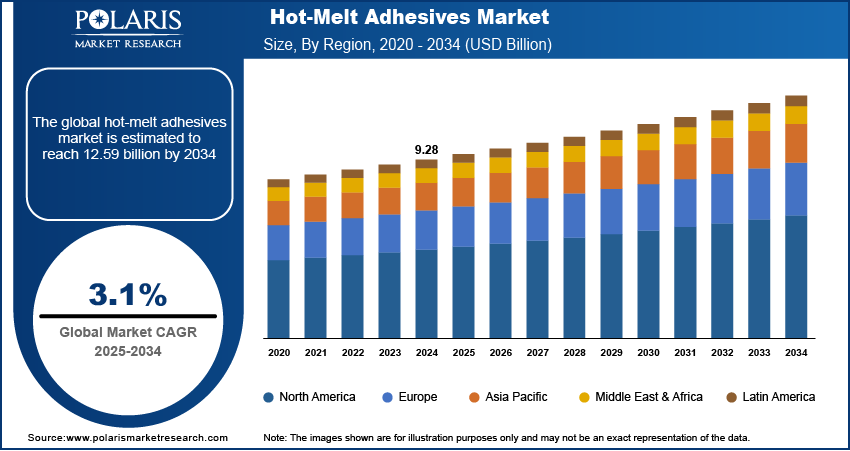
To Understand More About this Research: Download Sample Report
Hot Melt vs Solvent-Based Adhesives
| Aspect | Hot Melt Adhesives | Solvent-Based Adhesives |
| Drying Time | Fast | Moderately slow because of solvent evaporation |
| Environmental Impact | Minimal | Higher impact due to volatile organic compounds emissions |
| Efficiency | High | Moderate |
| Application | Commonly used in automation | Limited in high-speed processes |
Source: Polaris Market Research Analysis
Market Dynamics
Innovative Product Launches
Companies are introducing advanced adhesive solutions to meet evolving needs and applications by developing new formulations with enhanced properties such as improved bonding strength, better thermal resistance, and reduced environmental impact. For instance, in March 2022, Conagen introduced debondable hot-melt adhesives made from high-performance, sustainable, and natural bio-molecules. The innovation provides manufacturers with an alternative solution for debondable structural adhesives, enabling cost savings and waste reduction in the manufacturing process. Such product launches are expanding the range of applications for hot-melt adhesives and catering to the needs of consumers seeking environment-friendly solutions. Thus, the introduction of new adhesive technologies and products is boosting the hot-melt adhesives revenue.
Strategic Initiatives by Manufacturers
Manufacturers are employing strategic activities to enhance their product offerings and expand reach. They are investing in research and development to innovate adhesive formulations and partnering with other companies to broaden their product portfolios and enter new geographies. For instance, in March 2023, Pidilite Industries partnered with Jowat SE, a German supplier of industrial adhesives, to provide locally manufactured Jowat hot melts to customers in India. These strategic activities are optimizing production processes and supply chains, thereby reducing costs, improving efficiency, and enhancing competitiveness. Thus, the increased focus of manufacturers on collaboration with other companies to produce and distribute adhesive solutions is driving the hot-melt adhesives development.
Eco-Friendly Nature of Hot Melt Adhesives
The demand for hot melt adhesive is rising because of its eco-friendly features such as the lack of solvents and low emissions of volatile organic compounds (VOCs). The use of bio-adhesive, along with its compatibility with recycled packing materials, has been instrumental in achieving sustainability goals. In addition to this, companies are focusing on saving energy during the process of the application itself.
Role in Packaging & E-commerce Growth
There has been an increased demand for good quality packaging due to the emergence of e-commerce. Hot melts are commonly utilized to quickly and efficiently pack products for shipment. Moreover, hot melts can be applied using automated machinery, thus increasing speed and minimizing delays. Hot melts are capable of bonding different surfaces, ensuring that the content of packages is protected during transportation
Source: Polaris Market Research Analysis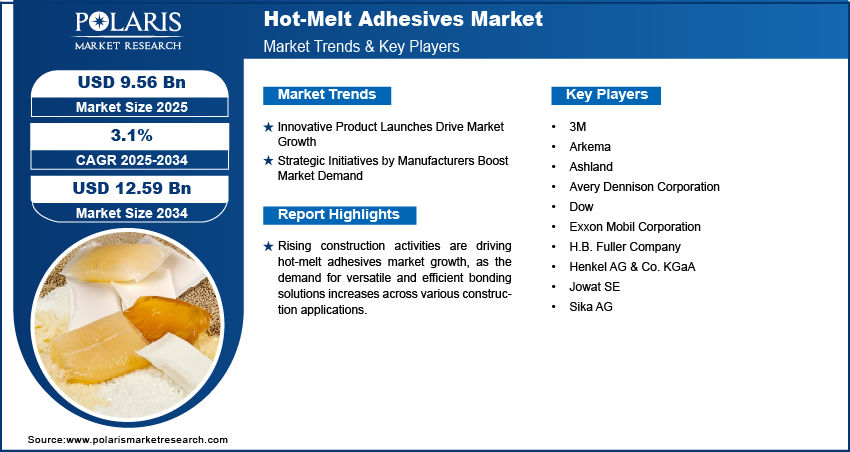
Get Full Segment-Level Forecasts & Insights: Download Sample Report
Segment Insights
Hot-Melt Adhesives Market Assessment Based on Type
The global hot-melt adhesives market, based on type, is segmented into amorphous polyalphaolefin, ethylene vinyl acetate, metallocene polyolefin, polyolefins, styrenic block copolymer, and others. The ethylene vinyl acetate (EVA) segment dominated the global market with 39.15% share in 2025 due to its versatile properties and wide range of applications in the paper, woodworking, automotive, and packaging industries. EVA-based hot-melt adhesives are known for heat resistance, durability, and flexibility, making them suitable for a variety of bonding needs in several industries. Moreover, an EVA-based hot-melt adhesives formulation possesses high VA content that results in higher transparency, more polarity, extended flexibility, and enhanced wettability to substrates. EVA adhesives also offer favorable processing characteristics, such as easy melting at relatively low temperatures. Thus, all the aforementioned factors have contributed to the segment’s dominance in the global market.
Hot-Melt Adhesives Market Evaluation Based on Application
The global hot-melt adhesives market, based on application, is segmented into automotive, bookbinding, furniture & woodwork, nonwoven hygiene products, packaging solutions, and others. The packaging solutions segment held the largest revenue share of 29.83% in 2025, driven by global growth in the packaging sector and increased demand for various types of packaging such as aseptic cartoon packaging across multiple sectors. For instance, the Packaging Industry Association of India stated that the packaging sector is growing at a CAGR of 22% to 25%. Further, the Indian Institute of Packaging reported that packaging consumption in India has increased by 200% over the period of the last ten years, rising from 4.3 kg to 8.6 kg per person per annum as of fiscal year 2020. This growth created a demand for efficient, secure, and attractive packaging. As a result, hot-melt adhesives have become essential for reliable sealing, bonding, and labeling solutions, contributing to the dominance of packaging solutions.
Source: Polaris Market Research Analysis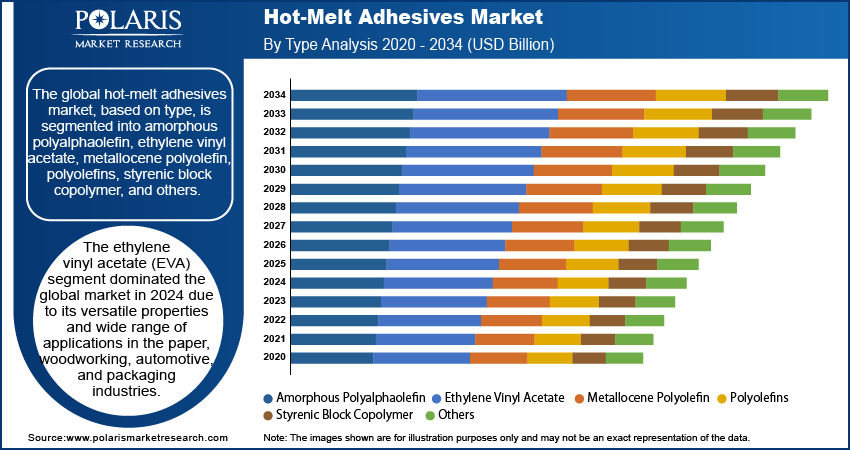
Need Granular Data Across All Market Segments? Request Customization
Regional Analysis
By region, the study provides the hot-melt adhesives market insights into North America, Europe, Asia Pacific, Latin America, and the Middle East & Africa. North America dominated the global market in 2025 with 27.90% share because of the expansion of production plants by key companies, which have enhanced the region's manufacturing capabilities and supply chain efficiency. The establishment and upgradation of production facilities in North America have also boosted local production capacities. For instance, in January 2021, Colquímica Adhesives, a global player in the industrial hot melt adhesives sector with its headquarters in Portugal, opened its new subsidiary, Colquímica Adhesives Inc., and its facilities in North Carolina, United States. Therefore, the presence of advanced manufacturing technologies and strong distribution networks has led to the North America hot-melt adhesives market dominance.
The market in Asia Pacific is projected to register a significant CAGR of 5.8% during the forecast period, driven by the automotive sector in countries such as China, India, and Japan. For instance, according to IBEF, the combined production of two-wheelers, three-wheelers, passenger vehicles, and quadricycles in India rose from 2,328,329 units in January 2024 to 2,358,041 units in April 2024. This growth in automotive production is creating the demand for advanced adhesive solutions that meet the durability requirements. Hot-melt adhesives are extensively used in automotive applications for bonding trim, assembly parts, and interior components. Thus, the increasing demand for adhesives is contributing to the significant growth in the region.
The market for hot-melt adhesives in China is anticipated to grow significantly due to the rapid expansion of the furniture sector within the country. For instance, according to the China National Furniture Association, China's furniture sector had a total of 6647 large-scale enterprises in 2021, generating a cumulative revenue of USD 122.43 billion, marking a 13.5% increase from 2020. This growth in the furniture industry has generated the need for hot-melt adhesives that have fast-setting properties and superior adhesion to materials such as wood, laminates, and textiles.
Source: Polaris Market Research Analysis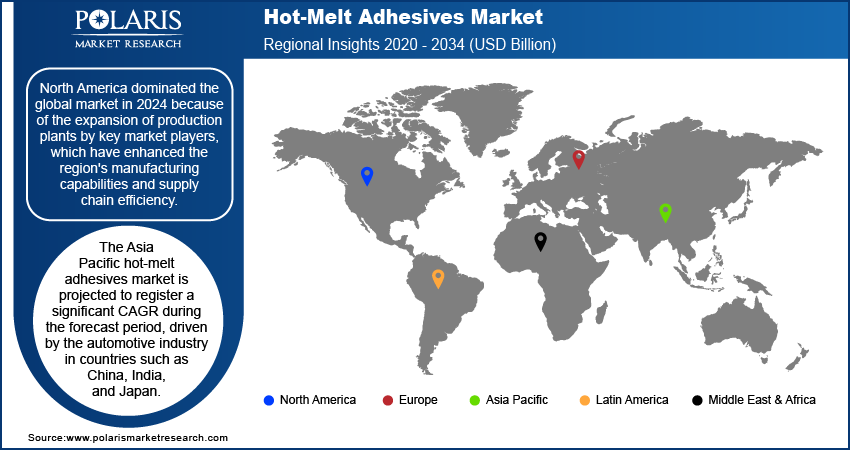
Curious About Regional Market Performance? Request Customization
Key Players and Competitive Insights
The global market is dominated by several key players competing for revenue share through innovation, strategic partnerships, and expansive product portfolios. The established players lead by offering advanced adhesive solutions tailored for diverse applications across industries, including packaging, automotive, and construction. The companies are investing in research and development to introduce high-performance products and maintain technological leadership.
The regional players and local manufacturers are increasingly focusing on emerging regions and specialized formulations to capture specific needs. The dynamic and evolving competitive environment fosters continuous improvement and innovation in the industry. Major players include 3M, Arkema, Ashland, Avery Dennison Corporation, Dow, Exxon Mobil Corporation, H.B. Fuller Company, Henkel AG & Co. KGaA, Jowat SE, and Sika AG.
Henkel AG & Co. KGaA is a multinational company that is primarily involved in the designing, manufacturing, and sale of home care & laundry, and beauty care products along with adhesive technologies. In June 2022, Henkel opened a hot melt adhesives facility in Nuevo Leon, Mexico, to produce both pressure-sensitive and non-pressure-sensitive hot melt under the Technomelt brand.
H.B. Fuller Company is a chemical manufacturing company that specializes in the formulation, manufacturing, and distribution of a wide range of sealants, adhesives, coatings, and other specialty chemical products. The company operates in over 34 countries in North America, Latin America, Europe, Asia Pacific, and the Middle East and Africa. The company operates in three business segments: Engineering Adhesives, Hygiene, Health and Consumable Adhesives, and Construction Adhesives. The Engineering Adhesives segment offers high-performance adhesives, including light cure, reactive, two-part liquids, polyurethane, film, silicone, and fast cure products, for applications in appliances and windows, filters, doors and wood flooring, transportation, textile, electronics, medical, appliance, aerospace and defense, heavy machinery, clean energy, and insulating glass sectors. In June 2021, H.B. Fuller entered into a distribution agreement with Jubilant Agri and Consumer Products Limited, a subsidiary of Jubilant Industries Limited. The agreement aims to cater to the increasing need for adhesive applications in the B2B woodworking segment.
List of Key Companies
- 3M
- Arkema
- Ashland
- Avery Dennison Corporation
- Dow
- Exxon Mobil Corporation
- H.B. Fuller Company
- Henkel AG & Co. KGaA
- Jowat SE
- Sika AG
Hot-Melt Adhesives Industry Developments
April 2026: Toyochem, one of the members of the artience Group, announced the global rollout of Labelmelt BL Series products. According to the company, the rollout of this line of alkali-soluble hot-melt pressure-sensitive adhesives will help offer environmentally friendly labeling solutions for the global market. (source: artiencegroup.com)
March 2026: Jowat SE announced its lineup for the interpack 2026 trade fair in Düsseldorf. The company’s new lineup focuses on high-performance and sustainable adhesive solutions under the tagline "Say goodbye to stringing.” (source: jowat.com)
In August 2025, Henkel launched Technomelt EM 335 RE, a hot-melt adhesive that enables clean label separation from PET bottles, supporting high-speed labeling while improving efficiency and reducing energy use. (Source: henkel.com)
In February 2025, Power Adhesives Ltd. introduced Tecbond 110B-PR, a biodegradable bulk adhesive for high-speed case sealing and carton closing, designed for strong bonding at lower operating temperatures and reduced energy consumption. (Source: poweradhesives.com)
In April 2024, VPF introduced HM302, a high-bonding hot-melt adhesive made from organic rubber, to its adhesive portfolio. According to VPF, the adhesive is mineral oil-free, is bio-based with an organic content of at least 45%, and has a lower carbon footprint. (Source: vpf.de)
Hot-Melt Adhesives Market Segmentation
By Type Outlook
- Amorphous Polyalphaolefin
- Ethylene Vinyl Acetate
- Metallocene Polyolefin
- Polyolefins
- Styrenic Block Copolymer
- Others
By Application Outlook
- Automotive
- Bookbinding
- Furniture & Woodwork
- Nonwoven Hygiene Products
- Packaging Solutions
- Others
By Regional Outlook
- North America
- US
- Canada
- Europe
- Germany
- France
- UK
- Italy
- Spain
- Netherlands
- Russia
- Rest of Europe
- Asia Pacific
- China
- Japan
- India
- Malaysia
- South Korea
- Indonesia
- Australia
- Rest of Asia Pacific
- Middle East & Africa
- Saudi Arabia
- UAE
- Israel
- South Africa
- Rest of Middle East & Africa
- Latin America
- Mexico
- Brazil
- Argentina
- Rest of Latin America
Hot-Melt Adhesives Market Report Scope
| Report Attributes | Details |
| Market Size Value in 2025 | USD 9.56 billion |
| Market Size Value in 2026 | USD 9.78 billion |
| Revenue Forecast by 2034 | USD 12.59 billion |
| CAGR | 3.1% from 2026–2034 |
| Base Year | 2025 |
| Historical Data | 2021–2024 |
| Forecast Period | 2026–2034 |
| Quantitative Units | Revenue in USD billion, volume kiloton, and CAGR from 2026 to 2034 |
| Report Coverage | Revenue Forecast, Market Competitive Landscape, Growth Factors, and Trends |
| Segments Covered |
|
| Regional Scope |
|
| Competitive Landscape |
|
| Report Format |
|
| Customization | Report customization as per your requirements with respect to countries, regions, and segmentation. |
Source: Polaris Market Research Analysis
Hot-Melt Adhesives Market FAQ's
The global market was valued at USD 9.56 billion in 2025 and is projected to grow to USD 12.59 billion by 2034.
The market is projected to register a CAGR of 3.1% from 2026 to 2034.
North America had the largest share of 27.90 in 2025.
A few of the key players in the market are 3M, Arkema, Ashland, Avery Dennison Corporation, Dow, Exxon Mobil Corporation, H.B. Fuller Company, Henkel AG & Co. KGaA, Jowat SE, and Sika AG.
The ethylene vinyl acetate segment dominated the market in 2024 with 39.15% due to its multifaceted properties and extensive utilization across the paper, woodworking, automotive, and packaging industries.
In 2025, the packaging solutions segment held the highest share of 29.83% in terms of revenue, primarily due to the global expansion of the packaging industry.
Download Sample Report of Hot-Melt Adhesives Market
Please fill out the form to request a customized copy of the research report.


