
Immersive Entertainment Market Growth Analysis Report, 2025-2034
REPORT DETAILS
Market Statistics
The Immersive Entertainment Market reached 114.37 in 2024, growing at a CAGR of 26.3% during 2025–2034. Growth is driven by VR/AR technology advancements and consumer appetite for experiential content.
Growth is attributed to the escalating demand for lifelike and captivating experiences, prompting continuous advancements in virtual and augmented reality technologies. These technologies are specifically designed to cater to consumers who seek more immersive content across various entertainment sectors. The gaming industry has been a major beneficiary of this trend. It has strategically leveraged cutting-edge graphics, interactive gameplay, and virtual reality experiences, successfully attracting a diverse and dedicated consumer base. As a result, the market is witnessing significant expansion, driven by the increasing popularity of immersive entertainment experiences.
Source: Polaris Market Research Analysis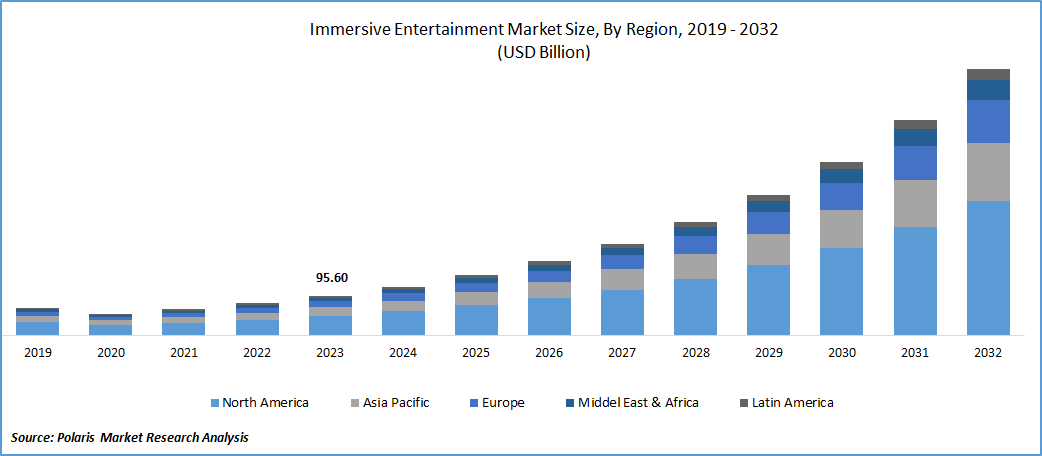
To Understand More About this Research: Download Sample Report
Immersive technologies, particularly the burgeoning trend of 360-degree videos, are gaining widespread popularity in the current market landscape. These videos provide users with a complete panoramic view, allowing them to manually navigate through the content and interact directly with various aspects of the stream rather than passively watching it. With the option to wear a virtual reality (VR) headset, viewers can explore a 360-degree video in all directions, offering a more lifelike experience. This market trend is expected to experience substantial growth over the forecast period.
The education sector is poised for significant transformation with the integration of immersive technologies. Utilizing virtual reality (VR) and augmented reality (AR) technologies engages students in immersive learning experiences that incorporate creative and interactive elements. Complex and abstract concepts become more accessible through 3D rendering, allowing visualization, and fostering a deeper understanding of the subject matter. Noteworthy immersive media startups in the education domain include zSpace, Nearpod, Immersive VR Education, & Universiv.
The global effects of the COVID-19 pandemic had widespread implications for demand and supply chains, resulting in disruptions across various industries. Notably, the immersive entertainment market experienced a significant impact during the pandemic, as lockdown measures heightened the demand for immersive technologies like virtual reality (VR), augmented reality (AR), and mixed reality (MR). These technologies provided individuals with the chance to participate in immersive gaming, virtually attend events, and explore diverse forms of entertainment. Additionally, continuous innovation and development in the market are expected to drive growth in the foreseeable future.
Source: Polaris Market Research Analysis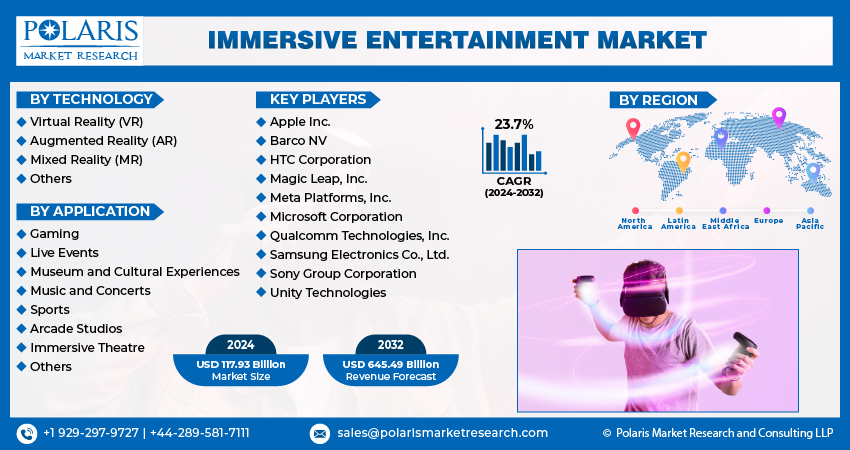
Get Full Segment-Level Forecasts & Insights: Download Sample Report
Industry Dynamics
Growth Drivers
Advancements in Technology
Surge in location-based entertainment (LBE), which leverages immersive technologies to craft distinctive experiences in physical settings such as theme parks and entertainment centers, is expected to drive market growth. LBE plays a pivotal role in broadening the market by providing consumers with novel and interactive experiences that go beyond the traditional home environment. This is anticipated to fuel the expansion of the immersive entertainment market throughout the forecast period.
The emergence of virtual concerts and events offers consumers the chance to partake in live entertainment without leaving their homes, aligning with shifting preferences and the demand for easily accessible experiences. The incorporation of immersive technologies into routine consumer activities, ranging from virtual travel adventures to interactive museum tours, adds an extra layer of attraction to immersive entertainment. This factor contributes significantly to the growing popularity of the market.
Report Segmentation
The market is primarily segmented based on technology, application, and region.
| By Technology | By Application | By Region |
|
|
|
Source: Polaris Market Research Analysis
To Understand the Scope of this Report: Request Customization
By Technology Analysis
Mixed Reality Segment Accounted for the Largest Market Share in 2024
Mixed reality segment accounted for the largest share. This dominance is attributed to ongoing technological advancements and a rising demand for integrated experiences that seamlessly blend virtual and real-world elements. MR's unique capability to overlay digital content onto the physical environment, coupled with interactive features, has led to the creation of immersive and dynamic entertainment scenarios.
Virtual reality segment will grow rapidly. This is primarily due to continuous advancements in VR hardware, characterized by more accessible and powerful headsets that significantly enhance the overall user experience. The versatile application of VR in various sectors, including amusement parks, arcade studios, immersive theaters, social experiences, and education, has contributed to its widespread adoption. The diverse and expanding use cases of VR across different industries are key factors propelling the growth of this segment throughout the forecast period.
By Application Analysis
Gaming Segment Held the Significant Market Share in 2024
Gaming segment held the significant market share. technological advancements in areas such as graphics, processing power, and virtual reality (VR) have substantially elevated the gaming experience, captivating a diverse audience. The rise of esports and online multiplayer gaming has fostered heightened community engagement and competitiveness. Simultaneously, the accessibility of mobile gaming has expanded the user base, serving as a catalyst for the growth of this segment throughout the forecast period.
Music & concert segment is expected to gain substantial growth rate. Virtual concerts have played a pivotal role in this growth by expanding the artist's reach beyond geographical constraints. The incorporation of advanced audio technologies and spatial sound design has heightened the immersive quality of live music encounters, emulating the ambiance of conventional concerts. Additionally, the global pandemic has expedited the acceptance of virtual and hybrid concert formats, leading to a change in consumer preferences towards digital alternatives.
Source: Polaris Market Research Analysis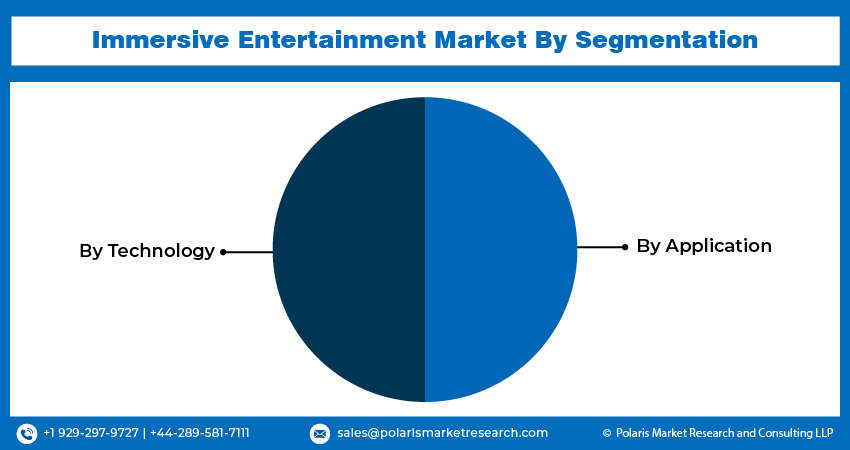
Need Granular Data Across All Market Segments? Request Customization
Regional Insights
North America Dominated the Global Market in 2024
This can be attributed to the region's leadership in technological innovation, boasting a robust ecosystem of tech companies consistently pushing the limits of immersive technologies like virtual and augmented reality. Region's well-established entertainment industry, notably with Hollywood and the gaming sector, has played a crucial role in fostering consumer awareness and acceptance of immersive experiences.
Furthermore, the prevalence of high disposable incomes in the region has significantly contributed to the widespread adoption of immersive entertainment forms, including virtual reality gaming, concerts, and experiential events. The combination of technological advancements and a thriving entertainment landscape, along with financial capacity, has positioned region well in market landscape.
Europe will grow with substantial pace. This accelerated growth can be attributed to Europe's rich cultural heritage and history, creating an ideal environment for the innovative application of immersive technologies in venues such as museums, theaters, and heritage sites. These technologies enhance visitor experiences by offering unique and interactive encounters with cultural and historical artifacts.
The increasing acceptance of these cutting-edge experiences among European consumers, coupled with the region's proactive investment in technological infrastructure, positions Europe for substantial growth in the market. As individuals in Europe embrace and seek out these advanced forms of entertainment, the region is poised to experience significant expansion in the immersive entertainment sector over the forecast period. The convergence of cultural richness, technological innovation, and consumer interest positions Europe as a key player in driving the growth of immersive experiences.
Source: Polaris Market Research Analysis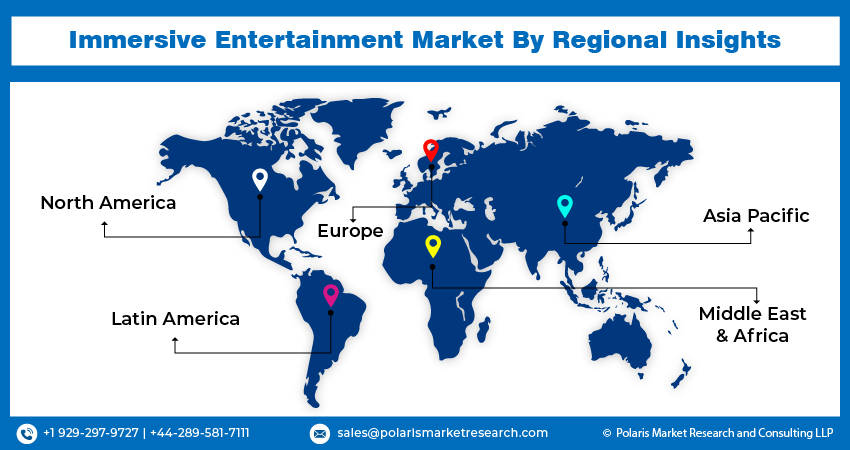
Curious About Regional Market Performance? Request Customization
Key Market Players & Competitive Insights
The market is characterized by high competitiveness, featuring numerous players. Key industry participants are directing their efforts towards strategic alliances, expansions, and the introduction of new products as part of their strategy to maintain competitiveness in the market.
Some of the major players operating in the global market include:
- Apple Inc.
- Barco NV
- HTC Corporation
- Magic Leap, Inc.
- Meta Platforms, Inc.
- Microsoft Corporation
- Qualcomm Technologies, Inc.
- Samsung Electronics Co., Ltd.
- Sony Group Corporation
- Unity Technologies
Recent Developments
- In August 2025: Six Flags Entertainment reported Q2 revenue of USD 930 million and launched a USD 90 million cost-cutting plan after its merger, highlighting focus on improving margins.
- In July 2025: EPR Properties posted 8.4% AFFO growth on USD 175 million revenue, raised full-year guidance, and increased its monthly dividend.
- In June 2025: Universal opened the USD 7 billion Epic Universe in Orlando, projecting a USD 2 billion economic impact in its first year.
- In May 2025: Cosm raised USD 300 million to develop immersive sports domes across Europe, Asia, and Australia, expanding its global footprint in experiential entertainment.
- In November 2023: Sony Pictures Entertainment is set to launch its inaugural immersive entertainment destination, named "Wonderverse," near Chicago at the Oakbrook Center mall. Encompassing a spacious 45,000 square feet, this indoor facility will showcase a combination of interactive installations, immersive multimedia experiences, dynamic attractions, and themed dining.
- In June 2023: Apple. has acquired Mira, a startup specializing in augmented reality (AR) headsets. This strategic move aligns with the Apple's introduction of the Vision Pro AR Headset, marking it company's foray into the AR-VR space.
Immersive Entertainment Market Report Scope
| Report Attributes | Details |
| Market size value in 2025 | USD 144.5 billion |
| Revenue forecast in 2034 | USD 442.11 billion |
| CAGR | 26.30% from 2025 – 2034 |
| Base year | 2024 |
| Historical data | 2020 – 2023 |
| Forecast period | 2025 – 2034 |
| Quantitative units | Revenue in USD billion and CAGR from 2025 to 2034 |
| Segments covered | By Technology, By Application, By Region |
| Regional scope | North America, Europe, Asia Pacific, Latin America, Middle East & Africa |
| Customization | Report customization as per your requirements with respect to countries, region, and segmentation. |
Source: Polaris Market Research Analysis
Gain profound insights into the 2024 Immersive Entertainment Market with meticulously compiled statistics on market share, size, and revenue growth rate by Polaris Market Research Industry Reports. This thorough analysis not only provides a glimpse into historical trends but also unfolds a roadmap with a market forecast extending to 2032. Immerse yourself in the comprehensive nature of this industry analysis through a complimentary Download Sample Report.
Immersive Entertainment Market FAQ's
Apple, Barco, Magic Leap, Meta Platforms, Microsoft, Qualcomm Technologies, Samsung Electronics, Sony, are the key companies in Immersive Entertainment Market.
The global immersive entertainment market is expected to grow at a CAGR of 26.30% during the forecast period.
The Immersive Entertainment Market report covering key segments are technology, application, and region
Increasing Consumer Demand are the key driving factors in Immersive Entertainment Market.
The global immersive entertainment market size is expected to reach USD 442.11 billion by 2034
Download Sample Report of Immersive Entertainment Market
Please fill out the form to request a customized copy of the research report.


