
Intelligent Transportation Systems Market Size, Industry Analysis Report, 2026-2034
REPORT DETAILS
Market Statistics
Intelligent Transportation System Market Overview
The intelligent transportation system (ITS) market size was valued at USD 59.94 billion in 2025 and is projected to register a CAGR of 8.45% from 2026 to 2034. The market growth is driven by a growing volume of vehicles, boats, and railways. Increasing investments in the development of smart cities are expected to boost the demand for ITS during the forecast period.
Key Takeaways
- North America held the largest revenue share of 31.0% in 2025. The dominance is fueled by its advanced transportation infrastructure, high vehicle penetration, and significant investments in smart city projects.
- The intelligent transportation system industry in Asia Pacific is expected to witness a significant CAGR of 9.50% during the forecast period. Rapid urbanization, increasing population, and significant government investments in smart transportation infrastructure boost the industry growth.
- The advanced traffic management system (ATMS) segment held the largest share of 24.0% in 2025. It is due to its crucial role in optimizing traffic flow and mitigating congestion in increasingly urbanized environments.
- The roadway segment accounted for a major share accounting for 35.0% in 2025. It is attributed to its critical role in addressing growing traffic congestion and improving safety on urban and interurban road networks.
- The railway segment is expected to witness a CAGR of 8.30% during 2026–2034. It is driven by rising investments in high-speed rail and smart rail technologies.
*Note: Figures and projections outlined in this report are the result of Polaris Market Research’s proprietary analytical processes, grounded in the latest available datasets and market observations.
Industry Dynamics
- The growing urbanization across the world is projected to propel the global intelligent transportation system market growth.
- The expanding air networks worldwide are fueling the global market expansion.
- Increasing urbanization and traffic congestion are expected to offer lucrative opportunities during the forecast period.
- Requirements for high initial investments hinder the adoption of intelligent transportation systems.
Market Statistics
- 2025 Market Size: USD 59.94 billion
- 2034 Projected Market Size: USD 124.43 billion
- CAGR (2026–2034): 8.45%
- North America: Largest market in 2025
AI Impact on Intelligent Transportation System Market
- Deep Learning facilitates object recognition, adaptive traffic control, and route prediction.
- It also enables computer vision and context awareness. It is crucial for real-time traffic analysis and autonomous navigation.
- Natural language processing (NLP) enhances human-machine interfaces in vehicles and control centers.
- AI technology optimizes fuel use, delivery efficiency, and safety.
- The technology provides predictive maintenance. It helps reduces downtime and operational costs by forecasting potential equipment failures.
- AI-integrated traffic management systems enhance flow, reduce congestion, and improves safety through real-time data analysis.
Source: Polaris Market Research Analysis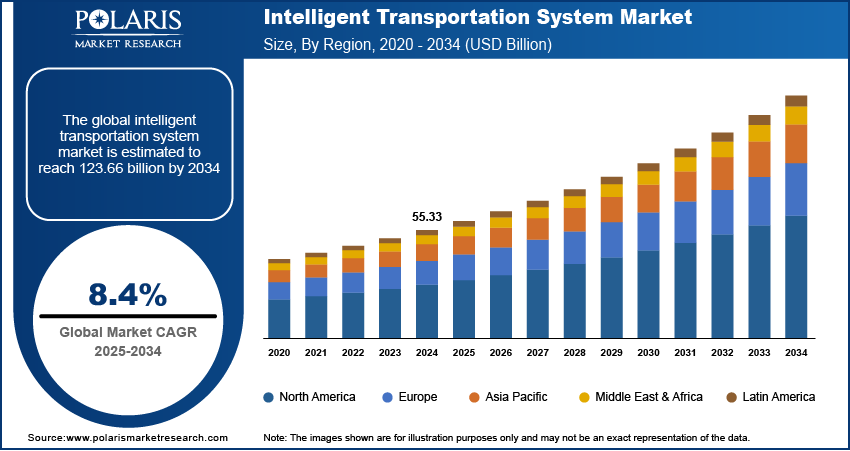
To Understand More About this Research: Download Sample Report
What is Intelligent Transportation System?
Intelligent transportation systems represent a transformative approach to managing transportation networks through the integration of advanced technologies. These systems utilize information and communication technologies (ICT) to enhance the safety, efficiency, and sustainability of transportation across various modes, including roadways, railways, and air travel.
The increasing focus and investment in smart city projects are propelling the global intelligent transportation system market growth. In September 2024, the government of India released ₹46,787 crores or USD 563.8 billion to 100 smart cities under the smart city mission (SCM). Smart cities aim to enhance the quality of life for residents through interconnected infrastructure, and transportation is a critical component of this vision. Intelligent transportation systems, which integrate advanced technologies such as IoT, AI, and big data analytics, address challenges such as traffic congestion, pollution, and road safety by enabling real-time monitoring, predictive traffic management, and seamless multi-modal transport. Moreover, investments in smart city initiatives involve deploying smart traffic lights, automated toll systems, and adaptive public transit services, all of which rely on intelligent transportation systems (ITS) for effective operation.
The intelligent transportation system market demand is driven by a growing volume of vehicles, boats, and railways. ITS technologies are being adopted to optimize traffic flow, reduce delays, and enhance safety with the increasing volume of vehicles, boats, and railways. ITS streamlines traffic management for vehicles and railways and improves efficiency in aviation and maritime operations. Additionally, the integration of smart sensors, connected devices, and communication networks facilitates better coordination across diverse modes of transport, addressing the challenges of traffic congestion and limited infrastructure.
Which are the Key Technologies in the Intelligent Transportation System (ITS) Market?
The intelligent transportation system (ITS) industry is witnessing the adoption of various technologies. For instance, different sensors, AI, and adaptive signals are used in traffic management to optimize flow. V2X, video analytics, and enforcement systems are deployed to manage road safety and security. Such applications form a data-driven, unified mobility framework. It supports cleaner, safer, and more efficient transportation. Market players are focusing on technological advancements to gain a competitive edge and accelerate business expansion.
| Technology | Description | Key Applications | Use Cases |
| Vehicle-to-Everything (V2X) | Facilitates wireless communication between vehicles, road users, and infrastructure. | Traffic management, road safety and security, public transport, freight management, automotive telematics, and road tolling systems | Collision warnings, cooperative signals, priority for emergency vehicles, and platooning |
| Artificial Intelligence (AI)/Machine Learning | Predictive and real-time analytics for traffic and operations. | Traffic management, public transport, road safety and security, parking management, environment protection, and others | Traffic prediction, signal optimization, incident detection, and demand forecasting |
| IoT Sensors and Detectors | Distributed sensing for traffic, infrastructure, and environment. | Traffic management, parking management, public transport, environment protection, and others | Speed and occupancy sensing, pollution monitoring, smart parking, and weather detection |
| CCTV & Video Analytics (ANPR/CV) | Camera-based detection, recognition, and enforcement. | Road safety and security, traffic and parking management, road tolling systems, and others | Speed enforcement, incident verification, ANPR, and vehicle classification |
| Advanced Traffic Management Systems (ATMS) | Centralized monitoring and control platforms. | Traffic management, road safety, public transport, environment protection, and others | Corridor control, DMS control, incident management, and transit prioritization |
| Adaptive Traffic Signals | Real-time signal timing optimization. | Traffic management, public transport, and environment protection | Adaptive signal coordination, emergency vehicle priority, and congestion reduction |
| Electronic Tolling and Congestion Pricing | Automated tolling and pricing based on time and location. | Road tolling systems, traffic management, automotive telematics, and freight management | Open-road tolling, RFID/C-V2X tolling, and congestion pricing. |
| Connectivity (5G/Edge/Cloud) | High-speed, low-latency communication, and compute. | All ITS applications, including traffic and safety management, telematics, freight, and public transport | Real-time V2X, cloud analytics, live streams, and edge compute for CV. |
| Cybersecurity and PKI | Protection of ITS communications and data. | Road safety and security, freight management, automotive telematics, and public transport | Secure V2X messaging, data encryption, device authentication, and threat response. |
Source: Polaris Market Research Analysis
Market Dynamics
Growing Urbanization Worldwide
The growing urbanization worldwide is projected to propel the global intelligent transportation system market. According to the World Bank collection of development indicators urban population in the world was reported at 57.34 % in 2023. Urban areas are experiencing a surge in transportation needs, which requires innovative solutions to maintain efficiency and safety. ITS technologies, such as real-time traffic monitoring, adaptive signal controls, and integrated public transit systems, help manage the complexities of urban mobility. These systems enable efficient use of resources, reduce travel times, and lower emissions, making them essential for sustainable urban development.
Expanding Air Networks Globally
The expanding air networks globally are estimated to fuel the global intelligent transportation system market during the forecast period. The expansion of air networks leads to the deployment of intelligent transportation systems to overcome challenges such as congestion, scheduling conflicts, and resource management. Additionally, ITS improves ground operations and optimizes passenger flow within airports, which increases the adoption of intelligent transportation systems within the aviation industry,
Source: Polaris Market Research Analysis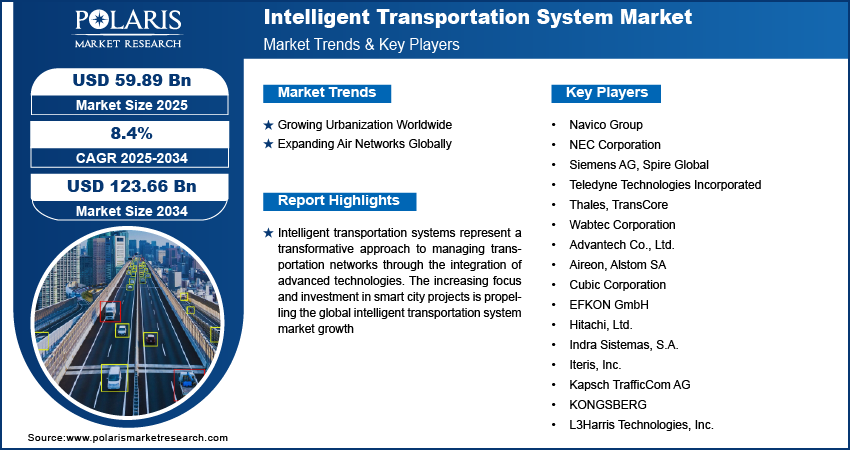
Get Full Segment-Level Forecasts & Insights: Download Sample Report
Traffic Management vs Fleet Management vs Public Transport Systems
| Parameter | Traffic Management Systems | Fleet Management Systems | Public Transport Systems | |
| Focus | Traffic flow optimization and congestion control | Vehicle tracking and fleet efficiency | Passenger transport and transit operations | |
| Key Function | Real-time monitoring, signal control, incident management | Route planning, fuel monitoring, driver tracking | Scheduling, ticketing, passenger information | |
| Technologies Used | AI, IoT sensors, adaptive signals, CCTV | GPS, telematics, AI analytics | Smart cards, mobile apps, real-time tracking | |
| End Users | Government, traffic authorities | Logistics companies, fleet operators | Public transport agencies | |
| Objective | Reduce congestion and improve road safety | Optimize fleet performance and reduce costs | Enhance passenger experience and transit efficiency | |
| Data Usage | Traffic density, vehicle movement, incidents | Vehicle location, fuel usage, driver behavior | Passenger flow, schedules, demand patterns | |
|
Source: Polaris Market Research Analysis
| Urban roads, highways | Logistics, delivery, transportation fleets | Buses, metros, rail networks |
Source: Polaris Market Research Analysis
Segment Analysis
Market Assessment by Type
Based on type, the intelligent transportation system market is categorized into advanced traveler information system (ATIS), advanced traffic management system (ATMS), advanced transportation pricing system (ATPS), advanced public transportation system (APTS), and emergency medical system (EMS). The advanced traffic management system (ATMS) segment held the largest market share of 24.0% in 2025 due to its crucial role in optimizing traffic flow and mitigating congestion in increasingly urbanized environments. The growing adoption of ATMS solutions arises from their ability to leverage real-time data, predictive product analytics, and adaptive signal control to enhance road network efficiency and reduce travel times. Urban centers worldwide have prioritized ATMS technologies to address the escalating challenges of population growth, vehicle density, and environmental concerns. Governments and municipalities have invested heavily in these systems to improve traffic safety, minimize fuel consumption, and lower carbon emissions, aligning with goals of sustainability and smart city development.
Market Evaluation by Mode of Transportation
In terms of mode of transportation, the intelligent transportation system market is divided into roadway, railway, airway, and maritime. The roadway segment accounted for a major intelligent transportation system market share of 55.0% in 2025 due to its critical role in addressing growing traffic congestion and improving safety on urban and interurban road networks. Governments and transportation agencies have prioritized investments in advanced technologies such as real-time traffic monitoring, adaptive traffic signal control, and incident management systems to enhance roadway efficiency. Increasing urbanization and the surge in vehicle ownership have created a need for smart solutions to manage traffic flow and reduce delays. Additionally, the rise of connected and autonomous vehicles has spurred further adoption of intelligent systems, enabling seamless vehicle-to-infrastructure communication and ensuring smoother transportation operations. These factors have contributed to the roadway segment dominance.
The railway segment is also expected to grow at the fastest pace of 8.30% in the coming years, owing to its growing importance in efficient mass transit. Governments worldwide are heavily investing in modernizing railway infrastructure with advanced technologies such as predictive maintenance systems, automated signaling, and passenger information systems to offer enhanced customer experience and optimize routine tasks. The increasing shift towards high-speed rail networks and the need to reduce carbon emissions have amplified the demand for intelligent solutions in railways. The enhanced focus on improving passenger experience, ensuring safety, and optimizing freight transportation further drives the adoption of intelligent transportation systems in the railway sector.
Real-World Applications of Intelligent Transportation Systems
| Application Area | Example | Description |
| Smart Traffic Signals | Adaptive signal control systems | Adjust signal timings in real time based on traffic conditions to reduce congestion |
| Toll Systems | Electronic toll collection (ETC) | Enables automated toll payments using RFID and reduces wait times at toll plazas |
| Public Transport Tracking | GPS-based bus/metro tracking | Provides real-time location updates and arrival predictions for passengers |
| Autonomous Vehicle Integration | Vehicle-to-Infrastructure (V2I) systems | Enables communication between vehicles and road infrastructure for safer and efficient movement |
Source: Polaris Market Research Analysis
Source: Polaris Market Research Analysis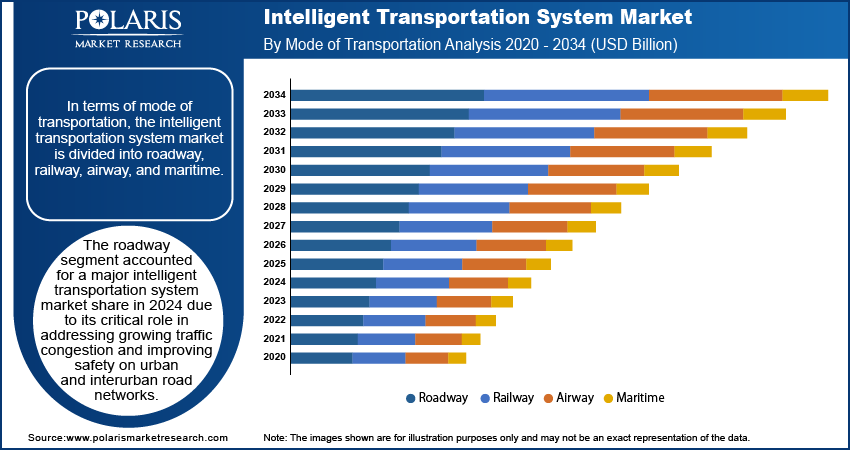
Need Granular Data Across All Market Segments? Request Customization
Regional Insights
By region, the study provides the intelligent transportation system market insights into North America, Europe, Asia Pacific, Latin America, and the Middle East & Africa. North America held the largest market share of 35.0% in 2025, due to its advanced transportation infrastructure, high vehicle penetration, and significant investments in smart city projects. The region has been at the forefront of adopting advanced technologies such as real-time traffic management, vehicle-to-everything (V2X) communication, and predictive analytics. The US dominated the market within the region, driven by robust government initiatives and funding for modernizing transportation systems. Programs such as the ITS deployment initiatives by the Federal Highway Administration’s and the presence of key industry players further accelerated the growth of the market in the region. The growing adoption of electric and autonomous vehicles in the US, supported by a comprehensive network of charging stations and intelligent traffic systems, further contributes to the region’s leadership.
The intelligent transportation system market in Asia Pacific is expected to witness a significant CAGR of 9.50%, over the forecast period due to rapid urbanization, increasing population, and significant government investments in smart transportation infrastructure. Countries such as China and India are leading this growth due to their extensive focus on reducing traffic congestion, improving road safety, and lowering environmental impact. China stands out as a dominant country in the region, driven by its ambitious smart city initiatives, widespread deployment of advanced traffic management systems, and integration of AI-driven solutions. The region's focus on enhancing public transportation, including high-speed rail systems and intelligent bus networks, further drives demand for intelligent transportation systems.
Source: Polaris Market Research Analysis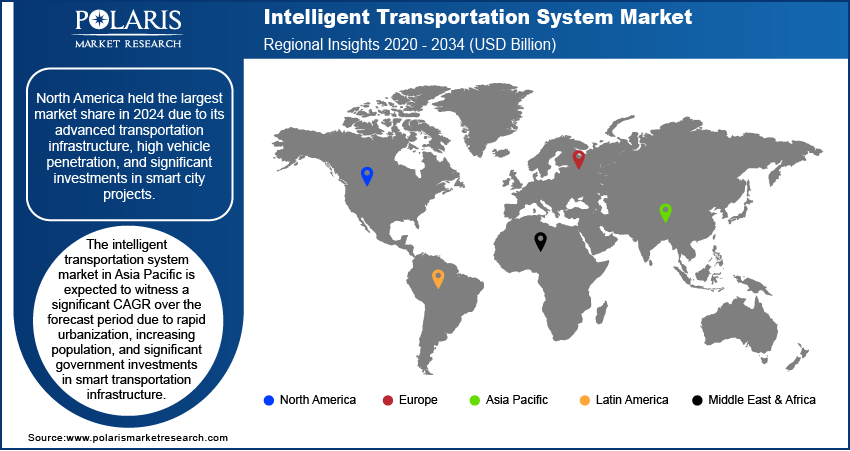
Curious About Regional Market Performance? Request Customization
Intelligent Transportation System Key Market Players & Competitive Analysis Report
Major market players are investing heavily in research and development in order to expand their offerings, which will help the intelligent transportation system market grow even more. Market participants are also undertaking various strategic activities to expand their global footprint, with important market developments including innovative launches, international collaborations, higher investments, and mergers and acquisitions between organizations.
The intelligent transportation system industry is fragmented, with the presence of numerous global and regional market players. Major players in the market include Navico Group; NEC Corporation; Siemens AG; Spire Global; Teledyne Technologies Incorporated; Thales; TransCore; Wabtec Corporation; Advantech Co., Ltd.; Aireon; Alstom SA; Cubic Corporation; EFKON GmbH; Hitachi, Ltd.; Indra Sistemas, S.A.; Iteris, Inc.; Kapsch TrafficCom AG; KONGSBERG; and L3Harris Technologies, Inc.
NEC Corporation is a prominent Japanese multinational corporation that specializes in information technology and electronics. Founded in 1899 through a partnership with Western Electric Company, NEC has evolved into a leading provider of telecommunications equipment and related services. The company's headquarters are located in the NEC Supertower in Minato, Tokyo. Over the years, NEC has established itself as a leader in the development and implementation of intelligent transportation systems (ITS), which are essential for modern urban mobility solutions.
Hitachi, Ltd. is a Japanese multinational corporation headquartered in Tokyo. It specializes in a wide range of sectors, including information technology, social infrastructure, and transportation systems. Established in 1910, Hitachi has grown to become a significant player in the global market. The company operates through various segments such as IT services, energy, mobility, and industrial systems, focusing on delivering innovative solutions that enhance societal well-being and promote sustainable development. Hitachi, Ltd. offers intelligent transportation system (ITS) solutions, including traffic management, smart rail systems, AI-powered predictive analytics, automated tolling, fleet management, and EV charging infrastructure, enhancing efficiency, safety, and sustainability in urban mobility.
List of Key Companies
- Navico Group
- NEC Corporation
- Siemens AG
- Spire Global
- Teledyne Technologies Incorporated
- Thales
- TransCore
- Wabtec Corporation
- Advantech Co., Ltd.
- Aireon
- Alstom SA
- Cubic Corporation
- EFKON GmbH
- Hitachi, Ltd.
- Indra Sistemas, S.A.
- Iteris, Inc.
- Kapsch TrafficCom AG
- KONGSBERG
- L3Harris Technologies, Inc.
Intelligent Transportation System Industry Developments
- January 2026: Kapsch TrafficCom expanded its traffic management role in New York with a USD 6.3 million contract. It focuses on advanced traffic management software and cloud-native solutions to improve traffic flow. (Source: kapsch.ne)
- June 2025: Pony AI and Xihu Group launched 1,000 Gen 7 robotaxis in Shenzhen. It marks one of the largest autonomous vehicle deployments to date. (Source: pony.ai)
- August 2025: the Pennsylvania Turnpike Commission, partnering with Applegreen Electric, enhanced its EV charging network by deploying 400 kW chargers at Somerset service plazas, allowing motorists to recharge almost any electric vehicle within 30 minutes. (Source: paturnpike.com)
- March 2025: The City of Alexandria secured USD 5 million from the Northern Virginia Transportation Authority for its Smart & Connected Vehicle Infrastructure project. (Source: alexandriava.gov)
- December 2024: Karsan showcased electric-bus upgrades featuring real-time passenger information and cabin-comfort enhancements. (Source: karsan.com)
- May 2024: The Intelligent Transportation Society of America released an update on C-V2X waivers and 5.9 GHz spectrum status, noting 50 approved deployments. (Source:itsa.org)
Intelligent Transportation System Market Segmentation
By Type Outlook (Revenue, USD Billion, 2021 - 2034)
- Advanced Traveler Information System (ATIS)
- Advanced Traffic Management System (ATMS)
- Advanced Transportation Pricing System (ATPS)
- Advanced Public Transportation System (APTS)
- Emergency Medical System (EMS)
By Mode of Transportation Outlook (Revenue, USD Billion, 2021 - 2034)
- Roadway
- Railway
- Airway
- Maritime
By Offering Outlook (Revenue, USD Billion, 2021 - 2034)
- Hardware
- Interface Boards
- Sensors
- Surveillance Cameras
- Telecommunication Networks
- Monitoring and Detection Systems
- Others
- Software
- Visualization Software
- Video Detection Management Software
- Transit Management Software
- Others
- Services
- Cloud Services
- Business Services
- Professional Services
By Application Outlook (Revenue, USD Billion, 2021 - 2034)
- Traffic Management
- Road Safety and Security
- Freight Management
- Public Transport
- Environment Protection
- Automotive Telematics
- Parking Management
- Road Tolling Systems
- Others
By Regional Outlook (Revenue, USD Billion, 2021 - 2034)
- North America
- US
- Canada
- Europe
- Germany
- France
- UK
- Italy
- Spain
- Netherlands
- Russia
- Rest of Europe
- Asia Pacific
- China
- Japan
- India
- Malaysia
- South Korea
- Indonesia
- Australia
- Vietnam
- Rest of Asia Pacific
- Middle East & Africa
- Saudi Arabia
- UAE
- Israel
- South Africa
- Rest of Middle East & Africa
- Latin America
- Mexico
- Brazil
- Argentina
- Rest of Latin America
Future Outlook
The ITS market will grow with more use of AI-driven traffic systems for real-time control and prediction. Autonomous mobility will increase demand for connected infrastructure and V2X communication. Smart city expansion will push adoption of integrated and data-driven transport systems. 5G integration will improve real-time data exchange, low latency, and system efficiency.
Report Scope
| Report Attributes | Details |
| Market Size Value in 2025 | USD 59.94 billion |
| Market Size Value in 2026 | USD 64.96 billion |
| Revenue Forecast in 2034 | USD 124.43 billion |
| CAGR | 8.45% from 2026 to 2034 |
| Base Year | 2025 |
| Historical Data | 2021– 2024 |
| Forecast Period | 2026 – 2034 |
| Quantitative Units | Revenue in USD Billion and CAGR from 2026 to 2034 |
| Report Coverage | Revenue Forecast, Market Competitive Landscape, Growth Factors, and Industry Trends |
| Segments Covered |
|
| Regional Scope |
|
| Competitive Landscape |
|
| Report Format |
|
| Customization | Report customization as per your requirements with respect to countries, regions, and segmentation. |
Source: Polaris Market Research Analysis
Intelligent Transportation Systems Market FAQ's
• The global intelligent transportation system market size was valued at USD 59.94 billion in 2025 and is projected to grow to USD 124.43 billion by 2034.
• The global market is projected to grow at a CAGR of 8.45% during the forecast period.
• North America had the largest share of the global market in 2025.
• Some of the key players in the market are Navico Group; NEC Corporation; Siemens AG; Spire Global; Teledyne Technologies Incorporated; Thales; TransCore; Wabtec Corporation; Advantech Co., Ltd.; Aireon; Alstom SA; Cubic Corporation; EFKON GmbH; Hitachi, Ltd.; Indra Sistemas, S.A.; Iteris, Inc.; Kapsch TrafficCom AG; KONGSBERG; and L3Harris Technologies, Inc.
• The railway segment is projected for significant growth in the global market.
• The advanced traffic management system (ATMS) segment dominated the intelligent transportation system market in 2025.
Download Sample Report of Intelligent Transportation Systems Market
Please fill out the form to request a customized copy of the research report.


