
IoT Sensors Market Growth Driver and Opportunities | 2025-2034
REPORT DETAILS
Market Statistics
Market Introduction
The global IoT sensors market was valued at USD 12.3 billion in 2024 and is anticipated to register a CAGR of 25.70% from 2025 to 2034. The increasing adoption across smart cities, healthcare, and industrial automation propels the industry growth. Advancements in sensor technologies are expected to boost the market expansion in the coming years.
Key Insights
- The pressure sensors segment held the largest revenue share in 2024. It is due to their versatile applications across various industries, including automotive, aerospace, and healthcare.
- The wireless technology segment held a significant revenue share in 2024. This is due to its scalability, flexibility, and cost-effectiveness.
- The commercial segment held significant revenue share in 2024. Enterprises across various industries, including retail and hospitality, widely adopt IoT sensors to streamline operations and enhance customer experiences.
- Asia Pacific is expected to experience significant growth during 2025-2034. Rapid urbanization in Asia Pacific propels the adoption of IoT technologies to tackle urban challenges.
- The North America industry growth is driven by growing demand for IoT solutions in smart homes, cities, industrial automation, and healthcare applications.
Industry Dynamics
- The proliferation of connected devices propels the demand for IoT sensors.
- The advent of 5G technology accelerates IoT sensor adoption by enabling high-speed, low-latency communication networks, which facilitate the transmission of vast amounts of data in real-time.
- The rising advancements are expected to open lucrative opportunities for IoT sensor use in diverse industries, including manufacturing, healthcare, agriculture, smart cities, and environmental monitoring.
- Rising privacy and security concerns restrict the adoption of IoT sensors.
Market Statistics
2024 Market Size: USD 12.3 billion
Source: Polaris Market Research Analysis
2034 Projected Market Size: USD 98.2 billionSource: Polaris Market Research Analysis
CAGR (2025–2034): 25.70%Source: Polaris Market Research Analysis
Asia Pacific: Largest market in 2024AI Impact on IoT Sensors Market
- Rapid urbanization across the world fuels the demand for AI-enabled IoT sensors in energy grids, traffic systems, and building automation. The sensors are used to reduce emissions, manage traffic congestion, and improve public safety.
- Artificial intelligence transforms sensors from reactive tools into predictive systems. They adapt to environmental changes and predict failures.
- In agriculture, AI-integrated sensors are used to forecast irrigation requirements based on soil and weather data.
- AI platform providers and IoT sensor makers partner to offer end-to-end ML pipelines.
Source: Polaris Market Research Analysis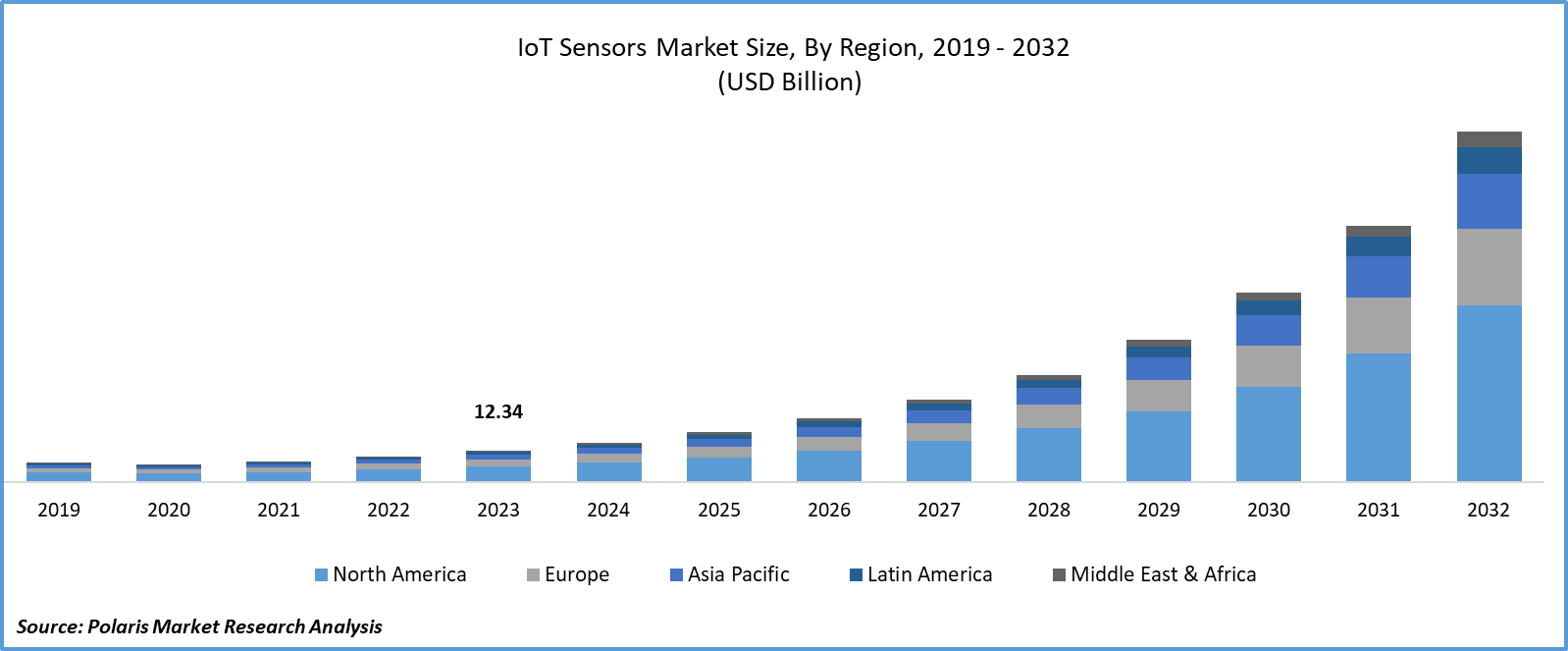
To Understand More About this Research: Download Sample Report
The IoT sensors market is witnessing significant growth fueled by the increasing demand for real-time data analytics and insights. IoT sensors serve as the foundational components of data collection, providing continuous streams of information from various physical assets and environments. This data is then processed and analyzed in real time, enabling organizations to gain valuable insights into their operations, identify trends, and make data-driven decisions promptly. From predictive maintenance in manufacturing plants to remote patient monitoring in healthcare facilities, IoT sensors play a crucial role in enabling proactive and informed actions. In addition, companies operating in the market are introducing new products to expand market reach and strengthen presence.
For instance, in October 2022, Infineon Technologies AG introduced the XENSIV connected sensor kit (CSK), a novel IoT sensor platform designed to facilitate swift prototyping and the creation of tailored IoT solutions.
Advancements in sensor technologies include improvements in sensor accuracy, miniaturization, energy efficiency, and integration capabilities. As sensors become more sophisticated and versatile, they can capture a broader range of data with higher precision, enabling more accurate monitoring and analysis in various applications. Additionally, advancements in wireless communication protocols and low-power consumption technologies have made it easier to deploy and maintain large-scale IoT sensor networks. These advancements have opened up opportunities for IoT sensors in diverse industries such as manufacturing, healthcare, agriculture, smart cities, and environmental monitoring. Furthermore, ongoing research and development efforts continue to drive innovation in sensor technologies, leading to the emergence of novel sensor types and functionalities.
Industry Growth Drivers
Increasing Adoption of Iot Technologies is Projected to Spur the Product Demand
The IoT sensors market experiences significant growth due to the increasing adoption of IoT technologies across various industries. These sensors are integrated into devices, machinery, infrastructure, and even consumer products, enabling the monitoring of various parameters such as temperature, humidity, pressure, motion, and more. Industries leverage IoT sensors to optimize operations, improve decision-making, and enhance user experiences. With the proliferation of connected devices and the advancement of wireless communication technologies, the IoT Sensors Market continues to expand rapidly. Moreover, ongoing innovations in sensor technology, including miniaturization, enhanced accuracy, and reduced costs, further drive the adoption of IoT sensors across diverse applications and industries.
Proliferation of Connected Devices and Smart Systems is Expected to Drive Iot Sensors Market Growth
The IoT sensors market is experiencing substantial growth driven by the proliferation of connected devices and smart systems. As industries embrace digital transformation, the deployment of IoT sensors becomes integral for gathering real-time data across diverse applications. These sensors facilitate remote monitoring, automation, and predictive analytics. In sectors such as manufacturing, healthcare, agriculture, and transportation, IoT sensors play a pivotal role in optimizing processes, improving efficiency, and enhancing decision-making. Additionally, the advent of 5G technology further accelerates IoT sensor adoption by enabling high-speed, low-latency communication networks, facilitating the transmission of vast amounts of data in real time.
Source: Polaris Market Research Analysis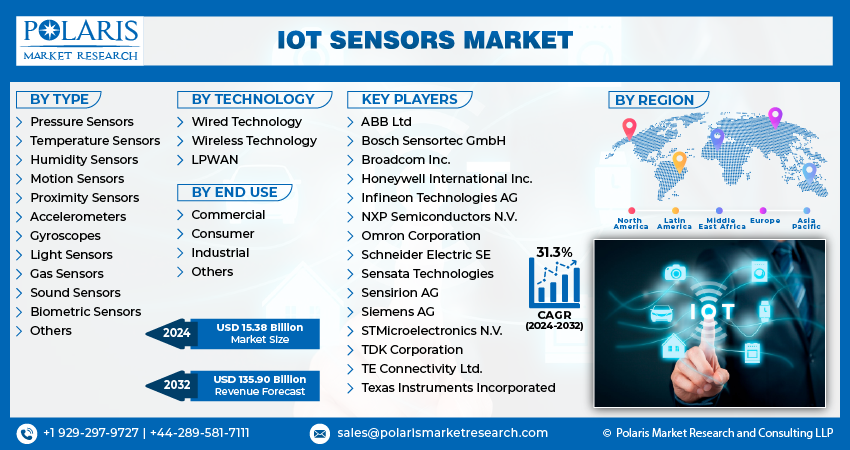
Get Full Segment-Level Forecasts & Insights: Download Sample Report
Industry Challenges
Security and Privacy Concerns Are Likely to Impede the Market Growth
Security and privacy concerns pose limitations to the growth of the IoT sensors market. Vulnerabilities in sensor networks can lead to unauthorized access, data manipulation, or theft of sensitive information, compromising user privacy and safety. Additionally, the interconnected nature of IoT ecosystems amplifies the potential impact of security breaches, posing risks to critical infrastructure, personal devices, and sensitive data. Concerns about data privacy, consent, and compliance with regulations such as GDPR further exacerbate these challenges.
Report Segmentation
The IoT sensors market analysis is primarily segmented based on type, technology, end use, and region.
| By Type | By Technology | By End Use | By Region |
|
|
|
|
Source: Polaris Market Research Analysis
To Understand the Scope of this Report: Request Customization
By Type Analysis
Pressure Sensors Segment Held Significant Revenue Share in 2024
The pressure sensors segment held significant revenue share in 2024. Their versatile applications across diverse industries including automotive, aerospace, healthcare, and manufacturing contribute to their widespread adoption. Pressure sensors play a crucial role in industrial automation and smart manufacturing processes, ensuring optimal equipment performance and minimizing downtime. Additionally, their integration into automotive systems for monitoring tire pressure, engine performance, and airbag deployment further drives their significant revenue share. Pressure sensors are essential components in medical devices such as ventilators and blood pressure monitors, aligning with the increasing demand for remote patient monitoring and telemedicine solutions in the healthcare sector.
By Technology Analysis
Wireless Technology Segment Held Significant Revenue Share in 2024
The wireless technology segment held significant revenue share in 2024 due to its scalability, flexibility, and cost-effectiveness. Wireless sensors offer easy deployment in large-scale networks without complex cabling, lowering upfront costs and facilitating rapid integration. They also require minimal maintenance, reducing operational expenses and downtime. Additionally, wireless technologies are compatible with various devices and protocols, ensuring interoperability and seamless integration within existing IoT ecosystems. These advantages make wireless sensors the preferred choice for businesses seeking efficient and adaptable solutions for data collection and monitoring, thereby driving their widespread adoption and dominance in the IoT sensors market.
By End Use Analysis
Commercial Segment Held Significant Revenue Share in 2024
The commercial segment held significant revenue share in 2024. Enterprises across various industries, including offices, retail, and hospitality, widely adopt IoT sensors to streamline operations and enhance customer experiences. These sensors are integral to smart building solutions, facilitating efficient management of lighting, HVAC systems, security, and occupancy. Moreover, businesses utilize IoT sensors for asset tracking and inventory management, improving asset visibility and reducing losses. Retailers leverage sensor data for foot traffic monitoring, shelf stocking, and customer behavior analysis to optimize store layouts and marketing strategies.
Source: Polaris Market Research Analysis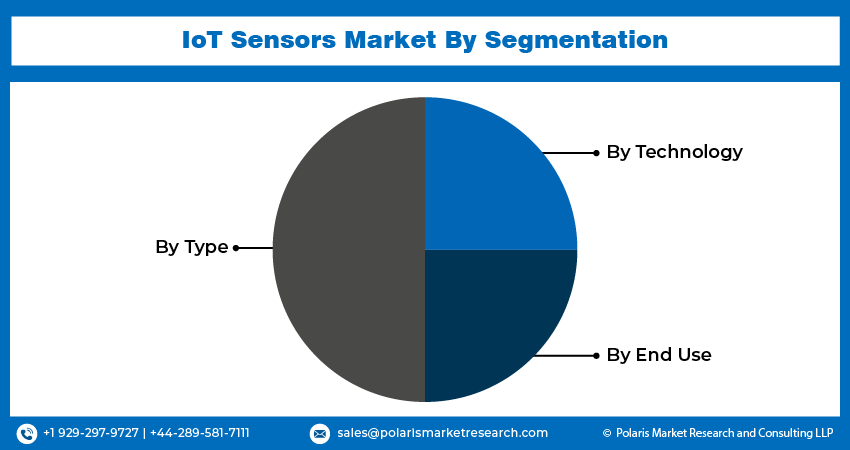
Need Granular Data Across All Market Segments? Request Customization
Regional Insights
Asia-Pacific is Expected to Experience Significant Growth During the Forecast Period
Asia-Pacific is expected to experience significant growth during the forecast period. Rapid urbanization across the region prompts increased adoption of IoT technologies to tackle urban challenges. Additionally, the region's emerging economies, such as China and India, present lucrative opportunities for IoT deployment across various sectors. The proliferation of mobile devices, improved internet connectivity, and the advent of 5G networks further bolster IoT sensor adoption. Supportive government policies and initiatives aimed at digitalization and smart infrastructure development are catalyzing market growth in Asia-Pacific.
The market in North America is influenced by technological innovation, fostering a rich ecosystem of research institutions and tech companies. North America demonstrates early adoption of IoT solutions across diverse industries like healthcare, manufacturing, automotive, and agriculture. Its robust digital infrastructure, including high-speed internet and extensive IoT networks, supports widespread sensor deployment. The growing demand for IoT solutions in smart homes, cities, industrial automation, and healthcare amplifies the market growth in North America.
Source: Polaris Market Research Analysis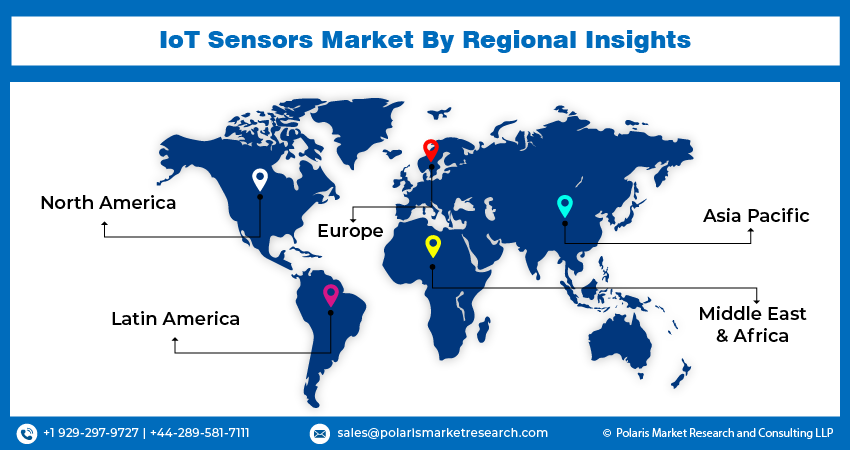
Curious About Regional Market Performance? Request Customization
Key Market Players & Competitive Insights
The IoT sensors market involves a diverse array of players, and the expected arrival of new contenders is poised to intensify rivalry. Established leaders continuously enhance their technologies to maintain a competitive advantage, emphasizing effectiveness, reliability, and safety. These firms prioritize strategic actions such as establishing collaborations, improving product portfolios, and participating in cooperative endeavors. Their aim is to outperform competitors within the field, securing a significant IoT sensors market share.
Some of the major players operating in the global IoT sensors market include:
- ABB Ltd
- Bosch Sensortec GmbH
- Broadcom Inc.
- Honeywell International Inc.
- Infineon Technologies AG
- NXP Semiconductors N.V.
- Omron Corporation
- Schneider Electric SE
- Sensata Technologies
- Sensirion AG
- Siemens AG
- STMicroelectronics N.V.
- TDK Corporation
- TE Connectivity Ltd.
- Texas Instruments Incorporated
Recent Developments
- In February 2025, Aeris launched IoT Watchtower, the world’s first fully integrated cellular IoT security solution, providing real-time visibility, zero-trust security, and compliance tools to protect enterprises from rising IoT cyber threats globally.
-
In May 2024, Murata Manufacturing signed a licensing agreement with Michelin to supply advanced RFID tire tags, enhancing tire management, traceability, security, and sustainability.
- In February 2023, Henkel unveiled an innovative sensor experience kit designed specifically for IoT development across various sectors. The Henkel Qhesive Solutions Sensor INKxperience Kit introduces four distinct printed electronics technologies, complete with pre-configured hardware and software for prototyping and conceptualizing engineering projects.
- In March 2022, Seeed Studio, the IoT hardware firm, introduced new products targeting AIoT solutions tailored for outdoor use, encompassing a range of devices from low-energy sensors to ultra-long-range gateways incorporating Edge AI capabilities.
- In May 2023, STMicroelectronics unveiled the industry's inaugural MEMS water/liquid-resistant absolute pressure sensor, featuring a declared 10-year longevity program specifically aimed at the industrial sector.
Report Coverage
The IoT sensors market report emphasizes on key regions across the globe to provide better understanding of the product to the users. Also, the report provides market insights into recent developments, trends and analyzes the technologies that are gaining traction around the globe. Furthermore, the report covers in-depth qualitative analysis pertaining to various paradigm shifts associated with the transformation of these solutions.
The report provides detailed analysis of the market while focusing on various key aspects such as competitive analysis, types, technologies, end uses, and their futuristic growth opportunities.
IoT Sensors Market Report Scope
| Report Attributes | Details |
| Market size value in 2025 | USD 15.5 billion |
| Revenue forecast in 2034 | USD 98.2 billion |
| CAGR | 25.70% from 2025 – 2034 |
| Base year | 2024 |
| Historical data | 2020 – 2023 |
| Forecast period | 2025 – 2034 |
| Quantitative units | Revenue in USD billion and CAGR from 2025 to 2034 |
| Segments covered |
|
| Regional scope |
|
| Competitive Landscape |
|
| Report Format |
|
| Customization | Report customization as per your requirements with respect to countries, region, and segmentation. |
Source: Polaris Market Research Analysis
IoT Sensors Market FAQ's
The IoT Sensors Market report covering key segments are type, technology, end use, and region.
The global IoT sensors market size is expected to reach USD 135.90 billion by 2034
IoT Sensors Market exhibiting the CAGR of 25.70% during the forecast period.
Asia-Pacific is leading the global market
key driving factors in IoT Sensors Market are Increasing adoption of IoT technologies
Download Sample Report of IoT Sensors Market
Please fill out the form to request a customized copy of the research report.


