
Laminated Busbar Market Size, Share, Global Analysis Report, 2026-2034
REPORT DETAILS
Market Statistics
Market Overview
The global laminated busbar market size was valued at USD 870.80 million in 2025. The market is projected to account for a CAGR of 6.9% between 2026 and 2034. The market is driven by increasing demand for compact and efficient power distribution systems in electronics and automotive sectors.
Key Insights
- Asia Pacific led the laminated busbar market with a 42% revenue share in 2025. Ongoing infrastructure development in emerging economies in the Asia Pacific has created an increased demand for advanced and compact electrical distribution solutions.
- North America is expected to witness the fastest growth, at a 7.4% CAGR. This is due to the growing adoption of laminated busbars in the region’s automotive industry.
- The aluminum segment accounted for the largest market share of 57.5% in 2025. The low weight and ease of application of aluminum make it suitable for electricity transmission.
- The industrial segment is projected to witness the highest CAGR of 7.7%. Rising urbanization and growing use of electric vehicles contribute to the segment’s robust growth.
Market Statistics
- 2025 Market Size: USD 870.80 million
- 2034 Projected Market Size: USD 1,585.13 million
- CAGR (2026–2034): 6.9%
- Asia Pacific: Largest Market in 2025
Industry Dynamics
- The rising global electricity demand has created a need for efficient power distribution systems. Laminated busbars are used in various applications to ensure reliable and compact distribution of power.
- Technological advancements and supportive government regulations are also contributing to the market expansion.
- Growing adoption of electric vehicles (EVs) is expected to present several laminated busbar market opportunities.
- Fluctuating raw material prices may impact market growth.
Source: Polaris Market Research Analysis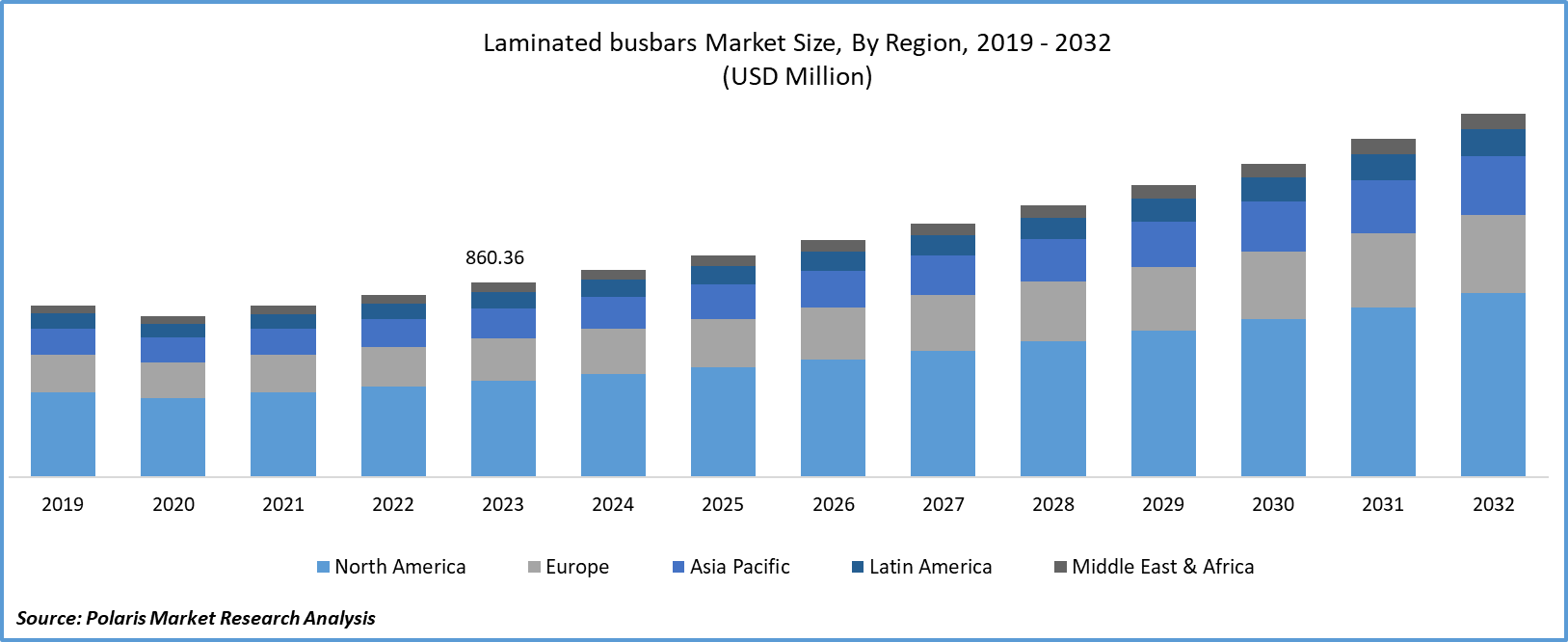
To Understand More About this Research:Download Sample Report
A laminated busbar is defined as a flat and layered component used for conducting electrical power. It is widely used in switchgears, electrical power distribution systems, and other applications in which efficient power distribution is critical. The laminated busbar structure is composed of various conducting layers, which are held together after being divided by insulating materials.
The main purpose of a laminated busbar is to create a compact and efficient way of conducting electrical currents from various components of a system. The layers of the conductive materials are typically made of copper or aluminum, as these are efficient and widely used for electrical applications. The insulating layers are placed between the conductive layers to prevent electrical short circuits. These laminated busbar insulation layers also ensure proper insulation between the phases.
Laminated busbars have several advantages. These laminated busbar advantages include space savings, improved thermal performance, and reliability. Laminated busbars are used in different applications where the power density is of critical importance. These include industrial plants, data center power distribution, and renewable energy systems. The laminated busbars' design may vary depending on the application’s demands, including the electrical characteristics of the system to be achieved.
In addition to saving space, laminated busbars can be used to minimize energy losses, improve electromagnetic compatibility, and make wiring easier and faster. This is important in the construction of EV battery packs, traction inverters, industrial drives, UPS systems, and energy storage systems. Therefore, with the growing adoption of electrification and modular power systems, there is a need for laminated busbars tailored to meet the current, thermal, and insulation requirements of various applications.
Effective laminated busbar heat dissipation is essential to maintaining the integrity of the laminated busbar. The laminated busbar should ensure efficient heat dissipation to prevent overheating. The laminated busbar should be designed in such a way that the voltage drop is minimized in order to maintain the efficiency of the power distribution system. The dimensions of the busbar are optimized in order to keep the voltage drop reduction within acceptable limits.
Manufacturers are increasingly focusing their efforts on the conductor's structure, insulation, and layering. This is to achieve a proper balance between conductivity, insulation, heat dissipation, and miniaturization. It is especially important as there is a general trend in power electronics toward higher switching speeds, higher current density, and the miniaturization of devices in the transport, industrial, and energy sectors.
The rising demand for lower energy costs, greater energy efficiency, and the growing adoption of green energy sources are driving the growth of the laminated busbar market. The increasing adoption of energy-efficient systems with minimal maintenance is boosting market growth. An increase in the need for parallel battery connections, along with government regulations on energy use, also contributes to market expansion. An increase in the demand for laminated busbars in industrial applications, along with the growing use of renewable energy, is fueling market expansion.
Demand is also increasing as adoption of battery energy storage systems, EV charging infrastructure, smart factory technologies, and high-efficiency converters in solar and wind power plants grows. In these applications, laminated busbars support the design, electrical performance, and heat management of compactly assembled systems.
Other factors that are contributing to this industry include favorable government regulations, technological innovations, and rising power electronics demand. The growing demand for laminated busbars from developing countries, smart cities, and awareness among consumers is likely to create several laminated busbar market opportunities.
One of the key opportunities that exists is in the area of application-specific customization. Power systems are becoming more specialized. This has meant that users require laminated busbars that meet specific size, conductor, mounting, insulation, and thermal requirements. It is creating busbar market opportunities for suppliers who can offer customized laminated busbar solutions, rather than competing only on price.
What Is Driving Laminated Busbar Market Growth?
Increasing Demand for Efficient and High-Reliability Power Distribution Systems
The electricity demand is growing worldwide. This has therefore led to an increased need for efficient power distribution systems. Laminated busbars are used in various applications such as switchgear and distribution boards. Laminated busbars are used to ensure compact and reliable power distribution. The growing focus on renewable energy sources, such as solar and wind power, has driven increased demand for laminated busbars in inverter and power-conversion equipment.
Laminated busbars play an extremely significant role in these applications in terms of their efficiency and compact design. The electrification of the automotive and transportation sector is one of the major factors that is boosting the use of laminated busbar EVs and hybrid electric vehicles. The laminated busbars are used in the power distribution system of electric and hybrid electric vehicles. The rise in demand for industrial automation and smart manufacturing technologies requires effective, space-saving solutions for power distribution. Laminated busbars are used in control panels and automation, which contributes to the growth of the laminated busbar market. Efforts to increase energy efficiency across sectors are also driving the market expansion.
In EVs and HEVs, laminated busbars are increasingly used in battery packs, battery management systems, onboard chargers, traction inverters, and DC link assemblies. The laminated busbar provides compactness and better current distribution and thermal performance over the conventional cable-based solution. In industrial laminated busbar applications, their use in drives, converters, motors, and power panels facilitates the simplification of assembly and operations.
Rising Electrification Across Renewable Energy, Energy Storage, and Data Center Infrastructure
The development of renewable energy sources and energy storage solutions is also driving demand for renewable energy laminated busbars. Solar inverters, wind energy converters, battery banks, and grid-connected storage solutions require space-saving solutions that have high current-carrying capacity with low losses. Laminated busbars are being used in these solutions, which saves space and enables clean and organized power distribution.
Another important driver of demand is the development of large data centers. The increasing density of data center racks, improvements in uninterruptible power supplies and backup power sources, and critical power distribution are creating demand for compact electrical interconnects. This is likely to sustain long-term demand for laminated busbars in digital infrastructure.
What Is Restricting Laminated Busbar Market Expansion?
Fluctuation in Raw Material Prices May Restrict Growth
Fluctuations in the prices of raw materials may affect the industry's growth. The prices of raw materials, including copper, aluminum, and insulating materials, may create uncertainty in laminated busbar manufacturing cost. Any increase in material prices may affect the profit margins of laminated busbar manufacturers.
Another significant restraint factor is the engineering complexities involved in custom laminated busbar design. In most of the end-use applications, there are specific requirements for tolerance, insulation, thermal validation, dielectric testing, and mechanical integration. This may result in a time-consuming and costly design process, as well as a barrier for small buyers of standard interconnect products.
Additionally, traditional cables and conventional busbar configurations continue to compete in cost-driven applications where the performance benefits of laminated busbars are not fully required. Therefore, the lifecycle value must be demonstrated through reduced assembly times, improved reliability, reduced space usage, and improved electrical performance.
Source: Polaris Market Research Analysis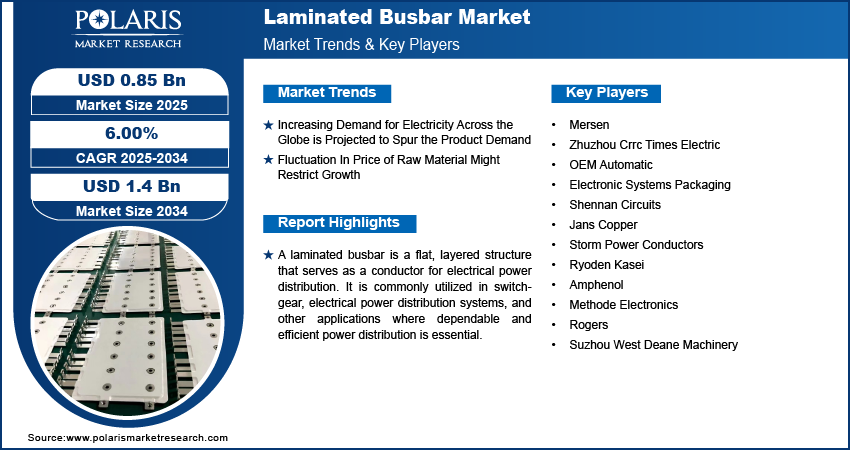
Get Full Segment-Level Forecasts & Insights: Download Sample Report
Market Segmentation
The laminated busbar market segmentation is primarily based on conductor, insulation material, application, and region. Each segment differs in terms of conductivity, insulating properties, heat-handling capacity, complexity, and cost. Looking ahead, growth in these laminated busbar segments will depend on EV adoption, renewable energy, industrial power demand, and demand for custom electrical connection solutions.
By Conductor Insights
Based on conductor, the laminated busbar market is segmented into copper and aluminium. The aluminum segment led the market with a 57.5% revenue share in 2025. Electric power transmission is carried out at a larger scale using aluminum-laminated busbars. Its technological characteristics include minimal weight and ease of application. Additionally, its ability to transport heavier loads further and more affordably is deduced from its characteristics of minimal weight and excellent mechanical quality. The major driver is the increased emphasis on energy saving and the preference for laminated busbars over cables. The geopolitical trade dispute between China and the United States may present challenges. Still, many of the benefits of smart city electrification development and the expansion of the switchgear, energy, and power markets also present opportunities.
Aluminum is gaining popularity in applications where reduced weight, cost savings, and adequate conductivity are significant. However, copper remains essential in high-performance applications where strong conductivity is required, along with adequate capacity for high-load conditions. Therefore, buyers are increasingly comparing copper vs. aluminum laminated busbars on the basis of cost, current requirements, heat performance, design constraints, and reliability.
By Insulation Material Insights
Based on insulation material, the market is segmented into polyester film, heat-resistant fiber, epoxy powder coating, polyamide film, epoxy glass, and others. Laminated busbar insulation materials selection is significant for safety, mechanical strength, heat resistance, and flexibility in laminated busbars. Epoxy powder coating busbars are commonly used due to their insulating ability. Polyester film busbar is often selected for cost-effectiveness and balanced performance. Polyamide or polyimide film is used for applications involving high-temperature exposure.
As applications become more complex, insulation selection is becoming more application-specific. Renewable energy systems, EV power modules, industrial drives, and aerospace applications require different levels of electrical strength, thermal resistance, mechanical endurance, and ease of manufacturing. This is where the insulation material strategy is becoming critical for laminated busbar manufacturers to be competitive in the market.
By Application Insights
Based on application, the laminated busbar market is segmented into datacenter, telecom, alternative energy, power electronics and SiC, transportation, aerospace & defense, industrial, and others. The industrial segment is projected to witness the fastest growth, at a 7.7% CAGR. The rising trend of urbanization and infrastructure development across the world is creating opportunities in the electrical sector. Laminated busbars are used in various infrastructure electrical systems, such as buildings and industrial plants. Continuous R&D activities are enhancing the properties of laminated busbars. In addition, innovation in laminated busbar products is also contributing to the segment’s growth by meeting the evolving needs of industries. The increasing emphasis on electric vehicles in the automotive and public transport sectors has led to a need for compact, efficient power distribution systems. Laminated busbars support the electrification of transportation. Thus, the industrial segment is expected to witness growth in the coming years.
The industrial segment is also likely to grow with laminated busbars being used in automation cabinets, motor drives, converters, robotics, process equipment, and factory power systems. Such products demand compactness, good connections, low maintenance, and stable performance with continuous operation. Currently, there is also growing demand for laminated busbars in power electronics, silicon carbide power electronics, telecom power modules, data centers, renewable energy solutions, and EV charging solutions. All of this supports the overall segmental growth.
Source: Polaris Market Research Analysis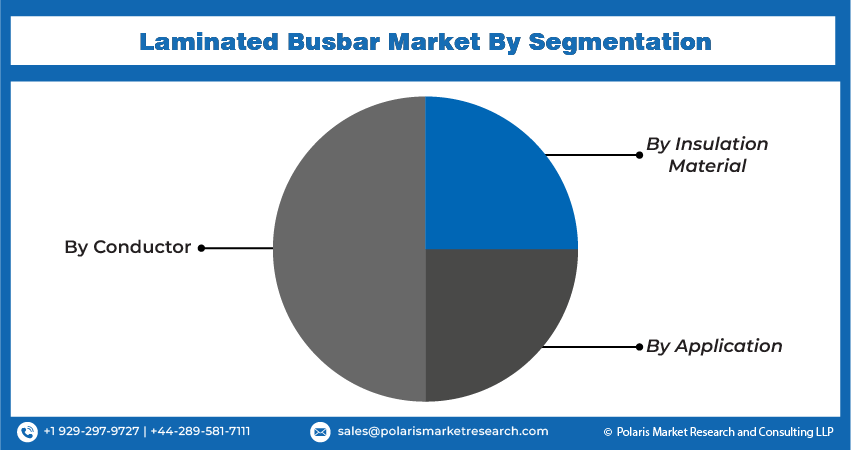
Need Granular Data Across All Market Segments? Request Customization
Regional Insights
Asia Pacific
The Asia Pacific laminated busbar market had the largest market share of 42.0% in 2025, with India and China leading in revenue. Ongoing infrastructure development projects in Asia Pacific countries, including China and India, often require advanced, compact electrical distribution solutions. Laminated busbars, due to their space-saving nature, could be in demand for infrastructure development projects. Asia Pacific countries have been actively investing in renewable energy projects as the global market for renewable energy has grown. Laminated busbars are used in various renewable energy applications, such as solar and wind power systems. Applications in electric vehicles and hybrid vehicles for power distribution, along with the growth of the automotive industry in Asia Pacific, may boost demand for laminated busbars.
A robust manufacturing base in electronics, EV parts, industrial equipment, and renewable energy equipment also supports the Asia Pacific. High production capacity, cost benefits, improved infrastructure, and increased levels of electrification make the Asia Pacific an important region for global laminated busbar demand. The rise in requirement for batteries, EV charging, and smart industrial systems is likely to further reinforce the Asia Pacific’s position as a leader in the global laminated busbar demand.
North America
The North America laminated busbar market is projected to witness the fastest growth, with a 7.4% CAGR. This is because of the growing adoption of laminated busbars in the automotive industry due to their outstanding corrosion resistance and temperature acceptance. North America has diverse manufacturing industries, and laminated busbars find applications in various manufacturing processes. Growth in manufacturing activities could drive demand for laminated busbars. There has been a growing emphasis on energy efficiency and sustainability in North America. Laminated busbars can reduce energy losses and enable energy-efficient power distribution.
With growing industrialization, North America is expected to dominate the market during the forecast period. Rising investments in data centers, grid infrastructure, EV manufacturing, renewable energy projects, and improved industrial electric systems also drive regional growth. As OEMs and utilities focus on improving power efficiency, miniaturization, and reliable electrical systems, laminated busbars are expected to gain traction in transport and stationary applications.
Europe
The demand for laminated busbars in Europe is expected to be high. The Europe laminated busbars market is driven by the region’s industrial electrification needs, rail modernization activities, renewable power systems, and the need for efficiency. The emphasis on high-performance systems, customization, and production for compliance in the region is expected to fuel the laminated busbars market in the region.
Latin America and Middle East & Africa
The Latin America laminated busbar market and the Middle East & Africa offer emerging opportunities. Industrial growth, electrical upgrades, electrification of commercial establishments, and renewable energy help sustain these regional markets. Although these regions account for a relatively small share of global demand, increased infrastructure investments and electrical system upgrades are expected to create growth opportunities for laminated busbar suppliers.
Source: Polaris Market Research Analysis
Curious About Regional Market Performance? Request Customization
Competitive Landscape
The laminated busbar market competition is intense. The established laminated busbar companies are using advanced technology, quality products, and brand reputation to generate business growth. Laminated busbar manufacturers are implementing various business strategies, such as R&D activities, acquisitions, and busbar product innovations, to enhance their product offerings and sustain the competition in the laminated busbar industry.
Competition in the laminated busbar market is being fueled by elements such as custom busbar manufacturing, insulation expertise, precise manufacturing, reliable supplies, and application-centric engineering support. Companies that have the capabilities to serve EV platforms, renewable energy solutions, industrial automation, and high-density power electronics with efficient and thermally optimized busbar solutions have greater opportunities to achieve a competitive advantage. Further, strategic acquisitions within the wider electrical infrastructure space could help improve capabilities within segments such as data centers, charging, and modular power distribution.
Mersen is a global provider of electrical power solutions. The company offers custom laminated busbars for applications in the fields of energy, transportation, and power electronics. The company specializes in high-performance, low-inductance solutions. Mersen has significant engineering and manufacturing expertise.
Ryoden Kasei Co., Ltd. is a Japan-based manufacturer specializing in insulating materials and laminated busbars. The company provides reliable and application-specific solutions. It is supported by its expertise in materials and precision manufacturing.
List of Key Companies
- Amphenol
- Electronic Systems Packaging
- Jans Copper
- Mersen
- Methode Electronics
- OEM Automatic
- Rogers
- Ryoden Kasei
- Shennan Circuits
- Storm Power Conductors
- Suzhou West Deane Machinery
- Zhuzhou Crrc Times Electric
Recent Developments
- July 2025: Eaton announced the acquisition of Resilient Power Systems Inc. The company stated that the acquisition will help expand the market for Resilient’s medium voltage solid-state transformers to data centers and other customers.
- May 2025: Legrand revealed the acquisition of cable-bus supplier Power Bus Way. According to Legrand, this marked its first data center acquisition in North America.
- March 2025: Eaton signed a USD 1.4 billion agreement to acquire Fibrebond Corporation. The move is expected to strengthen its position in modular power enclosures for multi-tenant data centers.
Market Segmentation
By Conductor Insights (Revenue, USD Million, 2021–2034)
- Copper
- Aluminum
By Insulation Material Insights (Revenue, USD Million, 2021–2034)
- Polyester Film
- Heat-resistant Fiber
- Epoxy Powder Coating
- Polyamide Film
- Epoxy Glass
- Others
By Application Insights (Revenue, USD Million, 2021–2034)
- Datacenter
- Telecom
- Alternative Energy
- Power Electronics and SiC
- Transportation
- Aerospace & Defense
- Industrial
- Others
By Regional Outlook (Revenue, USD Million, 2021–2034)
- North America
- US
- Canada
- Europe
- Germany
- France
- UK
- Italy
- Spain
- Netherlands
- Russia
- Rest of Europe
- Asia Pacific
- China
- Japan
- India
- Malaysia
- South Korea
- Indonesia
- Australia
- Vietnam
- Rest of Asia Pacific
- Middle East & Africa
- Saudi Arabia
- UAE
- Israel
- South Africa
- Rest of Middle East & Africa
- Latin America
- Mexico
- Brazil
- Argentina
- Rest of Latin America
Laminated Busbar Market Report Scope
| Report Attributes | Details |
| Market Size in 2025 | USD 870.80 million |
| Market Size in 2026 | USD 928.42 million |
| Revenue Forecast by 2034 | USD 1,585.13 million |
| CAGR | 6.9% |
| Base Year | 2025 |
| Historical Data | 2021–2024 |
| Forecast Period | 2026–2034 |
| Quantitative Units | Revenue in USD million, and CAGR from 2026 to 2034 |
| Report Coverage | Revenue Forecast, Market Competitive Landscape, Growth Factors, and Trends |
| Segments Covered |
|
| Regional Scope |
|
| Competitive Landscape | Laminated Busbar Industry Trend Analysis (2025) Company profiles/industry participants profiling include company overview, financial information, product/service benchmarking, and recent developments |
| Report Format | PDF + Excel |
| Customization | Report customization as per your requirements with respect to countries, regions, and segmentation. |
Source: Polaris Market Research Analysis
Report Coverage
The laminated busbar market report focuses on key regions worldwide to provide users with a better understanding of the product. Also, the report provides market insights into recent developments and trends, and analyzes the technologies gaining traction worldwide. Furthermore, the report provides in-depth qualitative analysis of the various paradigm shifts associated with the transformation of these solutions.
The report provides a detailed analysis of the market, focusing on key aspects such as competitive analysis, conductors, insulation materials, applications, and future growth opportunities.
Laminated Busbar Market FAQ's
The laminated busbar market size stood at USD 870.80 million in 2025. The market is projected to reach USD 1,585.13 million by 2034.
The market is projected to account for a CAGR of 6.9% between 2026 and 2034.
A laminated busbar is an electrical conductor in which multiple sheets of copper or aluminum are laminated with insulating materials. Laminated busbars are used for efficient power transmission in compact devices such as EV battery packs, inverters, switchgear, industrial drive systems, and renewable power systems.
The market is driven by the growing demand for compact and high-current power distribution systems in EVs and renewable energy systems.
Laminated busbars can minimize space requirements, thermal performance, assembly and inductance. They also offer more predictable electric behavior than traditional cable assemblies in high-power systems.
The two most commonly used materials for conductors are copper and aluminum. Copper is preferred for its high conductivity and space-saving features. Aluminum is used for its weight-saving and cost-effective features.
The major end-use industries that make use of laminated busbars are the automotive industry, industrial automation, power electronics, and renewable energy. The laminated busbars are also used in the telecom industry, aerospace and defense industry, data center industry, and the transportation industry.
Laminated busbars are used in EV components such as battery packs and battery management systems. Their use helps improve current flow and packaging efficiency.
Common insulation materials used in laminated busbars include epoxy powder coating, polyester film, heat-resistant fiber, epoxy glass, and polyamide or polyimide films.
Raw material pricing volatility, especially copper and aluminum, is a key restraint. In addition, customization may increase the cost of development and manufacturing.
Download Sample Report of Laminated Busbar Market
Please fill out the form to request a customized copy of the research report.


