
Low-Code Application Development Platform Market Growth Analysis Report, 2026-2034
REPORT DETAILS
Market Statistics
What is Low-Code Application Development Platform Market Size?
Global low-code application development platform market size was valued at USD 37.55 billion in 2025 and is anticipated to exhibit the CAGR of 23.8% during the forecast period.
Market Statistics
- 2025 Market Size: USD 37.55 Billion
- 2034 Projected Market Size: USD 256.11 Billion
- CAGR (2026-2034): 23.8%
- Largest Market: North America
Industry Trends
The growing low-code development platform market is witnessing remarkable expansion, fueled by the emergence of cloud technology that has democratized application development. This accessibility now extends to businesses of all sizes, including micro startups, as excessive costs and infrastructure complexities no longer force them. Even small enterprises are swiftly embracing no-code platforms to enhance agility and foster innovation.
Cloud-based solutions have transformed conventional legacy systems by providing unparalleled flexibility, transparency, and automation, thus significantly minimizing errors and expediting processes. This adaptability can be further tailored to suit evolving requirements, diminishing reliance on IT support and costly infrastructure. The nimbleness facilitated by low-code platforms empowers businesses to respond to dynamic market conditions and evolving consumer preferences promptly. This result is increasing the low-code development platform market share.
These platforms empower internal stakeholders, enabling them to construct applications without extensive coding expertise, thereby reducing expenses and obviating the necessity for expensive software developers. Additionally, they aid in monitoring shadow IT and mitigating security vulnerabilities by allowing business users to collaborate with IT departments in developing solutions. Ultimately, these platforms alleviate the scarcity of developers, offering a remedy to the global talent deficit and facilitating digitally-driven transformations.
Source: Polaris Market Research Analysis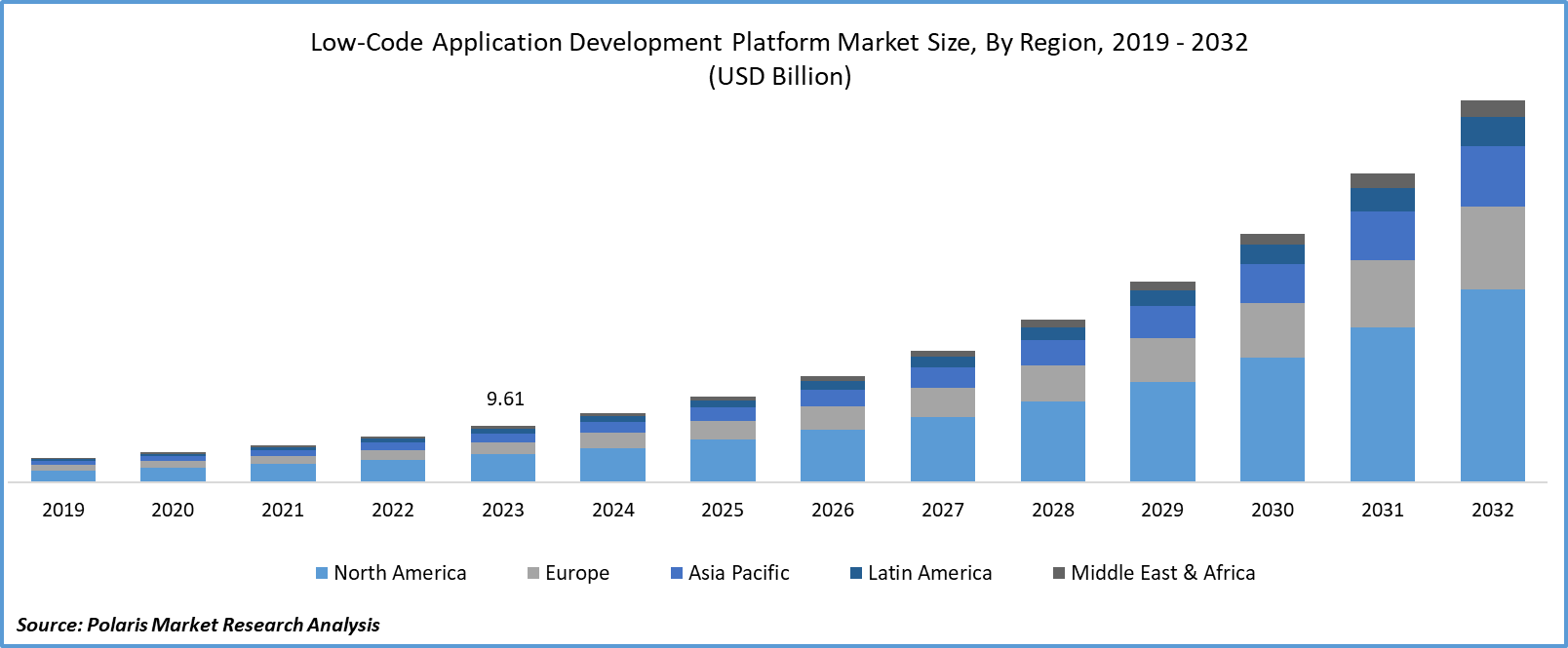
To Understand More About this Research: Download Sample Report
For instance, in March 2023, Aurachain, the low-code development platform specializing in process applications, revealed its plans to integrate state-of-the-art artificial intelligence (AI) technology. This initiative involves incorporating robust AI-assisted functionalities to assist Aurachain customers in the design, construction, and enhancement of applications. By providing contextual guidance and insights into process activities, this advancement is poised to revolutionize workflow automation and usher in a new era of efficiency.
The integration signifies a notable augmentation of the platform's capabilities through various AI techniques, including Generative AI, image recognition, reactive AI, and unsupervised machine learning.
However, by granting greater autonomy to development teams, low code platforms contribute to reducing resource costs, thereby aligning with the evolving needs of businesses striving to meet the immediate demands of their digital transformation journey. Consequently, the escalating demand for solutions that cater to the dynamic requirements of modern business models is anticipated to propel the low-code application development platform market growth.
The low-code application development platform market size and share report details key market dynamics to help industry players align their business strategies with current and future trends. It examines technological advances and breakthroughs in the industry and their impact on the market presence. Furthermore, a detailed regional analysis of the industry at the local, national, and global levels has been provided.
Source: Polaris Market Research Analysis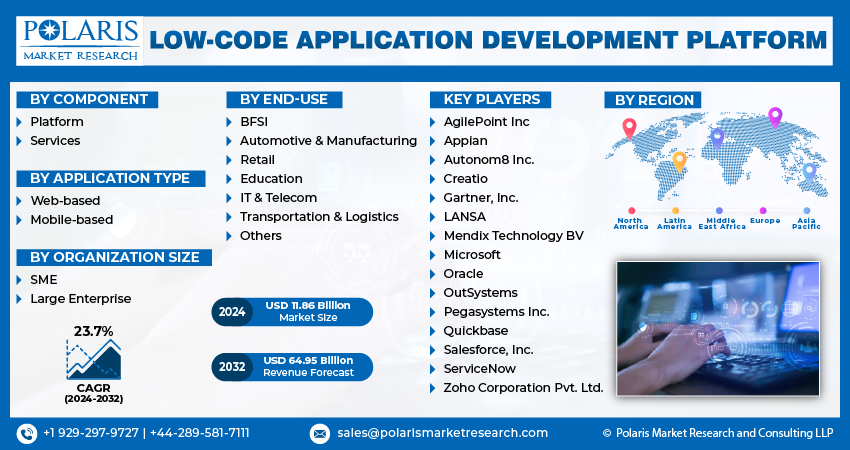
Get Full Segment-Level Forecasts & Insights: Download Sample Report
Key Takeaways
- North America dominated the largest market and contributed to more than 37% of the share in 2025.
- The Asia-Pacific region is expected to witness the fastest-growing CAGR during the forecast period.
- By organization size category, the small and medium-sized enterprises (SME) segment held the largest market share in 2025.
- By end-use category, the BFSI segment is expected to grow at the fastest CAGR during the forecast period.
What are the Market Drivers Driving the Demand for Low-Code Application Development Platform Market?
Increasing Investment Digital Transformation
Businesses across various industries are increasingly investing in digital transformation to enhance efficiency, agility, and customer experience. Low-code platforms offer a faster and more flexible approach to application development, aligning with these initiatives. With the evolution from Web 2.0 to Web 3.0 and the consequent rise in digital transformation, there's been a surge in the adoption of API-centric business models. This approach enables organizations to share their application information and features with external partners, developers, and internal departments. Hence, the low-code application development platform market trends are expected to increase during the forecast period.
By communicating through a documented interface, organizations can leverage their products and services more effectively, utilizing data and functionality. The increasing demand for advanced technologies has prompted businesses to adopt disruptive solutions, which in turn boosts productivity and fosters growth. Now, businesses prioritize their digital presence to meet evolving consumer preferences and provide enhanced customer value, thereby driving revenue in the low-code application Development Platform market. Rising Demand for Rapid Application Development (RAD): there is a growing need for rapid development and deployment of applications in the business environment. Low-code platforms enable developers to build applications with minimal hand-coding, accelerating the development process.
Which Factor is Restraining the Demand for the Low-Code Application Development Platform?
Limitations in software integration and customization capabilities
If a low-code development platform struggles to integrate seamlessly with existing software systems, it may deter potential users from adopting the platform. Businesses rely on a diverse array of software applications to manage various aspects of their operations. If a low-code platform cannot integrate with these existing tools, it may disrupt workflows and suffer additional costs to find workarounds or switch to alternative solutions. This limitation can significantly impede the market's expansion. Customization capabilities are often crucial for businesses to tailor software solutions to their specific needs and workflows. If a low-code platform needs more customization options, businesses may find themselves constrained by the platform's limitations. They may need help to implement unique features, adapt workflows, or accommodate evolving requirements effectively. This limitation can discourage adoption and hinder the low-code application development platform market's growth as businesses seek flexible solutions that can adapt to their changing needs over time.
Top Platforms of Low-Code Application Development
| Platform | Key Features | Manufacturing Applications |
| OutSystems | Enterprise scalability, AI automation, DevOps integration. | Logistics hubs (e.g., Rossmann), predictive maintenance. |
| Mendix | Multi-experience apps, cloud support, collaboration tools. | IT/OT convergence, shopfloor integration. |
| Microsoft Power Platform | Power Apps, automation, Azure/Dynamics integration, AI Copilot. | Data workflows, mobile apps for operations. |
| Siemens Opcenter (Low-Code) | MOM augmentation, legacy system capture. | Digital transformation, agility in production. |
Source: Polaris Market Research Analysis
Report Segmentation
The market is primarily segmented based on component, application type, organization type, end-use, and region.
| By component | By Application Type | By Organization Size | By End-use | By Region |
|
|
|
|
|
Source: Polaris Market Research Analysis
To Understand the Scope of this Report: Request Customization
Category Wise Insights
By Organization size Insights
Based on organization size analysis, the market is segmented on the basis of SMEs and large enterprises. The small and medium-sized enterprises (SME) segment held the largest market share in 2025; SMEs often have limited resources and workforce compared to larger enterprises. Low-code application development platforms offer these businesses a flexible and scalable solution to build custom applications quickly and cost-effectively. SMEs can adapt these platforms to meet their specific needs without the need for extensive coding expertise or large development teams. Low-code development platforms typically offer a pay-as-you-go pricing model or affordable subscription plans, making them more accessible to SMEs with limited budgets. These platforms enable SMEs to reduce development costs while still delivering high-quality applications to meet their market size requirements.
By End-use Insights
Based on type analysis, the market has been segmented based on BFSI, automotive & manufacturing, retail, education, IT & telecom, transportation & logistics, and others. The BFSI is predicted to grow at the fastest CAGR during the forecast period due to the growing imperative to digitize financial services, including tasks such as client origination, onboarding, self-servicing, and back-office operations; there is a rising interest in low-code development platforms. This interest stems from the desire to enhance user experiences, reduce operational costs, increase company agility, and expedite time to market which drives the significant demand of the low-code application development platform industry.
The evolution of technology across different generations has significantly transformed how financial service organizations generate value for their customers, employees, and stakeholders. The relentless drive for innovation, compliance with regulatory requirements, and swift issue resolution have intensified the demand for applications and software solutions.
In the banking, financial services, and insurance (BFSI) sector, escalating client expectations for innovative digital products and services underscore the need for expeditious application development processes. This facilitates frequent updates and ensures a swift time-to-market for new offerings. To meet these demands, banks seek modern, straightforward, and secure application development methods that leverage widely available frameworks, reusable code, and components.
Source: Polaris Market Research Analysis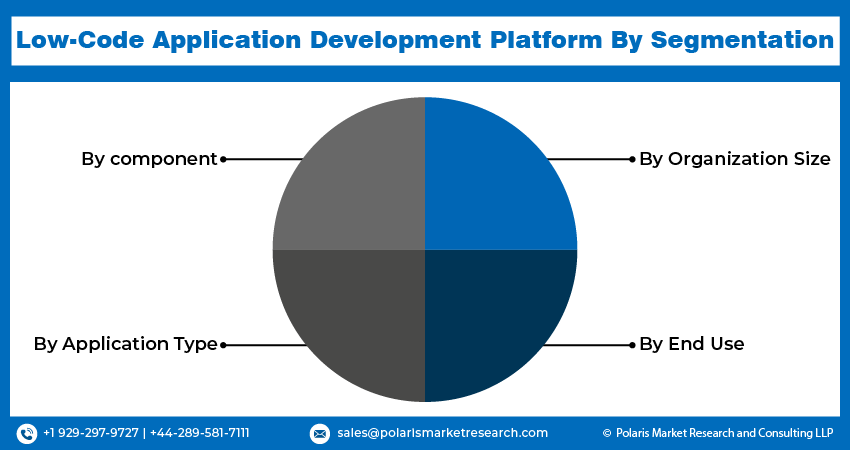
Need Granular Data Across All Market Segments? Request Customization
Regional Insights
North America
The North American region dominated the largest market share in 2025 and is expected to maintain its dominance over the anticipated period. The region has a strong demand for digital solutions across sectors such as finance, healthcare, manufacturing, and retail. Low-code development platforms offer a flexible and efficient way to build and deploy these solutions, driving their popularity in the market. Both the US and Canada boast robust economic conditions and are anticipated to be key contributors to the expansion of the low-code development platform market. Robust IT infrastructure and high-speed internet connectivity are essential for leveraging cloud-based low-code development platforms. This enables businesses to access and utilize these platforms effectively, further fueling their adoption.
Asia Pacific
The Asia-Pacific region is expected to witness the fastest-growing CAGR during the forecast period. The Asia-Pacific region encompasses countries with rapidly growing economies, such as China, India, and Southeast Asian nations. These countries are experiencing significant industrialization, urbanization, and digital transformation, which drive the demand for technology solutions like low-code application development platforms. There is a growing adoption of digital technologies and cloud-based solutions across various industries in the Asia-Pacific region. Businesses are increasingly recognizing the need for agile and efficient software development processes, due to greater interest in low-code application development platforms.
Source: Polaris Market Research Analysis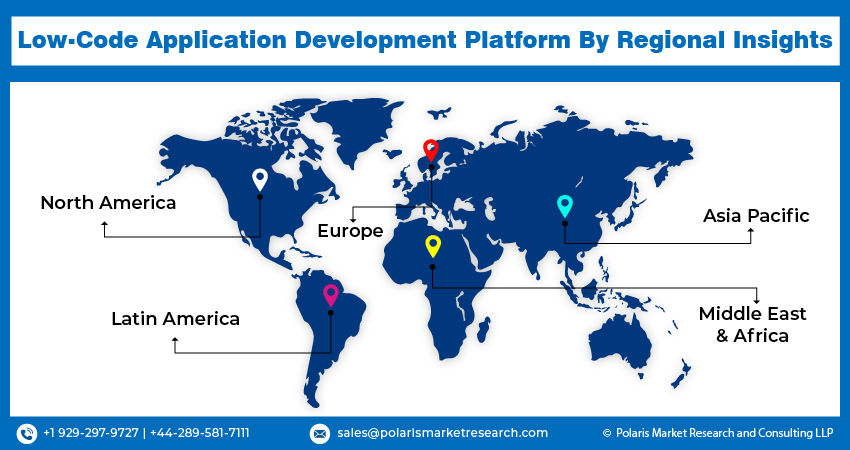
Curious About Regional Market Performance? Request Customization
Competitive Landscape
The low-code application development platform market is fragmented and is anticipated to witness competition due to several players' presence. Partnerships and alliances play a significant role in shaping the competitive landscape. Low-code platform providers frequently collaborate with technology companies, system integrators, and consultancy firms to expand their market statistics, enhance their platforms' capabilities, and deliver integrated solutions to customers. These partnerships enable providers to leverage complementary technologies, industry expertise, and customer relationships to gain a competitive edge.
Some of the major players operating in the global market include:
- AgilePoint Inc
- Appian
- Autonom8 Inc.
- Creatio
- Gartner, Inc.
- LANSA
- Mendix Technology BV
- Microsoft
- Oracle
- OutSystems
- Pegasystems Inc.
- Quickbase
- Salesforce, Inc.
- ServiceNow
- Zoho Corporation Pvt. Ltd.
Recent Developments
In May 2025: Salesforce announced its USD 8 billion purchase of Informatica to combine data management and AI within the Salesforce Platform.
In March 2025: Appian launched version 25.1 with an AI-driven data fabric that handles 75× more documents per hour.
In January 2025: Triton agreed to acquire Neptune Software, adding 800 clients and 5 million licenses to its portfolio.
In December 2024: Salesforce introduced AgentForce Testing Center to manage AI agents throughout their lifecycle in production.
In January 2024: Microsoft announced major updates to its Power Platform by adding AI features and RPA tools. These upgrades allow citizen developers to use AI for data analysis and automated processes, making application development easier and faster.
In November 2023: Mendix partnered with Amazon Web Services to connect its low-code platform with Amazon SageMaker. This lets developers use ready-made AI models inside Mendix apps, helping simplify AI integration and shorten development time.
Report Coverage
The low-code application development platform market report emphasizes key regions across the globe to provide a better understanding of the product to the users. Also, the report provides market insights into recent developments, and trends and analyzes the technologies that are gaining traction around the globe. Furthermore, the report covers an in-depth qualitative analysis of various paradigm shifts associated with the transformation of this technology
The report provides a detailed analysis of the market while focusing on various key aspects such as competitive analysis, component, application type, organization size, end use, and their futuristic growth opportunities.
Low-Code Application Development Platform Market Report Scope
| Report Attributes | Details |
| Market Size in 2025 | USD 37.55 billion |
| Market Size in 2026 | USD 46.39 billion |
| Revenue Forecast in 2034 | USD 256.11 billion |
| CAGR | 23.8% from 2026 – 2034 |
| Base year | 2025 |
| Historical Data | 2021 – 2024 |
| Forecast Period | 2026 – 2034 |
| Quantitative Units | Revenue in USD billion and CAGR from 2026 to 2034 |
| Segments Covered | By Component, By Application Type, By Organization Size, By End Use, By Region. |
| Regional Scope | North America, Europe, Asia Pacific, Latin America, Middle East & Africa |
| Customization | Report customization as per your requirements with respect to countries, region, and segmentation. |
Source: Polaris Market Research Analysis
Low-Code Application Development Platform Market FAQ's
The global low-code application development platform market size is expected to reach USD 256.11 billion by 2034
Key players in the market are AgilePoint Inc., Appian, Autonom8 Inc., Creatio, Gartner, Inc., LANSA
North American contribute notably towards the global Low-Code Application Development Platform Market
Low-Code application development platform market exhibiting the CAGR of 23.8% during the forecast period.
The Low-Code Application Development Platform Market report covering key segments are component, application type, organization type, end use, and region.
Download Sample Report of Low-Code Application Development Platform Market
Please fill out the form to request a customized copy of the research report.


