
Machine Control System Market Demand, Growth Opportunity, 2026-2034
REPORT DETAILS
Market Statistics
Market Overview
The global machine control system market size stood at USD 5.96 billion in 2025. The market is projected to account for a CAGR of 7.6% between 2026 and 2034. The growing demand for automation and precision in heavy machinery is a major driver of the market. The need to enhance work efficiency and complete tasks more quickly is also fueling market demand. Furthermore, the emphasis on workplace safety and the reduction of workplace accidents is promoting the use of these systems.
Additionally, the market is benefiting from the adoption of digital construction methods. Contractors are increasingly turning to connected equipment, 3D design models, and real-time positioning systems to provide more accurate cut and fill, reduce surveying costs, and eliminate costly rework. As infrastructure owners and contractors increasingly focus on productivity, fuel efficiency, and data-driven construction operations, machine control systems are becoming a standard feature of construction technology rather than optional upgrades.
Key Insights
- The global navigation satellite system (GNSS) segment, in terms of type, held the largest machine control system market share in 2025. This is because of the increasing use of high-precision technology to improve efficiency in construction.
- By equipment, the excavators segment accounted for the largest market share in 2025. This is due to the rising integration of advanced machine control systems to improve digging accuracy and reduce operational costs.
- By end use, the infrastructure sector was the market leader in 2025. The rising number of large-scale infrastructure development projects and investments in smart construction technologies by the government are factors that contribute to the dominant position of this segment.
- The North America region accounted for the largest machine control system market share in 2025. This is because of the strong emphasis on advanced technology in this region and the mature construction industry.
- Asia Pacific is projected to witness the fastest growth. Rapid industrialization and urban development drive the regional market growth.
- Another trend that is influencing the market is the increasing adoption of AI-enabled control features such as predictive grading, automatic route adjustment, and improved machine performance, particularly in major road construction and earthmoving operations.
Industry Dynamics
- The increasing emphasis on higher jobsite productivity and faster project completion is a key driver. Organizations are employing these systems to reduce project timelines and minimize costs while ensuring accuracy and minimizing material wastage in large projects like infrastructure development.
- An increasing emphasis on worker safety and accident prevention is also a significant driving force. These technologies automate dangerous tasks. So, workers do not need to be in hazardous locations at construction and mining sites. This reduces the number of accidents and provides a safe working environment.
- Automation and advanced technology are being increasingly used in heavy industries. It is making the grading, digging, and paving operations more accurate. This has resulted in an increased demand for machine control systems.
- The market is also facing some challenges. These include the cost of implementation, calibration, and software compatibility. There is also the need to train the operators in the use of digital designs and precision guidance systems. In spite of the challenges, the long-term cost savings of rework, staking, fuel, and machine utilization have continued to promote the use of this technology.
Market Statistics
2025 Market Size: USD 5.96 billion
2034 Projected Market Size: USD 11.52 billion
CAGR (2026–2034): 7.6%
North America: Largest market in 2025
Source: Polaris Market Research Analysis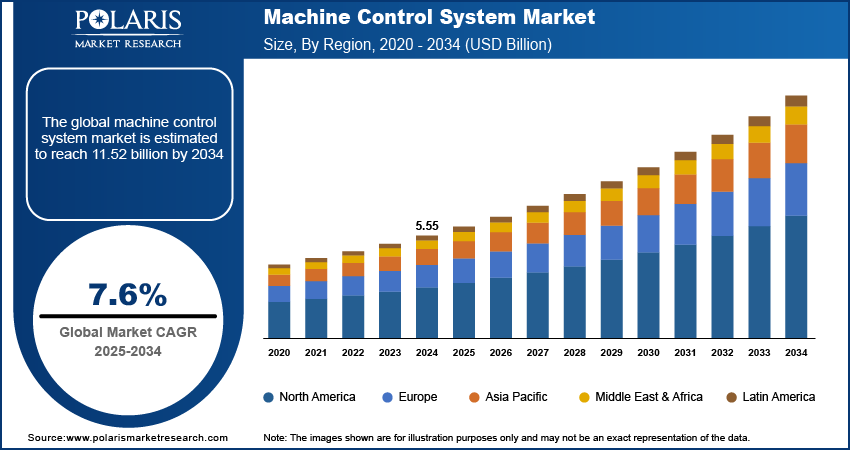
To Understand More About this Research:Download Sample Report
AI Impact on Machine Control System Market
- Artificial intelligence (AI) technology enables terrain analysis, semi-autonomous equipment, and predictive grading. These are standard features in modern control systems.
- AI allows machines to learn from operational data. Using the data, machines can adjust control parameters autonomously. Such use of technology improves efficiency and reduces human intervention.
- AI tools adjust machine operations autonomously using live data. This improves energy efficiency, throughput, and product consistency.
- AI systems analyze sensor data to predict equipment failures before they happen. This helps in reducing downtime and maintenance costs.
- Grade optimization, bucket path correction, route optimization, and site progress tracking are also being implemented using AI. AI-powered machine control systems combine the use of sensors, telematics, and digital terrain models to enable semi-autonomous machine control. The system allows project managers to track productivity, equipment, and maintenance activities in a more efficient manner. This further improves the value-for-money aspect not only for the larger contractors but also for the mid-sized firms looking for conclusive results on their connected equipment.
Machine control systems incorporate technology such as GNSS, lasers, and sensors to automate and guide heavy equipment. These systems enable equipment to work with a high degree of accuracy based on a digital design plan. They eliminate the need for conventional surveying and guesswork. This results in more efficient and accurate work being done on site.
One factor affecting the market is the growing need for data analytics and real-time site management. These solutions generate significant data on machine performance and site progress. This data enables project managers to make more informed decisions about resource allocation, monitor productivity remotely, and manage intricate projects efficiently. The data also offers valuable insights for conducting preventative maintenance.
Another major factor that makes this technology popular is the growing need to fill the gap in skilled labor availability. Currently, there is a major skilled labor shortage in construction. This technology enables operators who are not very skilled to effectively operate complex machines with a high level of accuracy. It reduces the time spent in training operators. It ensures that companies maintain a high standard of work quality despite the reduced availability of skilled workers. The adoption of this technology relieves the workload of skilled employees. It enables them to focus on more complex tasks. For instance, the U.S. Bureau of Labor Statistics has reported an increasing need for construction managers and the need for new technologies to improve labor productivity and safety.
Another major driver for this market is the increased demand for sustainable construction technology. The machine control systems help in reducing over-excavation and optimizing transport operations. The systems reduce fuel consumption by enabling machines to finish operations in fewer passes, thus saving fuel. This is an important driver for the market, considering cost management and sustainability in construction operations.
Drivers and Trends
Increased Focus on Worker Safety
The increasing focus on improving the safety of construction workers is one of the major factors that is driving the machine control system market. There are certain risks involved in the traditional way of operating heavy machines and grinding machines, as it is not easy to get a clear view of the surroundings, and the task itself is risky. Machine control systems are effective in preventing accidents caused by human error. This has led construction and mining companies to invest in technology that can better protect their workers. In addition, real-time operator guidance systems can be used to perform tasks with greater confidence in complex operations like trenching, slope work, and grading in high-traffic or low-visibility areas. This enables safer earthmoving operations by reducing the need to estimate movements.
According to the United States Bureau of Labor Statistics Census of Fatal Occupational Injuries in 2023, the construction industry had the most fatalities in comparison to all other industries, with a total of 1,075 fatalities. The Census report stated that the most common cause of fatalities was falls, slips, and trips, accounting for nearly 40 percent of all fatalities in the construction industry. This indicates the need for technology that helps minimize the dangers of working at heights and in hazardous locations. This is why there is a strong need for machine control systems in such industries.
Rising Government Investments in Infrastructure
Another major factor that drives the market for machine control systems is the major government spending on infrastructure projects around the world. The governments are making major investments in the construction of new roads, bridges, and other infrastructure projects. The completion of such major projects on time and within budget requires contracts that make use of the most efficient and accurate tools available. Machine control systems are a major part of such requirements. These systems make large construction jobs faster and more accurate. This shift is particularly significant for transport corridors, upgrades, airports, and smart city construction. It’s because the requirements for accuracy are becoming more stringent. Contractors are under pressure to complete jobs more quickly without compromising quality. As more infrastructure projects are using digital project delivery processes for work and performance results, machine control systems are becoming more significant to contractors.
A Congressional Budget Office presentation on public spending on transportation and water infrastructure revealed that in 2023, public spending on such infrastructure totaled $626 billion. This is a significant amount spent on public infrastructure, and therefore there is a need for modern, efficient means to ensure such projects are completed. With more public spending on such infrastructure, demand for technology that ensures it is completed efficiently and accurately is expected to grow.
Connected and Data-Driven Jobsites
A key machine control system market trend is the shift from separate machine guidance systems to connected jobsites. Contractors are increasingly demanding machine control systems that can interface with cloud-based machine control dashboards, fleet management systems, and digital terrain models in real time. This allows contractors to monitor machine usage and compare actual machine usage with design information. It also enables them to address productivity problems. With this shift toward connected construction, there may be a need for more software-centric control systems.
Source: Polaris Market Research Analysis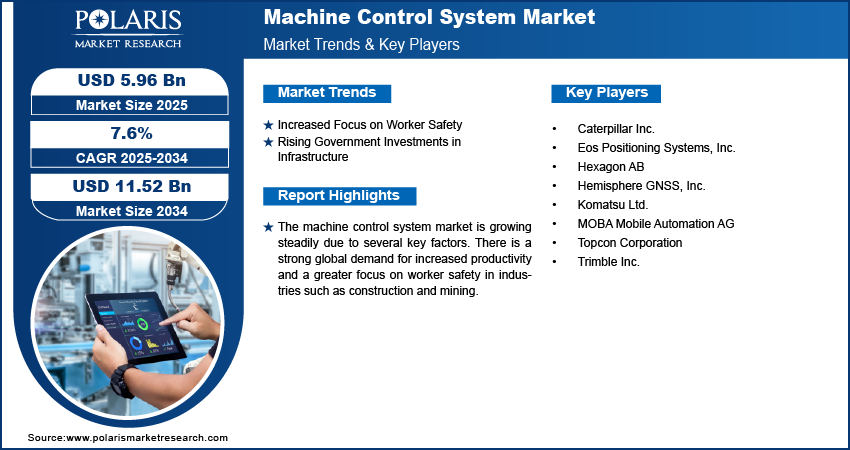
Get Full Segment-Level Forecasts & Insights: Download Sample Report
Segmental Insights
Type Analysis
Based on type, the segmentation includes global navigation satellite system (GNSS), sensors, total stations, and laser scanners. The global navigation satellite system (GNSS) segment held the largest machine control system market share in 2025. This is because it uses satellite signals to provide real-time location information, which is crucial in navigating machinery with high precision. GNSS technology is used in a variety of applications. These include grading, digging, and paving, and in large-scale projects such as highways and dams. It can cover large distances with minimal equipment. This makes it the preferred choice for large-scale construction and mining activities. The large share of this segment is attributed to its compatibility with other advanced technologies, thus improving efficiency and reducing waste in such activities. The use of GNSS-based solutions can prove to be particularly useful in large earthmoving operations. This is because they minimize the need for manual staking. They can also provide continuous machine position information over large areas. Their ability to work with 3D design files and support remote corrections also helps improve project coordination.
The laser scanners market is expected to have the highest growth rate during the forecast period. This is because laser scanners can create detailed 3D maps and models of a work area with high accuracy. This is particularly useful in job areas that require detailed measurements and complex designs. These include building renovations or specialized surveys. The rapid growth of this segment can be attributed to the ongoing improvement of technology, which has made it more accurate and easier to use. As a result, they are being used in many areas outside their traditional use. They can quickly gather large amounts of data, making them useful for quality checks.
Equipment Analysis
Based on equipment, the segmentation includes excavators, loaders, graders, dozers, scrapers, and paving systems. The excavators segment held the largest machine control system market share in 2025. These machines are crucial in digging, trenching, demolition, and handling materials in a variety of projects, from residential buildings to large-scale projects. The machine control systems used in excavators help in automating and directing the movement of the bucket with high precision. This allows for digging to specific depths and angles, thus avoiding the need for manual checks and surveying teams. The capacity of these systems to make digging processes more efficient, reduce reworks, and decrease costs on a machine that is integral to most projects has made them a leading choice for companies. The versatility and use of the machines in modular construction, mining, and utility work ensure they constitute a significant market. There is also an increasing popularity in the use of automated excavators. This is because it can speed up the process while promoting uniformity among people with different levels of experience.
The graders segment is expected to witness the highest growth rate during the forecast period. Graders play an essential role at the end of a project, as they are used to provide smooth and level surfaces for roads, airfields, and the foundations of buildings. The increasing demand for perfectly graded surfaces and the complexity of design plans are the major factors that are causing the rapid adoption of machine control systems for graders, as they can provide a perfect grade with the help of lasers and GNSS technology, saving a lot of time, fuel, and money by completing the job with fewer passes over the surface. As infrastructure development remains a global focus, the importance of precise grading technology increases, thereby fueling the rapid growth of this segment.
Machine control systems are also becoming more prevalent in dozers, which are used for earthmoving and land preparation. The machine control systems assist operators in maintaining surface levels and slopes, especially during large soil movements. Additionally, paving systems can benefit from machine control technology in road and highway construction. This technology can help maintain uniform thickness and smoothness, thereby promoting road quality and minimizing waste materials.
End Use Analysis
Based on end use, the segmentation includes infrastructure, commercial, residential, and industrial. The infrastructure segment held the largest machine control system market share in 2025. It covers the construction of new roads, highways, bridges, dams, airports, and utilities. All of this requires high precision and efficiency, which machine control systems can achieve. Machine control systems in infrastructure allow contractors to complete complex earthmoving and grading operations in a precise and efficient way. That way, they can meet stringent time and budget requirements. The high demand for machine control systems, driven by increased government funding for infrastructure development, contributes to the segment’s leading market share.
The residential segment is anticipated to register the highest growth rate during the forecast period. The global population, especially in urban areas, is growing. So, there is a constant need for new housing developments. This drives a lot of residential construction activity. These projects are often smaller than infrastructure or commercial projects. But the increasing use of machine control systems in this sector is a major driver of its rapid growth. These systems help home builders improve productivity. They also reduce manual labor on tasks such as site preparation, foundation work, and landscaping. The growing awareness among smaller contractors of the benefits of using this technology to save time and reduce costs is driving its adoption. All of this makes residential construction a fast-growing sector.
Source: Polaris Market Research Analysis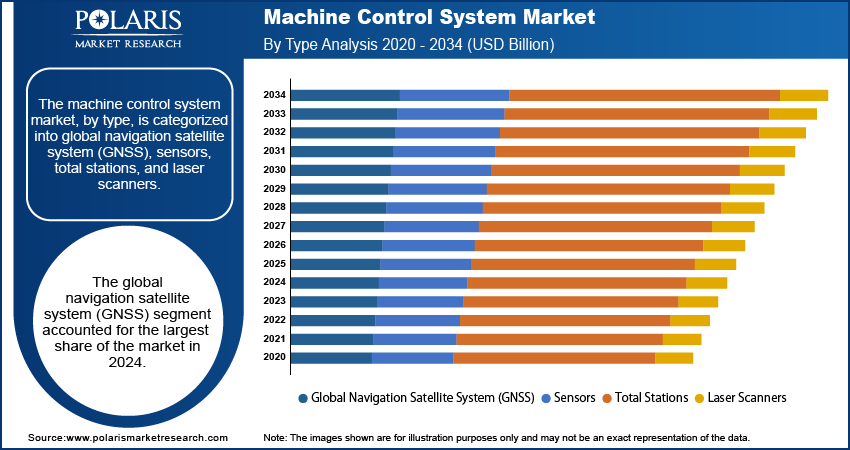
Need Granular Data Across All Market Segments? Request Customization
Regional Analysis
The North America machine control system market accounted for the largest share in 2025. The regional market is driven by a strong focus on advanced technology and a mature construction industry. The region has been quick to adopt machine control systems to improve work quality and safety on various projects. The high level of automation in the construction equipment, mining, and agriculture sectors also supports the ongoing demand for these technologies. Additionally, the region benefits from a large number of key companies that continually innovate and introduce new products. North America’s lead is further supported by the higher rate of digital equipment usage and telematics adoption. The region also benefits from productivity-improving technology acceptance among large contractors and fleet operators.
U.S. Machine Control System Market Insights
In North America, the U.S. holds a major share. The country has a highly active and established construction industry that relies heavily on advanced technology for tasks such as grading, digging, and paving. Government initiatives and investment in infrastructure projects are another factor that contributes to the growth of the country. The need to carry out accurate and efficient work in areas such as highway construction, bridges, and other public works makes the use of these systems a necessity.
Europe Machine Control System Market Trends
The industry in Europe is well developed, with a strong focus on modernizing its construction and industrial sectors. The region has high standards for quality and safety, which is why there is a strong preference for technologies that can help eliminate mistakes and provide greater protection for workers. There are also several large-scale construction and residential projects that are contributing to the growth of the industry in this region. The region is highly focused on digital transformation, and the implementation of such technologies is a major part of this process. The region’s focus on sustainable construction and modernizing aging infrastructure for transportation and public infrastructure also presents market opportunities.
The Germany machine control system market has the largest revenue share in 2025. The reason for this high revenue share is its strong economy and robust manufacturing sector, which drives high demand for machine control systems. It has also emphasized the adoption of new technology, and its established construction industry has made it a major contributor to the European market. Additionally, its efforts to build new housing and improve its infrastructure are boosting this market.
Asia Pacific Machine Control System Market Overview
Asia Pacific is the fastest-growing regional market. Its high growth rate can be attributed to the rapid rate of industrialization and urbanization. There is a lot of investment in new infrastructure in the countries in this region. This has created a huge demand for high-tech construction equipment. The need to automate to boost productivity and meet the demands of a growing population is also a major contributor. As technology becomes more accessible, more companies are adopting this technology to boost their operations. Asia Pacific is a region with robust growth due to ongoing urban infrastructure, transportation upgrades, and industrial corridor development. These activities are creating high demand for precise earthmoving and grading solutions.
China Machine Control System Market Outlook
China holds a major share of the industry in Asia Pacific, as it has a large and active construction sector. The country has also invested heavily in developing its infrastructure, which includes high-speed rail, new airports, and smart cities, among other infrastructure systems. These are complex infrastructure systems that demand the highest levels of precision and efficiency. Therefore, the application of machine control systems has been increasing in the country's construction and mining industries.
Source: Polaris Market Research Analysis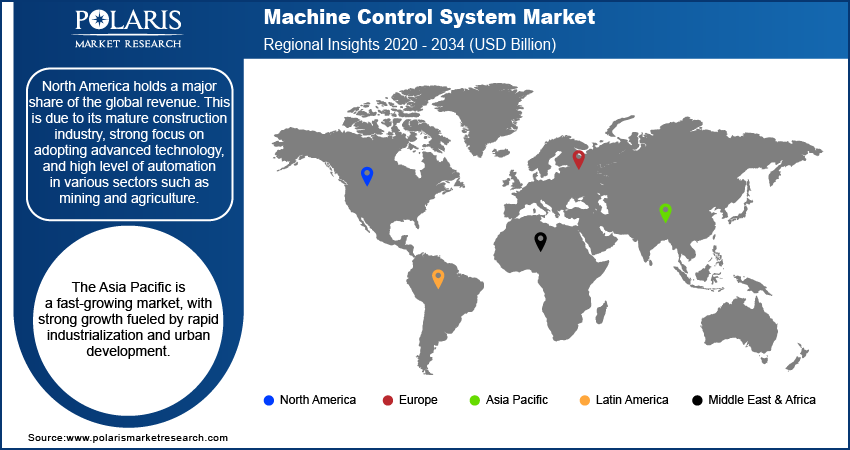
Curious About Regional Market Performance? Request Customization
Key Players and Competitive Insights
The competitive landscape is made up of both large, well-known companies and smaller, specialized firms. The major companies, like Trimble, Hexagon (Leica Geosystems AG), Topcon Corporation, MOBA Mobile Automation AG, and Caterpillar Inc., have a larger machine control system market share due to their strong presence in the global market. These companies usually have the whole product spectrum, from hardware like GNSS receivers and sensors to software that handles the data. The competition in this industry is mainly based on product development, partnerships with equipment companies, and strong customer support.
Competition is now being fueled more by the capabilities of the platforms, not just the hardware. Companies are differentiating themselves by providing cloud connectivity, API integrations, 3D model compatibility, workflow compatibility, and OEM partnerships that bring machine control systems and equipment together. In addition, the service, training, and ease of use of software are becoming key factors in selection for contractors.
A few prominent machine control system market companies include Trimble Inc., Hexagon AB, Topcon Corporation, MOBA Mobile Automation AG, and Hemisphere GNSS, Inc. Other important players include Caterpillar Inc., Komatsu Ltd., and Eos Positioning Systems, Inc.
List of Key Companies
- Caterpillar Inc.
- Eos Positioning Systems, Inc.
- Hemisphere GNSS, Inc.
- Hexagon AB
- Komatsu Ltd.
- MOBA Mobile Automation AG
- Topcon Corporation
- Trimble Inc.
Machine Control System Industry Developments
April 2025: Hexagon completed the acquisition of the Geomagic software business from 3D Systems Corporation. This acquisition allows Hexagon to offer new reverse engineering and inspection software to users. This software is compatible with various 3D scanning devices.
April 2025: Trimble introduced API capabilities for its Accubid Anywhere estimating solution. This allows contractors to efficiently collaborate on designs by working more effectively across various software systems.
Machine Control System Market Segmentation
By Type Outlook (Revenue – USD Billion, 2021–2034)
- Global Navigation Satellite System (GNSS)
- Sensors
- Total Stations
- Laser Scanners
By Equipment Outlook (Revenue – USD Billion, 2021–2034)
- Excavators
- Loaders
- Graders
- Dozers
- Scrapers
- Paving Systems
By End Use Outlook (Revenue – USD Billion, 2021–2034)
- Infrastructure
- Commercial
- Residential
- Industrial
By Regional Outlook (Revenue, USD Billion, 2021–2034)
- North America
- US
- Canada
- Europe
- Germany
- France
- UK
- Italy
- Spain
- Netherlands
- Russia
- Rest of Europe
- Asia Pacific
- China
- Japan
- India
- Malaysia
- South Korea
- Indonesia
- Australia
- Vietnam
- Rest of Asia Pacific
- Middle East & Africa
- Saudi Arabia
- UAE
- Israel
- South Africa
- Rest of Middle East & Africa
- Latin America
- Mexico
- Brazil
- Argentina
- Rest of Latin America
Machine Control System Market Report Scope
| Report Attributes | Details |
| Market Size in 2025 | USD 5.96 billion |
| Market Size in 2026 | USD 6.40 billion |
| Revenue Forecast by 2034 | USD 11.52 billion |
| CAGR | 7.6% |
| Base Year | 2025 |
| Historical Data | 2021–2024 |
| Forecast Period | 2026–2034 |
| Quantitative Units | Revenue in USD billion, and CAGR from 2026 to 2034 |
| Report Coverage | Revenue Forecast, Market Competitive Landscape, Growth Factors, and Trends |
| Segments Covered |
|
| Regional Scope |
|
| Competitive Landscape | Machine Control System Industry Trend Analysis (2025) Company profiles/industry participants profiling include company overview, financial information, product/service benchmarking, and recent developments |
| Report Format | PDF + Excel |
| Customization | Report customization as per your requirements with respect to countries, regions, and segmentation. |
Source: Polaris Market Research Analysis
Machine Control System Market FAQ's
The machine control system market stood at USD 5.96 billion in 2025. The market is projected to reach USD 11.52 billion by 2034.
A machine control system is a precision guidance solution that employs various technologies such as GNSS, sensors, total stations, and lasers to assist in more accurate execution of digging, grading, paving, and earthmoving operations by heavy equipment.
The market growth is mainly driven by rising construction automation and increasing infrastructure investment. The market also benefits from the stronger focus on worker safety.
The GNSS segment leads the machine control system market. This is because it allows high-precision positioning across large outdoor job sites.
Excavators hold the leading share. This is due to their extensive use across trenching, site preparation, demolition, utility work, and infrastructure projects.
North America accounts for the largest machine control system market share. Strong contractor adoption of construction automation and mature equipment fleets drives the region’s leading market position.
AI improves terrain analysis and predictive grading. It also makes route optimization, machine calibration, and predictive maintenance possible.
Machine control systems reduce stacking and minimize manual guesswork. These systems also lower fuel and labor costs by reducing unnecessary machine passes.
The main challenges include high upfront costs and training requirements. Challenges also exist around compatibility across software platforms and equipment brands.
They are used in grading, slope control, sub-base, and paving alignment to improve accuracy and minimize waste.
No. They can also be used in mining, agriculture, quarrying, and other heavy equipment operations.
Download Sample Report of Machine Control System Market
Please fill out the form to request a customized copy of the research report.


