
Marine Hatch Covers Market Size, Global Analysis Report,2026-2034
REPORT DETAILS
Market Statistics
What is Marine Hatch Covers Market Size?
The global marine hatch covers market was valued at USD 172.95 million in 2025 and is expected to grow at a CAGR of 7.7% during the forecast period.
Market Statistics
- 2025 Market Size: USD 172.95 Million
- 2034 Projected Market Size: USD 336.90 Million
- CAGR (2026-2034): 7.7%
- Largest Market: North America
The continuous expansion of global sea-borne transportation, the increased number of vessels being built or retrofitted with highly advanced or innovative hatch cover systems, and exponential growth in the global shipbuilding and marine industry are among the primary factors influencing the growth of the market. In addition, the rising innovations in hatch cover designs and materials and the development of new products that are more efficient, lighter, and durable, which led to significant cost savings and increased operational efficiency for vessel owners, have also been propelling the market growth over the years.
Source: Polaris Market Research Analysis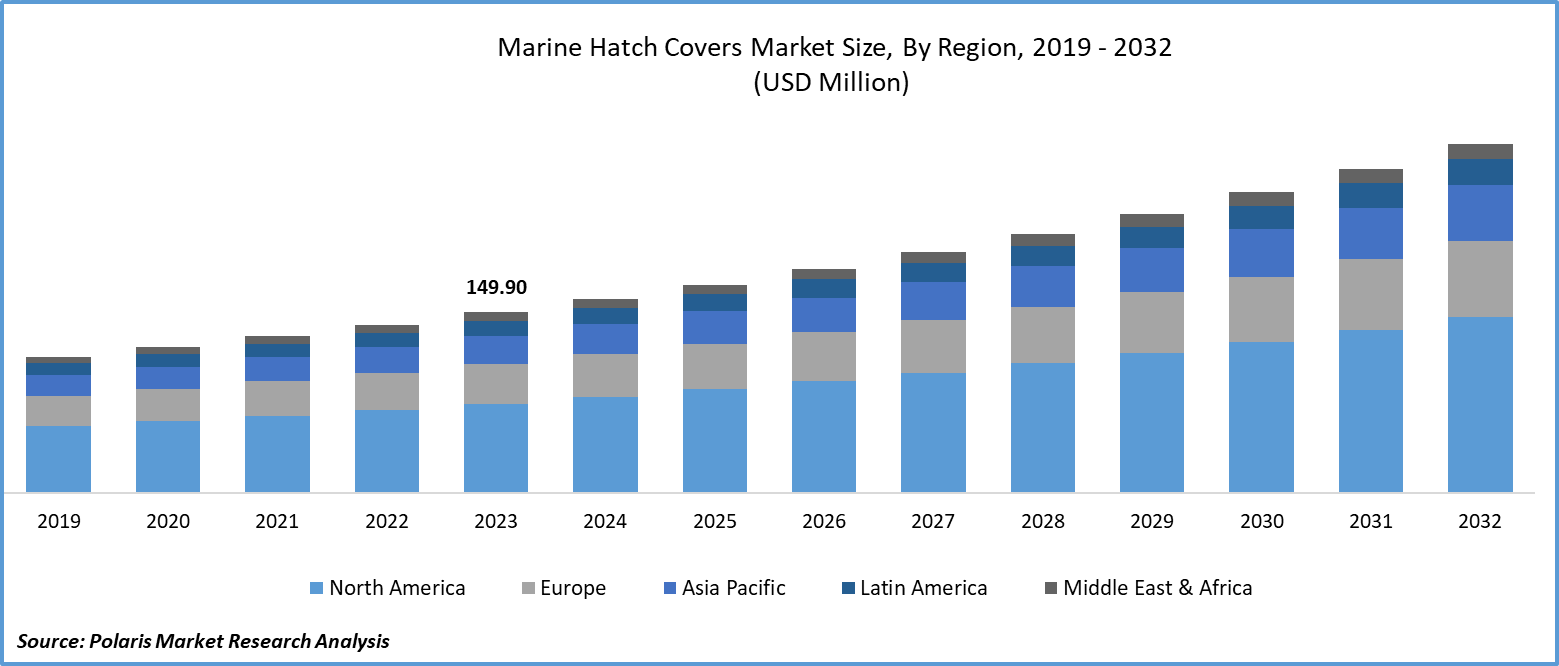
To Understand More About this Research: Download Sample Report
For instance, according to a recent report published by UNCTAD, the global fleet reached a carrying capacity of nearly 2.2 Bn dwt in January 2022, which is 63 Mn dwt compared to the past year. Also, the bulk carriers have dramatically increased between the period 2012 to 2022, and their share rose from 41 to 43 percent. Moreover, many modern hatch cover systems are now equipped with sensors and innovative monitoring systems that allow ship operators to monitor the condition and status of the hatch remotely. And also helps in the early detection of issues and enables real-time control and adjustment of hatch covers while enhancing the overall safety and operational efficiency and leading to significant market growth opportunities over the coming years.
Industry Dynamics
Growth Drivers
Growing global maritime trade and need for aging fleet replacement driving the market growth
The continuous growth in the global maritime trade that includes the transportation of goods and commodities via ships, resulting in an increased need for highly efficient cargo containment and protection against harsh weather conditions, is the leading factor driving the global market growth at a rapid pace. Besides this, as older vessels are now becoming less useful and have several quality and feature issues, they need to be replaced with newer and innovative ships with advanced hatch cover systems, which is anticipated to create lucrative opportunities for companies operating in the market. For instance, as per a report by UNCTAD, the global maritime trade bounced back in the 2021, with shipments grew by around 3.2 percent to reach about 11 Bn tons. The growth was recorded in almost every emerging or developing region, with 5.6 percent in Africa and 3% in Latin America.
Trends in Marine Hatch Covers
| Trend | Description of new direction |
| Lightweight composite (GFRP/FRP) hatch covers | Use of glass‑fiber‑reinforced plastic (GFRP) and other fiber‑reinforced composites to reduce weight, improve corrosion resistance, and lower fuel consumption compared with traditional steel covers. |
| Eco‑friendly, high‑performance surface materials and coatings | Development of eco‑friendly, high‑durability coatings and surface‑engineered materials to reduce corrosion, extend service life, and lower maintenance and environmental impact. |
| Smart monitoring and condition‑based maintenance | Movement toward sensor‑based monitoring of hatch cover condition (deformation, sealing, leaks, corrosion) to support condition‑based maintenance and early detection of weathertightness problems. |
| Regulatory focus on weathertightness and inspection standards | Continued tightening and clarification of standards and guidelines for hatch cover design, inspection, and maintenance to ensure weathertight integrity on bulk carriers and other cargo ships. |
| Green and energy‑efficient ship designs using lighter topside structures | Wider marine “green tech” trends favor lighter topside structures (including hatch covers) to reduce deadweight and fuel consumption as part of energy‑efficiency and emissions‑reduction measures. |
Source: Polaris Market Research Analysis
Source: Polaris Market Research Analysis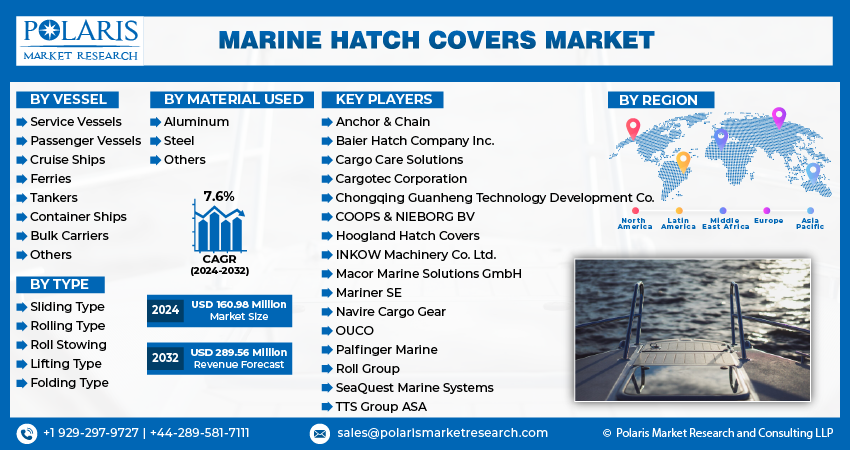
Get Full Segment-Level Forecasts & Insights: Download Sample Report
Report Segmentation
The market is primarily segmented based on vessel, type, material used, and region.
| By Vessel | By Type | By Material Used | By Region |
|
|
|
|
Source: Polaris Market Research Analysis
To Understand the Scope of this Report: Request Customization
By Vessel Analysis
Container ships segment accounted for the largest market share in 2025
The container ships segment accounted for the largest share. The growth of the segment market is highly attributable to the widespread use of container ships for international trade, as they offer a highly efficient and standardized method for cargo transport. Apart from this, international maritime regulations often require container ships to maintain certain safety standards and adhere to environmental regulations, thereby, the adoption of hatch covers is drastically increasing as it helps in securing cargo and preventing environmental hazards and makes them indispensable for regulatory compliance.
By Type Analysis
Sliding type segment held the majority market share in 2025
The sliding type segment held the majority market share in terms of revenue in 2025, which is majorly driven by their widespread popularity and adoption due to the ability to secure and protect cargo from adhere weather conditions, theft, and seawater coupled with the cost-efficiency and enhanced operational productivity as compared to other types available in the market. In addition, sliding hatch covers are gaining huge traction all over the world as they are relatively easy to operate and require minimal workforce for opening and closing, which can significantly reduce labor costs and improve operational efficiency.
The rolling type segment is expected to exhibit the highest growth during the projected period, which is largely attributable to its numerous beneficial characteristics and features, including cargo flexibility, higher reliability, cost-efficiency, and reduced risk of cargo spoilage, among many others.
By Material Used Analysis
Aluminum segment is projected to witness highest growth during forecast period
The aluminum segment is projected to grow at the highest growth rate during the study period, mainly due to growing awareness among leading manufacturers of hatch covers about the advantageous characteristics of aluminum, such as lightweight, corrosion resistance, low maintenance, energy efficiency, environmental benefits, and easy customization to fit specific ship designs and requirements. Besides this, aluminum hatch covers are suitable for a wider range of vessel types, including container ships, bulk carriers, and tankers, which makes them a versatile choice in the marine industry.
The steel segment led the industry market with a considerable share in 2025, which is significantly driven by its widespread utilization in the marine industry because of its durability, strength, and ability to withstand the harsh conditions of marine environments like heavy loads and rough seas. There has been a rising proliferation of steel cover design that mainly includes automation, remote monitoring, and integration with several other ship systems, which could also fuel its demand and growth over the coming years.
Source: Polaris Market Research Analysis
Need Granular Data Across All Market Segments? Request Customization
Regional Insights
North America region dominated the global market in 2025
The North America region dominated the global market. The regional market growth can be largely attributed to the constant growth of the maritime industry and the presence of favorable maritime safety regulations and standards, creating a significant need for marine hatch covers to ensure the safety and efficiency of vessel operations. In addition, there are numerous advancements in hatch cover design and technology, such as more efficient and durable materials, automated or remote-controlled systems, and improved sealing mechanisms, which result in greater demand for such products as shipowners across the region seeking to upgrade their vessels to more reliable and efficient options.
Asia Pacific will grow at a significant rate on account of the robust presence of a well-established shipbuilding industry in several countries, along with the growing focus on safety and environmental protection in the maritime industry. With the increasing emphasis on reducing emissions and adopting eco-friendly technologies in the region, there is a growing demand for technologically advanced hatch covers that contribute to better fuel efficiency and environmental sustainability and could generate lucrative growth opportunities for the region’s market.
Source: Polaris Market Research Analysis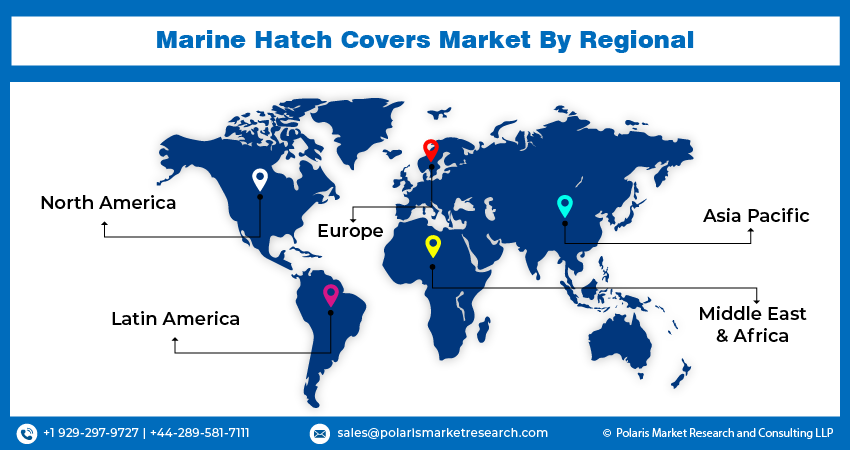
Curious About Regional Market Performance? Request Customization
Key Market Players & Competitive Insights
The marine hatch covers market is highly fragmented, with the presence of significant global market players who are extensively focusing on the adoption of new product launches and approvals and various business expansion and development strategies, including partnerships, collaborations, acquisitions, and mergers, in order to expand their business with emerging and untapped regions globally.
Some of the major players operating in the global market include:
- Anchor & Chain
- Baier Hatch Company Inc.
- Cargo Care Solutions
- Cargotec Corporation
- Chongqing Guanheng Technology Development Co.
- COOPS & NIEBORG BV
- Hoogland Hatch Covers
- INKOW Machinery Co. Ltd.
- Macor Marine Solutions GmbH
- Mariner SE
- Navire Cargo Gear
- OUCO
- Palfinger Marine
- Roll Group
- SeaQuest Marine Systems
- TTS Group ASA
Recent Developments
- In March 2023, a new range of automated marine hatch covers featuring advanced sealing technology was launched, improving cargo protection and shortening loading and unloading times to enhance overall efficiency in marine transportation.
- In November 2021, MacGregor, ordered hatch cover order for the 12, TEU containerships. The ships will be built by the Japan Marine for the Taiwanese company Wan Hai Lines.
Marine Hatch Covers Market Report Scope
| Report Attributes | Details |
| Market size in 2025 | USD 172.95 million |
| Market size in 2026 | USD 185.91 million |
| Revenue forecast in 2034 | USD 336.90 million |
| CAGR | 7.7% from 2026 – 2034 |
| Base year | 2025 |
| Historical data | 2021 – 2024 |
| Forecast period | 2026 – 2034 |
| Quantitative units | Revenue in USD million and CAGR from 2026 to 2034 |
| Segments covered | By Vessel, By Type, By Material Used, By Region |
| Regional scope | North America, Europe, Asia Pacific, Latin America; Middle East & Africa |
| Customization | Report customization as per your requirements with respect to countries, region and segmentation. |
Source: Polaris Market Research Analysis
Marine Hatch Covers Market FAQ's
The global marine hatch covers market size is expected to reach USD 336.90 million by 2034
Key players in the market are Macor Marine Solutions, Palfinger Marine, Baier Hatch Company, Anchor & Chain
North America contribute notably towards the global marine hatch covers market
The global marine hatch covers market is expected to grow at a CAGR of 7.7% during the forecast period.
The marine hatch covers market report covering key segments are vessel, type, material used, and region.
Download Sample Report of Marine Hatch Covers Market Size, Global Analysis Report,2026-2034
Please fill out the form to request a customized copy of the research report.


