
Microgrid Market Size, Share Global Analysis Report, 2025-2034
REPORT DETAILS
Market Statistics
Market Overview
The global Microgrid Market was valued at USD 91.94 billion in 2024 and is anticipated to grow at a CAGR of 17.50% from 2025 to 2034. Increasing energy resilience demands, rural electrification efforts, and decarbonization strategies are driving adoption globally.
The electrical distribution services offered by microgrids play a crucial role in enhancing local resiliency and improving the operation and stability of regional electric grids. Moreover, there is an increasing emphasis on utilizing renewable resources for power generation, which is anticipated to boost the demand for microgrids in the coming years. The manufacturing sector is recognizing the importance of adopting captive power generation systems to reduce dependence on electricity supply from the regional electric grid. This shift towards self-sufficiency in power generation is expected to be a significant driving factor.
Source: Polaris Market Research Analysis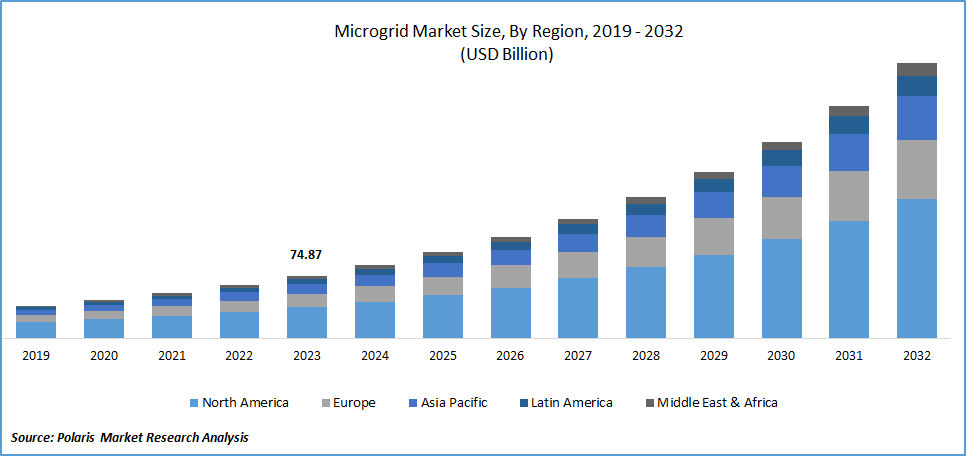
To Understand More About this Research: Download Sample Report
Additionally, there is a growing awareness and emphasis on power generation using alternative renewable sources, including wind, solar, and hydrogen. This awareness is translating into an increased interest and demand for microgrids, which can efficiently integrate and manage power from these renewable sources. As the world focuses more on sustainable and environmentally friendly energy solutions, the positive impact of this awareness on the growth of the microgrid market is evident.
In recent years, the combination of population growth and urbanization in emerging markets has led to a surge in government spending on infrastructure development. This trend is anticipated to play a pivotal role in stimulating power demand, consequently contributing to the growth of the microgrid industry. As governments invest in expanding and enhancing their infrastructure, there is a natural increase in the need for reliable and efficient power solutions, driving the adoption of microgrids.
A noteworthy development in this landscape is the increased spending on developing innovative smart microgrid prototypes. The implementation of the Galvin Energy Initiative by The Galvin Project is a notable example, and such initiatives are expected to create new markets by introducing advanced and intelligent microgrid solutions. Additionally, the emergence of the United States & Canada as prominent destinations for shale gas production, facilitated by the widespread adoption of hydraulic fracturing technology, is set to ensure access to diverse and abundant power sources for buyers. The availability of shale gas contributes to energy security and diversifies the sources of power for microgrid applications, further fostering growth in the industry.
Source: Polaris Market Research Analysis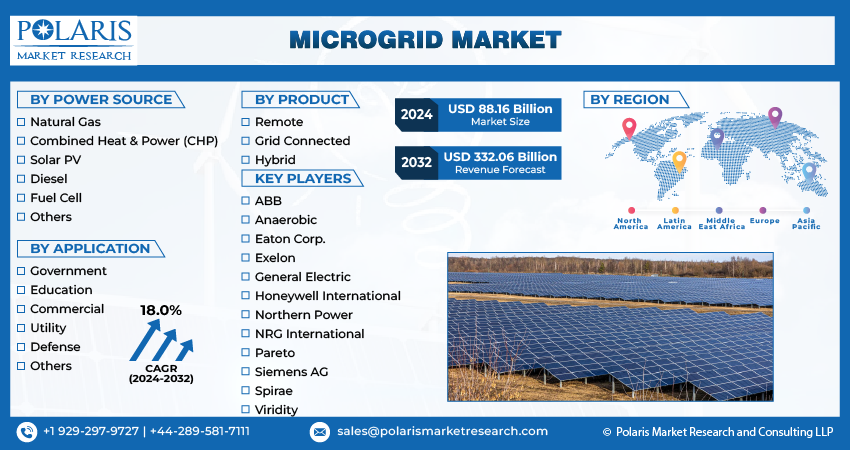
Get Full Segment-Level Forecasts & Insights: Download Sample Report
Growth Drivers
Rising Power Demand in Developing Nations Spurs Growth of Microgrid Solutions
The increasing demand for power in developing nations, fueled by growth in both household & industrial sectors, is anticipated to serve as a significant driving force. A microgrid, characterized as a local electric system capable of supplying power either in parallel or independently from the main electric grids, is gaining prominence. The shift in preference from remote central power plants to more localized & distributed generation, aiming for improved reliability, resiliency, & energy efficiency in urban areas, communities, and campuses, is expected to exert a considerable influence on the growth of the market.
Report Segmentation
The market is primarily segmented based on power source, product, application, and region.
| By Power Source | By Product | By Application | By Region |
|
|
|
|
Source: Polaris Market Research Analysis
To Understand the Scope of this Report: Request Customization
By Power Source Analysis
CHP Segment Held the Largest Share of the Market in 2024
The CHP segment held the largest share. A shift strongly influences the segment's growth in preference from the traditional SHP system to energy generation from a single fuel source. Notably, the cell segment is projected to experience a noteworthy growth rate. The operational advantages of fuel cells, including their ability to function at high temperatures & optimum electrolytic loss, are expected to expand their application scope significantly soon.
The diesel power segment is projected to grow at the fastest rate. This can be attributed to stringent regulations that aim to limit power generation from fossil fuels, including diesel. Governments and environmental bodies are increasingly emphasizing cleaner and more sustainable energy sources, leading to a measured growth outlook for diesel power. However, the high adoption rate of diesel power sources for electricity generation, particularly in the manufacturing sectors of developed economies, is expected to act as a favorable factor. In some industries, diesel generators are still widely used due to their reliability, efficiency, and the existing infrastructure.
By Product Analysis
Grid Connected Segment Registered the Largest Market Share in 2024
Grid connected segment accounted for the largest share. This dominance is attributed to the growing popularity of smart microgrid-connected PV systems, which aim to deliver electricity to consumers while minimizing transmission losses efficiently. In recent years, North Power Systems has been at the forefront of utilizing technology that integrates their wind turbines with the solar PV and diesel gen-sets within the microgrid. This hybrid technology is established in the grid projects situated in diverse locations such as Hawaii, Alaska, & Antarctica.
The adoption of grid-connected microgrids is on the rise in both rural and urban areas, particularly in regions with limited or no access to the main power grid. The expansion of distributed energy resources, such as solar panels and energy storage systems, has significantly contributed to the proliferation of grid-connected microgrids. Additionally, communities are increasingly turning to microgrids to diminish their carbon footprint and enhance energy independence.
By Application Analysis
Education Segment Held the Significant Market Revenue Share in 2024
The education segment held the largest share. The increase in government expenditures on enhancing education infrastructure, particularly in rural areas of developing countries, is anticipated to influence this segment positively.
Microgrids play a crucial role in supplying backup power during outages, particularly in critical facilities such as hospitals and data centers. The defense sector is increasingly leveraging microgrids to decrease dependence on traditional fuel sources and enhance energy security. Microgrids are effectively powering defense bases and remote installations, ensuring reliable and secure power supply even in challenging environments.
Source: Polaris Market Research Analysis
Need Granular Data Across All Market Segments? Request Customization
Regional Insights
North America Region Held the Largest Share of the Global Market in 2024
The North America region dominated the market. The substantial impact can be attributed to the widespread adoption of the captive power methods in the industrial & municipal sectors. This adoption is driven by the aim of reducing dependence on the government-borne power supply.
The Asia Pacific region is projected to grow at a rapid pace. The driving forces behind this growth include a positive outlook for the manufacturing and construction sectors in major markets. This optimism is propelled by regulatory support aimed at fostering domestic investments in these sectors.
Source: Polaris Market Research Analysis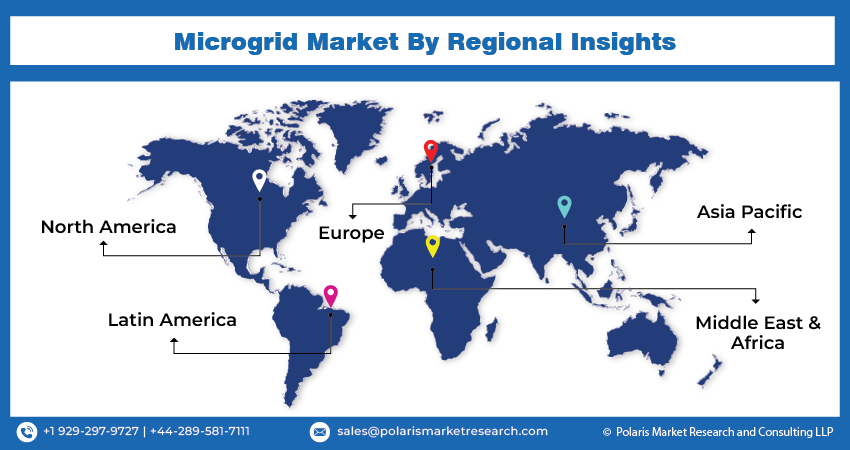
Curious About Regional Market Performance? Request Customization
Key Market Players & Competitive Insights
Key players in the industry are consistently involved in merger and acquisition initiatives, expanding their manufacturing facilities, investing in research and development activities, and exploring opportunities for vertical integration throughout the value chain.
Some of the major players operating in the global market include:
- ABB
- Anaerobic
- Eaton Corp.
- Exelon
- General Electric
- Honeywell International
- Northern Power
- NRG International
- Pareto
- Siemens AG
- Spirae
- Viridity
Recent Developments
- September 2025: Eaton collaborated with Xendee to boost microgrid efficiency through AI-based optimization tools. The partnership targets higher energy savings, improved security, and stronger sustainability, enabling smarter, more resilient power systems across diverse uses and future-ready energy infrastructure.
- August 2025: Caterpillar (US) and Hunt Energy (US) formed a long-term strategic partnership to deliver efficient, independent energy solutions for data centers, planning up to 1 GW capacity with gensets, gas turbines, control systems, and battery storage.
- June 2025: Tesla (US) finalized a USD 440.0 million agreement with Clearway Energy in Utah for a 1.4 GWh battery system, enhancing grid performance and energy reliability.
- February 2025: California-based BoxPower launched solar-powered microgrid storage systems to expand energy access in remote regions. By combining advanced technology with intelligent software, the firm speeds installation and optimizes performance, delivering sustainable and reliable power for underserved communities.
- March 2022: GE Renewable Energy's Grid Solutions, in collaboration with the BOND Civil & Utility Construction, secured an EPC contract from the Empire Wind. The contract involves the design and construction of an on-shore digital substation for the first offshore wind farm, Empire Wind, located off the coast of New York.
- January 2022: Ameresco acquired a new microgrid project in Prince Edward Island, Canada. The collaboration between Ameresco & the Prince Edward Island Energy Corporation will oversee the development of the "Slemon Park Microgrid Project.
Microgrid Market Report Scope
| Report Attributes | Details |
| Market size value in 2025 | USD 108.03 billion |
| Revenue forecast in 2034 | USD 463.68 billion |
| CAGR | 17.50% from 2025 – 2034 |
| Base year | 2024 |
| Historical data | 2020 – 2023 |
| Forecast period | 2025 – 2034 |
| Quantitative units | Revenue in USD billion and CAGR from 2025 to 2034 |
| Segments covered | By Power Source, By Product, By Application, By Region |
| Regional scope | North America, Europe, Asia Pacific, Latin America, Middle East & Africa |
| Customization | Report customization as per your requirements with respect to countries, region, and segmentation. |
Source: Polaris Market Research Analysis
Browse Our More Top Selling Reports:
Data Center Market Size & Share
Green Data Center Market Size & Share
Respiratory Care Devices Market Size & Share
Microgrid Market FAQ's
ABB, Anarbic, Eaton Corp., Exelon, General Electric are key companies in Microgrid Market.
The global microgrid market and is expected to grow at a CAGR of 17.50% during the forecast period.
power source, product, application, and region are key segments covered.
Increasing emphasis on energy resilience and reliability key driving factors in Microgrid Market.
The global microgrid market size is expected to reach USD 463.68 billion by 2034.
Download Sample Report of Microgrid Market
Please fill out the form to request a customized copy of the research report.


